You know you need help with your online store. Sales have plateaued, your site feels dated, and you’re spending more time wrestling with tech than actually growing the business. So you Google “ecommerce agency Australia” and suddenly you’re drowning in options — all promising the world, all looking vaguely the same.
What’s in This Article
Here’s the problem: most ecommerce brands pick an agency based on a flashy portfolio or a convincing sales pitch. Six months and $30,000 later, they’ve got a pretty website that doesn’t convert, a monthly retainer that delivers reports nobody reads, and a sneaking feeling they’ve been taken for a ride.
The brands that get this right — the ones scaling past $1M, $5M, $10M — they choose an ecommerce agency the same way they’d choose a business partner. They look beyond the surface. They ask harder questions. And they understand that the right agency relationship should pay for itself many times over.
What Does an Ecommerce Agency Actually Do?
Before you start comparing agencies, you need to understand what you’re actually buying. An ecommerce agency is not a web designer who happens to know Shopify. A genuine full-service ecommerce agency covers strategy, design, development, marketing, and ongoing optimisation — all working together as a system.
Think of it this way: your Shopify store is the engine, but an engine alone doesn’t win races. You need someone who understands the fuel (your products and brand), the track (your market and customers), and the pit crew (the ongoing tweaks that keep you competitive).
A strong ecommerce agency should be able to help with brand strategy and positioning, Shopify store design and development, conversion rate optimisation (CRO), email marketing automation, paid advertising (Meta, Google, TikTok), SEO and content strategy, and analytics and reporting. The best agencies — like Insiteful, the agency arm of eCommerce Circle — don’t just execute tasks. They build a complete growth system around your brand.
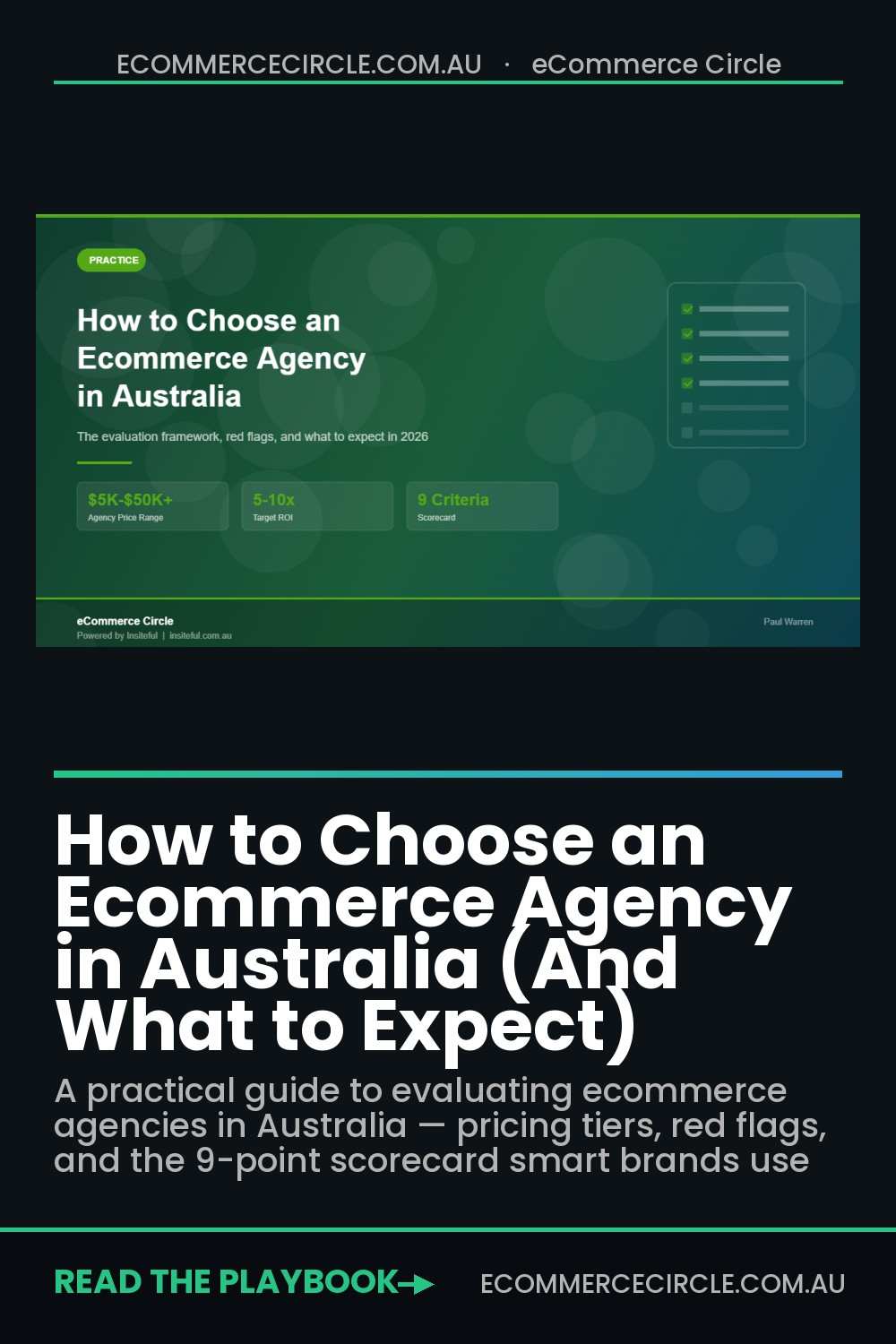
The 9-Point Ecommerce Agency Evaluation Scorecard
After working with hundreds of ecommerce brands across Australia, we’ve developed a scorecard that cuts through the noise. These are the nine criteria that actually predict whether an agency relationship will deliver results or drain your budget.
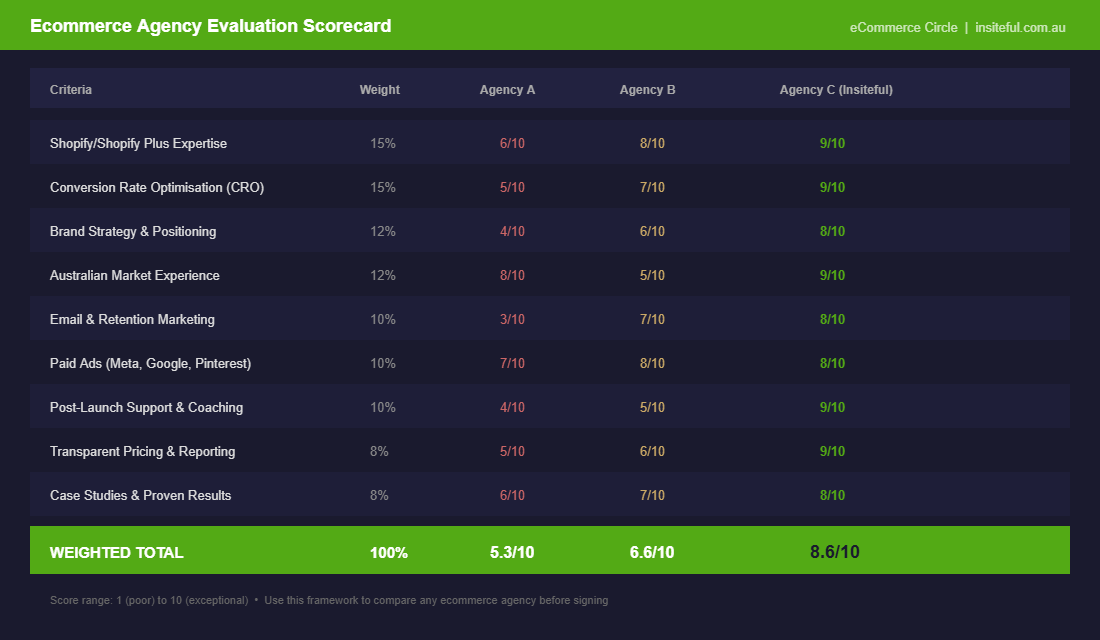
1. Platform Specialisation
Does the agency specialise in your platform, or do they claim to do everything? An agency that works across Shopify, WooCommerce, Magento, BigCommerce, and custom builds is spreading themselves thin. You want a team that lives and breathes your platform daily. For Shopify and Shopify Plus brands, that specialisation means they understand Liquid templating, the app ecosystem, checkout extensibility, and the quirks that come with each theme architecture.
2. Proven Results in Your Niche
A beautiful portfolio means nothing without the numbers behind it. Ask for case studies with actual metrics — revenue growth, conversion rate improvements, return on ad spend. Any agency worth their fees will happily share these. Look for results with brands similar to yours in size, product type, or target market.
3. Strategic Thinking vs Task Execution
There’s a massive difference between an agency that asks “what do you want us to build?” and one that says “here’s what we think you should do, based on your data, and here’s why.” The first is a pair of hands. The second is a growth partner. You’re paying for strategic thinking, not just task completion.
4. Full-Funnel Capability
Your store doesn’t exist in isolation. Traffic, conversion, retention, and referral all need to work as a connected system. An agency that only does design, or only does ads, is solving one piece of a much bigger puzzle. The best ecommerce agencies think in terms of the complete customer journey — from first touchpoint through to repeat purchase and advocacy.
5. Transparent Pricing
If an agency can’t clearly explain what you’re paying for and what you’ll get in return, that’s a red flag. Watch out for vague retainer structures, hidden fees for “extra revisions,” and contracts that lock you in for 12 months with no performance benchmarks. Good agencies are upfront about costs because they’re confident in their delivery.
What Should an Ecommerce Agency Cost in Australia?
This is the question everyone asks and nobody wants to answer directly. So let’s be direct.
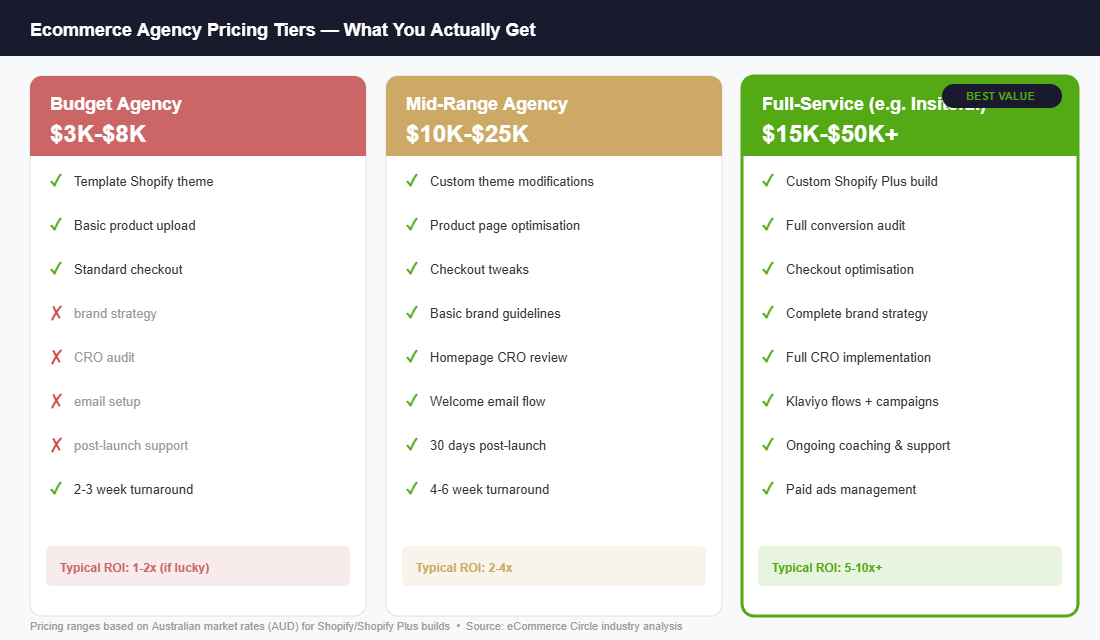
Starter tier ($3,000–$8,000/month): This typically covers a Shopify store build or refresh, basic email marketing setup, and some ongoing maintenance. Suitable for brands doing under $500K in annual revenue who need foundational work done right. At this level, you’re getting execution support with some strategic guidance.
Growth tier ($10,000–$25,000/month): This is where most serious ecommerce brands land. You’re getting strategic planning, ongoing CRO, email marketing automation, paid advertising management, and regular reporting with actionable insights. This tier suits brands doing $500K–$5M who are ready to scale aggressively.
Scale tier ($15,000–$50,000+/month): For established brands doing $5M+ who need a full-service growth team. This includes everything in the growth tier plus advanced analytics, multi-channel advertising, international expansion support, and dedicated account management. At this level, your agency essentially functions as your outsourced marketing department.
The key metric isn’t what you spend — it’s your return on investment. A $15,000/month agency that generates $150,000 in additional revenue is infinitely better value than a $3,000/month agency that generates nothing measurable.
The More Orders Model: How the Best Agencies Think
At Insiteful, every client engagement follows what we call the More Orders Model — a three-phase framework that ensures nothing gets missed and everything builds on what came before.
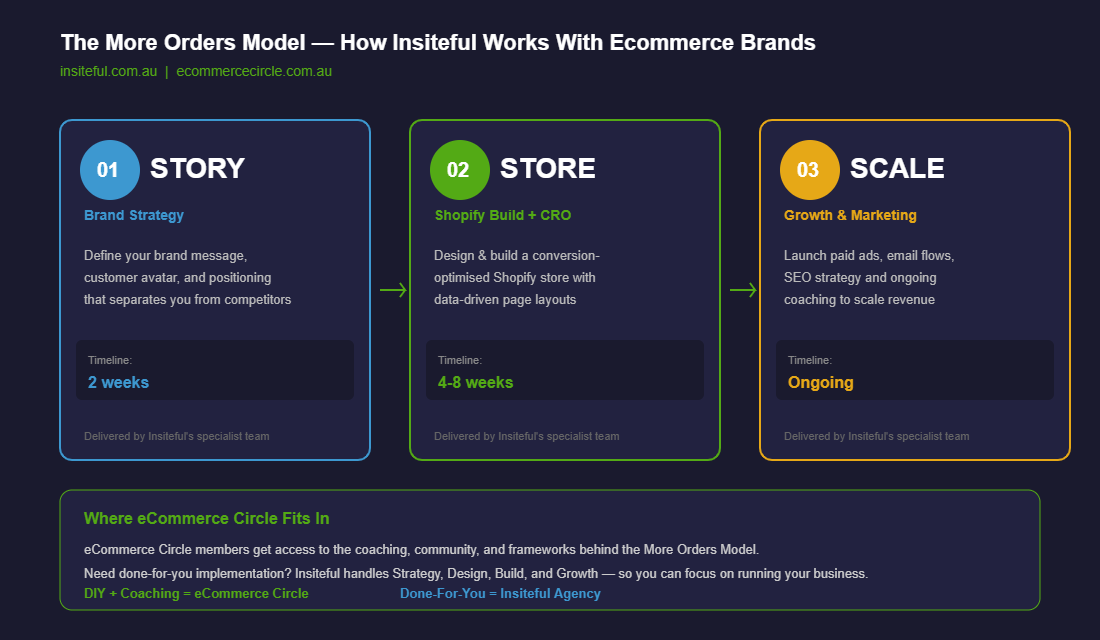
Phase 1: Story. Before touching a single pixel, we dig deep into your brand. Who are your customers? What makes you different? Why should someone buy from you instead of the 47 other stores selling similar products? Most agencies skip this entirely and jump straight to design. That’s why most ecommerce stores look interchangeable. Your story is your competitive advantage — it needs to be crystal clear before anything else happens.
Phase 2: Store. With your brand story locked in, we build (or rebuild) your Shopify store to convert. Every design decision, every piece of copy, every product page element is engineered to move visitors toward a purchase. This isn’t about making things look pretty — it’s about creating a buying experience that feels effortless. We’re talking homepage design, collection page layout, product page optimisation, checkout flow, mobile experience, and site speed.
Phase 3: Scale. Now that your store converts, we turn on the traffic. Meta Ads, Google Ads, SEO, email marketing, content strategy — all working together as a system. This is where most brands try to start, which is exactly why they waste money. Running ads to a store that doesn’t convert is like pouring water into a leaky bucket. The More Orders Model fixes the bucket first.
Red Flags: When to Walk Away From an Agency
Not every agency deserves your business. Here are the warning signs that should have you heading for the door.
They guarantee specific results. No legitimate agency can guarantee you’ll hit $1M in revenue or achieve a 5x ROAS. There are too many variables outside their control. What they can guarantee is a proven process, transparent reporting, and a commitment to continuous improvement.
They won’t share case studies or references. If an agency can’t point to specific brands they’ve helped grow — with real numbers — that tells you everything. Either they don’t have results worth sharing, or they don’t have permission to share them (which means their clients aren’t exactly singing their praises).
They lock you into long contracts with no performance clauses. A 12-month contract isn’t inherently bad — some strategies genuinely need time to compound. But if there are no performance benchmarks, no quarterly reviews, and no exit clauses for underperformance, you’re taking all the risk while the agency takes none.
They outsource everything offshore without telling you. There’s nothing wrong with global teams. But if you’re paying premium Australian rates and the work is being done by a junior developer in a different timezone with no quality oversight, that’s a problem. Ask where the work gets done and who’s actually doing it.
They don’t understand your platform. If your agency is Googling how to edit Shopify metafields or doesn’t know the difference between Shopify and Shopify Plus, you’ve got the wrong partner. Platform expertise isn’t optional — it’s the foundation everything else is built on.
Why eCommerce Circle + Insiteful Is a Different Model
Most ecommerce brands face a choice: hire an agency (expensive, hands-off) or try to learn everything themselves (cheap, overwhelming). We built something that eliminates that trade-off.
eCommerce Circle is the coaching and community arm — where ecommerce owners learn the strategy, frameworks, and thinking behind what actually drives growth. Our Insights blog covers everything from email marketing funnels to Meta Ads strategy to Pinterest marketing.
Insiteful is the done-for-you agency arm — where brands that want expert execution can get it from a team that’s been building Shopify stores since 2015. Same team, same framework, same obsession with results.
Whether you need coaching to build your own capability, agency support to execute at a high level, or a combination of both, the underlying system is the same: the 10 P’s of the More Orders Operating System — Product, Prospects, Profit, Patrons, Promotion, Platform, Performance, People, Protection, and Practice.
This means your coaching and your agency work are always aligned. You’re never getting conflicting advice. You’re never rebuilding something that was already done. Everything compounds.
The 12 Questions to Ask on the First Call
Most founders walk into an agency call and let the agency run the agenda. That is how you end up buying a deck instead of an outcome.
Bring this list. The answers matter less than how comfortable they are answering. An agency that gets twitchy about question 4 or question 9 is telling you something.
- Who exactly will touch my account day to day, and what else are they working on? You want names and account loads, not a team page. A strategist carrying 14 accounts is not thinking about yours.
- What does month one look like, hour by hour? Vague onboarding is the single best predictor of a slow first quarter.
- Show me a client you did not get results for, and tell me why. Every agency has them. The ones who claim otherwise are either new or not being straight with you.
- What is your average client tenure? Under 6 months means churn. Over 18 months means either they are good or their clients are stuck in a contract. Ask which.
- Which of my numbers will you be held to? Push for one primary metric, not a dashboard of nine.
- Do you work with any of my direct competitors? Not automatically disqualifying, but you need to know.
- Who owns the ad accounts, the pixel, the theme repo, and the creative files? The answer must be you. Always.
- What happens to my store if we part ways next Tuesday? Listen for whether they have an offboarding process at all.
- What is your pricing model and what triggers a scope change? Undefined scope creep is the most common source of agency resentment on both sides.
- How do you report, and how often? Weekly async written updates beat a monthly slide deck almost every time.
- What do you need from me to do your best work? A good agency has a clear, slightly demanding answer here.
- What would you not do for my brand right now? The best answer any agency ever gives is a well-argued no.
Question 12 is the tell. An agency that will happily sell you paid social, SEO, email, and a rebuild all at once is selling capacity, not strategy. The ones worth hiring will tell you your product pages need fixing before another dollar goes into traffic.
What a Healthy First 90 Days Actually Looks Like
The first 90 days sets the tone for the whole relationship. If you are still waiting on a strategy document in week six, you already know how this ends.
Days 1 to 14: audit and access. They should be pulling your Shopify Analytics, GA4, ad accounts, and email platform, and coming back with findings you did not already know. Expect a written audit, not a call. If their audit tells you things you could have read off your own dashboard, that is a bad sign. A real audit surfaces things like a 4.1 second mobile LCP, a 71% cart abandonment rate, or the fact that 38% of your revenue comes from one channel.
Days 15 to 30: the plan and the first ship. You should have a prioritised roadmap with owners and dates, and at least one thing should already be live. Agencies that spend a full month planning are burning your retainer on internal comfort.
Days 31 to 60: execution rhythm. Weekly updates, a shared board you can see without asking, and visible movement on the primary metric. This is also when you find out whether the senior person who sold you the work is still in the room.
Days 61 to 90: first real read. By day 90 you should be able to point at a number that moved. Not “brand awareness”. A number. Conversion rate up from 1.8% to 2.3%. Email revenue share up from 19% to 27%. Blended CAC down 14%. If nobody can name the number, the engagement has no spine.
Set this expectation in writing before you sign. A one-page document that says “at day 90 we will review X, Y, and Z, and either continue or stop” removes every awkward conversation later. Most agencies will happily agree to it. The ones who resist are the ones you needed the clause for.
How to Structure the Agreement So You Can Actually Leave
The contract is not where you extract value. It is where you cap your downside. Aussie founders routinely sign 12-month lock-ins on a handshake vibe and then spend eight months paying for work they stopped believing in around month three.
- Start on 3 months, not 12. A good agency will accept a 90-day initial term because they back themselves. Roll to monthly after that.
- 30-day notice, both ways. Anything longer than 60 days is the agency managing their cash flow with your money.
- Ownership clause in writing. Ad accounts, Business Manager, Klaviyo, GA4, the theme repository, and every creative asset are yours, in your entities, from day one. Agency-owned ad accounts are the single most common way Aussie brands get held hostage.
- Named-person clause. If the senior strategist you were sold leaves the account, you can exit without penalty.
- Defined scope with a change process. Write down what is in, what is out, and what an extra costs. Ambiguity here damages good relationships, not just bad ones.
- Offboarding spelled out. A 14-day handover of accounts, documentation, and passwords. Put it in the contract while everyone still likes each other.
On price: in Australia, a serious growth retainer for a brand doing $100k to $500k AUD a month generally lands between $4,000 and $12,000 AUD a month, and a full Shopify rebuild between $15,000 and $60,000 AUD depending on complexity. Quotes far below that range usually mean offshore juniors with no strategic layer. Quotes far above usually mean you are paying for an account management tier you do not need yet.
One last thing worth checking before you hire anyone: whether the problem you are trying to solve is actually an agency problem. If your issue is that nobody internally owns growth, an agency will not fix that. Building the internal systems and SOPs first makes every agency dollar afterwards work harder, and it means you can hold them to a standard because you understand the work.
How to Get Started
If you’re evaluating ecommerce agencies right now, here’s the simplest way to cut through the noise: use the 9-point scorecard above, do your due diligence, and have real conversations with at least three agencies before committing.
If you want to understand what’s actually driving (or killing) your store’s performance before you spend a cent on agency fees, start with the free resources inside eCommerce Circle. Read the Insights articles, understand the 10 P’s framework, and figure out exactly where your biggest opportunities are.
And if you’re ready to talk about what Insiteful could do for your brand specifically — whether that’s a full store rebuild, a conversion audit, or a complete growth strategy — let’s talk. No pressure, no hard sell. Just a straight conversation about where you are, where you want to be, and the fastest way to get there.