Here’s what happens to most Shopify brands when they first try TikTok Ads: they take their best-performing Meta creative, drop it into TikTok Ads Manager, set a budget, and wait for results.
What’s in This Article
Then nothing happens. Or worse — they get views and engagement, but zero sales.
The problem isn’t TikTok. The problem is that TikTok rewards a completely different type of content and buying behaviour than any other ad platform. Brands that understand this are seeing CPMs 40-60% lower than Meta, conversion rates above 2%, and ROAS that makes their Meta account manager nervous. The Australian SMB advertiser base on TikTok grew 45% year-on-year between 2024 and 2025 — and the brands getting in early with the right structure are building a serious advantage.
This is the complete playbook for running TikTok Ads that drive actual revenue for your Shopify store — from campaign structure to creative testing to scaling without blowing your budget.
Why TikTok Ads Work Differently (And Why That’s Your Advantage)
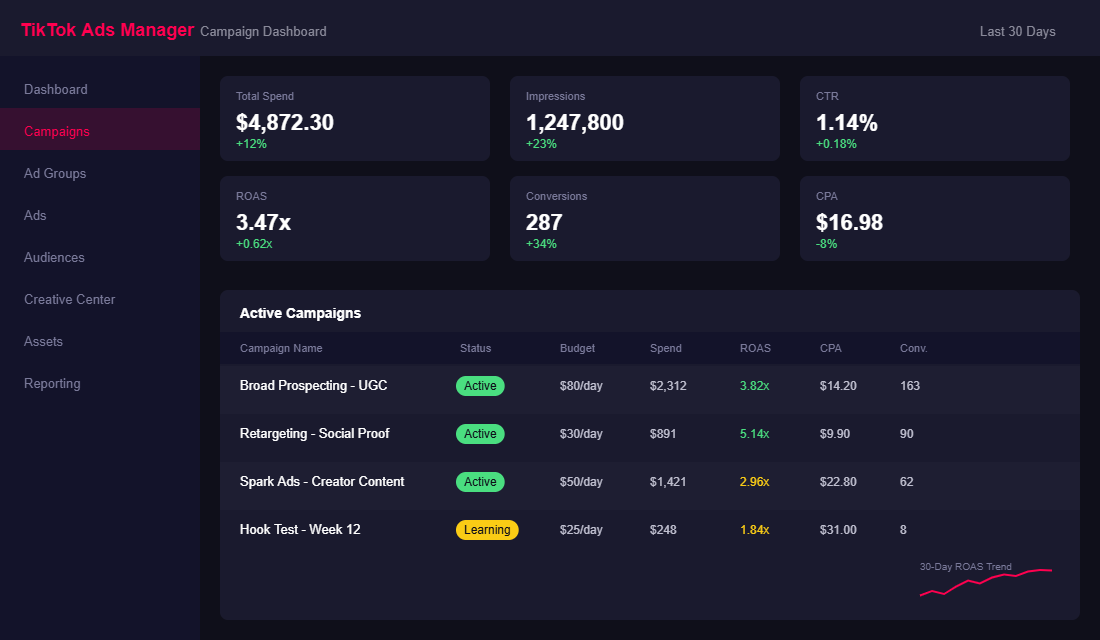
TikTok isn’t just another paid social channel. It’s an entertainment-first platform where the algorithm serves content based on interest signals, not social graphs. That distinction matters enormously for how ads perform.
On Meta, your targeting does the heavy lifting. On TikTok, your creative does.
The algorithm evaluates every video — organic or paid — against the same engagement signals: watch time, completion rate, shares, and replays. If your ad doesn’t hold attention in the first two seconds, TikTok simply stops showing it. No amount of audience targeting can save boring creative.
This creates an advantage for smaller brands. You don’t need a massive ad budget or a recognised name. You need content that feels native to the platform. The average CPM on TikTok sits between $4-$9 for ecommerce brands, compared to Meta’s median CPM north of $14. That means your testing budget stretches further, and you can validate creative angles at a fraction of the cost.
The average CTR for ecommerce ads on TikTok is around 0.84%, with top-performing creatives pushing well above 1.5%. But here’s the real metric that matters: TikTok users are 1.7x more likely to purchase a product they discovered on the platform compared to other social channels.
The opportunity is real. But only if you build your campaigns the right way from day one.
Setting Up Your TikTok Ads Foundation on Shopify
Before you spend a dollar, you need three things properly connected: the TikTok Pixel, the Shopify TikTok sales channel, and your TikTok Events API (server-side tracking).
Step 1: Install the TikTok sales channel from the Shopify App Store. This connects your product catalogue and enables you to run dynamic product ads. The setup takes about ten minutes and syncs your entire inventory automatically.
Step 2: Set up the TikTok Pixel via the Shopify integration. This tracks standard ecommerce events — ViewContent, AddToCart, InitiateCheckout, and CompletePayment. But don’t stop here.
Step 3: Enable TikTok’s Events API for server-side tracking. This is critical. Browser-based pixels miss roughly 20-30% of conversions due to iOS privacy changes and ad blockers. The Events API sends conversion data directly from your Shopify server to TikTok, giving you much more accurate attribution. If you’ve already set up server-side tracking for Meta (and if you haven’t, read our guide on fixing broken analytics), the process is similar.
One setup detail most brands miss: make sure your TikTok Pixel and Events API are properly deduplicated. Without deduplication, you’ll double-count conversions and your reported ROAS will be inflated. The Shopify integration handles this automatically if you use the native app — but if you’ve done any custom implementation, verify it in TikTok Events Manager before launching any campaigns.
The Campaign Structure That Actually Scales
Forget everything you know about Meta’s campaign structure. TikTok’s algorithm needs room to learn, and the biggest mistake brands make is over-segmenting their campaigns from the start.
Here’s the structure we recommend for Shopify brands starting with TikTok Ads:
Campaign 1: Broad Prospecting (Top of Funnel)
- Objective: Conversions (optimise for Complete Payment, not Add to Cart)
- Targeting: Broad — age 18-54, your core country (Australia), minimal interest targeting
- Budget: $50-$100/day to start
- Ad groups: 1-2 with 3-5 creatives each
- Bid strategy: Lowest cost (let TikTok’s algorithm find the right users)
The key insight: TikTok’s algorithm is extraordinarily good at finding buyers when you give it a clear conversion signal and enough budget to learn. Narrow targeting actually hurts performance because you’re restricting the algorithm’s ability to discover high-intent users you’d never have targeted manually.
Campaign 2: Retargeting (Middle/Bottom of Funnel)
- Objective: Conversions (Complete Payment)
- Audiences: Website visitors (7-14 days), Video viewers (watched 50%+), Add to Cart but didn’t purchase
- Budget: 20-30% of your prospecting budget
- Creatives: Testimonials, UGC reviews, urgency-driven content, product comparisons
Campaign 3: TikTok Shop Campaigns (If Available)
If you’re in a market where TikTok Shop is live, this is a separate beast entirely. In-app checkout converts at 10%+ — dramatically higher than sending users off-platform. Australian brands should be preparing for TikTok Shop’s expansion by building their content engine and creator relationships now, even before it officially launches locally.
Keep your campaign structure lean. Two to three campaigns maximum. Let the creative do the segmentation work, not your audience settings. If you want to compare this approach to how you’d structure Meta campaigns, our Meta Ads account structure guide breaks down the differences.
Creative That Converts (The 80% of Your Success)
On TikTok, creative IS your targeting. The algorithm shows your ad to people who engage with similar content — so the style, hook, and format of your video determines who sees it far more than any audience setting you choose.
Here’s the creative framework that works for ecommerce:
The Hook (First 1-3 Seconds)
Your ad lives or dies in the first two seconds. If someone scrolls past, TikTok kills your delivery. Winning hook formats include:
- Pattern interrupt: “Stop scrolling if you’ve ever [common frustration]…”
- Bold claim: “This $29 product replaced my entire skincare routine”
- Curiosity gap: “Nobody talks about why most Shopify stores fail at this…”
- Social proof: “47,000 Australians switched to this last month”
- Controversy: “Your Meta ads agency doesn’t want you to know this”
The Body (4-30 Seconds)
Show the product in use. Demonstrate the transformation. Address objections before the viewer even thinks of them. The best TikTok ads follow one of these proven formats:
- UGC testimonial: Real customer talking to camera about their experience
- Before/after demonstration: Show the problem, then the solution
- “Day in my life” integration: Product woven naturally into lifestyle content
- Founder story: You talking directly about why you built the product
- Unboxing: First impressions and genuine reactions
The CTA (Final 3-5 Seconds)
Keep it simple and direct. “Link in bio”, “Shop now”, or “Tap below to grab yours.” Don’t overthink this — the hook and body do the selling.
Critical rule: Native beats polished. Ads shot on an iPhone in natural lighting outperform studio-quality brand videos by 3-5x on TikTok. Your content needs to feel like something a friend would post, not something a marketing team produced.
Spark Ads — Your Secret Weapon for Higher ROAS
If you’re only running standard in-feed ads on TikTok, you’re leaving money on the table.
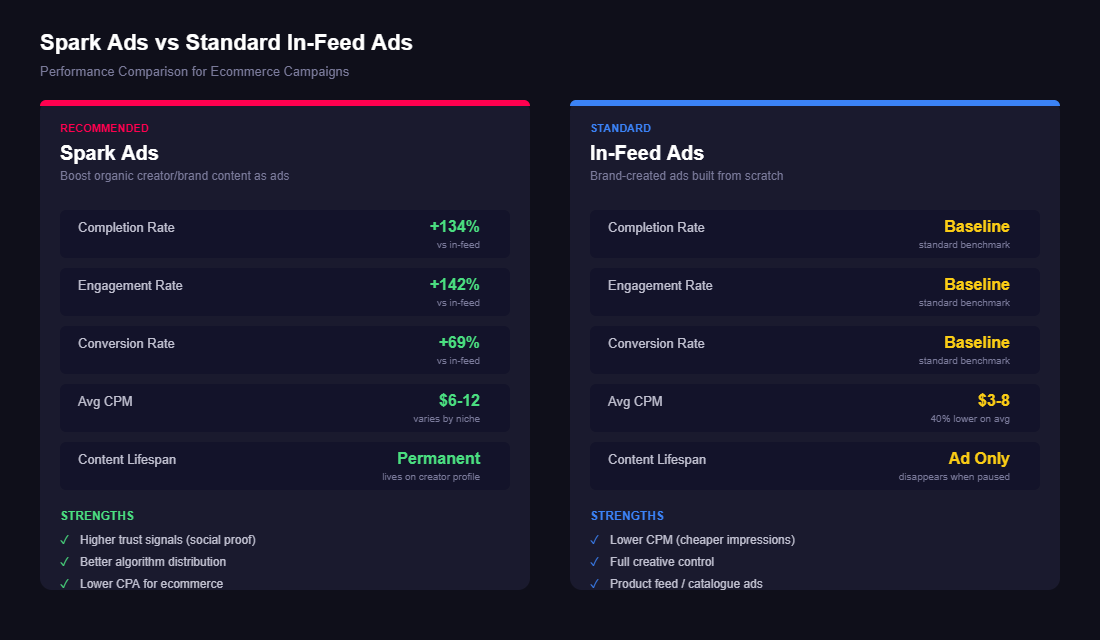
Spark Ads let you boost organic TikTok content — either from your own account or from creators who’ve posted about your product. The performance difference is significant:
- 134% higher completion rates compared to standard in-feed ads
- 142% higher engagement rates
- 69% increase in conversion rates
- Content lives on the creator’s profile permanently, continuing to drive organic reach
Here’s how to use Spark Ads effectively for your Shopify store:
Step 1: Identify your best organic content. Look at your TikTok analytics for videos with above-average completion rates and engagement. These are your proven hooks — the algorithm has already validated them.
Step 2: Partner with micro-creators. Find creators with 10,000-100,000 followers in your niche. Send them your product. Ask them to create authentic content (not scripted ads). When a video performs well organically, request a Spark Ad authorisation code and boost it.
Step 3: Test Spark Ads against standard in-feed ads. Run both formats with the same budget and compare CPA (cost per acquisition). In our experience, Spark Ads consistently deliver a lower CPA because the social proof and authenticity signals dramatically improve trust.
For Australian brands like HiSmile, this creator-led content strategy has been transformational. Their TikTok presence — built heavily on influencer and UGC content — generated over $2.67 million USD in gross merchandise value in early 2026 alone.
The Creative Testing System (Because Ads Die Fast on TikTok)
Here’s an uncomfortable truth about TikTok Ads: most creatives lose performance after 7-10 days. The algorithm exhausts the audience that responds to that specific style, and performance drops off a cliff.
This means creative testing isn’t optional — it’s the backbone of your entire TikTok strategy.
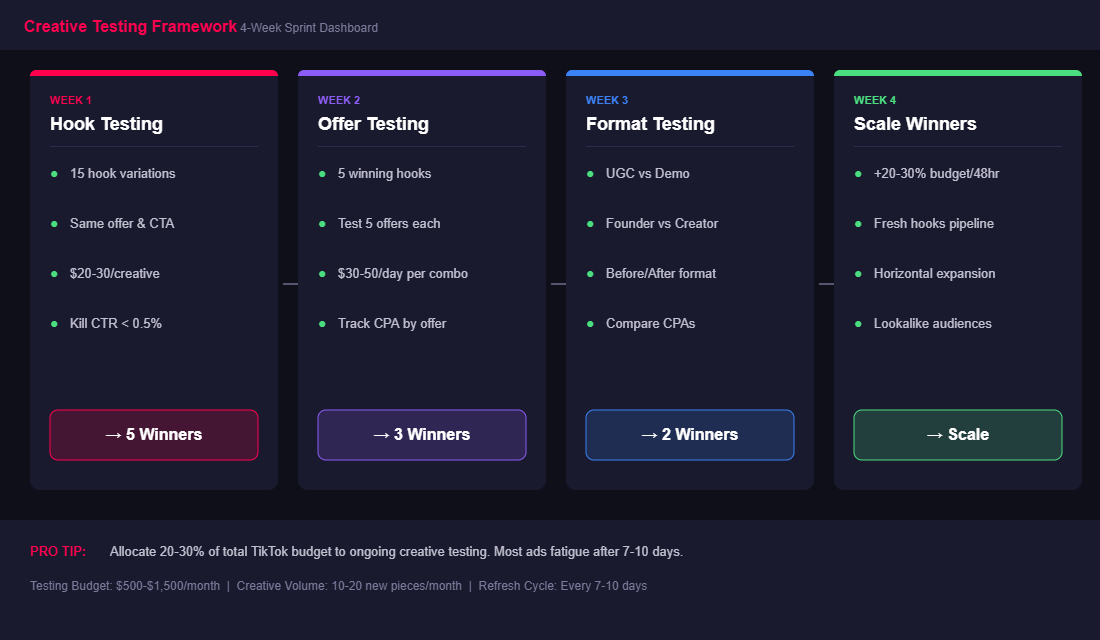
Follow this 4-week testing framework:
Week 1: Test hooks. Create 10-15 variations of the same core message with different opening hooks. Same offer, same CTA, different first three seconds. Spend $20-$30 per creative. Kill anything with a CTR below 0.5% after 48 hours.
Week 2: Test offers and angles. Take your 3-5 winning hooks and pair them with different offers — free shipping, bundle deals, percentage off, gift with purchase. Run each combination at $30-$50/day.
Week 3: Test formats. Take winning hook + offer combinations and create different video styles — UGC, founder story, product demo, before/after. This tells you which format resonates best with your specific audience.
Week 4: Scale winners. Any creative with a CPA below your target? Increase budget by 20-30% every 2-3 days. But keep testing new hooks and angles in a separate “testing” campaign so you always have fresh creatives ready to replace fatigued ones.
Budget guideline: Allocate 20-30% of your total TikTok budget to testing new creative every single month. The brands that scale profitably on TikTok are the ones that treat creative production as a continuous process, not a one-time project.
Scaling Without Blowing Your Budget
You’ve found winning creatives. Your CPA is profitable. Now how do you scale without tanking performance?
The golden rule on TikTok: increase budget by no more than 20-30% every 48-72 hours. Sudden budget spikes reset the algorithm’s learning phase and destroy your delivery efficiency.
Here’s the scaling playbook:
Vertical scaling (increase spend on winners): Identify ad groups with consistent CPA below target for 3+ days. Increase daily budget by 20% every 48 hours. If CPA spikes more than 30% above target, pause and wait 24 hours before resuming at the previous budget level.
Horizontal scaling (expand reach with new angles): Duplicate winning ad groups with fresh creative variations. Test new audience segments — lookalike audiences based on purchases, new geographic markets, different age brackets. Launch new campaigns with different optimisation events like Add to Cart for broader top-of-funnel reach.
Creative scaling (the real lever): Produce 10-20 new creative pieces per month. Brief creators with your proven hooks and formats. Repurpose winning organic content as Spark Ads. Use TikTok Creative Center to research trending formats and sounds in your category.
A realistic budget trajectory for Australian Shopify stores: Start at $50-$100/day for the first month (testing phase). Scale to $200-$500/day in month two with proven creatives. Profitable brands typically spend $2,000-$10,000+ monthly with 2-4x ROAS on TikTok.
EHPlabs — another Australian brand — generated more than $350,000 in gross merchandise value directly through TikTok during the 2025 Cyber Weekend alone. That’s the kind of scale that’s possible when you’ve built the creative engine and campaign structure to support it.
The Compound Effect — TikTok as Part of Your Growth System
TikTok Ads don’t exist in isolation. The brands getting the best results treat TikTok as one part of an integrated growth machine.
Here’s how TikTok fits into the bigger picture:
TikTok drives discovery. Your top-of-funnel TikTok content introduces new audiences to your brand at a lower CPM than any other platform. Someone sees your product in a native-feeling video and their interest is sparked.
Email captures the relationship. Once someone visits your site from TikTok, your email marketing funnel takes over. Welcome sequences, abandoned cart flows, and post-purchase emails convert that initial interest into repeat purchases. If you haven’t built these yet, that should be your next priority.
Meta retargets the warm audience. Your TikTok traffic builds custom audiences on Meta. Retarget your TikTok visitors on Instagram and Facebook with social proof ads, testimonials, and offers. Cross-platform retargeting consistently outperforms single-platform campaigns.
Product bundles increase AOV. When TikTok drives traffic to your store, make sure your product pages are optimised with bundles, upsells, and cross-sells to maximise the value of every click. Our guide on Shopify product bundling walks through exactly how to set this up.
This is the compounding effect: TikTok fills the top of your funnel cheaply, email and retargeting convert that traffic, and your average order value strategy ensures every sale is profitable. Each piece amplifies the others.
Common TikTok Ads Mistakes That Burn Budget Fast
Before we get to the launch checklist, here are the most expensive mistakes we see Shopify brands make on TikTok — and how to avoid each one.
Optimising for the wrong event. Many brands set their campaign objective to “Traffic” or “Add to Cart” because it is cheaper per result. But cheaper does not mean better. TikTok’s algorithm optimises aggressively for whatever you tell it to — so if you optimise for Add to Cart, you will get people who add to cart but never purchase. Always optimise for Complete Payment. Yes, the CPA looks higher during the learning phase, but the quality of buyers is dramatically better. Brands that switch from Add to Cart to Complete Payment typically see a 40-60% improvement in actual ROAS within two weeks.
Killing campaigns too early. TikTok needs roughly 50 conversions per ad group to exit the learning phase. If you are spending $50/day and your average CPA is $25, that is 25 days before the algorithm has enough data to optimise properly. Most brands panic after three days of high CPA and shut everything down. Give your campaigns at least 7-10 days and a minimum of $500 in spend before making any optimisation decisions. The data from those first 50 conversions is what makes everything afterwards profitable.
Using the same creative across all placements. TikTok offers multiple placements including the For You feed, search results, and Pangle (their audience network). Each placement performs differently. Your best-performing For You feed creative might flop in search. Use automatic placement to start, but once you have enough data, break out your top-performing placements into separate ad groups with tailored creative.
Ignoring TikTok Creative Center. This is a free tool most brands never touch, and it is genuinely one of the best resources available for ad creative research. You can see top-performing ads in your category, trending sounds, and creative patterns that are working right now. Spend 20 minutes in TikTok Creative Center every week and you will never run out of creative angles. The brands producing the highest volume of winning creative are the ones mining this tool religiously.
Not tracking server-side conversions properly. If your TikTok Events API is not set up correctly, TikTok is missing 20-30% of your conversions. That means the algorithm is optimising on incomplete data, which means worse targeting and higher CPAs. If your TikTok reported ROAS is significantly lower than what you see in Shopify, your tracking is broken. Our server-side tracking guide walks through the exact fix.
Your TikTok Ads Launch Checklist
Before you launch your first TikTok campaign, run through this checklist:
- TikTok Pixel + Events API installed and deduplicated on your Shopify store
- Product catalogue synced via the Shopify TikTok sales channel
- 3-5 native-style creatives ready — UGC, founder story, or product demo format
- Broad prospecting campaign set up optimising for Complete Payment
- Retargeting audiences built — site visitors, video viewers, cart abandoners
- Testing budget allocated — minimum $50/day for prospecting, $20/day for retargeting
- Creative refresh plan in place — aim for 3-5 new creatives per week
- TikTok Creative Center bookmarked for trending format and sound research
- Spark Ad partnerships initiated with 2-3 micro-creators in your niche
Inside the eCommerce Circle, TikTok Ads strategy is one of the core areas we work on with members — from creative frameworks and campaign structure to scaling profitably alongside Meta, Google, and email. If you’re ready to add TikTok to your growth mix (or fix what isn’t working), we’d love to chat.