Most Shopify founders are working harder than ever and feeling like the business is going sideways. The average Shopify store owner now puts in 47 hours a week managing their store, and somehow the to-do list still grows every Friday afternoon. Orders ship, ads run, emails go out, and yet nothing feels like it’s compounding.
What’s in This Article
The problem isn’t effort. It’s rhythm. Most stores run on what I call fire-brigade mode — the founder reacts to whatever’s loudest in Slack, whatever the agency just emailed about, whatever the supplier delayed this morning. There’s no weekly cadence, no operating rhythm, no system that forces the right conversations to happen at the right time. Just a frantic blur of motion.
The brands quietly compounding past $5M, $10M, $30M a year don’t run faster than you. They run on a tighter rhythm. They’ve replaced the 50 reactive Slack pings a day with five structured meetings a week — and the difference between those two operating models is the difference between a store that grinds and a store that grows. This is the playbook.
Why Most Shopify Stores Drown In Motion (And What’s Really Going On)
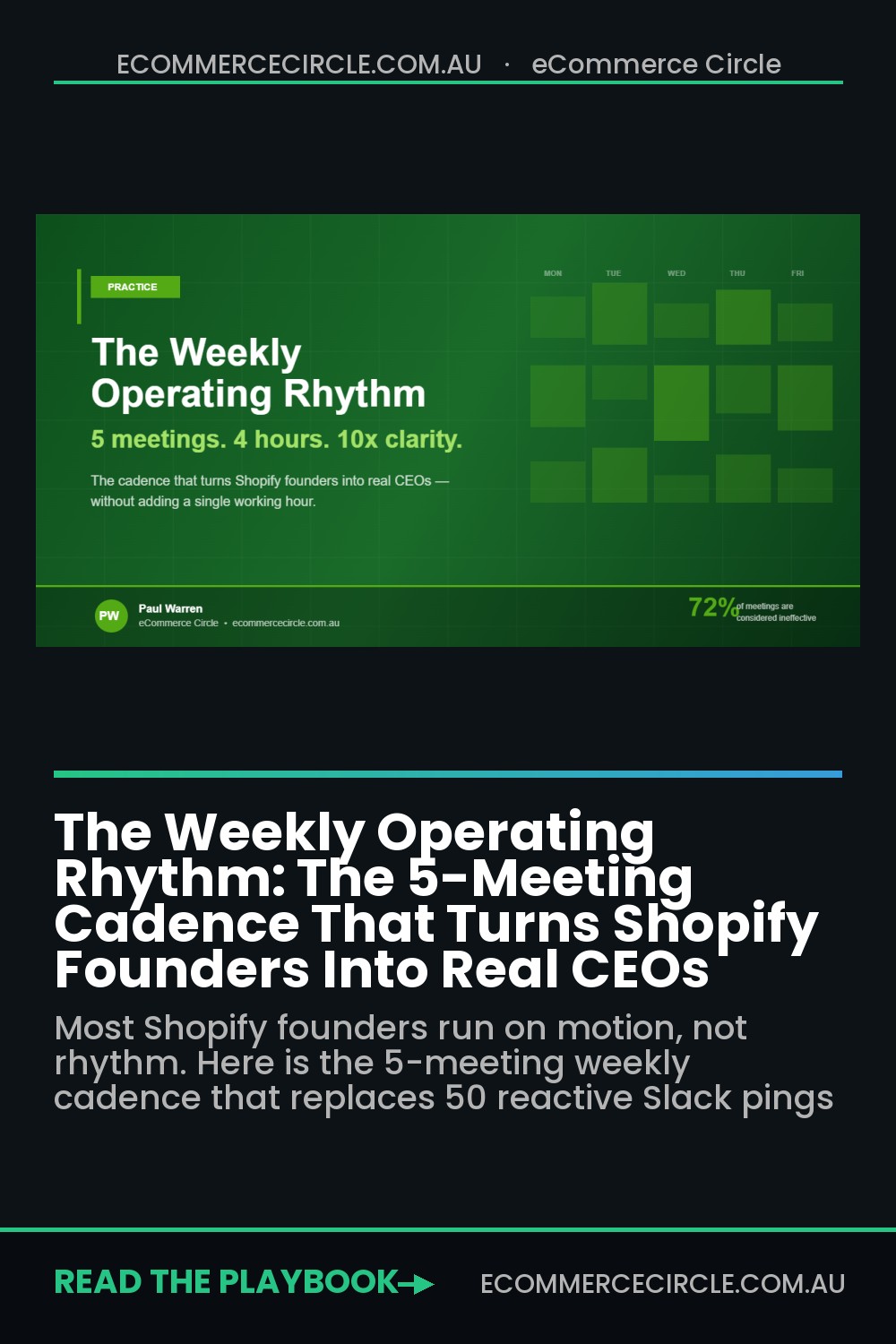
Here’s the data point that should stop every founder cold. Across global productivity research, 72% of meetings are considered ineffective, and only 11% are actually productive. The average employee now spends 11.3 hours a week in meetings — adding up to 392 hours a year, almost ten full work weeks of life that produce nothing. Time wasted in pointless gatherings has doubled since 2019 to about five hours a week per person.
So the answer isn’t “have more meetings.” It’s “have a small number of the right meetings, run incredibly well, on a fixed weekly cadence.” That’s the entire premise of an operating rhythm, and it’s the single biggest leverage point in the business of every brand we coach inside the eCommerce Circle.
When a Shopify store has no rhythm, three predictable things happen. First, the numbers go unread. The dashboards exist but nobody actually looks at them weekly, so a 12% drop in conversion rate hides for three weeks while you keep pumping ad spend into a leaking funnel. Second, marketing becomes random. The agency does what it always does, the email schedule drifts, and the brand never connects what it spent on ads to what came out the other end. Third, the team stops bringing problems forward. Without a structured Issues meeting, problems either explode in someone’s face or get quietly absorbed into someone’s anxiety.
The fix is mechanical. You install a five-meeting weekly rhythm, you protect those slots from everything else, and you let the rhythm do the heavy lifting. Founders consistently tell us it feels like the business stops being chaotic within two to three weeks of running this properly. That’s not because the world got quieter. It’s because the rhythm finally sorted the noise.
The Sunday Reset: Your 30-Minute Solo Planning Session
Before any meeting with the team happens, the founder needs a personal reset. The Sunday Reset is a 30-minute solo session, ideally somewhere away from your desk, with a notebook and a coffee. No team. No screens beyond the dashboard you’re reviewing. No Slack.
The job in this 30 minutes is to walk the business in your head before the team walks into the week. You’re answering four questions: What did we say we’d do last week? What actually got done? What’s the single most important thing this week needs to deliver? And what do I need to say “no” to so that thing actually happens?
- Pull the weekly numbers. Sessions, conversion rate, AOV, total revenue, total ad spend, contribution margin. Compare to last week and to the same week last year. You should be able to see this in one screen.
- Identify the bottleneck. One number is dragging the rest. Maybe traffic is up but CVR is flat. Maybe AOV collapsed because of a discount stack you forgot about. Whatever it is, you walk into Monday’s meeting already knowing the question.
- Pick your one thing. Not three. Not five. The single highest-leverage outcome for the week. Write it on the top of the page in big letters. This is the thing every other meeting will laser back to.
- Pre-write the headlines. What’s the customer headline you’ll share Monday? What’s the team headline? Most founders walk in cold and the meeting drifts. Pre-writing 30 seconds of headlines fixes that completely.
This sounds simple. It is. But almost no founder actually does it consistently, and the ones who do are dramatically calmer and more decisive on Monday morning. If you only adopt one part of this entire playbook, make it the Sunday Reset.
Meeting 1 — Monday Numbers (15 Minutes, 9:00am)
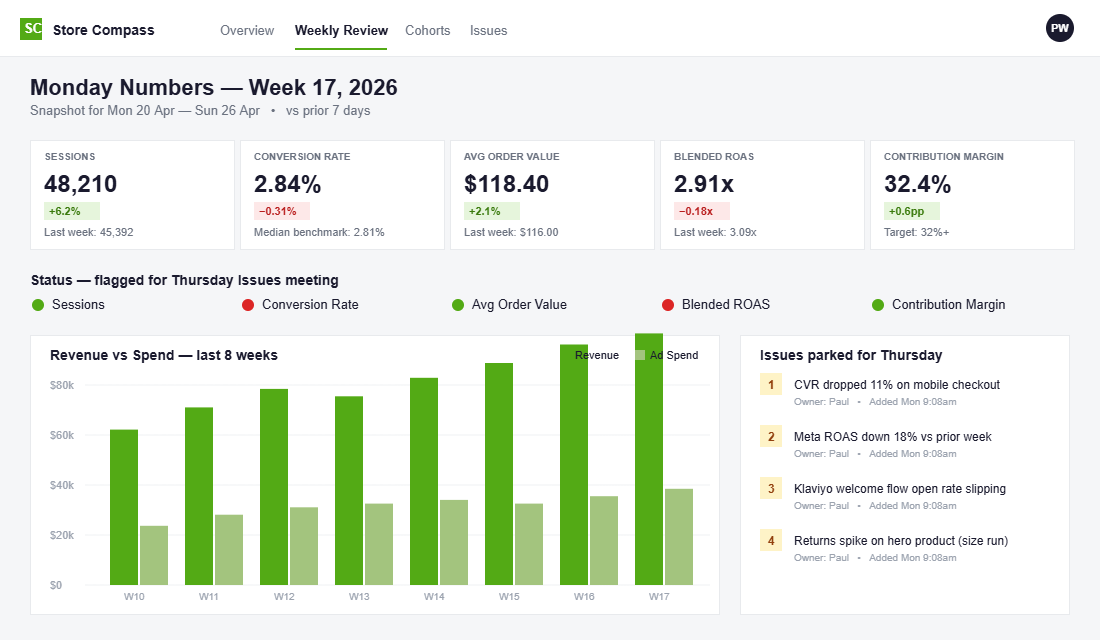
This is the heartbeat. Fifteen minutes, every Monday, same time. The whole leadership team — even if “leadership” is just you and one other person — sits down and reviews the same dashboard together. No discussion of solutions yet. Just the numbers.
Inspired by the EOS Level 10 Meeting framework that’s been used by over a million companies through Gino Wickman’s Traction system, the format is dead simple: you scan the numbers, you mark each one green (on track) or red (off track), and you flag any red as an “issue” to be solved later in the week. You do not solve issues in this meeting. You only surface them. Speed matters.
- Sessions and traffic mix. Total sessions vs last week. Paid vs organic vs direct vs email. If paid traffic dropped 20%, you need to know now, not Friday.
- Conversion rate. Across a dataset of 21 Shopify stores doing $688M combined, the median CVR was 2.81% in 2025, dipping to 2.17% in early 2026. If yours is sitting under 2%, that’s a red. If it’s above 3.5%, that’s a green flag — protect what’s working.
- AOV. A flat or declining AOV when you’re running discount-heavy promotions tells you the discount is doing the work, not the brand. Track it weekly.
- Revenue and ad spend ratio. Revenue divided by spend gives you blended ROAS at a glance. A leaking ratio is the earliest sign your funnel has broken before any agency report tells you.
- Contribution margin per order. The number most stores never review weekly and the number that determines whether you can scale at all. We covered this in detail in Contribution Margin for Shopify Stores.
Fifteen minutes. Numbers only. Issues parked. Done. The discipline is in keeping it short — once you let people start solving things, the meeting balloons to 45 minutes, you’ve burned half the morning, and the rest of the rhythm collapses.
Meeting 2 — Tuesday Marketing Stand-Up (30 Minutes, 10:00am)
Marketing is where most stores leak the most cash and run on the most fumes. The Tuesday Marketing Stand-up is the meeting that closes that loop. Thirty minutes, with whoever runs ads, whoever runs email, and whoever owns content or social. If that’s all you, that’s fine — you’re meeting with yourself, but you’re meeting with a calendar and an agenda.
The agenda is built around three buckets, and each gets ten minutes maximum. Performance, Pipeline, Plan. Performance is what last week’s spend produced. Pipeline is what’s in flight right now. Plan is what’s locked in for next week and what creative or copy needs to land before then.
- Performance (10 min). Pull blended ROAS, channel-level ROAS, top three creatives by spend, top three creatives by ROAS. Note any creative that’s fatigued (CPA up 30%+ week-on-week is the rough threshold). Look at the email program — open rates, click rates, revenue per recipient. Don’t audit the strategy yet. Just call out what worked and what’s tired.
- Pipeline (10 min). What’s already booked in for the next 7-14 days? Email sends, ad campaigns going live, influencer drops, affiliate posts. Anyone walking in saying “we don’t have anything next week” is the issue you solve here.
- Plan (10 min). What new creative gets briefed today? What email gets written this week? What’s the test we’re running this fortnight? Three to five priorities for the quarter is the sweet spot in scaling research — apply that same focus weekly.
The meeting closes with one outcome: a single document — Notion, Google Doc, a whiteboard photo, doesn’t matter — that lists every marketing action shipping in the next seven days, who owns it, and when it’s live. If you can’t produce that doc in the last two minutes of the meeting, the meeting failed. Run it again until you can.
Meeting 3 — Wednesday Customer & Product Hot Seat (45 Minutes, 11:00am)
By Wednesday, you’ve reviewed the numbers and you’ve sorted the marketing engine. Now you spend deliberate time on the two things every founder underweights: the customer and the product. Not in a vague “we should focus on customers” way. In a specific, agenda-driven, 45-minute hot seat.
The hot seat rotates each week. One week the spotlight is on a single customer cohort — say, second-time buyers, or your top 10% by lifetime value. The next week, it’s a single product or collection that’s either over-performing or quietly bleeding. The week after, it’s a piece of feedback that keeps coming up in support tickets. The point is depth, not breadth.
- Open with three real customer voices. Read out two reviews and one support ticket from the past week. Verbatim. No paraphrasing. The team needs to hear how customers actually talk, not how the brand thinks customers talk.
- Walk through the cohort or product data. If you’re focused on returning customers this week, pull repeat purchase rate, time-to-second-order, and cohort revenue from your analytics. If it’s a product, pull units sold, return rate, and review sentiment. Cohort-level review is non-negotiable — we walked through this in Cohort Analysis for Shopify Stores.
- Ask one question and one only. “What’s the next experiment that would move this needle?” Not “what should we do.” Experiments. Hypotheses. Bets you can test in two weeks and measure against a clear number.
- Pick one bet. Walk out with one experiment owned by one person with a launch date and a success metric. Everything else stays in the parking lot.
This is the meeting most stores never run, and it’s the meeting that quietly compounds the brand. The Aussie brands that have grown into category leaders — Bondi Sands, which has driven 560% organic growth and expanded into the UK and US, or Showpo, which scaled from Jane Lu’s garage to over $30 million a year shipping to 100 countries — didn’t get there by reacting weekly. They got there by running deliberate, narrow, customer-and-product hot seats that produced one solid bet at a time.
Meeting 4 — Thursday Operations & Issues (45 Minutes, 2:00pm)
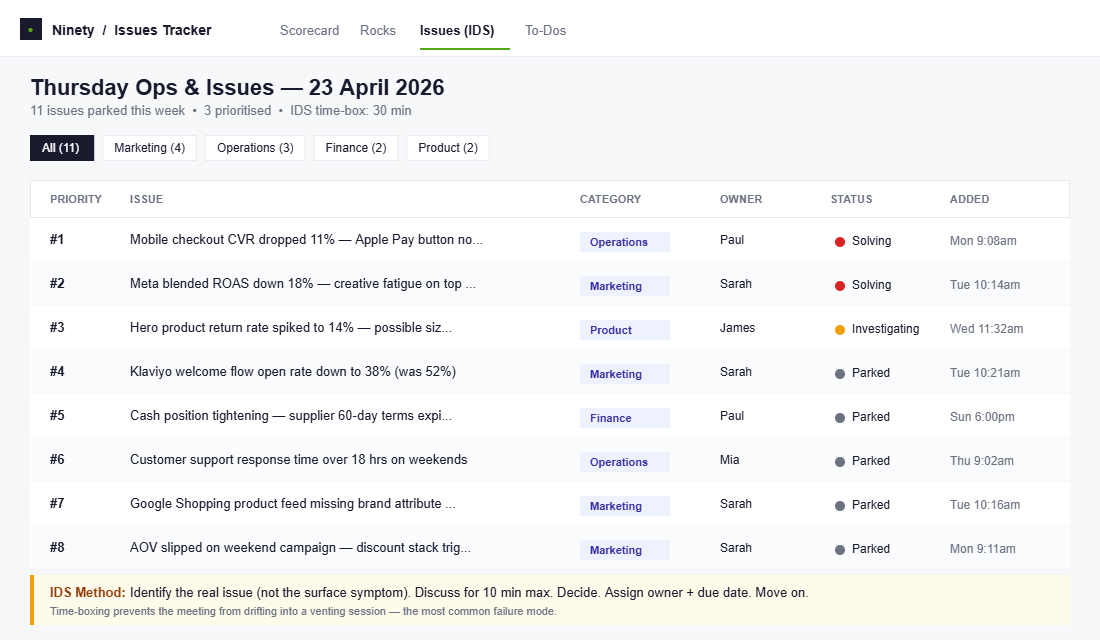
Here’s where you finally sit down and solve the issues you’ve been parking all week. The Thursday Operations meeting uses a format borrowed directly from the EOS Level 10 — a structured “Issues, Discuss, Solve” cycle that prevents meetings from drifting into venting sessions.
The agenda runs in three blocks. First block: a quick walk through the to-do list from last Thursday — every item is either done or it’s not, and undone items become an issue. No long explanations, no excuses, no side conversations. Second block: the issues list. You’ve been adding to this all week from Monday’s numbers, Tuesday’s marketing, Wednesday’s hot seat, and any operational fires. You rank the top three by impact and you work them top down. Third block: the to-do list for next Thursday gets written, with a single owner per item.
- To-do review (5 min). Last week’s commitments. Done or not done. Don’t relitigate why — just record it.
- Issues prioritised (5 min). Everyone calls out the top issues from the week. The team votes — often as simple as “raise your hand for the three you’d solve first.”
- Issues solved (30 min). Top issue first. Identify what’s actually going on (most issues aren’t what they look like on the surface). Discuss for 10 minutes maximum. Decide. Assign. Move to issue two. The discipline is in the time-boxing.
- New to-dos written (5 min). Every decision becomes a to-do with an owner and a date. If a decision doesn’t have an owner, it didn’t happen.
What this meeting prevents is the slow accumulation of unaddressed issues that turns into a quarter-end meltdown. The companies running this format consistently — and there are over a million businesses globally using EOS — are the ones that scale without the founder cracking. The discipline of solving three issues a week, every week, compounds. By the end of a quarter you’ve cleanly solved 30+ real issues. By the end of a year, you’ve solved 130+. That’s a different business.
Meeting 5 — Friday Founder Review (60 Minutes, 3:00pm)
The Friday Founder Review is the one meeting that’s about you, not the team. Sixty minutes, solo, ideally with a notebook and the dashboard. You’re closing the loop on the week and pre-loading next week so Sunday becomes a reset, not a panic.
Three sections, twenty minutes each. Reflection. Forecast. Time audit.
- Reflection (20 min). What were the three biggest lessons from this week? What did the data tell you that you didn’t see on Monday? What’s the pattern from the last 4-6 weeks of dashboards? Most founders never zoom out long enough to see the pattern. This 20 minutes is where the real strategic insight lives.
- Forecast (20 min). What’s already locked in for next week? What’s on the marketing calendar for the next 30 days? What’s the cash position heading into the next pay cycle? What’s the inventory position for the next 60 days? Look forward as deliberately as you looked back.
- Time audit (20 min). Where did your hours actually go this week? If 47 hours is the average for Shopify owners, where did your 47 land? Were they spent on the things only you can do, or on things a coordinator should be doing? This is where founders quietly identify the next role to hire and the next set of tasks to delegate.
End the session by writing three sentences in your notebook: The win this week was X. The lesson this week was Y. The one move next week is Z. Three sentences. That’s it. Most founders try to write a five-page reflection and burn out by week three. Three sentences is sustainable for a decade.
The Daily 10-Minute Huddle: The Spine That Holds It Together
The five meetings above are the bones of the rhythm. The daily 10-minute huddle is the spine. It’s the shortest meeting on your calendar and arguably the most important.
Every weekday, same time, ten minutes maximum, standing up if you’re in the same room or on a quick video call if you’re remote. Three questions per person, in this order. What did I ship yesterday? What am I shipping today? What’s blocking me? That’s it. No solutions in the huddle — blockers go straight onto the issues list for Thursday. The huddle exists for visibility and momentum, not problem-solving.
- 9:00-9:10am works for most teams. Early enough that the day hasn’t started bleeding into chaos. Late enough that everyone’s actually awake.
- Standing up matters if you’re in person. The moment people sit down, the meeting expands. Standing keeps it crisp.
- Cameras on if remote. The huddle is also a temperature check on the team. You can hear when someone’s stressed before they even raise it.
- Skip it on Mondays. Monday’s Numbers Meeting replaces it. Two huddles in one morning is overkill.
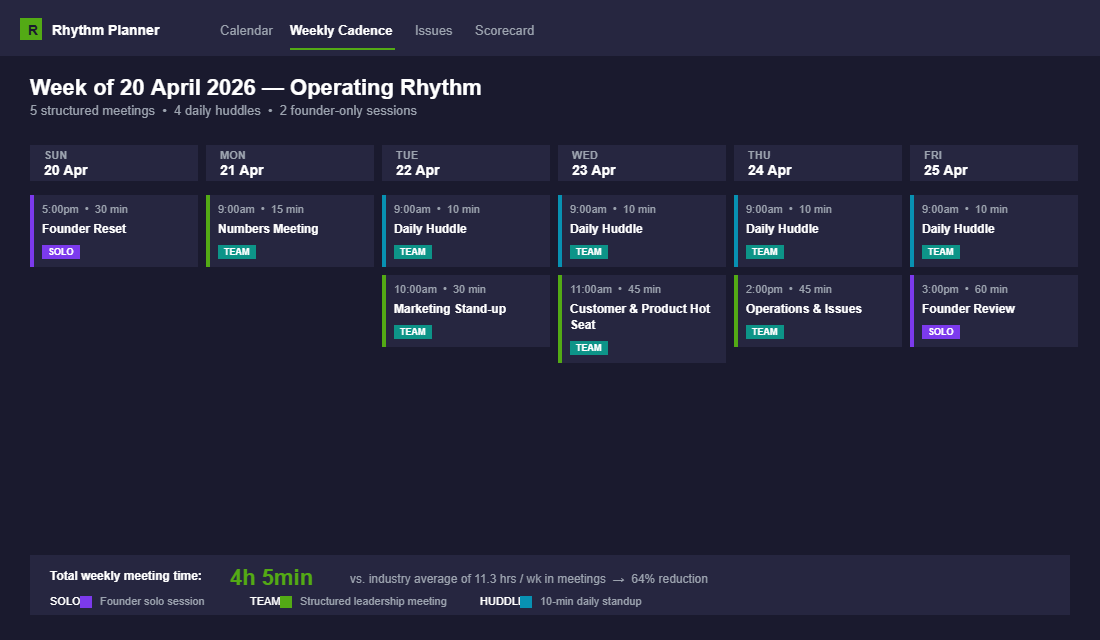
Add it up. Five structured weekly meetings averaging 39 minutes, plus four daily huddles of 10 minutes. That’s roughly four hours of meeting time across a week — well under the 11.3 hours the average employee burns in calls. And every one of those four hours produces an outcome you can point to.
The Tools That Make This Work (Without Adding Tool Bloat)
The rhythm matters more than the software. But three tools genuinely earn their keep when you’re running this cadence at scale.
- Notion or Google Docs for the agendas. One template per meeting, duplicated weekly. Fields: numbers, issues list, to-do list, owner, due date. Don’t overengineer this. We’ve watched founders burn three weeks building the perfect Notion system instead of running the meeting once.
- A weekly numbers dashboard — Polar Analytics, Triple Whale, or Shopify’s native reports. The point is the same five numbers in the same place every Monday. Build it once, freeze the layout, and don’t redesign it for six months. Set-up time is roughly 30-60 minutes if you’re using one of the dedicated tools, longer if you’re stitching together Shopify reports manually.
- A purpose-built EOS tool (Ninety, Strety, or Bloom Growth) — optional but powerful. If you’ve adopted the Level 10 format and you’re scaling past five team members, these tools handle the issues list, to-dos, and scorecard automatically. Most are AUD $20-50 per user per month and pay for themselves in saved meeting time within the first quarter.
If you’re a one or two-person team, skip the third tool entirely. A Notion page and a phone alarm at 9am Monday is enough to start. The mistake we see most often is founders buying tools before they’ve built the rhythm. Tools amplify a working system. They don’t create one.
The Compound Effect: Why This Rhythm Beats Hustle Every Time
Here’s the move that makes the whole thing click. Every individual meeting in this rhythm is small. Fifteen minutes here. Thirty minutes there. Forty-five there. None of them feel like the thing that’s going to transform your business. None of them produce a viral campaign or a 10x quarter on their own.
But run the full rhythm for 12 weeks straight and the compounding starts to show up everywhere. The numbers are reviewed every Monday, so problems get caught at week one instead of week six. Marketing is reviewed every Tuesday, so creative fatigue gets fixed inside a fortnight. The customer and product hot seat runs every Wednesday, so you’ve shipped 12 deliberate experiments by quarter’s end instead of three. Issues are solved every Thursday, so 30+ real problems are off the books before they cost you. And the founder reviews and resets every Friday and Sunday, so by Monday morning the calmest, clearest version of you walks into the week.
Compare that to a store running on motion alone. Same number of hours. Same revenue, maybe. But no compounding. The CVR slowly drifts down for three weeks before anyone notices. Two great creative ideas die in someone’s drafts because nobody looks at the marketing pipeline. Six customer complaints all about the same product land in three different inboxes and never get connected. The founder ends Sunday more anxious than they started.
This is the gap between a $1M store and a $10M store. It’s not work ethic. It’s not budget. It’s not even the right Shopify theme. It’s whether the business runs on a rhythm that catches problems at week one and converts them into experiments by week two — or runs on adrenaline that catches them at month three when the damage is already done.
Implementing the Rhythm: Your 30-Day Rollout Plan
Knowing the rhythm is one thing. Actually installing it inside a Shopify business that already has a chaotic calendar is another. Here is the 30-day rollout we walk every coaching member through, broken into 4 weekly chunks. Do not try to install all five meetings on Monday — that fails 9 times out of 10.
Week 1: Install the Monday Numbers Review only. Pick a 30-minute block every Monday at the same time. Build the one-page dashboard in Shopify Analytics or a Google Sheet pulling from Shopify, Klaviyo, and your ad platforms. The 7 numbers you need: revenue, orders, AOV, conversion rate, blended ROAS, ad spend, and email revenue. Nothing else. The first 2 Mondays will feel slow as you wire up the data — that is normal. By week 3, the dashboard takes 5 minutes to update and the meeting feels worth its weight in gold.
Week 2: Add the Friday Wrap. Block 30 minutes every Friday at 3pm. The agenda is fixed: what shipped this week, what slipped, what we learned, and what next week’s top 3 priorities are. No solutioning, just status. The hardest part is keeping it to 30 minutes — set a timer. Members report this meeting alone removes 70% of the “what is everyone working on?” Slack messages by month two.
Week 3: Add the Wednesday 1:1s with your direct reports. 30 minutes each, same time every week. Agenda: their wins, their blockers, your coaching, your asks. The single most important question to ask: “What is the one thing I can stop doing, start doing, or keep doing to make your job easier?” Members consistently report that this question alone triples the value of their 1:1s. For more on how to delegate cleanly during this transition, see the delegation playbook.
Week 4: Add the Monthly Business Review and the Quarterly Strategic Day. Schedule the MBR for the first Wednesday of every month, 90 minutes, with your operations and marketing leads. Schedule the Quarterly Strategic Day at the end of each quarter, half day, ideally off-site (even just a different café works). By the end of week 4 you have all five rituals running and roughly 70% adoption — full adoption typically takes 8-12 weeks as the team learns the rhythm.
The Tools That Make the Rhythm Run Itself
You do not need an enterprise stack to make this work. Aussie Shopify founders running the full rhythm typically use this combination, total cost under $200 AUD/month:
- Google Calendar (free) — every meeting is a recurring block with the agenda in the description. Never reschedule the recurring slot; reschedule individual instances if needed.
- Notion or Google Docs (free to $20 AUD/month) — one running document per meeting type, with rolling notes. The “Friday Wrap” doc and “Monday Numbers” doc become your operating memory.
- Shopify Analytics + Triple Whale or a Google Sheet ($0-$129 AUD/month depending on stack) — the source of truth for your Monday Numbers Review dashboard. Triple Whale is worth it once you cross $80K/month revenue.
- Loom (free to $15 AUD/month) — for async updates so meetings stay short. If your Monday Numbers Review starts running long, ask people to send Loom video pre-reads instead.
- Slack or WhatsApp (free) — for the daily standup channel where everyone drops their top 3 priorities each morning. This single thread replaces 80% of “what are you working on?” interruptions.
The tools are not the magic — the rhythm is. Plenty of founders have all these tools and zero rhythm. Plenty of founders run the rhythm on a paper notebook and crush it. Pick the tools that fit your team’s existing habits.
Your Weekly Rhythm Template (Steal This)
Print this, paste it into Notion, screenshot it to your phone — whatever you need. This is the cadence. Run it for a quarter and you’ll never go back to fire-brigade mode.
- Sunday 5:00pm — Founder Reset (30 min, solo). Pull weekly numbers. Identify the bottleneck. Pick the one thing for next week. Pre-write the headlines.
- Monday 9:00am — Numbers Meeting (15 min, leadership). Five core metrics. Green or red. No solutions. Surface issues only.
- Tuesday 10:00am — Marketing Stand-up (30 min, marketing team). Performance. Pipeline. Plan. Walk out with a single doc of next-7-day actions.
- Wednesday 11:00am — Customer & Product Hot Seat (45 min, leadership). One cohort or product. Three customer voices. One bet for the fortnight.
- Thursday 2:00pm — Operations & Issues (45 min, leadership). Last week’s to-dos. Top three issues. Solve. Assign. Repeat.
- Friday 3:00pm — Founder Review (60 min, solo). Reflection. Forecast. Time audit. Three sentences in the notebook.
- Tue–Fri 9:00am — Daily Huddle (10 min, whole team). Yesterday. Today. Blocker. Done.
Total weekly investment: about four hours of meetings plus a couple of hours of solo founder time. Compare that to the 47 hours a typical Shopify owner already spends working on their store, and you’ll see the rhythm doesn’t add hours — it redirects them. Less time reacting. More time leading.
Inside the eCommerce Circle, installing this operating rhythm is one of the first moves we make with every member. Not because it’s complicated, but because it’s the single highest-leverage habit shift in the whole business. Once the rhythm is locked in, every other lever — ads, email, retention, product, hiring — gets dramatically easier to pull. If you’d like a hand installing it inside your business, let’s talk.