Every Aussie Shopify founder I work with hits the same wall somewhere between $1.5M and $4M a year. The store is doing well, the brand is humming, and the founder is drowning. Inbox triage at 6am. Supplier emails at 10pm. A Slack channel that pings every twenty minutes with another small fire only they can put out.
What’s in This Article
You know the moment. You sit down to plan the next quarter and instead spend the morning chasing a freight invoice, fixing a Klaviyo segment, and explaining to a new VA why the SKU naming convention matters. The work that grows the business sits untouched. The work that keeps the business alive eats every hour you have.
This is the Operations Manager moment. The role most founders hire too late, hire wrong, or never hire at all. 75% of entrepreneurs struggle with delegation, and the data is brutal: founders who do delegate see meaningfully higher growth than those who hold on. Hiring an Operations Manager is not a luxury for $5M brands. For most Aussie Shopify operators, it is the single hire that decides whether the next two years look like growth or grind.
Why the Operations Manager is the most powerful hire you can make
Most founders hire the wrong first leadership role. They hire a marketer because revenue feels like the obvious lever. They hire a customer service lead because the inbox is screaming. Both can help. Neither solves the underlying problem, which is that you are still the person every decision routes through.
An Operations Manager is the role that takes the daily mechanics of running a Shopify business off your plate so you can spend your time on the things only you can do: brand, product, vision, big partnerships, and capital decisions. They own the weekly rhythm. They own the SOPs. They own the small fires. They are the chief of staff for a Shopify business.
Get this hire right and your week changes shape. You stop being the dispatcher and start being the strategist. Get it wrong and you have spent six figures hiring a glorified VA who needs you to make every call anyway.
When to hire: the four signals that say it is time
Hiring an Operations Manager too early burns cash you do not have. Hiring too late costs you the next year of growth. The trigger is not a revenue number alone. It is a combination of revenue, complexity, and founder time. Look for these four signals together.
- Signal 1: Revenue between $1.5M and $4M. Below $1.5M, the role is hard to justify on margin. Above $4M without one, you are leaking growth because nothing strategic gets shipped.
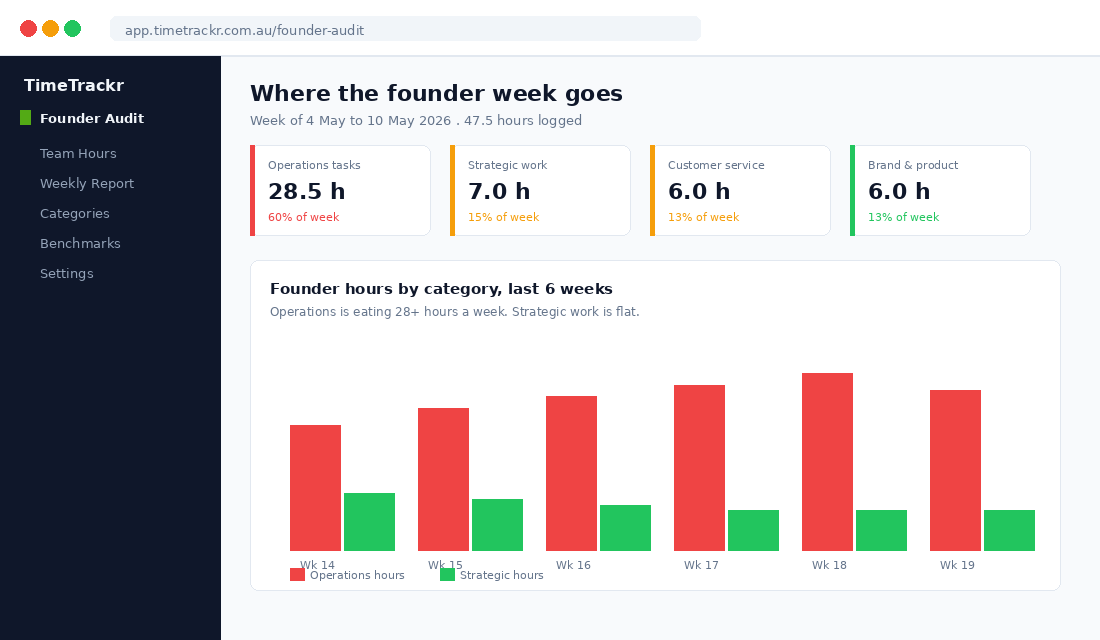
- Signal 2: You are spending 20+ hours a week on operations. Track it for one week. If 20 or more hours are going to inbox, supplier coordination, app fixes, fulfilment chases, and team questions, the lever is here.
- Signal 3: You have at least three contractors or part-timers. A VA, a designer, a marketer, a 3PL. Once there are three or more inputs to coordinate, someone other than you needs to be the hub.
- Signal 4: Strategic work has stopped shipping. If your last quarterly plan is six months old and nothing on it has moved, the business is in maintenance mode. That is the loudest signal.
If you tick three of four, the hire is overdue. If you tick four of four, you are already paying for the role in lost growth. The cost of the wrong founder hours is brutal. A founder hour spent on a freight discrepancy is an hour not spent on a partnership conversation that compounds for years.
What an Operations Manager actually owns (the role scorecard)
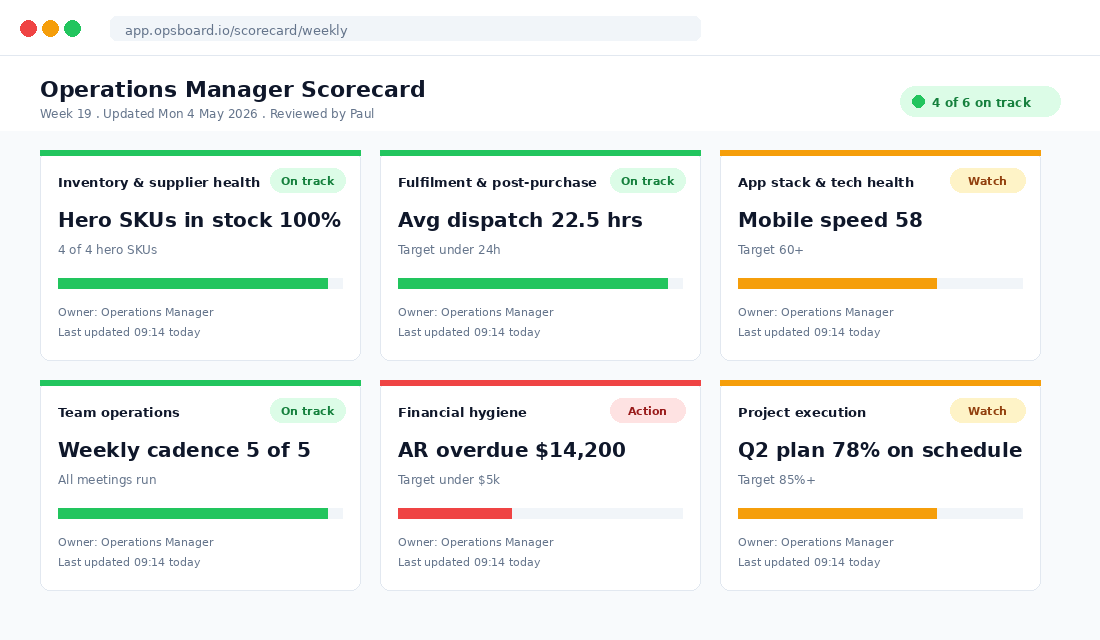
Most job ads for this role read like a wishlist. “Detail-oriented self-starter who can wear many hats.” That is not a role. That is a personality test. A real Operations Manager owns clear outcomes you can measure. Here is the scorecard we use with eCommerce Circle members.
- Inventory and supplier health. No stockouts on hero SKUs. Reorder points set and respected. Supplier scorecard updated monthly. Three quotes on the table for any line item over $5k a month.
- Fulfilment and post-purchase. Average dispatch time under 24 hours. Customer service first response under 4 hours. Returns processed within 5 business days. NPS tracked weekly.
- App stack and tech health. Shopify and Klaviyo audits monthly. Subscription costs reviewed quarterly. New apps trialled with a 30-day kill switch. Site speed score above 60 on mobile.
- Team operations. Weekly team meeting run, not attended. Quarterly OKRs tracked. Onboarding for new hires owned. SOPs written and updated.
- Financial hygiene. Daily cash position visible. Weekly P&L variance review with the founder. AP and AR managed without founder involvement. BAS and payroll on time, every time.
- Project execution. Quarterly plan kept on track. Monthly retros run. New initiatives shipped on schedule with documented learnings.
That is six outcome areas, twenty-something individual metrics. Build the role around outcomes, not activities. An Operations Manager is not measured by hours or tasks. They are measured by whether the wheels stay on while the business grows.
What to pay: the 2026 Aussie compensation benchmarks
Compensation is where most founders get nervous. They underpay and end up with a coordinator who cannot run anything. They overpay and burn margin they cannot afford. Here are the real Aussie numbers, pulled from SEEK and Glassdoor in early 2026.
- Sydney eCommerce Manager median: $127,500 base. Source: SEEK April 2026.
- Melbourne eCommerce Manager median: $125,000 base. Source: SEEK April 2026.
- Ecommerce Operations Manager average across AU: $124,684 base. Range $119,353 to $130,016. Source: Glassdoor April 2026.
- Brisbane and Perth typically run 5 to 10% lower for the same scope.
- Add 11.5% super to all base figures for true cost. Some employers fold super into the disclosed number, some do not. Confirm at offer stage.
For a $1.5M to $4M Shopify business, the right band is $95k to $125k base plus super, depending on city, scope, and seniority. Add a 5 to 10% performance bonus tied to two or three of the scorecard outcomes. Avoid equity for this role unless they are a true co-founder. Cash on cash plus a clean bonus structure attracts the right operator and avoids the politics that wreck early teams.
One more compensation note. The cheapest version of this role is not someone for $60k. The cheapest version is the right person at $115k who saves you 25 founder hours a week. If your time is worth $200 an hour in growth output, that is $260k a year of recovered capacity. The math is not close.
Where to find them: four channels that actually work for Aussie ecommerce
The right Operations Manager rarely comes from a generic SEEK ad. They are passive, they are referred, and they often come from inside the industry. Use these four channels in order.
- Channel 1: Your network. Post in your founder community, your eCommerce Circle peer group, your industry association. The strongest hires usually come from a warm referral by someone who has worked with the candidate.
- Channel 2: LinkedIn outreach to second hires. Search for “Ecommerce Coordinator” or “Ops Coordinator” at brands two notches above yours. The person who is the number two at a $10M brand is often ready to be the number one at a $3M brand. Pay close attention to brands like Bondi Sands, Frank Body, and Who Gives A Crap. Their alumni are everywhere.
- Channel 3: Specialist recruiters. Use ecommerce-specialist agencies like Gilmore Personnel or Six Degrees Executive for the senior end of the market. Expect 15 to 20% of first-year salary as fee. Worth it for the shortlist quality if you do not have the time to filter 200 applications yourself.
- Channel 4: SEEK and LinkedIn paid ads. Last resort, not first resort. If you go this route, write the ad like a pitch, not a job description. Lead with the brand, the founder, the product, and the mission. Save the requirements for the bottom.
Bondi Sands is a useful case study. They re-platformed to Shopify Plus and run a 100+ person team across AUNZ and the US. Almost every Operations and eCommerce role there is filled internally or via direct outreach, not job boards. Build the network now, not when you need to hire.
The five-stage interview process
Most founders interview operations candidates the same way they interview marketers, which is to say badly. They talk too much, ask vague questions, and hire on vibes. An Operations Manager interview should test for systems thinking, attention to detail, and the ability to push back on a founder. Here is the process that works.
- Stage 1: 30-minute screen. Founder or recruiter. Confirm motivation, salary expectation, work eligibility, and culture fit. 70% of candidates exit here.
- Stage 2: 60-minute deep dive. Walk through their last role in detail. Ask “what was broken when you started, what did you fix, how did you measure it” for every responsibility on their CV. Look for specifics. Generic answers are a red flag.
- Stage 3: Paid case study. Pay $300 to $500 for a four-hour exercise. Give them a real problem you have right now. A messy app stack audit, a fulfilment SLA review, a supplier scorecard build. Brief them with the same context you would give an internal hire. Look at how they think, not just what they produce.
- Stage 4: Reverse interview. Let them ask you anything for 45 minutes. The questions they ask reveal more than any answer they give. Strong candidates ask about your cash position, your churn, your supplier risk, your hiring plan.
- Stage 5: Reference calls. Three references, including their last direct manager. Ask “would you hire them again, and for what role.” If the answer is hesitant or vague, walk away.
Total elapsed time should be three to four weeks, not two months. Move fast on strong candidates. The Aussie ecommerce hiring market is small and good operators get multiple offers.
The 90-day plan: how to know if the hire is working
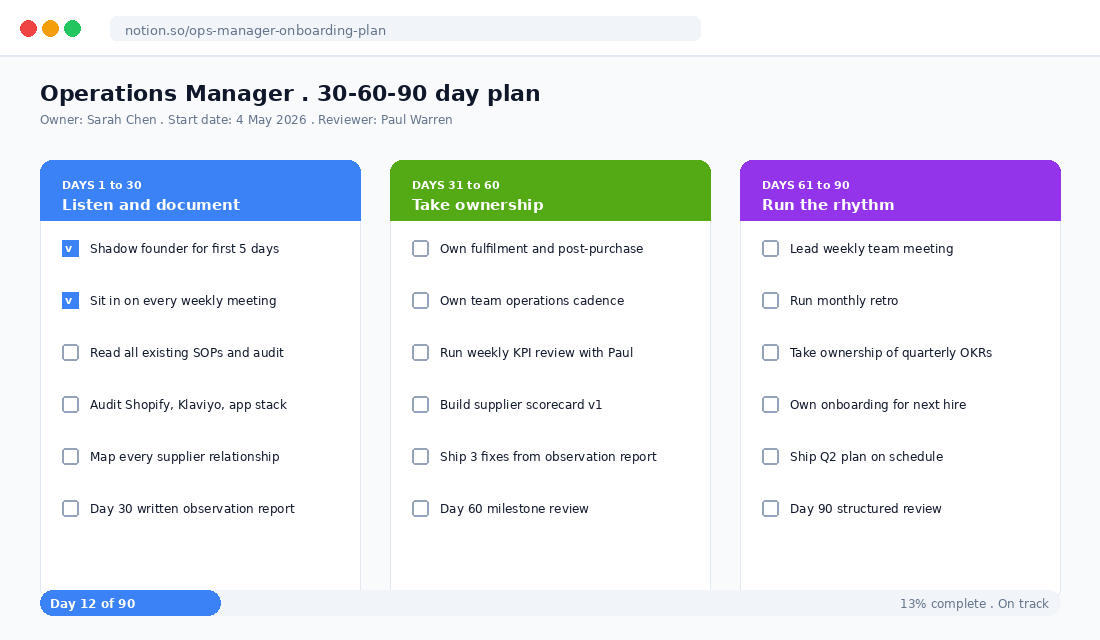
The first 90 days decide whether this hire compounds for the next three years or quietly drains the business. Most failed Operations Manager hires fail in the first quarter, not because the person was wrong, but because the founder did not set up the role to win. Use this 30-60-90 framework.
- Days 1 to 30: Listen and document. They shadow you, sit in on every meeting, read every existing SOP, audit every tool. They produce a written observation report at day 30. No major changes yet. Their job is to understand the business as it is.
- Days 31 to 60: Take ownership of two scorecard areas. Pick the two outcome areas where the pain is sharpest. For most founders, that is fulfilment and post-purchase plus team operations. Hand the reins fully. You do not get to take them back when something goes sideways.
- Days 61 to 90: Run the weekly rhythm. They own the weekly team meeting, the weekly KPI review with you, and the monthly retro. By day 90, they should be running the operating cadence of the business. Read our deeper take on the weekly operating rhythm if you have not already locked one in.
At day 90, you sit down for a structured review. Three questions: What is working? What is broken? What needs to change in the next 90 days? Be honest. If the role is not landing, address it now. The cost of holding on to the wrong hire compounds quietly for months before it shows up in the numbers.
The tool stack: how to set them up to win in week one
An Operations Manager without the right tooling is just an expensive coordinator. Set them up with a basic stack on day one and they will pay for themselves inside the first quarter. The non-negotiable starter kit is small and cheap.
- Notion or ClickUp for SOPs and the team handbook. Notion is cleaner for documentation, ClickUp is stronger for project tracking. Pick one. Build a single team workspace with sections for SOPs, weekly meetings, quarterly OKRs, supplier records, and onboarding.
- Slack for daily comms. Channels by function, not by person. #ops, #cs, #marketing, #leadership. Move the team off email for internal work in the first 30 days.
- Loom for async training. Every SOP should have a 3-minute Loom alongside the doc. Faster to record, easier to update, more useful for new hires.
- Shopify Flow for automations. Free and underused. Auto-tag VIP customers, route high-value orders, alert on inventory thresholds. The Ops Manager should own the Flow library.
- A simple weekly KPI sheet in Google Sheets. Six rows: revenue, conversion rate, AOV, returns rate, customer service first response time, dispatch SLA. Updated every Monday. Reviewed every Tuesday with you.
Setup steps for Notion as the team operating hub. Day one: create a workspace, build the four core sections (SOPs, Meetings, OKRs, Onboarding), import any existing docs. Day two to seven: the new Ops Manager audits, restructures, and links every document. Day eight onwards: every new SOP starts in Notion. No exceptions. The team handbook becomes the source of truth, and the founder stops being the source of truth.
The compound effect: what the right hire actually delivers
Hiring this role is not really about offloading tasks. It is about changing what the business is capable of. Three things compound when the right Operations Manager lands.
Founder time becomes strategic time. The 25 to 30 hours a week you used to spend on ops becomes 25 to 30 hours on partnerships, product, brand, and capital. That is roughly 1,200 hours of founder strategic time recovered in year one. There is no other hire that buys you that.
The team scales without you. A good Ops Manager hires the next two or three people themselves. The customer service lead, the second VA, the warehouse coordinator. You are no longer the hiring funnel. The team grows around the operating rhythm, not around you. This is how a $2M business becomes a $5M business in 18 months instead of 36.
The business becomes sellable. A Shopify business with a documented operating system, a clear scorecard, and a leadership team that runs the day-to-day is worth a 1.5 to 2x multiple premium over one that lives entirely in the founder’s head. The Operations Manager is the first piece of that institutional layer. Everything that compounds enterprise value follows.
For more on building the broader hiring sequence, our team building roadmap walks through every role from solo founder through the first leadership layer. And if you want to nail the onboarding piece specifically, the 30-60-90 day onboarding framework goes deeper on what to expect at each milestone.
Your Operations Manager hire checklist
Print this. Tape it to your monitor. Work the list in order. If you tick every box, you have set the role up to win.
- Pre-hire. Founder time-track for one week. Confirm three of four hire signals. Define the six outcome areas. Set the salary band ($95k to $125k base plus super). Brief your network.
- Sourcing. Post in your peer group. LinkedIn outreach to 20 second hires at brands one to two notches above you. Brief one specialist recruiter. Last, post on SEEK if you still need pipeline.
- Interview. 30-minute screen. 60-minute deep dive on past role. Paid four-hour case study with real problem. 45-minute reverse interview. Three references including last direct manager.
- Offer. Base plus super. 5 to 10% bonus tied to scorecard outcomes. No equity. Start date within 4 weeks. Send the offer in writing within 48 hours of decision.
- First 90 days. Days 1 to 30: listen, document, write observation report. Days 31 to 60: own two scorecard areas. Days 61 to 90: run the weekly operating rhythm. Day 90 review: what is working, what is broken, what changes next.
- Tooling on day one. Notion workspace built. Slack channels by function. Loom installed. Shopify Flow access. Weekly KPI sheet live.
- Quarterly review. Six scorecard areas reviewed in writing every quarter. Bonus calculated against scorecard. Compensation reviewed annually against SEEK and Glassdoor benchmarks.
The Operations Manager hire is the moment a founder-led business becomes a real company. It is not the most glamorous hire and it does not show up on a launch announcement. It is the hire that decides whether you are still the bottleneck of your business in two years or whether you are running it.
Inside eCommerce Circle, the Operations Manager hire is one of the core conversations we have with members crossing the $2M mark. If you want a second opinion on your timing, your scorecard, or your candidate shortlist, let’s talk.