Most Aussie Shopify founders are obsessed with the order coming in. Almost no one is paying attention to what happens 48 hours later.
What’s in This Article
Here is the uncomfortable maths. The average Shopify store in 2026 has a customer lifetime value of around AUD 168 over three years. The top 10% of stores hit AUD 250 to AUD 450. The single biggest difference is not their ad spend, their pricing, or their AOV. It is the 90 days after the first order.
If a customer does not come back inside 90 days, there is only a 12% chance they ever will. That window is closing while you are busy refreshing your ad dashboard. The post-purchase email sequence is the cheapest, highest-impact thing you will build all year, and most stores have either none of it, or a single weak “thanks for your order” auto-reply that converts nothing.
This post is the 7-email flow we use with the operators inside eCommerce Circle. It is built for Klaviyo, but the structure works in any tool. Real timing, real subject lines, real benchmarks, and the exact role each email plays. By the end you will have a system that turns first-time buyers into a repeat-customer base, and a P&L line item that compounds every month you keep it running.
Why Most Aussie Shopify Brands Lose Money After the First Order
Here is the pattern we see in audits. A founder spends 50 to 65% of their time and budget on acquisition. Meta. Google. TikTok. UGC creators. New offers. The whole “more orders” engine is pointed at the front door.
Then the customer hits the thank-you page, gets an order confirmation that looks like a tax invoice, and is never strategically contacted again until a generic Black Friday campaign three months later.
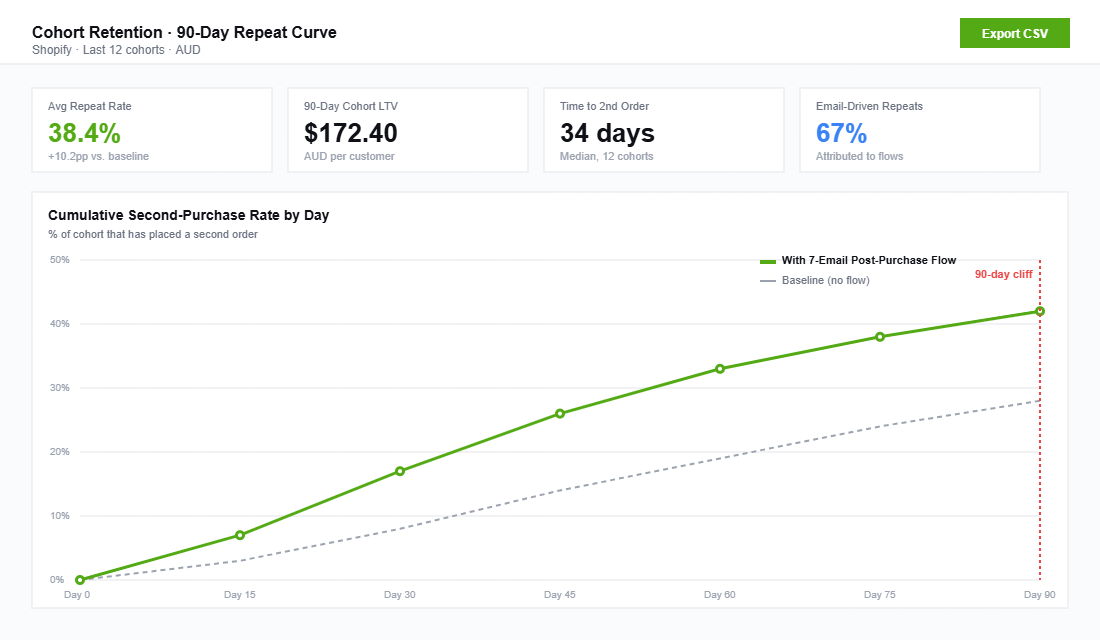
The result is predictable. The average Shopify repeat purchase rate sits at 28.2%. Stores with advanced email programs run 40 to 52%. The gap is not luck. It is engineered, and the engineering happens in the post-purchase flow.
Three numbers to internalise before we go further:
- Email flows generate 41% of all email revenue from just 5.3% of total sends. Flows are the single highest-return surface in your marketing stack.
- Automated flow click-through is 5.58% versus 1.69% for campaigns. Triggered, contextual emails outperform broadcasts by more than 3x.
- Email subscribers have roughly 3x the lifetime value of non-subscribers (AUD 285 vs AUD 95 over 3 years). The flow is what builds the subscriber. The subscriber is what builds the LTV.
If you do not run a deliberate post-purchase sequence, you are leaving the most profitable revenue on the table. Worse, you are training your customers to forget you.
The 90-Day Window: What the Cohort Data Says About Repeat Buyers
Before we get to the emails, you need to know the shape of the curve you are trying to bend.
Look at any healthy Shopify store as a cohort over 90 days:
- Month 2: 8 to 12% of the cohort makes a second purchase.
- Month 3: Another 5 to 8% comes back.
- Month 6 cumulative: 18 to 28% have repurchased.
- Month 12 cumulative: 22 to 35%.
Most of the lifetime second-order revenue is decided in the first 90 days. After that, the curve flattens hard. Customers who go silent past 90 days have only a 12% chance of ever buying again, and even then it is usually because of a discount campaign that destroys margin.
Your post-purchase flow has one job. Compress the time between order one and order two, and lift the percentage of customers who complete that second purchase. Every email below has been engineered to do exactly that.
Email 1: The Real Thank You (Day 0, Sent 30 Minutes After Order)
Sent: 30 minutes after the order is placed. Goal: Build emotional attachment, not deliver logistics.
The order confirmation already does the receipt job. Klaviyo or the Shopify default handles that automatically. What it does not do is build a relationship.
Email 1 is a personal-feeling note from the founder. Plain text. No big banners. Sent at 30 minutes so it lands after the order confirmation has settled. Subject line examples that work in Australian markets:
- “From Paul: a quick note about your order”
- “Your [brand] order, and a thank you”
- “[First name], we just wanted to say something”
The body is 80 to 120 words. Three things only:
- A real “thank you” with one specific reason their order matters (story, mission, what it funds).
- A “what to expect next” line so they are not anxious about shipping.
- A reply prompt. “Hit reply if you have any questions, I read every one.” This single line lifts open-to-reply rates dramatically and trains Gmail and Outlook to mark you as a real sender. Deliverability follows.
This is also where you set the brand voice for everything that follows. Coco and Eve does this beautifully, weaving Bali-inspired ritual language into their first send. Sand & Sky uses the Australian botanicals story. The voice is the asset.
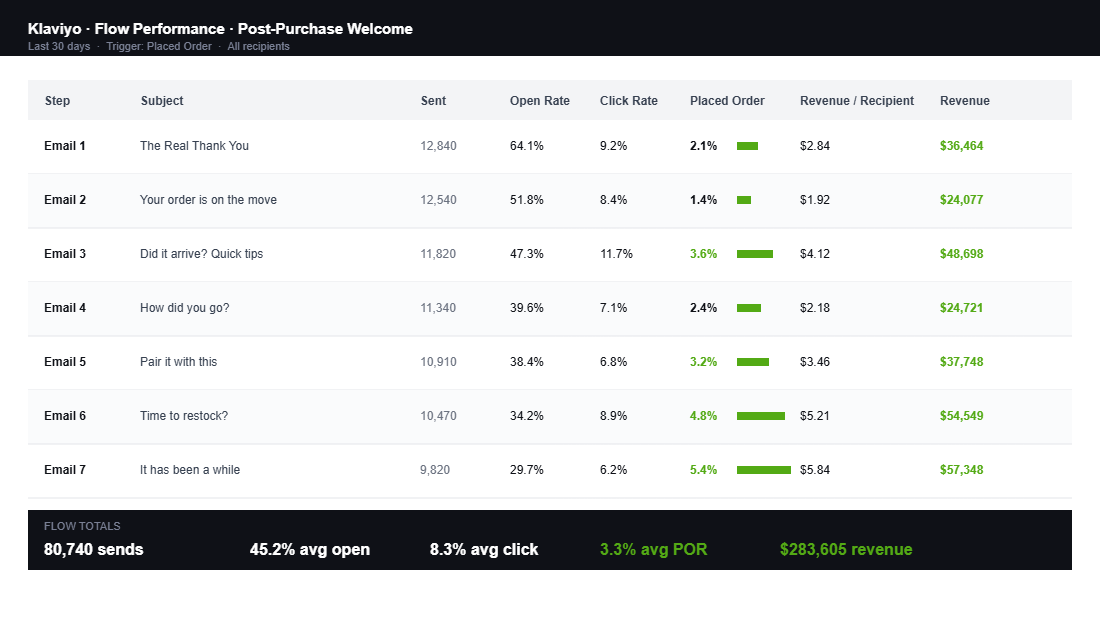
Benchmark: 60 to 65% open rate. If you are below 50%, your subject line is the problem, not the segment.
Email 2: The Anticipation Builder (Day 2)
Sent: 48 hours after order placed. Goal: Kill buyer’s remorse and make the box feel like an event.
Shipping windows in Australia are long. A regular customer in Perth waiting on stock from a Sydney warehouse is sitting in 3 to 5 days of dead air. That is when refund requests, Reddit second-guessing, and chargebacks start.
Email 2 fills that void. Structure:
- Subject: “Your [product] is on the move. Here is what is inside the box.”
- Top section: Behind-the-scenes content. A photo of the warehouse, the founder’s voice on packaging, or a 30-second video of the product being made.
- Middle section: “What to do when it lands.” If you sell skincare, three usage tips. If you sell apparel, fit notes. If you sell food, a recipe.
- Bottom section: A soft proof element. One real customer review with a photo.
This email is not about the order. It is about the experience the order is wrapping into. Done well, the customer is now anticipating the box rather than just waiting for it.
Benchmark: 45 to 55% open rate, 8 to 12% click rate.
Email 3: The “Did It Arrive?” Onboarding (Day 5 to 7)
Sent: When the tracking number flips to delivered, plus 24 hours. Goal: Get the product used and get the customer to a “small win” inside the first week.
This is the highest-impact email in the flow and the one most stores skip. The customer has the box. Either they opened it and started using it, or it is sitting on the kitchen bench unopened.
Your job is to make sure they unbox and use it. Three structural blocks:
- Acknowledgement: “Your [product] should be with you by now. We hope you love it.”
- Activation: A short, punchy how-to. Three usage steps. One photo per step.
- Social proof drop: “Here is how three other customers used theirs in the first week.” With photos.
For consumable products this email also seeds the replenishment cycle. For apparel, it seeds a return-or-keep decision. For higher consideration purchases, it seeds a review.
Klaviyo lets you trigger this off the Shopify “fulfilled” event, then add a 24-hour delay. If you cannot get tracking webhooks reliably, fire it on Day 6 of the flow.
Benchmark: 40 to 50% open rate. Klaviyo’s 2026 data shows post-purchase flows hitting an average 40 to 45% open rate, with top performers at 61.68%.
Email 4: The Review Ask (Day 14)
Sent: 14 days after order placed. Goal: A 5-star review in your reviews app and an opportunity to upsell on the thank-you page.
Reviews compound. They lift conversion on the product page, they fuel ads, and they give you content for retargeting. Shopify operators systematically under-invest in this email and then complain about being out-reviewed by competitors.
Two-screen design:
- Email body: “How did you go with [product]? Tap a star to tell us.” Uses an inline 1-to-5 star widget that links to the review form prefilled.
- Review confirmation page: Once they hit 4 or 5 stars, drop them on a thank-you page with a complementary product offer at 10% off (next 48 hours only).
We use Junip and Stamped with most of our Connect members. Both integrate cleanly with Klaviyo. If you are on a tighter budget, the native Shopify product reviews app works, but expect lower review rates because the form is clunkier.
The 4-or-5-star segmentation matters. Customers who tap 1 to 3 stars get routed to a private feedback form, not the public review form. You learn from them. You do not let them air it on your product page before you have had a chance to fix it.
Benchmark: 35 to 45% open rate. 8 to 15% leave a review (median is 4 to 8%, so you should be above industry).
Email 5: The Cross-Sell That Does Not Feel Like One (Day 21)
Sent: 21 days after order placed. Goal: Plant the second-purchase decision.
The customer is past the honeymoon. They like the product or they have already returned it. The Shopify cohort data is clear: the biggest “second purchase” moment is in the 14 to 30 day window. Email 5 is what you fire into that window.
Three things separate a good cross-sell email from a bad one:
- It is contextually relevant to the first purchase. Klaviyo’s predictive analytics or a Rebuy AI block makes this easy. If they bought a tinted moisturiser, you offer the same shade lipstick, not a random hero product.
- It positions the offer as a “complete the kit” not a “buy more.” The framing is that the next product makes the first product better, not just a separate sale.
- It carries proof, not pressure. Show the bundle being used by an existing customer. Avoid countdown timers, scarcity, and “today only” framing in this email. That tone breaks the trust the first 4 emails built.
Subject line patterns that work:
- “The thing most people get with their [product]”
- “Pair it with this and here is why”
- “What 76% of [product] buyers grab next”
If you want to learn how to build the segments that make this email accurate, our Klaviyo segmentation playbook has the 7 segments we use with every Connect member.
Benchmark: 35 to 42% open rate. 2 to 4% placed-order rate is healthy. Top 10% of flows hit 4.93%.
Email 6: The Replenishment or Re-Engagement Trigger (Day 45)
Sent: Day 45 OR when usage cycle ends, whichever is sooner. Goal: Trigger the second purchase before the cohort flattens.
This is where most stores lose customers. Day 45 is the dead zone. The product is integrated, the novelty has worn off, and the next ad they see is from a competitor.
Two paths, and the right one depends on the product type.
Replenishment path (consumables, skincare, supplements, food, pet, home care): “Time to restock your [product]?” Use the average usage cycle as the trigger. If your serum lasts 60 days, fire on Day 45 with a one-click reorder link. Add a subscribe-and-save offer (10 to 15% off recurring) as the upsell.
Re-engagement path (durables, apparel, accessories, one-time products): “Have you seen what we just dropped?” Lead with new arrivals filtered by their past purchase category. Add a section pulling their saved items or a “you might like these based on your last order” block.
For both paths, segment out customers who already placed a second order. Nothing breaks trust faster than asking someone to “come back” when they bought again two weeks ago.
To set this up properly you need the customer scored against recency and frequency. Our RFM segmentation guide walks through the model we use to keep these triggers accurate.
Benchmark: 30 to 40% open rate. 3 to 6% placed-order rate.
Email 7: The 90-Day Saver (Day 75)
Sent: Day 75. Goal: Catch the customer before they hit the 90-day silent zone.
This is the last shot before the curve flattens. The customer has not come back. Email 6 did not convert. You have 15 days before the cohort data says they are 88% gone.
The 90-Day Saver does three things:
- Acknowledges the silence honestly. “It has been a while since your last order.” Not weird, not desperate, just a real human note.
- Offers a meaningful reason to come back. Not 10% off. That does not move people who already cooled. We see strong pull from one of three things: a curated bundle priced at a “thank you” rate, a free add-on with their next order, or early access to a new product line.
- Has a hard but fair deadline. Seven days. Real. The deadline is what creates the action, not the discount itself.
Most Aussie founders are scared to send this email. They worry it will train customers to wait for discounts. The data says otherwise. Customers triggered by Email 7 either repurchase or drop into a quarterly cadence anyway. They were going regardless. The Saver pulls back the ones who can be pulled, and protects margin on everyone else.
If you have a loyalty program running, this is also where you remind them of their points balance and the reward they are 1 order away from claiming. We have seen Connect members convert 18 to 22% of the Email 7 segment using the points-balance prompt alone.
Benchmark: 28 to 35% open rate. 4 to 8% placed-order rate.
The Compound Effect: What 7 Emails Actually Add to Your P&L
Stack the benchmarks together and the maths gets interesting fast.
Take a store doing 1,000 orders per month at AUD 95 AOV. Standard repeat rate is 28.2%, putting second-order revenue at roughly AUD 26,790 per cohort. Build the 7-email flow at industry-typical performance and the same cohort produces a 38 to 45% repeat rate. Second-order revenue jumps to AUD 36,100 to AUD 42,750.
Across 12 monthly cohorts that is between AUD 110,000 and AUD 190,000 of recovered annual revenue. No new ad spend. No new SKUs. No new traffic.
The flow also lifts the LTV number you use to make every other decision. If your blended LTV moves from AUD 168 to AUD 230 because of better post-purchase, your CAC payback shrinks, your bid ceilings go up, and your ad team can suddenly afford the audiences that were previously unprofitable. The post-purchase flow is the system that quietly rebuilds the rest of your acquisition maths.
This is also the section where deliverability matters more than copy. If your post-purchase emails are landing in Promotions or Junk, none of these benchmarks apply. Run our email deliverability playbook before you build the flow, not after.
Tool Stack and Setup: Klaviyo Configuration in 60 Minutes
You need three things to ship this flow this week.
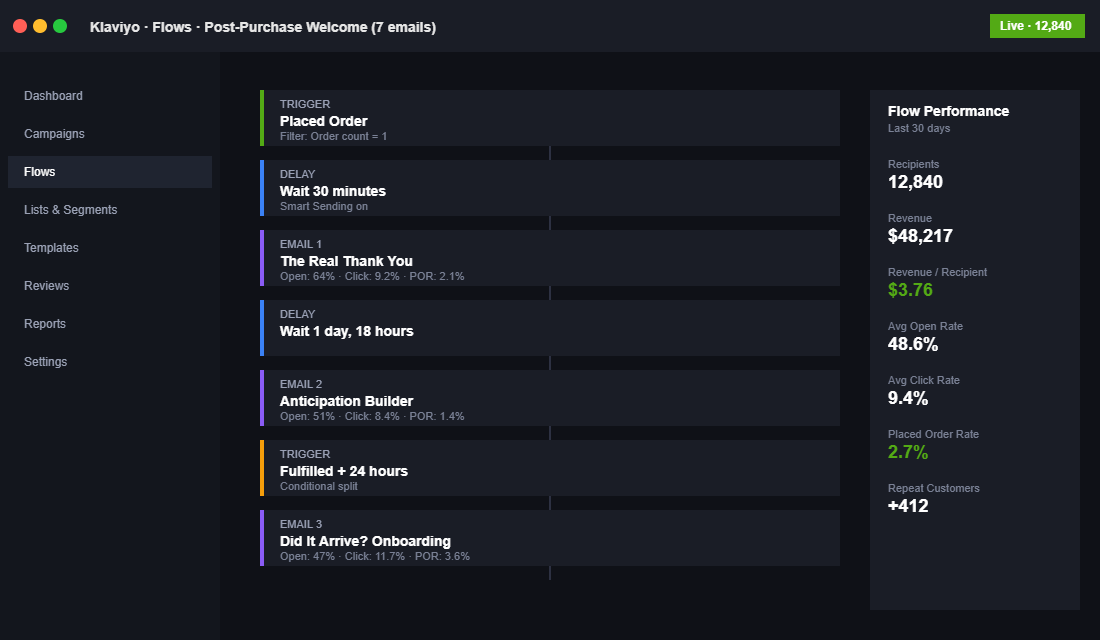
1. Klaviyo (or your existing ESP). The 7-email flow is built natively in Klaviyo’s flow builder. Trigger: “Placed Order” event. Filter out customers who have placed more than one historical order so they do not get the same emails again. If you are on Shopify Email or Mailchimp and want to upgrade, Klaviyo has the Shopify integration that makes RFM segmentation actually work.
2. A reviews app that talks to Klaviyo. Junip, Stamped, Yotpo, or Loox. Pick the one your theme already supports. The integration matters because Email 4 needs to push the review prompt and the post-review follow-up triggers in Klaviyo.
3. A subscribe-and-save app, if you have a consumable. Recharge, Loop, or Skio. This is what closes the loop on Email 6’s replenishment path and locks the customer into the highest-LTV behaviour your store can produce.
Setup checklist for the flow itself:
- Build all 7 emails as templates first, then string them together. Trying to build inside the flow editor is slow.
- Use a “Flow Filter” of “Placed Order Count is exactly 1” so customers only enter once.
- Add a 30-minute delay before Email 1 so it does not race past the order confirmation.
- Add Smart Sending (24 hours) at the flow level so customers do not get hammered if they place two orders in a week.
- Set up SMS branches alongside Emails 1, 4, and 6 if you have an SMS list. Post-purchase SMS gets 90%+ open rates and converts at 2 to 3x email for transactional touchpoints.
Run the flow for 30 days, then audit using the placed-order rate per step. The median across all flows is 1.42%, but post-purchase steps with the right setup should clear 3 to 5%. Anything below 1.5% gets rebuilt or cut.
The Three Numbers That Tell You If the Flow Is Actually Working
A seven-email sequence is only worth building if you measure whether it earns its keep. Most founders look at open rates and stop there. Open rates feel good but don’t pay the bills. Track these three numbers instead, and check them monthly in Klaviyo.
1. Second-order rate (repeat purchase within 90 days). This is the headline metric for the whole flow. A healthy Aussie DTC brand sees 20 to 30% of first-time buyers come back within 90 days; the genuinely good ones push past 30%. If you’re sitting under 15%, your post-purchase experience, not your ad spend, is the thing holding back growth.
2. Flow-attributed revenue. Email should drive 25 to 30% of total revenue for a mature store, and automated flows (not one-off campaigns) should account for roughly half of that. In Klaviyo, look at the revenue your post-purchase and winback flows generate per recipient, not just in total, so a small list doesn’t fool you into thinking the flow is weak.
3. Per-email conversion. Post-purchase emails routinely see 40 to 60% open rates, well above the 25 to 35% you’d expect from a promo blast, because the customer just chose you. Use that attention. If your cross-sell email (Email 5) converts under 1 to 2%, the product recommendation logic is wrong, not the customer. Swap to complementary items based on the first purchase and watch it move.
Don’t trust a single month of data to tell you a change worked. When you tweak timing, an offer, or a subject line, run it as a controlled test using the Shopify A/B testing playbook so you’re reading signal, not noise.
What to Build This Week
Pick the three highest-impact emails and ship them first. For most Aussie stores that is Email 1 (Real Thank You), Email 4 (Review Ask), and Email 6 (Replenishment). Those three alone will shift your repeat rate inside 60 days. Build out the full 7 by week four.
Inside eCommerce Circle, the post-purchase flow is one of the core pillars we work on with every member. If you want a second opinion on yours, let’s talk.