Most Aussie Shopify founders treat EOFY like Black Friday’s quieter cousin. They throw a 20% off banner on the homepage, fire two emails, and watch June revenue limp across the line. Then on July 1 they wonder why the numbers were flat.
What’s in This Article
Meanwhile the smart operators are running a 6-week machine. They pulled in $50K to $200K of extra revenue before June 30, locked in their best-ever AOV month, and walked into the new financial year with a database that grew 25%. Same products. Same store. Completely different result.
Australians are forecast to spend $10.5 billion during EOFY sales this year. 71% of Australians intend to shop the period, up from 38% the year prior. Younger demographics are even more engaged: 82% of Millennials and 81% of Gen Z say they will pull the trigger. June retail spending lifts 2.9% year on year off the back of this single window. If you sell on Shopify and your customers are Aussie, this is the biggest event of your financial calendar after BFCM. And in some niches, it is bigger.
This is the EOFY playbook we run inside eCommerce Circle with hundreds of Aussie Shopify founders. The 6-week timeline, the 5-layer offer stack, the email and SMS cadence, and the B2B angle that most brands forget entirely.
Why EOFY Is the Most Underrated Sales Window in Aussie Ecommerce
EOFY is a different animal from Black Friday or Boxing Day. The buyer intent is sharper. Consumers are working through a “use it or lose it” mindset on bonus money, tax refunds, super contributions and bulk-buy stockpiling. 85% report being more price-conscious than they were five years ago, and 76% say cost-of-living has made them more likely to shop sales events. That is not a casual browser. That is a buyer who has been waiting.
The other thing most operators miss is the B2B layer sitting underneath. Every Aussie small business with under $10M turnover can claim the $20,000 instant asset write-off on eligible assets installed and ready to use by June 30. That means corporate buyers, sole traders, consultants and tradies are all hunting for tax-deductible purchases in the same window. If you sell anything that can be framed as a business expense (office gear, tools, software, training, equipment, vehicle accessories, branded merch) you have a second audience most of your competitors will not even speak to.
The average EOFY consumer spend sits at around $1,450 per shopper. Your job for the next six weeks is to give that spend a clear reason to land in your store rather than in someone else’s cart.
The 6-Week EOFY Campaign Timeline (Map It Out Before You Build It)
The brands that pull forward $50K+ all do the same thing first: they build a campaign timeline before they touch a single email or banner. EOFY is not one sale, it is a system of waves that compound into a much bigger result than any single push.
Here is the timeline we run inside the workshop. Adjust the dates for your launch, but the cadence does not change.
Week -6 to -4 (Late May): Foundation Phase
- Audit your inventory. What is sitting on the shelf? What is moving? Build your hero offers around stock you actually want to clear, not your top sellers (those sell anyway).
- Forecast your numbers. Last year’s June revenue, AOV, conversion rate, units sold. Set a target that is 25 to 40% above that. Without a number you cannot tell if the campaign worked.
- Audit your acquisition flows. Pop-up offer, welcome series, abandoned cart, browse abandonment. Every dollar of paid traffic you push during EOFY hits these flows first. Fix them now, not on June 15.
- Build the landing page. A dedicated /eofy or /eofy-sale page. Hero, offer stack, top 12 to 20 products, urgency element, FAQ. Live and indexed by early June.
Week -3 to -2 (Early June): Tease and Segment
- Tease the sale. One soft email to the full list with a “something big is coming” angle. Build anticipation, not urgency.
- Run an EOFY signup capture. Pop-up swap: “Get 24-hour VIP access to our EOFY sale before everyone else.” This single change can grow your list 15 to 25% in two weeks.
- Segment your list. VIPs (top 10% by spend), recent buyers (last 90 days), lapsed (91 to 365 days), prospects (subscribers who never bought). Each gets a different message.
Week of June 16 to 22: VIP Early Access and Soft Launch
- VIP gets first crack. 24 to 48 hours of “early access” pricing. This protects your best customers from feeling like they get the same deal as a cold prospect.
- Run a flash drop. One product, 24 hours, deeper discount than the main sale. It signals “something is happening”.
- Turn on paid traffic. Meta, Google, TikTok retargeting first, then cold mid-week. Your CPMs spike in late June, so capture demand early.
Week of June 23 to 30: Main Event Crescendo
- Main sale public. Full offer live across the site, banner up, landing page hero updated.
- Daily flash drops. One per day, fresh angle, fresh email. Keeps the list opening.
- Mid-sale anchor. Day 5, a curated “top picks” email. Stops the slump.
- 48-hour and 24-hour warnings. The single highest converting emails of the campaign. Do not skip them.
- Final 4 hours. SMS only, sent at 8pm on June 30. The deepest discount or fastest-shipping promise.
July 1 to 7: After-Party and Reset
- July 1 thank you. Recap, social proof, gentle “missed out?” offer for non-buyers (one week, 10% off).
- VOC survey. One-question survey to buyers: “What made you finally pull the trigger?” Free research for next year.
- Win-back to bargain hunters. Tag everyone who only ever bought during a sale. Build a non-discount nurture sequence to start moving them off discount dependency.
The 5-Layer Offer Architecture (Why 20% Off Site-Wide Is Lazy)
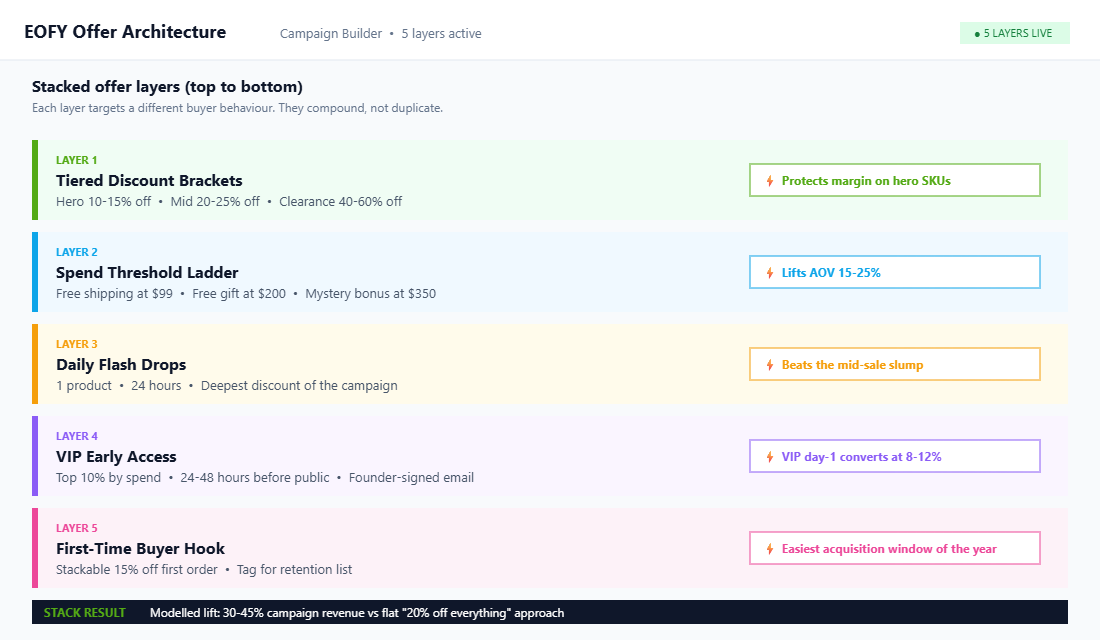
“20% off everything” is the laziest play in ecommerce. It trains your customers to wait for the next sale, it shreds margin on items that did not need a discount, and it gives you nothing to A/B test, retarget, or layer into urgency. The brands that win EOFY build an offer stack with five layers. Each one targets a different buyer behaviour.
Layer 1: Tiered Discount Brackets (Not a Flat Site-Wide)
Split your catalogue into three buckets: hero products (10 to 15% off), mid-tier (20 to 25% off) and clearance (40 to 60% off). Hero products are your best-margin, top-selling items. Clearance is dead stock you want gone. This protects margin while still giving the customer a reason to scroll. Lorna Jane runs this structure: up to 40% off selected styles, layered with an additional 20% on top of select sale items. Cotton On goes deeper at up to 50% on select styles. Both protect full-price hero ranges.
Layer 2: Spend Thresholds (Drive AOV, Not Just Volume)
Build a three-tier spend ladder visible on every PDP, the cart drawer, and a sticky banner. Example: free shipping at $99, free gift at $200, mystery bonus or upgrade at $350. Spend thresholds reliably push AOV up 15 to 25% on top of whatever the discount drives. The reason they work is they reframe the buying decision from “should I buy this?” to “what else should I add to hit the next reward?”
Layer 3: Daily Flash Drops (Solve the Mid-Sale Slump)
Every multi-day sale has a slump on day 3 to 5. Daily flash drops fix it. One product, 24 hours, a deeper discount than the rest of the sale. Stack the calendar with hero SKUs your audience already wants. Email goes out at 7am with the flash, expires at 11.59pm, replaced the next morning. Klaviyo flow automates the whole sequence. You get a fresh reason to email and a fresh reason for customers to keep checking back.
Layer 4: VIP Early Access (Protect Your Best Customers)
Your top 10% of customers should never feel like they got the same offer as a cold prospect. Give VIPs 24 to 48 hours before the public launch. Frame it as a “thank you”, not a privilege. This builds loyalty equity for the entire next year and front-loads your campaign revenue (sale-day-one is typically your highest day, and now it lands on a list that already converts at 8 to 12% vs 1 to 2% cold).
Layer 5: First-Time Buyer Hook
EOFY is the easiest customer acquisition window of the year. A separate “first order 15% off” code (stackable or substitutable with the main offer) turns prospects sitting in your welcome sequence into buyers. Tag every customer acquired in this window. They are your retention list for the next 12 months.
The Email and SMS Sequence That Does 60% of the Heavy Lifting
Across hundreds of EOFY campaigns we have audited inside eCommerce Circle, email and SMS reliably deliver 50 to 65% of total campaign revenue. The brands that under-perform send four or five emails total and call it a day. The brands that over-perform send 12 to 15 across the campaign with a tight cadence and clear segmentation.
Here is the 10-email, 4-SMS sequence we use inside the workshop. Steal it.
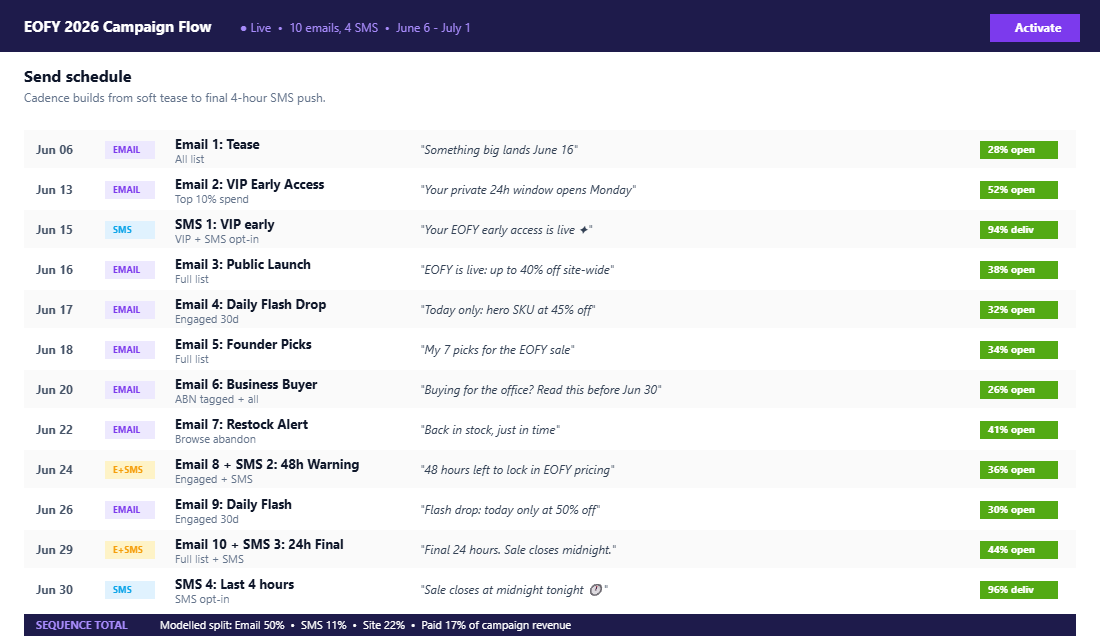
- Email 1 (Day -10): Tease. “Something big is coming on June 16.” Subject line teases curiosity, not the discount.
- Email 2 (Day -3): VIP Early Access Invite. Only to your top spenders. “Your private 24-hour window opens Monday.”
- Email 3 (Day 1): Public Launch. Full offer reveal. Hero image, top 6 products, clear CTA. This is the highest-revenue email of the campaign.
- Email 4 (Day 2): Daily Flash Drop. One product, 24 hours, deeper discount.
- Email 5 (Day 3): Top Picks Curated. Founder’s choice, 5 to 7 items, social proof per product.
- Email 6 (Day 5): The Business Buyer Angle. Tax-deductible framing, instant asset write-off mention, gift-card option for B2B clients.
- Email 7 (Day 7): Restock Alert. “Back in stock just in time for EOFY.” Even one product restocked counts.
- Email 8 (Day 9): 48-Hour Warning. Urgency, scarcity, fresh subject line. “Two days left.”
- Email 9 (Day 10): 24-Hour Final Call. Single hero offer, deepest urgency.
- Email 10 (Day 11): Last 4 Hours. Plain text, founder voice, “Sale closes at midnight.”
SMS sits on top. Four messages maximum: VIP early access alert (Day -1), public launch (Day 1, late afternoon), 48-hour warning (Day 9 morning), final 4 hours (Day 11, 8pm). SMS converts at 4 to 8x the rate of email on the final-call sends, but only if you have not burnt the channel earlier in the year.
The B2B Tax-Time Angle Most Brands Miss Completely
This is the lever almost nobody pulls. The $20,000 instant asset write-off means any Aussie small business buying eligible assets before June 30 can claim the full deduction immediately. If your products can be reframed as business expenses (office gear, equipment, tools, software, training, vehicle accessories, branded apparel for staff, end-of-year gifting) you have a buyer with a deadline. That is the cleanest selling environment on the calendar.
How to layer this in without making it weird for your B2C audience:
- Send a dedicated “for business” email. One send, mid-campaign, to your full list. Headline: “Buying for the office before June 30? Here is your tax-deductible shortlist.” Even if 90% of the list is B2C, the 10% who own a small business will convert hard.
- Build a /eofy-business landing page. Bulk pricing, ABN field at checkout, gift card option, fast invoicing. Index it on Google for “EOFY [your category] tax deductible”.
- Highlight the asset write-off threshold. A small banner: “Assets under $20,000 may be instantly deductible. Speak to your accountant.” This single line of microcopy doubles the perceived value of every purchase.
- Reach out to existing business buyers. Anyone who has bought with an ABN in the last 12 months. Direct email from the founder, 48 hours before the public sale. This is your highest-conversion message of the campaign.
This audience is also less price-sensitive than retail. They care about deadline, deductibility and invoice convenience. Lean into all three.
The On-Site Conversion Stack (What Lives on Your Store During the Sale)
Email gets them to the site. The on-site experience decides if they buy. During EOFY your store should look meaningfully different from the rest of the year. If a returning visitor cannot tell within 2 seconds that something is on, you have failed the basic conversion test.
- Site-wide countdown banner. Top of every page, shows time remaining to sale close. Test red vs brand colour. Red usually wins for urgency.
- Hero swap on homepage. Do not bury the sale. Hero image, sale headline, primary CTA “Shop the EOFY sale”.
- Dedicated /eofy landing page. The page your emails, ads and banner all point to. Top 12 to 20 hero products, spend threshold visualised, FAQ, social proof.
- PDP urgency widget. “Only 4 left at this price” or “EOFY price ends June 30 at midnight”. Klaviyo or Tydal or built-in Shopify metafields.
- Cart drawer reinforcement. Spend threshold progress bar, free gift display, upsell carousel. EOFY traffic converts 20 to 35% better with a properly built cart drawer.
- Exit-intent pop-up. For non-buyers, fire a “wait, here is an extra 5% if you commit now” or an SMS opt-in for a flash code.
If you want a deeper read on the cart drawer side, we have already covered it in detail in our Shopify Cart Drawer Optimisation framework. Pair that with the 7-point checkout audit and you have the conversion stack sorted before June 16.
The Numbers You Track (or You Cannot Improve It Next Year)
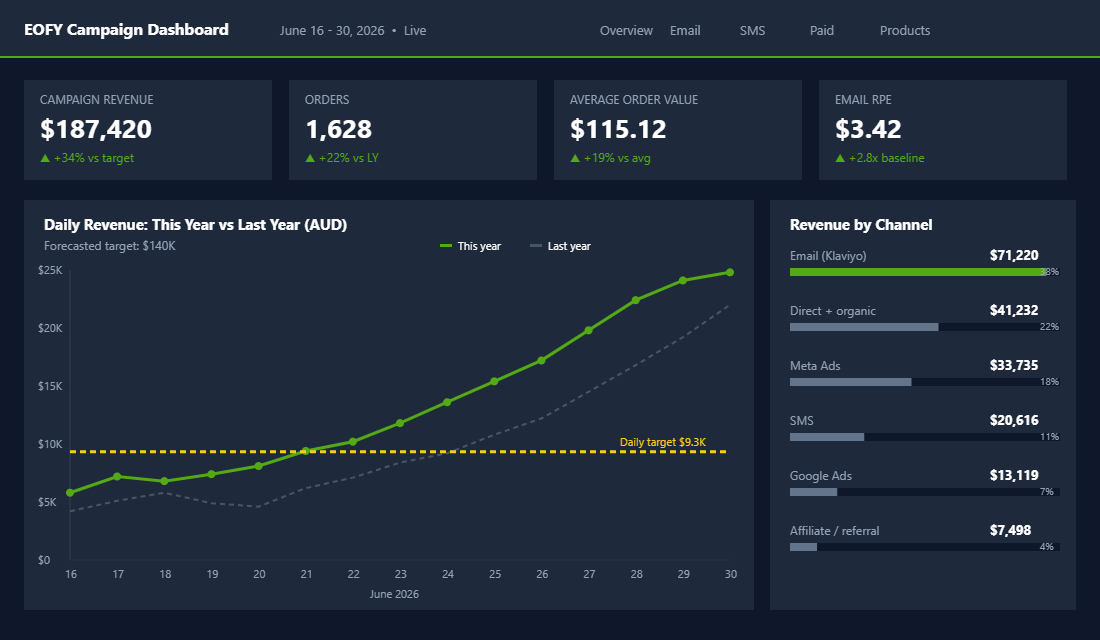
If you do not measure this campaign, you cannot run it 30% bigger next year. Build a simple EOFY dashboard before launch and update it daily. The metrics that matter:
- Daily revenue and orders. Compared to last year’s same date and your in-campaign target.
- AOV vs benchmark. EOFY should lift your AOV 15 to 25% above non-sale months thanks to the spend threshold structure.
- Conversion rate by channel. Email and SMS will convert at 4 to 8x cold paid. If they do not, your flows are broken.
- New vs returning revenue split. If new customer revenue is over 60%, your retention engine is leaking. If returning is over 80%, your acquisition layer needs work for next campaign.
- List growth. Track net new subscribers in the campaign window. Healthy benchmark is 15 to 25% list lift over six weeks.
- Email revenue per send (RPE). Klaviyo gives this natively. Compare each EOFY send to your year-to-date average. The good ones should be 2 to 4x.
- Return rate (July). EOFY returns spike around 27.6% in July compared to non-campaign months. Factor it into your net revenue calculation, not just gross.
Save the dashboard. In Week -6 of next year’s campaign you open it, set your target at 25 to 40% above this year, and you have a starting point.
The Compound Effect: Why These Layers Work Together
Any one of these layers will lift EOFY revenue. The compound effect is what separates a $50K bump from a $200K one.
Imagine the math. List grows 20% during the tease window because the pop-up swapped to an EOFY VIP capture. That same list segments cleanly into VIP, recent, lapsed and prospect, so each one gets the right offer. Day 1 is your biggest revenue day because VIPs hit a 10% conversion rate. Spend thresholds push AOV from $95 to $124 (a 30% lift). Daily flash drops keep open rates above 35% across the campaign rather than dropping to 12% by day 5. The B2B email adds a 15% revenue tail nobody else captured. The 48-hour and 24-hour warnings convert at 3 to 4% (vs the 0.8% campaign average). The final 4-hour SMS adds another 6 to 8% of campaign revenue in one push.
Stack those compounding lifts and a brand that did $120K in June last year is suddenly doing $180K to $220K this year. Same products. Same audience. Different system.
And the cleanest part: every win is repeatable. Save the timeline, save the emails, save the offer architecture, save the dashboard. Next year you start at 80% built. The brands that compound 30 to 50% growth on EOFY every year are not getting smarter. They are just running a system.
Your EOFY Pre-Flight Checklist
Run through this in the next 14 days. Anything not ticked, fix it before June 1.
- Revenue target set (25 to 40% above last June)
- Inventory audit complete (heroes, mid, clearance buckets defined)
- /eofy landing page built and indexed
- 5-layer offer architecture mapped (discount tiers, spend ladder, flash drops, VIP access, first-buyer hook)
- 10-email and 4-SMS sequence drafted in Klaviyo (or your ESP)
- VIP segment created (top 10% by 12-month spend)
- Pop-up swapped to EOFY VIP capture by June 1
- Site-wide countdown banner ready (paused until June 16)
- Cart drawer and checkout audited (use our cart drawer and checkout frameworks)
- B2B/ABN page or email drafted
- EOFY revenue dashboard built (daily revenue, AOV, RPE, list growth)
- July 1 thank-you and win-back email queued
You have six weeks. The brands that treat EOFY like a system and not a 3-day banner will look back at a record June. Pair this with our 90-day Shopify growth sprint framework and you have an entire Q4 mapped out before you finish reading this.
Inside eCommerce Circle, the EOFY playbook is one of the core sprints we run with every member through May and June. If you want a second set of eyes on yours before launch, let’s talk.