Most Aussie Shopify founders treat discounting like a volume knob. Sales feel slow, they reach for 20% off. Cash flow gets tight, they fire up a flash sale. The store survives the month and the founder convinces themselves the promotion “worked”.
What’s in This Article
It did not work. Not in any way that matters. Revenue lifted, contribution margin halved, and the next month started with a customer base that has now been trained to wait for the next sale before they buy. That is not a promotion. That is a slow leak.
The data backs this up. Aampe’s discount research found that 15% off drove the strongest conversion lift versus control, while deeper discounts like 30 and 40% generated weaker incremental revenue per visitor. Yet 50% off remains the single most common discount amount used by major retailers. The instinct to go deeper is almost always wrong.
The brands we work with inside eCommerce Circle who run the most profitable promotional calendars are not the ones with the deepest discounts. They are the ones with the most discipline. They have a documented architecture for how and when to discount, what the math has to look like before a promotion goes live, and a hard line they will not cross even when revenue is soft.
This is the five-tier framework we walk them through. It is not theory. It is the same playbook that has helped hundreds of Aussie Shopify founders run promotional calendars that lift revenue 30% year-on-year without watching contribution margin collapse with every sale.
The Math You Have to Do Before Any Sale (And Why Most Founders Skip It)
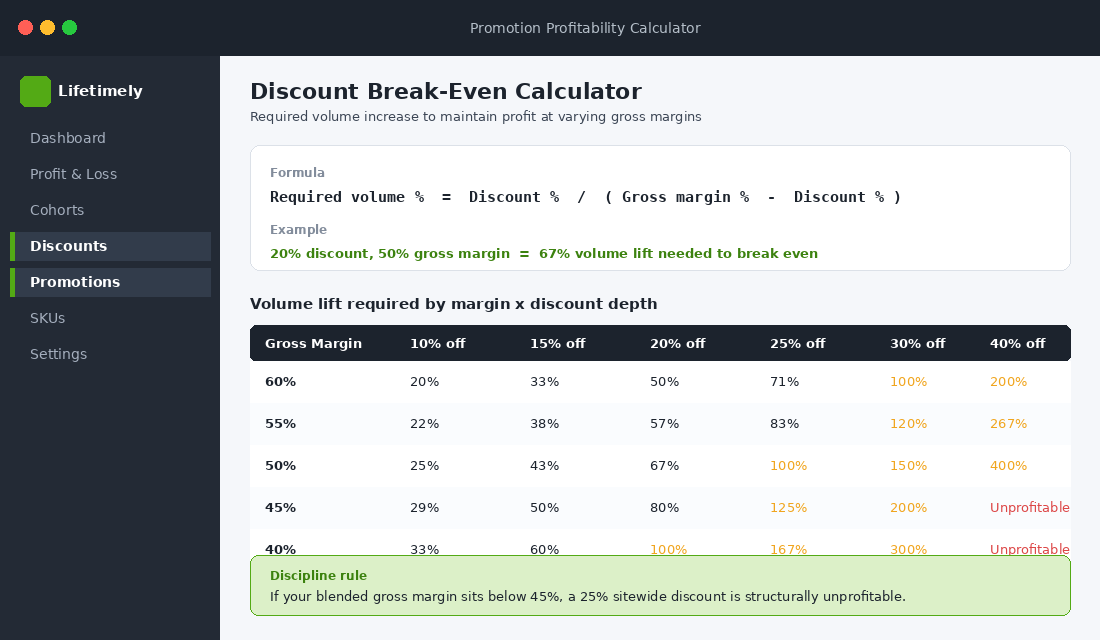
There is one formula you need to write down before you ever touch a discount code generator. It is the break-even volume formula, and it tells you how much extra revenue a promotion has to generate just to stand still on profit.
Required volume increase = Discount % ÷ (Gross margin % – Discount %)
Run that on your own store right now. If your gross margin is 60% and you run a 20% sitewide discount, you need a 50% volume increase just to break even on profit. If your margin is 50% and you discount 25%, you need a 100% volume increase. If your margin is 45% and you discount 30%, you need a 200% volume increase before your store makes the same profit it would have at full price.
Most Aussie DTC brands run 20 to 30% sitewide discounts during BFCM and never come close to those volume requirements. They book a revenue record and a profit decline in the same week. That is the trap.
Healthy contribution margins in DTC ecommerce sit between 15 and 30% after all variable costs. Below 10% signals a structural problem. A poorly designed 30% off promotion can punch a hole straight through that floor for the entire promotional window, and the recovery can take months. This is why discount discipline matters more than any other lever in your Profit P. We covered the full diagnostic in The Shopify Contribution Margin Audit, and discount architecture is the single biggest pattern we see destroying margin in audits.
Tier 1: Full Price (The Foundation Most Brands Erode by Accident)
The foundation of the discount discipline framework is the share of your revenue that comes in at full price. Not at “intro offer” pricing. Not at “free shipping over $100” pricing. Full margin, full price, no asterisk.
The benchmark we use with Connect members is at least 60% of annual revenue from full price or lightly discounted purchases with contribution margin above 50%. Below 60%, you are running a perpetual sale and your customers know it. Bondi Born sits at the premium end of this benchmark. The brand rarely discounts more than twice a year, and when it does, the offers are short, targeted, and never sitewide. The result is a customer base that buys at $300 to $600 price points without flinching.
To protect Tier 1, you need three things.
- A documented MAP (Minimum Advertised Price) policy. Even for your own store. Decide what your floor price is for each SKU and write it down. Every discount decision is measured against that floor.
- Discount-free hero windows. The four weeks after a product launch should be full-price only. Train customers that new gets premium pricing. Frank Body still does this with every product drop and it is part of why their AOV holds.
- A friction-free full-price experience. If your checkout has a “Got a discount code?” field at the top, you are flagging to every customer that the right thing to do is search for one. Move that field down, collapse it, or remove it. Studies consistently show this lifts non-discounted conversion by 5 to 8%.
Tier 1 is the tier you defend. The other four tiers exist to maximise revenue without cannibalising it.
Tier 2: Soft Offers (The Discount That Does Not Look Like a Discount)
Soft offers are the most underused tool in the Aussie DTC kit. These are promotions where the customer perceives value without you eroding the price of your product. The economics are dramatically better than a percentage discount.
Free shipping is the cleanest example. Customers perceive free shipping as 15 to 20% more valuable than the equivalent dollar amount taken off the order, and it typically outperforms an equivalent percentage discount by 10 to 15% in conversion lift. Yet the cost to you is fixed and known: the shipping you would have charged. If your average shipping cost on a $120 order is $12, you have given away 10% of perceived value at a 10% cost, but you have not touched the price of the product. That is a much healthier trade than a 10% sitewide discount.
The four soft offer plays we use most often:
- Threshold free shipping. Free shipping over a number that sits 15 to 25% above your current AOV. Aussie brand Who Gives A Crap built a multi-million dollar subscription business partly on the back of free shipping over $35 mechanics that nudge first-time buyers into bigger boxes.
- Gift with purchase (GWP). A low-COGS, high-perceived-value freebie at a spend threshold. Skincare brands like Frank Body do this brilliantly with travel-size add-ons that cost them $2 to $4 and feel like a $20 gift to the customer.
- Bundle pricing. Sell a curated three or four-item set at a price that is 10% off the sum but increases AOV by 200 to 300%. We covered the full architecture in Shopify Product Bundles. Bundles lift AOV without the perception that the brand is “on sale”.
- Loyalty points multipliers. Double or triple points for a 48-hour window. Customers feel rewarded, the cost is deferred to a future redemption, and the average redemption rate sits at 13 to 20% so a chunk of the offer is never actually claimed.
If you are running soft offers well, they should cover at least four of the twelve months in your promotional calendar. They are your default promotional tool, not your tactical one.
Tier 3: Tactical Discounts (Segment-Targeted, Time-Bound, Surgical)
Tier 3 is where percentage discounts finally show up, but only under three strict conditions. They are segment-targeted. They are time-bound. They are tied to a specific business outcome you can measure. If a discount fails any of those three tests, it does not run.
This is where RFM segmentation does its real work. The typical Shopify store finds that 10 to 15% of customers classified as Champions generate 35 to 45% of total revenue. Champions do not need a discount. They will buy at full price and a discount sent to them is value handed back for no incremental reason. Campaigns using RFM segmentation yield up to a 77% boost in ROI compared to one-size-fits-all promotions, which is exactly the point.
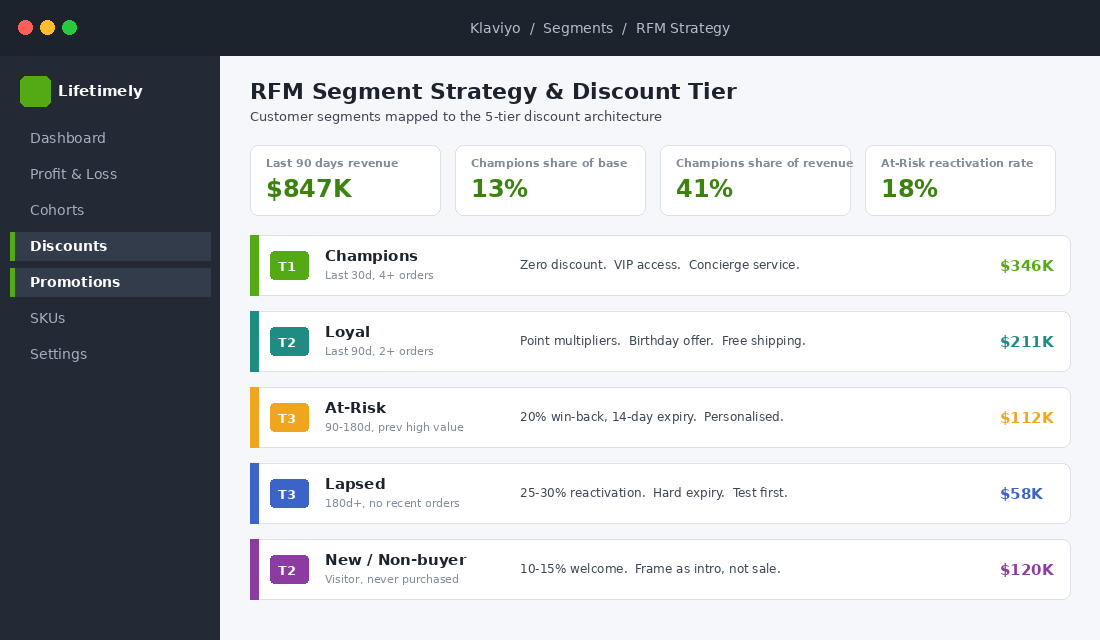
Here is the segmentation map we use with Connect members:
- Champions (last 30 days, high frequency, high monetary). Zero discount. Early access to new launches. VIP-only collection drops. Concierge service. The mistake is sending them BFCM emails. They were going to buy anyway.
- Loyal customers (last 90 days, multiple orders). 10% point multipliers on loyalty programs. Birthday or anniversary offers. Free shipping below threshold. Soft offers, never deep cuts.
- At-Risk (90 to 180 days since last order, previously high value). The 20% win-back offer with a 14-day expiry. This segment converts at 10 to 15% with a well-timed offer. This is the most profitable use of a percentage discount in your entire calendar.
- Lapsed (180+ days, ghost customers). The 25 to 30% reactivation offer with a hard expiry. Test before scaling. Many of these customers will not return regardless of the offer, but the cost of finding the ones who will is lower than acquiring a new customer.
- New visitors / non-buyers. First-purchase offer at 10 to 15% off, framed as a welcome rather than a discount. This is your acquisition tool, not your promotional tool.
Every Tier 3 discount runs to a single segment, with a unique code, with an expiry, with a measured outcome. You should be able to tell me at the end of any campaign exactly which segment took the offer, what the contribution margin was on that segment’s revenue, and whether the campaign hit its target. If you cannot, you ran a Tier 4 sitewide promotion with a Tier 3 label.
Tier 4: Sitewide Promotions (Twice a Year, Maximum)
Sitewide promotions are the nuclear option in the discount discipline framework. Used twice a year, they create urgency, drive new customer acquisition at scale, and clear inventory. Used six times a year, they destroy your full-price economics permanently.
The hard rules for Tier 4:
- Maximum two sitewide events per year. BFCM is one. Choose carefully for the second. End of financial year (June 30 in Australia), Easter, Mother’s Day, or a brand-specific event like an anniversary sale.
- Maximum 25% sitewide discount. Deeper discounts on selected items are fine, but the headline rate that sits on the homepage banner does not go above 25%. The Shopify BFCM data shows the most common discount tier is 20% (used by 31% of stores), 30% (24%), 25% (18%), and only 8% of stores offer 40%+. The deepest discounters are not the highest performers. They are the ones who got addicted.
- Blended gross margin floor of 45%. Across the entire promotion window, your blended gross margin cannot drop below 45%. If your pre-promotion margin is 55%, a 25% sitewide cut is on the edge of acceptable. If your margin is 45%, you cannot run 25% sitewide without losing money. This is a hard line, not a guideline.
- At least 60% of revenue from non-discounted SKUs. Hero SKUs and new launches stay at full price during the event. Customers shopping the sale will still convert on full-price items if the assortment is right.
Aussie brand Aje is a masterclass in Tier 4 discipline. The label runs two big promotional windows a year. BFCM and end of season. The headline discount is rarely above 30%, and the brand uses tier 4 events to clear specific collections, not to discount the whole catalogue. New seasons stay at full price the entire time. Customers who want the new collection pay full price. Customers chasing a deal pick from last season. Both transactions are profitable.
Tier 5: Clearance (Controlled, SKU-Level, Margin Recovery Only)
Tier 5 is the SKU-level clearance tier. Discontinued products, end-of-season inventory, slow movers eating up cash flow. The goal is not revenue growth. The goal is to convert dead stock into working capital you can deploy back into the hero SKUs.
The economics of Tier 5 are different to every other tier. You are not optimising for contribution margin. You are optimising for cash recovery. A $40 product with a $15 COGS sitting in a warehouse is not earning anything. Selling it at 50% off ($20) still recovers $5 of contribution margin and clears the bin location for inventory that turns. The alternative is writing it off entirely.
The structure that works:
- A dedicated “outlet” or “last chance” collection page. Discounted SKUs live here. The rest of the catalogue is full price.
- No homepage promotion. Tier 5 is for customers who go looking. It does not interrupt the full-price shopping journey.
- Inventory rules. An SKU enters Tier 5 only if it has sat below its target sell-through rate for 90+ days, or if it is being discontinued, or if it is a seasonal product within 30 days of the season ending.
- Hard exit. A Tier 5 SKU has a maximum lifetime of 60 days in the outlet. After that it goes to wholesale, donation, or write-off. The outlet is not a permanent home.
Done well, Tier 5 should be 5 to 8% of annual revenue. Done poorly, it bleeds into Tier 1 by undercutting your own full-price SKUs and training customers to wait for the next clearance email.
The Annual Promotional Cadence (What This Looks Like on a Calendar)
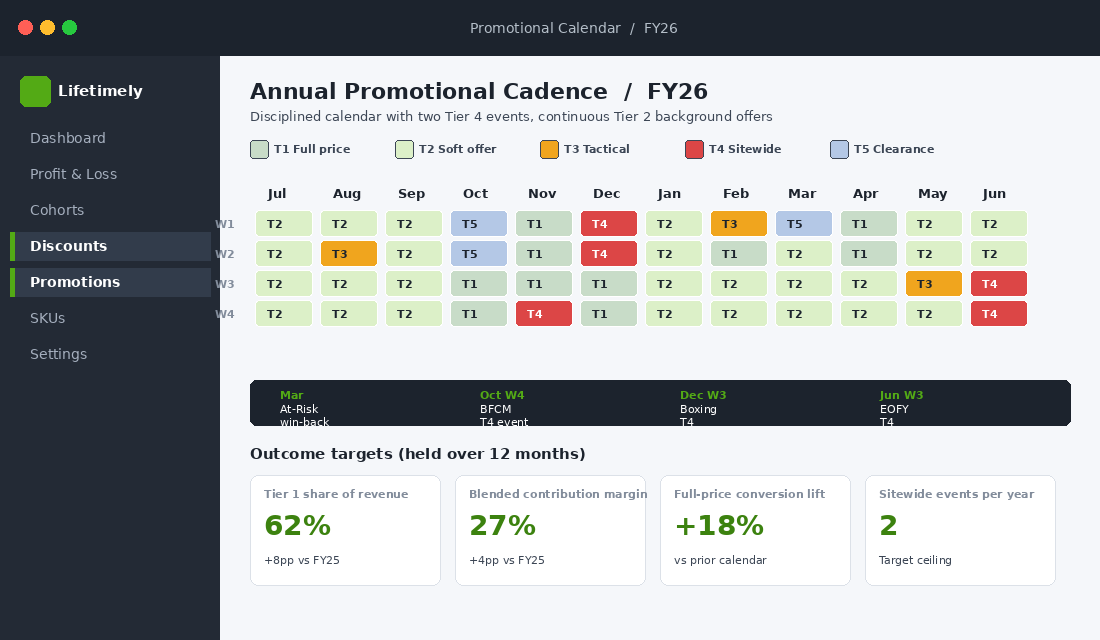
If you assemble the five tiers correctly, your annual promotional calendar has rhythm. There is a default state (Tier 1 plus Tier 2 background offers), tactical campaigns running on Tier 3, two major Tier 4 events, and continuous Tier 5 outlet management. The calendar is intentional rather than reactive.
Here is the cadence we set with the average $1m to $5m Shopify brand we work with:
- January to March. Tier 1 plus Tier 2. Free shipping threshold lift, loyalty points double in January, new launches at full price. One Tier 3 win-back campaign in February to recover December purchasers who have not returned.
- April to June. Easter Tier 4 event for fashion or gift verticals (cap at 20% sitewide). Mother’s Day Tier 3 campaign with bundles. End of financial year Tier 4 for high-AOV verticals only. Otherwise Tier 1 plus bundle promotions.
- July to September. Tier 1 plus Tier 2. New season launches at full price. One Tier 3 At-Risk win-back in August. Begin BFCM inventory planning. We mapped the full operational playbook in The Shopify BFCM Inventory Planning Playbook.
- October to December. BFCM Tier 4 event (cap at 25%, four-day window, full SKU discount strategy mapped). Boxing Day Tier 4 event if relevant to the vertical. Tier 3 nurture campaigns to convert BFCM acquirers to repeat customers in December.
The Three Numbers You Track Before, During, and After Every Promotion
Discipline only works if you can measure it. Most founders measure revenue uplift and call it a day. That is the lie that lets bad discounting persist. You need three numbers tracked on every promotion, every time, no exceptions.
- Net Revenue Per Visitor (NRPV). Total revenue minus discount cost, divided by total visitors. If NRPV during your promotion is lower than your pre-promotion baseline, the campaign destroyed value even if revenue spiked. This is the single most important metric on any sale.
- Blended Contribution Margin. Total revenue minus all variable costs (COGS, shipping, payment processing, discount cost, returns) as a percentage of revenue. The promotion window blended CM must stay above the 45% floor for sitewide events, and ideally only drop 3 to 5 percentage points below your monthly baseline.
- Full-Price Cannibalisation Rate. The percentage of promotion-window orders that were placed by customers who had purchased at full price in the previous 60 days. If this number is above 20%, you are giving away margin to customers who would have paid full price anyway. Adjust segmentation immediately.
The tool we recommend for tracking this without burning a finance team’s time on it is Lifetimely (now part of Shopify’s analytics ecosystem) or TrueProfit. Both pull live COGS, shipping costs, payment processing, and ad spend into a single dashboard so you can see contribution margin during a sale, not three weeks after the close. Setup is a 30-minute job: connect the COGS feed, connect Klaviyo, connect Meta and Google ad accounts, set your variable cost rules. Once it is in place, you can see whether a promotion is creating value or destroying it within four hours of launch.
The brands that hold this discipline are not the ones with the largest finance teams. They are the ones who instrument these three numbers before they ever launch a campaign and refuse to celebrate revenue without checking margin first. We dig deeper into the measurement layer in CAC Payback Period for Shopify, which sits alongside this framework as the financial discipline layer of the More Orders Operating System.
The Compound Effect: What Twelve Months of Discipline Looks Like
Here is what changes when you actually run this framework for a full year. Three things shift, and they compound.
The first shift is customer behaviour. When customers know your brand only discounts twice a year, they stop waiting. They buy when they want the product. Full-price conversion rate lifts 15 to 25% over a 12-month window because the option of “waiting for the sale” is no longer rational. That is the single biggest lever in your entire growth equation, and it costs nothing except saying no to a discount in March.
The second shift is margin compounding. When your contribution margin stops getting crushed every six weeks, you have more cash to reinvest. More cash to reinvest means more ad spend at a healthy CAC, which means more new customers, which means more LTV, which means more cash again. A 5 percentage point lift in annual blended CM on a $2m/yr store is $100K in retained profit. That money funds your next product launch, your next hire, or your next round of inventory without touching debt.
The third shift is brand equity. Brands that discount constantly trade short-term cash flow for long-term brand erosion. Brands that discount with discipline preserve premium positioning, which protects price elasticity, which protects margin. Aje, Bondi Born, and Who Gives A Crap are all proof points. None of them are the cheapest in their category and none of them need to be. Their customers buy them because the brand has held its price line.
Inside eCommerce Circle, the discount architecture is one of the first conversations we have with new members because the upside is so high and the cost of changing is so low. You do not need new tools, new traffic, or new products. You need a documented framework and the discipline to hold it when revenue feels soft. The brands that hold it through one full year almost never go back.
The Leak Problem: Why Your Tier 3 Discount Ends Up on Every Coupon Site
You build a beautiful segmented campaign. Fifteen per cent, at-risk customers only, seven days. Then someone pastes the code into OzBargain and by Tuesday it is sitting in Honey, Cashrewards and three browser extensions that auto-apply at checkout.
Now every full-price customer gets your win-back discount. Your Tier 1 foundation just became Tier 3 by accident, which is exactly the erosion the five-tier architecture exists to prevent.
This is not rare. On most Aussie DTC stores, 20 to 40 per cent of redemptions on a public alphanumeric code come from customers who were already going to buy at full price. You did not win an order. You bought back margin you already had.
Four fixes, all of them cheap:
- Unique codes, never shared codes. Klaviyo, Omnisend and Shopify Flow all generate one-time codes per recipient. A leaked code that works once is not a leak.
- Kill the guessable pattern. WELCOME10, SAVE15 and SPRING20 get brute-forced by extensions. Use a random string.
- Set customer eligibility on the code itself, not just in the email. Shopify lets you restrict a discount to a specific customer segment. If the code only fires for the at-risk segment, the coupon site listing is dead on arrival.
- Cap total redemptions at roughly 120 per cent of the segment size. If 400 people got the email and 900 people redeemed, you have your answer.
Run a leak check the Monday after every Tier 3 campaign. Search your brand name plus “discount code” and see what comes back. If your codes keep escaping, the discount code leak defence playbook covers the full containment system.
How to Prove a Promotion Was Incremental (The 10% Holdout)
Every promotion looks like it worked. Revenue went up during the sale, so the sale caused the revenue. That is the reasoning behind most discount calendars, and it is wrong often enough to cost real money.
The test is a holdout. Before you send, randomly withhold 10 per cent of the target segment. They get no email, no SMS, no code. Everything else stays the same.
Then compare revenue per recipient across both groups over the promotion window plus seven days. The seven-day tail matters, because a discount often pulls forward a purchase that was coming anyway.
Worked example. You email 6,000 at-risk customers with a 15 per cent code, holding back 600.
- Treated group: $4.10 revenue per recipient
- Holdout group: $2.60 revenue per recipient
- Incremental lift: $1.50 per recipient, or roughly $8,100 across the 5,400 treated
- Discount cost at 15 per cent on $22,140 of treated revenue: about $3,320
- Net: clearly worth running again
Flip the numbers so the holdout does $3.80 and the treated does $4.10, and you just paid $3,320 to move $1,600 of revenue you already had. That campaign gets cut, not repeated.
Two rules keep this honest. You need at least 300 to 500 people in the holdout for the result to mean anything, and you only need to run the test once or twice a year per campaign type, not every send. Klaviyo handles the split natively; a random 10 per cent slice of the segment does the job in any ESP.
Do this on your three biggest recurring campaigns and you will usually find one that has been quietly subsidising customers who never needed the discount. That single deletion is often worth more than the next promotion you were about to design. It is the same discipline behind the discount dependency audit, and it pairs directly with the margin work in the pricing power playbook.
The 30-Day Implementation Checklist
If you want to put this framework into practice this month, here is the sequence we run with Connect members:
- Week 1. Run the break-even math on your last three promotions. Calculate required volume increase, actual volume increase, and net contribution margin impact. Most founders are shocked by what they find. Document the gap.
- Week 2. Install Lifetimely or TrueProfit. Connect COGS, shipping, payment processing, and ad spend. Establish your baseline NRPV and blended CM for the previous 90 days. This is your control.
- Week 3. Build your annual promotional calendar using the five tiers. Maximum two Tier 4 events. Three to six Tier 3 segmented campaigns. Continuous Tier 2. Lock the calendar with a written rationale for every promotion.
- Week 4. Set up RFM segmentation in Klaviyo (or your ESP equivalent). Build five flows: Champion VIP, Loyal nurture, At-Risk win-back, Lapsed reactivation, New welcome. Assign discount tiers to each segment. Test the at-risk win-back flow first because it pays for the entire setup.
Inside eCommerce Circle, the discount discipline framework is one of the core pillars of the Profit P inside the 10 P Operating System. If you want a second opinion on whether your current promotional calendar is building profit or quietly draining it, let’s talk.