Every Aussie Shopify founder running subscriptions has the same hidden leak. It is not the ads. It is not the product. It is the seventeen seconds between a subscriber clicking “Cancel” and the system processing it. That window is where a quarter to nearly half of your churn either gets recovered or walks out the door forever.
What’s in This Article
Most subscription stores treat the cancel button as a button. Click it, you are gone. The good ones treat it as a conversation. The best ones treat it as a multi-step interception system with reason capture, personalised save offers, pause and skip alternatives, and a clean hand-off to win-back if the cancel still goes through. The performance gap between those three approaches is enormous. A bare cancel flow saves 0%. A basic flow saves 10 to 15%. An advanced, reason-matched flow with escalating offers saves 35 to 40% of every subscriber who clicked cancel.
If your store does $30k MRR in recurring revenue and you go from a 0% save rate to a 30% save rate, that is roughly $9k of monthly revenue you would otherwise have to replace with new acquisition. At a $40 CAC, you just avoided buying 225 new customers a month. This is the highest-impact retention work most subscription brands never do. Here is the seven-step system we run with our subscription members inside eCommerce Circle.
Why the Cancel Button Decides Your Subscription CLV
Subscription churn benchmarks for Aussie DTC look like this. Health and wellness sits at 8 to 12% monthly. Beauty and personal care sits at 8 to 14%. Food and beverage replenishment is the worst, at 12 to 18%. General merchandise subscription boxes sit at 10 to 15%. Best-in-class brands across all categories sit at 3 to 4% monthly churn. The difference between average and best-in-class is not magic. It is mostly the save flow.
About 44% of all subscription cancellations happen inside the first 90 days, which means the bulk of your churn is preventable habit-formation failure rather than long-term dissatisfaction. And 60 to 75% of total churn is voluntary, meaning the customer made a conscious choice to leave. That conscious choice is where the save flow lives. Involuntary churn (failed payments) needs its own system, which we will cover in another piece.
One Aussie brand that has built a serious moat here is Who Gives A Crap. They grew their subscription program 250% over two years, and a chunk of that came from rebuilding the customer portal to let subscribers skip or delay shipments without contacting support. Their localised notification stream now sees 75% open rates because the messaging is timed to Aussie delivery windows. When your save flow respects how your subscriber actually lives, they reach for the cancel button less often in the first place.
Step 1: Stop the Brick Wall (Frame the Cancel as a Conversation)
The first page of a great save flow is not an offer. It is a benefit reminder. Before you ask why the subscriber wants to leave, you remind them what they signed up for. This is not a hard sell. It is a “here is what you would be giving up” page with three or four specific, customer-history-driven facts.
For a coffee subscription, page one shows the customer their savings versus retail (you have saved $147 over 8 deliveries), their favourite roast they discovered through the box, their loyalty point balance, and the next bonus they would earn at the next milestone. For a skincare subscription, it shows them the streak (you are 4 months into the routine that takes 90 days to show full results) and the free product they get on the next anniversary delivery.
Three rules for page one:
- Use real numbers from their account. Generic copy gets skipped. “You have saved $147” stops the click.
- Include a forward-looking moment. Loyalty milestones, anniversary gifts, or a product launch they would miss. Loss aversion is louder than a discount.
- Limit it to one screen on mobile. If they have to scroll, you have lost them. One headline, three bullets, two buttons.
The two buttons matter. The primary button is “Keep my subscription”. The secondary is “Continue to cancel”. Not “Cancel anyway”, which feels combative. The secondary button stays visible. Hiding the cancel option is the fastest way to get a chargeback or a one-star review.
Step 2: Build a Reason Survey That Actually Captures Truth
If they click through page one, page two is the reason survey. This is the single most undervalued data set inside a subscription business. Every cancel reason is a free signal about your product, your pricing, your delivery cadence, or your category fit. Most brands either skip the survey entirely or stuff it with six bland options (“too expensive”, “no longer need”, “other”). Neither produces useful data.
The reason survey needs to be tailored to your category. For replenishment subscriptions (coffee, supplements, toilet paper), the likely reasons are: I have too much already, I want a different product, the delivery is too frequent, the delivery is not frequent enough, the price went up, or I am switching brands. For curation subscriptions (snack boxes, beauty samples), the reasons skew differently: the curation does not feel personalised, I have already tried what I wanted to try, I am cutting discretionary spend.
Build the survey with these rules:
- Six to eight reasons maximum. More than that and people pick “other” out of fatigue.
- Make the reasons mutually exclusive. “Too expensive” and “value not high enough” are the same thing dressed differently. Pick one.
- Reasons drive different downstream offers. If you cannot map a different save offer to each reason, the reason is not granular enough.
- Always include a free-text “anything else” field. Optional, single-line. This is your goldmine for product roadmap.
Once you have 200 cancellation responses, sort them by reason. If 40% say “too much product”, you have a default cadence problem and need to drop your default frequency. If 30% say “found a cheaper alternative”, you have a price perception problem and need to lean harder on value-per-delivery messaging in the onboarding. The survey is not just a save-flow tool. It is your retention research panel.
Step 3: Match the Save Offer to the Reason (Stop Defaulting to a Discount)
This is where most subscription brands burn margin and still lose the customer. They show every cancelling subscriber the same 20% off offer regardless of why the subscriber is leaving. If the reason is “I have too much product already”, a discount makes the problem worse. The subscriber gets more of the thing they already have too much of.
Each cancellation reason needs its own save offer. Here is the matching logic we use with members:
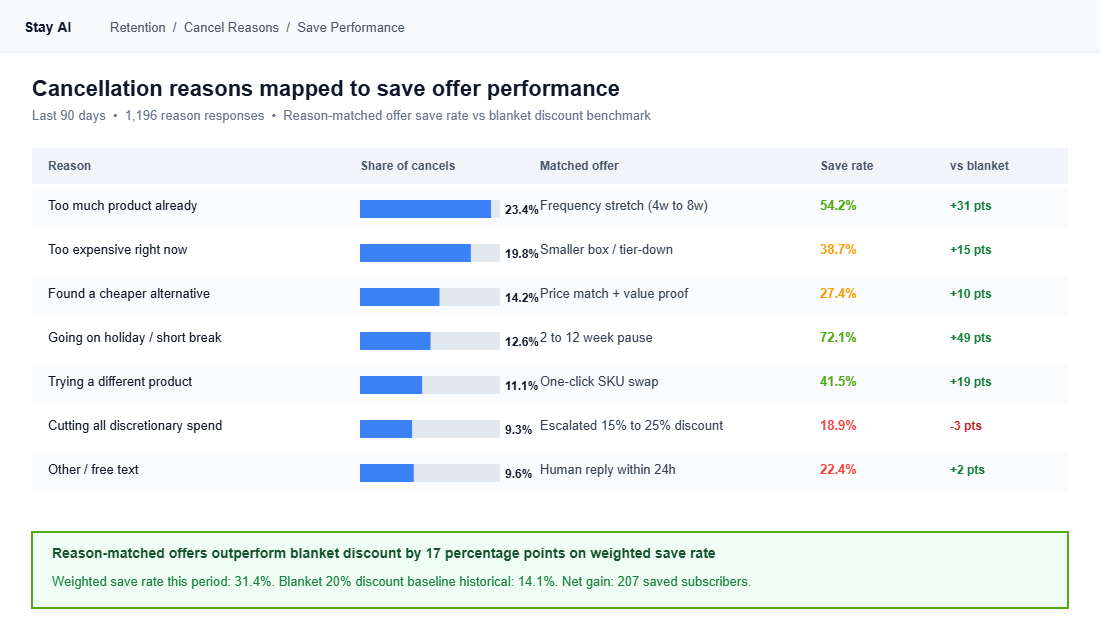
- “Too much product” gets a frequency change. Offer to switch them from 4-weekly to 8-weekly. Frame it as “would you like to stretch your delivery to every 8 weeks instead”. Save rate on this offer typically lands at 45 to 60% because it solves the actual problem.
- “Too expensive” gets a tier-down or a smaller box. If you have a smaller SKU or a lower price point, surface it. A genuine product downgrade beats a discount because it preserves your average order value going forward.
- “Found a cheaper alternative” gets a price match plus proof. Offer to match the competitor on the next delivery, then surface a third-party review or comparison that explains your value.
- “Trying a different product” gets a swap. One-click swap to a different SKU in your catalogue. This is where flexible subscription apps earn their keep.
- “Going on holiday” or “short-term break” gets a pause. Two to twelve week pause, no discount needed.
- “Cutting all spending” gets a discount, but escalated. First offer 15%, then 25% on a final page. Save 50%+ off cases for the absolute last page of the flow.
This matching logic is the difference between a 10 to 15% save rate (blanket discount flow) and a 25 to 35% save rate (reason-matched flow). The blanket discount approach is also the most expensive way to retain a customer because it permanently resets their price expectation. Every save offer should preserve your gross margin where possible.
Step 4: Pause, Skip, Swap (The Three Levers That Quietly Save 20 to 40% of Cancels)
Pause, skip, and swap are the three buttons that turn would-be churners into temporarily-inactive subscribers. They sound boring. They are not. Subscription businesses that offer flexible pause, skip, and swap see 20 to 40% lower overall cancellation rates than rigid subscription programs. The benchmark Loop publishes is that 25% of would-be churners will pause instead of cancel when the option simply exists on the page.
The reason this works is psychological. “Cancel” feels final. “Pause for 8 weeks” feels reversible, low-stakes, no-loss. A subscriber who pauses comes back at a 60%+ rate if the brand handles the resume well. The same subscriber who cancels comes back at maybe 15 to 25% through a win-back sequence. Pause beats cancel by a factor of three.
How to set up each option:
- Pause: Offer 2, 4, 8, and 12-week pauses as preset buttons. Send a “your subscription resumes in 7 days” email before the auto-resume. Track pause-return rate as a core metric.
- Skip: One-click skip on the next delivery. Healthy stores see 3 to 5 skips per cancellation, meaning skip absorbs a lot of would-be cancel intent. If your ratio is below that, skip is buried or hard to find.
- Swap: Let subscribers swap to a different SKU, a different size, or a different flavour. Subscribers who can swap or skip are up to 25% more likely to renew at their next billing cycle.
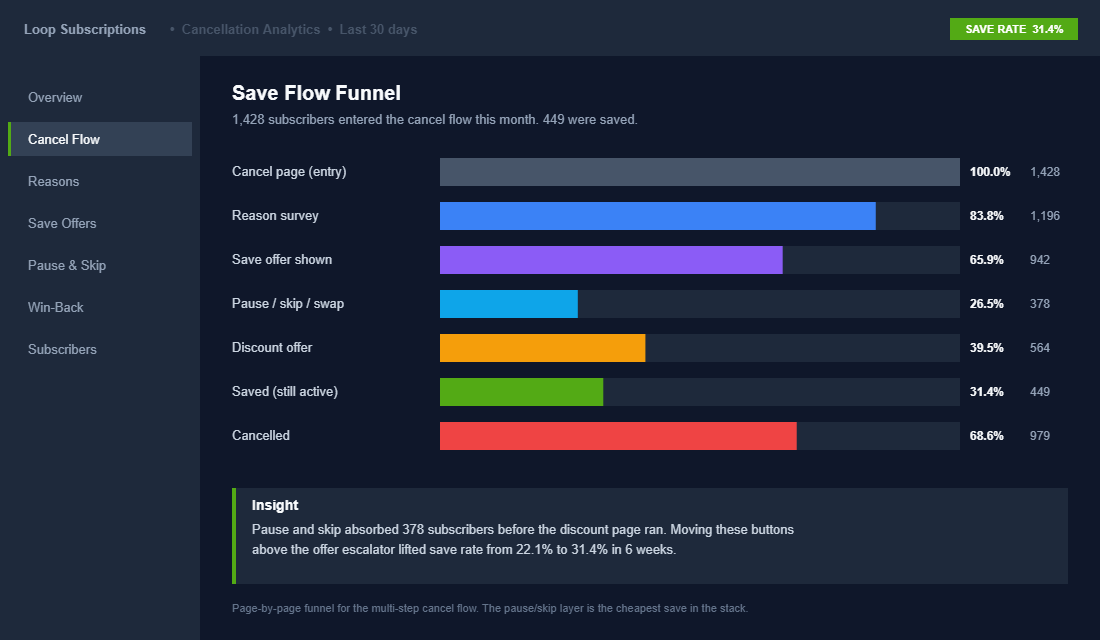
One non-obvious tip: surface pause and skip BEFORE the discount offer in your cancel flow. If the cancel sequence is benefit reminder, reason survey, then save offer, then pause/skip, you are training subscribers that the way to get out of a delivery is to cancel. Flip the order. Show pause and skip before the discount escalator. You will save more subscribers without giving up a single dollar of margin.
Step 5: The Win-Back Hand-Off (When the Cancel Goes Through Anyway)
Some subscribers will still cancel. That is fine. The job is not to save 100%. The job is to save 25 to 40% and then hand the rest off to a structured win-back program that picks them up 30, 60, and 90 days later. If you have read the Shopify win-back playbook, this part should feel familiar. The difference for subscription customers is the trigger and the offer.
The post-cancel win-back sequence should fire at three windows:
- Day 14 after cancel: “We miss you” email referencing the specific products they were getting. Surface social proof. No discount yet.
- Day 30 after cancel: Resubscribe offer tied to the cancellation reason they gave. If they said “too frequent”, the offer is “come back on a 12-weekly cadence”. If they said “too expensive”, the offer is a smaller box or a 20% restart credit.
- Day 60 after cancel: Soft new-product launch email. If your range has shifted since they left, this is the moment to surface that. Include a 25% restart discount with a 14-day expiry.
Industry win-back conversion sits at 15 to 25% across the 90 days post-cancel for well-run sequences. Stacked on top of a 30% save rate, your effective subscriber recovery rate is 40 to 47% of every cancel attempt. That is the number worth chasing.
Step 6: The Tool Stack (Loop, Recharge, Skio, Stay AI)
The save flow lives in your subscription platform. Pick the right one or your save rate is capped no matter how good your strategy is. The landscape consolidated in April 2026 when Recharge acquired Skio for $105 million, so you are now choosing between three real platforms plus the native Shopify Subscriptions app.
- Loop Subscriptions: Best-in-class cancellation flow builder. Conditional multi-step journeys based on order count, subscription tenure, and reason. Built-in page-by-page save-rate analytics. Strong fit for brands doing $30k+ MRR who care about save-rate optimisation as a discipline.
- Recharge (with Skio): The incumbent. Massive merchant base, deep app ecosystem, reliable. The Skio acquisition adds a more modern customer portal. Strong for brands $100k+ MRR or those needing integrations with everything.
- Stay AI: Newer, with an AI-driven personalisation layer for save offers. Worth evaluating for brands with a large product catalogue where reason-matched offers need to scale beyond manual setup.
- Shopify Subscriptions (native): Free, basic, fine for brands under $10k MRR or stores still validating the subscription motion. Cancel flow is minimal. You will outgrow it once you take save-rate seriously.
Two things to test before you commit. First, can the platform branch the save flow on order count? A first-time subscriber who cancels needs a different offer to a 12-month subscriber. Second, can it surface analytics at the page level? You need to see which page is leaking and iterate, not just see the bulk save rate.
Step 7: The Save-Rate Scorecard (Five Numbers to Track Every Monday)
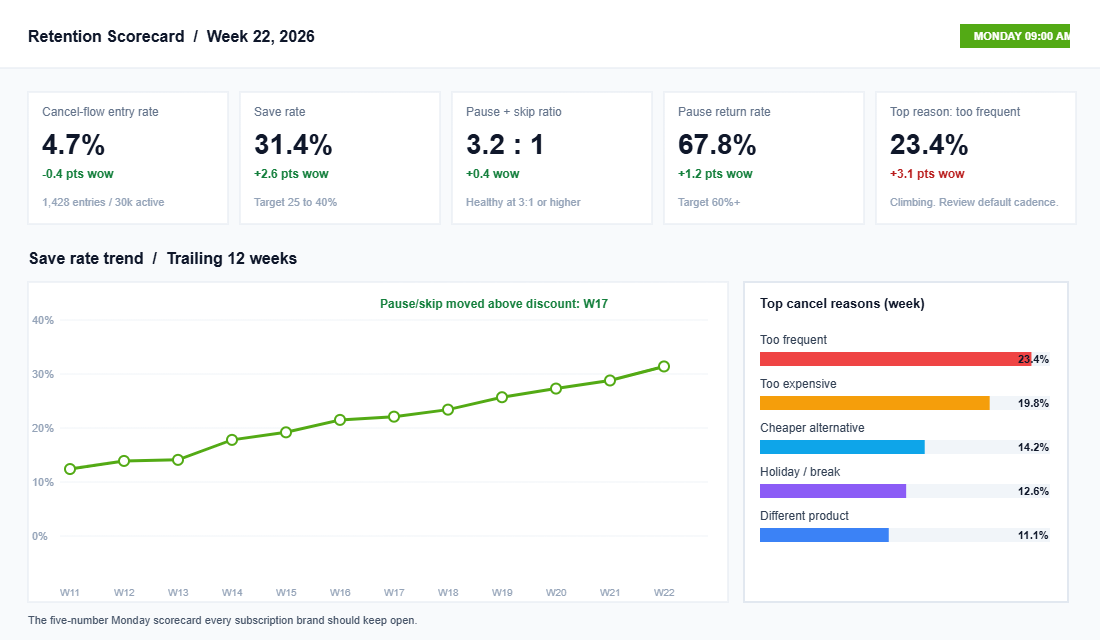
If you cannot measure it, you cannot improve it. Most subscription brands track monthly churn and stop there. Monthly churn is the lagging indicator. The leading indicators are what tell you where to invest the next week of work. Here is the five-number Monday scorecard we have members keep open at all times.
- 1. Cancel-flow entry rate. What percentage of active subscribers hit the cancel page in the last 7 days. Trending up usually means a product or pricing problem upstream.
- 2. Save rate. Of those who hit the cancel page, what percentage are still active 7 days later (excluding refunded). Target 25 to 40%.
- 3. Pause and skip ratio. Pauses plus skips divided by cancels. Healthy ratio is 3:1 or higher. Below 1:1 means the buttons are buried.
- 4. Pause return rate. Of subscribers who paused, what percentage resumed when their pause window ended. Target 60%+.
- 5. Top three cancel reasons by frequency. Watch the mix change week to week. A new reason climbing the ranks is the earliest warning signal you have for product, pricing, or delivery issues.
These five numbers belong on a dashboard your operations lead checks every Monday morning. If any number moves more than 20% week-on-week, it gets investigated before lunch. The brands we work with that hit 3 to 4% monthly churn are obsessive about these five numbers. The brands stuck at 10%+ churn often have no idea what their save rate is.
The Compound Effect: What Happens When These Steps Stack
Most founders look at this list and assume the steps are additive. They are not. They compound. Step 1 (benefit reminder) raises the save rate by maybe 5 percentage points on its own. Step 2 (reason survey) does not save anyone directly but makes step 3 dramatically more effective. Step 3 (matched offers) doubles your save rate compared to a blanket discount. Step 4 (pause/skip/swap) absorbs 20 to 40% of the people who would otherwise have to engage with the offer flow at all. Step 5 (win-back) recovers another 15 to 25% of the ones who slip through.
Stack it all together and a brand that started with a bare cancel button and 8% monthly churn typically lands at 4 to 5% monthly churn within 90 days of building the full flow. That is the difference between a subscription business that grows because new acquisition outpaces churn, and one that grows because retained subscribers compound. Same acquisition, half the leak, double the MRR over twelve months.
This work pairs directly with the 5-signal churn prediction health score, which catches at-risk subscribers 30 to 60 days before they ever click cancel. The save flow is your last line of defence. The health score is your early-warning system. Together, they form the retention spine of a healthy subscription program. If you want to see how this slots into the broader recurring revenue engine, the $30K MRR subscription playbook covers the full picture.
Involuntary Churn: The Cancellations Nobody Chose
A save flow only catches the customers who click cancel. It does nothing for the ones who never made a decision at all — the ones whose card expired, hit its limit, or got reissued after a fraud alert.
This is involuntary churn, and it typically accounts for 20% to 40% of all subscription cancellations. For most Aussie subscription brands it is the single largest churn bucket, and it is also the cheapest to fix, because the customer still wants the product. Nothing needs to be sold. A payment just needs to go through.
Four things move the number:
- Account updater. Visa and Mastercard both run services that automatically refresh reissued card details. Shopify Payments, Stripe and most subscription apps support it. Turning it on recovers 10% to 15% of failed payments with zero customer contact.
- Smart retry timing. Retrying a declined card an hour later mostly fails again. Retrying on day 3, day 5 and day 8 — and avoiding the last two days of the month when balances are lowest — lifts recovery meaningfully. Most platforms let you set this in a few clicks and never do.
- Pre-expiry reminders. A short email 30 days before the card on file expires, with a one-click update link. Expect 20% to 35% of recipients to update before anything ever declines.
- A real dunning sequence. Three to four emails plus an SMS across 14 days, each with a direct update-payment link that does not require logging in. A well-built sequence recovers 30% to 50% of failed payments.
Do the maths on your own store before you decide this is a small problem. A brand with 1,200 active subscribers at $65 a month and 6% monthly involuntary churn is losing 72 subscribers and about $4,700 in monthly recurring revenue. Halving that recovers roughly $28,000 a year, and the work is a weekend of configuration. The Shopify dunning playbook has the full sequence, timing and copy.
Fix the Reasons, Not Just the Cancellations
A save flow that runs forever without changing the product is a bandage. The reason survey you built in Step 2 is only worth the effort if someone acts on it, and most brands never close that loop.
Set a standing rule: once a quarter, take the top three cancellation reasons and assign each one an owner and a fix with a due date. The reasons themselves point at very different problems.
- “Too much product” or “I have too much stock.” Your default frequency is wrong for a chunk of your base. Offering a longer interval at signup usually beats offering a pause at cancellation. Brands that add a frequency choice on the product page often see this reason drop by half.
- “Too expensive right now.” Sometimes price, more often perceived value drifting after month three. Look at what changes in the box between month one and month four. If the unboxing gets thinner, so does the reason to stay.
- “Delivery problems.” This is not a subscription problem, it is a fulfilment problem wearing a subscription costume. Fix the carrier or the packaging, then win the customer back properly with a service recovery process rather than a discount.
- “It was too hard to change my order.” The most damning one, and the most fixable. If a customer cannot skip, swap or reschedule in under 60 seconds from their phone, they will cancel instead of persist. Measuring this properly is what the Customer Effort Score is built for.
Track one number against this work: the share of cancellations attributed to your top reason. If it is not falling quarter on quarter, you are saving customers from a problem you have decided not to solve, and you will keep paying to save the same people again next month.
Your Save Flow Build Checklist
If you want a copy-and-paste starter, here is the eCommerce Circle save flow checklist. Run through this in order and you will land in the 25 to 40% save-rate range within a quarter.
- Page 1: Benefit reminder with three customer-history facts and a clear “Keep my subscription” primary button.
- Page 2: Reason survey with six to eight category-specific options plus a free-text field.
- Page 3: Reason-matched save offer. Map every reason to a non-discount option first, with discount as the final fallback.
- Page 4: Pause, skip, swap surfaced as visible buttons. Pause presets at 2, 4, 8, and 12 weeks.
- Page 5: Final cancel confirmation with a single sentence “we will be here when you are ready” message. No more save attempts here. Respect the decision.
- Post-cancel: Win-back sequence triggers at day 14, 30, and 60. Tie offers to the cancel reason where available.
- Operations: Five-number Monday scorecard. Cancel-flow entry rate, save rate, pause/skip ratio, pause return rate, top three reasons.
Print this. Tape it to the wall. Build the flow in your subscription platform. Watch your churn drop within the first 60 days.
Inside eCommerce Circle, subscription retention is one of the core pillars we work on with every member running recurring revenue. If you want a second opinion on your current save flow and a roadmap for what to build next, let’s talk.