Every Shopify store you have ever built has a quiet leak. It is not in your checkout, your ad account, or your shipping rates. It is the slow, invisible drift of customers who bought once, liked what they got, and then simply stopped coming back. Nobody complained. Nobody churned loudly. They just went silent.
What’s in This Article
Most founders never see it because the dashboard keeps moving. New orders come in, revenue ticks up, and the lapsed customers fade into the background of a 12,000-row customer export. Meanwhile you keep paying to acquire strangers who cost 5 to 25 times more than the people who already trust you.
Here is the number that should sting: repeat customers make up roughly 21% of a typical store’s buyers but drive about 44% of revenue and 46% of orders. When a chunk of that group goes dormant, you are not losing a few sales. You are bleeding your most profitable segment. A proper win-back flow plugs that leak. This is the exact system we run with Aussie founders inside eCommerce Circle, and it routinely recovers $50K or more a year from people you have already paid for.
Why Win-Back Beats Acquisition Every Single Time
Reactivation is the highest-leverage email you are probably not sending. The maths is lopsided in your favour. The probability of selling to an existing customer sits around 60 to 70%. For a cold prospect it collapses to 5 to 20%. You are choosing between a warm conversation and shouting at a stranger.
Win-back emails reflect that. They convert at an average of around 10%, with open rates near 29% against a typical promotional benchmark closer to 21%. These people know your brand, have your product in a cupboard, and have handed over their card details before. The friction is already gone. You just have to give them a reason and a moment.
The first job is to see the problem clearly. Before you write a single email, build the segment so you can stare at the dollar value sitting idle. When founders see that their dormant list represents six figures of historic spend, the priority sorts itself out.
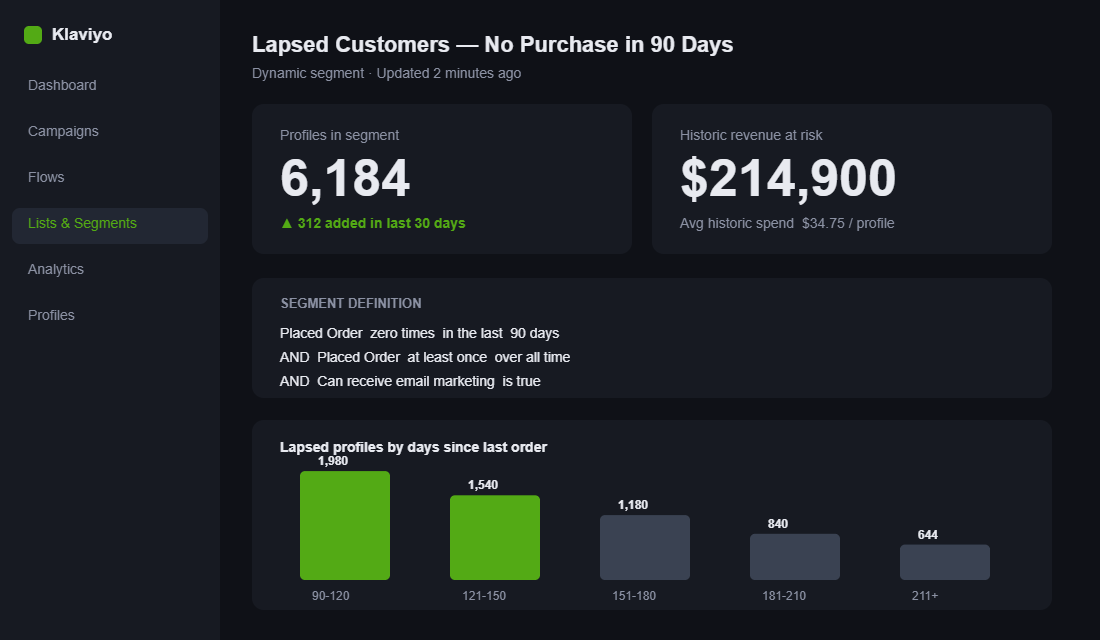
That screenshot is not a vanity metric. Each band on the chart is a different conversation. Someone 95 days past their last order needs a nudge. Someone 220 days out needs a stronger reason and an honest acknowledgement that it has been a while. Treating them the same is why most win-back attempts flop.
Step 1: Define Your Lapse Window Around Your Real Purchase Cycle
The single biggest mistake is borrowing someone else’s timing. A coffee brand where customers reorder every 30 days has a completely different lapse window to a premium homewares store where a customer might buy twice a year. Send a “we miss you” email 60 days after a kettle purchase and you look desperate. Send it 60 days after a coffee reorder and you are right on time.
Work out your average time between orders first. In Shopify, pull your repeat purchase data, or in Klaviyo look at the “time between orders” metric. Then set your lapse trigger at roughly 1.5 to 2 times that gap. The logic is simple: by the time a customer has gone half again as long as they normally would, they have genuinely stalled, not just paused.
- Consumables (coffee, supplements, skincare). Reorder cycle 30 to 45 days, so trigger win-back at 60 to 90 days.
- Apparel and accessories. Reorder cycle 90 to 120 days, so trigger at 150 to 180 days.
- Considered or high-ticket (homewares, electronics). Reorder cycle 6 to 12 months, so trigger at 9 to 14 months.
If you genuinely do not know your cycle yet, 90 days is a safe default for most Aussie DTC stores. It is long enough to exclude people who are simply between orders and short enough that your brand is still warm in memory. Refine it once you have the data. Understanding this number also sharpens your customer lifetime value calculations, because reactivation is one of the cheapest ways to lift it.
Step 2: Build the Lapsed Segment in Klaviyo (The Setup)
Klaviyo is the tool we reach for here because the flow trigger and the segment logic live in one place. Here is the build, step by step, so you can replicate it this afternoon.
- Create a dynamic segment. Go to Lists & Segments, click Create Segment, and name it “Lapsed 90 Days” (or your window).
- Set the core condition. “Placed Order zero times in the last 90 days” AND “Placed Order at least once over all time”. This captures past buyers who have gone quiet, not people who never purchased.
- Add deliverability guards. AND “Can receive email marketing is true”. This keeps unsubscribed and suppressed profiles out automatically.
- Exclude active subscribers. If you run a subscription, exclude anyone with an active subscription so you do not nag a paying customer.
- Trigger the flow on segment entry. Build a new flow triggered by “added to segment: Lapsed 90 Days”. Now every customer who crosses your lapse line is enrolled automatically, forever.
The beauty of a segment-triggered flow is that it runs without you. Set it once and it works every day, quietly enrolling each customer the moment they go cold. That is the difference between a one-off “win-back campaign” you blast manually and a permanent recovery system.
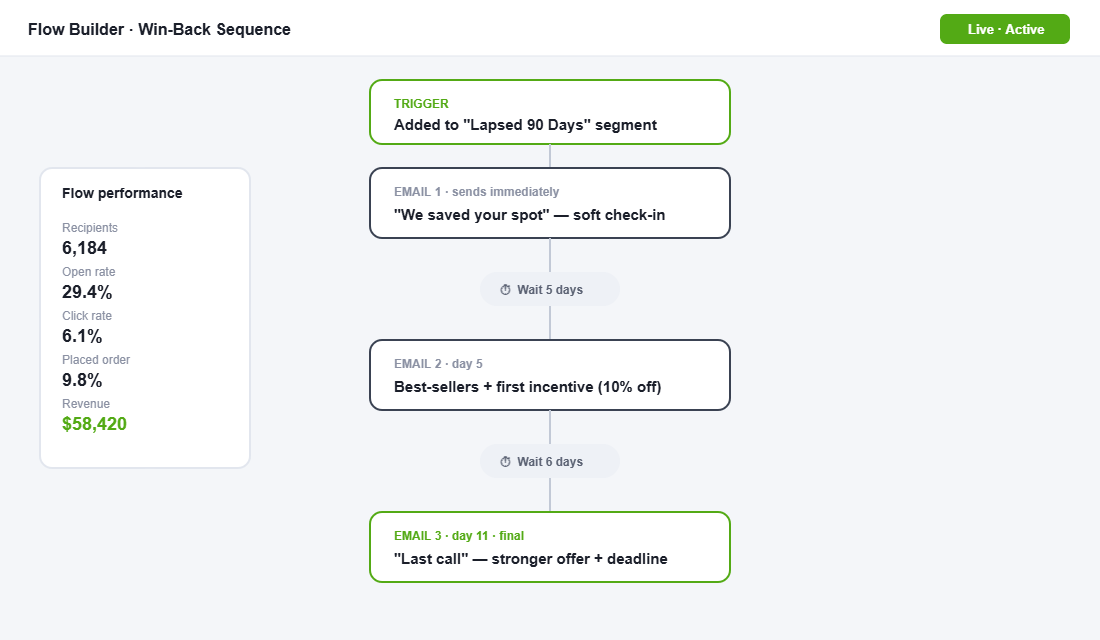
Three emails is the sweet spot. Klaviyo’s own guidance lands here too: one light touch, one with an incentive, one final call. More than three and you start training people to ignore you. Fewer than three and you leave money on the table from the people who needed a second reminder.
Step 3: The 3-Email Sequence That Does the Heavy Lifting
Timing matters as much as copy. The proven cadence is: Email 1 sends immediately on enrolment, Email 2 around day 5, and Email 3 around day 11. Each one escalates in both urgency and incentive.
Email 1: The soft check-in (no discount)
Open with a human tone, not a fire sale. Something like “We saved your spot.” Remind them what they loved, show one or two products tied to their last purchase, and ask a genuine question. No discount yet. You are testing whether a simple nudge brings them back, because the customers who return here cost you nothing in margin.
Email 2: Best-sellers plus the first incentive
Now you sweeten it. Lead with three to six best-sellers or new arrivals (Klaviyo recommends exactly this) and attach a modest incentive, typically 10% off or free shipping. This is the workhorse email. In most flows we run, it pulls the largest single share of recovered revenue.
Email 3: The last call with a deadline
The final email is honest and direct. “This is the last time we will email this offer.” Bump the incentive slightly (15% or a bonus gift), add a genuine expiry, and make the path to checkout one click. Urgency that is real, not invented, is what converts the fence-sitters.
Step 4: The Incentive Ladder (Stop Leading With Your Biggest Discount)
The most expensive mistake in win-back is opening with your deepest discount. Do that and you train good customers to lapse on purpose, because they learn that going quiet earns a coupon. You also torch margin on people who would have bought at full price.
Instead, climb a ladder. No discount, then a small one, then a slightly larger final offer. This protects margin, rewards only the customers who genuinely needed the push, and keeps your brand from feeling like a permanent clearance rack. The brands that get this right see remarkable returns. A Bloomreach-powered win-back for Voyo Croatia hit a 38% open rate and 500% ROI in six months using personalised content before resorting to discounts. Getir reactivated hard-churned app users without any discount at all, purely through creative and relevance.
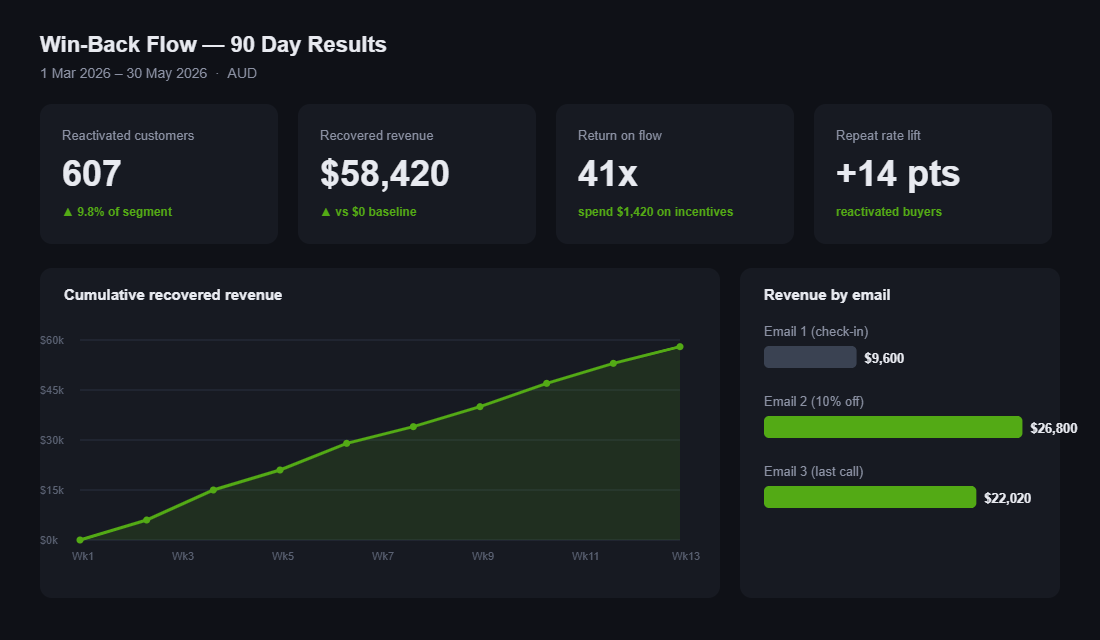
Those results are typical of a flow built properly. In one Klaviyo case, a win-back targeting a 60,000-person segment converted 5.2% to a purchase, producing over 3,100 orders and roughly $372,000 in 90 days. You will not hit that number on a smaller list, but the percentages hold. A 9 to 10% placed-order rate on a few thousand dormant buyers is a very real $50K+ a year for a mid-sized Aussie store.
Step 5: Suppress, Sunset, and Protect Your Deliverability
A win-back flow is also a deliverability tool, and most founders miss this. The customers who ignore all three emails are dead weight in your list. Continuing to email them drags down your open rates and signals to Gmail and Outlook that your sends are unwanted, which hurts inbox placement for your whole list.
- Tag non-responders. If a profile opens nothing across all three emails, add a “win-back unresponsive” tag at the end of the flow.
- Move them to a low-frequency segment. Stop sending daily campaigns. Drop them to one send a month at most.
- Sunset the truly dead. After a final attempt, suppress profiles with zero engagement in 12+ months. A smaller, engaged list out-earns a bloated, ignored one every time.
This is where win-back connects to the rest of your retention engine. The customers who do come back should flow straight into your post-purchase sequence and, ideally, your loyalty program, so you do not have to win them back a second time.
The Compound Effect: Why This Flow Pays Forever
A win-back flow is not a campaign. It is a standing asset. Build it once and it enrols every newly lapsed customer automatically, every single day, with zero ongoing effort. The 600 customers it reactivates this quarter are not a one-time win either. Reactivated buyers have a higher second-purchase rate, which means many of them re-enter your normal repeat cycle and keep buying.
Stack that against acquisition. A reactivated customer costs you a fraction of a discount, while a new one costs you a full customer acquisition cost that keeps climbing as ad platforms get more crowded and expensive. Bain’s research is blunt on this: a 5% lift in retention can grow profit by 25 to 95%. Win-back is the most direct retention lever you can pull, and unlike a loyalty program or a referral scheme, it works on revenue you have already earned and lost.
The founders who scale calmly are not the ones with the cheapest ads. They are the ones who refuse to let paid-for customers walk out the back door.
Your Win-Back Flow Checklist
Use this to build or audit your flow today. If you cannot tick every box, you have found your next 30 minutes of highest-value work.
- Lapse window set to 1.5 to 2x your real reorder cycle (default 90 days if unknown).
- Dynamic “Lapsed” segment built with past-buyer logic and deliverability guards.
- Flow triggered on segment entry so enrolment is automatic and permanent.
- Three emails, escalating: soft check-in (day 0), best-sellers plus 10% (day 5), last call plus deadline (day 11).
- Incentive ladder, not a single deep discount at the top.
- Product recommendations of three to six best-sellers or new arrivals in emails 2 and 3.
- Suppression and sunset logic at the end to protect deliverability.
- Returners routed into your post-purchase and loyalty flows.
Set this up properly and you will recover revenue you assumed was gone, protect your margin, and clean your list at the same time. Three emails, one segment, working quietly in the background while you focus on growth.
Inside eCommerce Circle, the win-back flow is one of the core Patrons pillars we build with every member, because reactivation is the cheapest revenue on the table. If you want a second opinion on yours, let’s talk.