There are 24 days left in the financial year. Right now, thousands of Aussie Shopify stores are preparing to do exactly the same thing: slap a 20% off banner on the homepage, send two emails, and call it an EOFY sale.
What’s in This Article
That approach leaves serious money on the table. Australians are spending $10.5 billion in EOFY sales this period, up 3.9% on the year before, according to research from the Australian Retailers Association and Roy Morgan. More than a quarter of Australians, around 6.1 million people, actively shop the mid-year sales. And unlike Black Friday, the buying skews big-ticket: the most common planned spend bracket is $1,000 to $4,999, and it is growing.
The brands that win June do not simply discount harder. They run a structured campaign: a clear job for the sale, an offer architecture that protects margin, a segmented send plan, and a hard finish. This is the 5-phase system we work through with eCommerce Circle members every June. Steal it.
Why EOFY Is the Most Underrated Sale Window on the Aussie Calendar
BFCM gets all the attention. Every brand you compete with spends months planning for November, inboxes hit saturation, and CPMs spike across Meta and Google at exactly the moment you need reach.
June is different. The EOFY window is a genuinely Australian retail moment, the competitive intensity in DTC inboxes is noticeably lower than November, and the buyer mindset is different. ABS household spending data shows Australians are still spending (retail spending was up 5% year on year in January 2026 at $38.63 billion for the month) but they are cautious. They are actively hunting value, and EOFY gives them permission to buy.
There are also two distinct buyers walking through your digital door in June. The first is the standard bargain hunter who knows sales are on everywhere. The second is the business buyer with a genuine tax motivation to spend before 30 June. Almost no DTC store builds for the second buyer, which is why Phase 3 of this playbook exists.
One more reason June matters: it is your BFCM dress rehearsal. Every system you build for EOFY (offer ladder, segments, countdown mechanics, support macros) gets reused in November with the bugs already ironed out.
Phase 1: Decide What the Sale Is For (Margin Math Before Marketing)
Most EOFY sales fail before the first email goes out because the founder never decided what the sale was actually for. There are three legitimate jobs an EOFY sale can do, and they demand different offers:
- Clear aged stock. Turn dead and slow-moving inventory into cash before you run your EOFY stocktake and face the write-down conversation with your accountant.
- Pull forward revenue and cash. Bank a strong June to finish the financial year with momentum and fund July purchase orders.
- Acquire new customers at breakeven. Use the sale as a CAC subsidy, accepting thin first-order margin to grow the file before the second half of the year.
Pick one primary job. A sale trying to do all three at once produces a muddled offer that does none of them well.
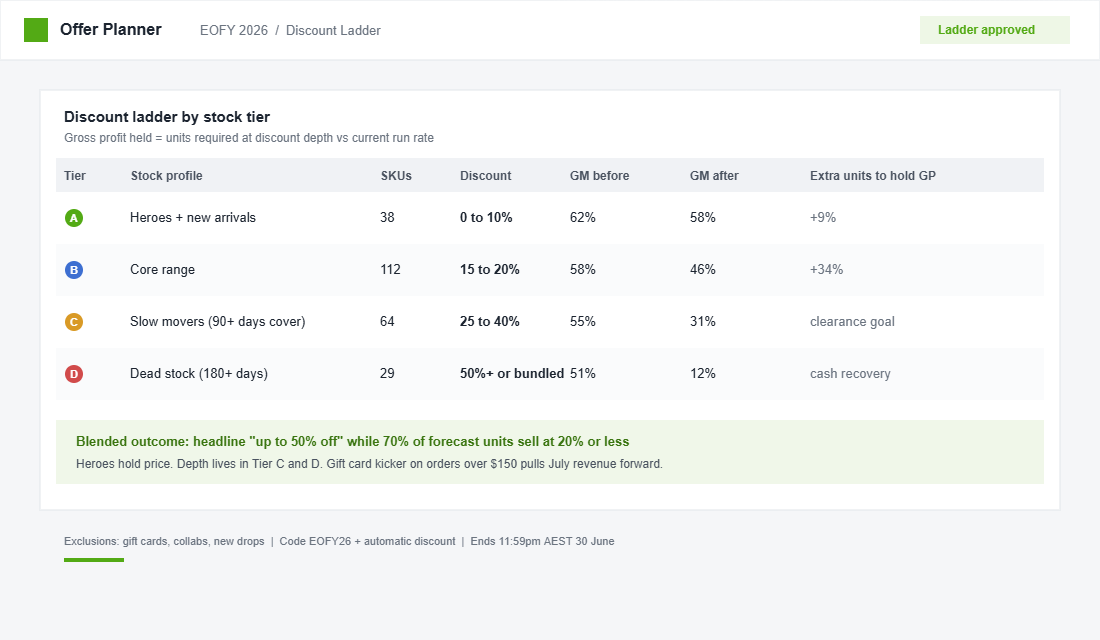
Then run the margin math before you pick a number. At a 60% gross margin, a 20% sitewide discount means you need roughly 50% more units just to hold the same gross profit dollars. If your traffic plan cannot plausibly deliver that volume, you are running a charity event, not a sale. We covered the underlying maths in the Pricing Power Playbook, and it matters twice as much when you are discounting.
The output of Phase 1 is a discount ladder built on stock tiers, not feelings:
- Tier A (heroes and new arrivals): 0 to 10% off, or excluded entirely.
- Tier B (core range): 15 to 20% off.
- Tier C (slow movers): 25 to 40% off.
- Tier D (dead stock): 50% or more, or bundled with Tier B as a value-add.
Phase 2: Build an Offer Architecture That Protects Margin
A flat sitewide percentage is the simplest offer and usually the weakest. It gives your best-selling, full-margin heroes the same discount as the dead stock you are desperate to move.
Look at how the bigger Aussie DTC brands structure EOFY instead. Koala runs “up to 30% off” with the depth varying by category: deeper on mattresses it wants to move, shallower on accessories. LSKD pushes “up to 50% off” but the depth lives in outlet and prior-season lines while new drops stay at full price. The headline number does the advertising; the ladder protects the margin.
Four architectures that outperform a flat sitewide discount:
- Category-tiered (“up to X% off”). Your Tier C and D stock carries the headline depth. Heroes hold price or sit at a token 10%.
- Spend tiers. “Spend $150, save $30. Spend $300, save $75.” This pushes average order value up instead of just margin down, and pairs beautifully with free shipping thresholds.
- Bundle-led offers. Attach a slow mover to a bestseller at a price that beats buying both separately. You move Tier D stock without putting a red slash through your hero product.
- The gift card kicker. “Orders over $150 get a $20 gift card for July.” You protect June margin and pull guaranteed July revenue forward at the same time.
Two execution details that separate clean sales from messy ones. First, use one memorable code (EOFY26) for attribution even if the discount is automatic, because automatic discounts remove checkout friction while the code gives you a clean campaign handle. Second, write your exclusions down before launch: gift cards, new arrivals, and collabs are typically out, and your customer service team needs that list before the first “why is this not discounted” email arrives.
Phase 3: Work the ABN Angle Most DTC Stores Ignore
Here is the most under-used EOFY lever in Australian ecommerce: the $20,000 instant asset write-off. Small businesses with turnover under $10 million can immediately deduct eligible assets costing under $20,000, provided the asset is installed and ready for use by 30 June 2026.
Think about what that covers. Desks, chairs, monitors, laptops, cameras, power tools, kitchen equipment, coffee machines, signage, storage. If any product in your catalogue could plausibly sit in a home office, a tradie’s ute, a cafe, or a studio, you have a second campaign hiding inside your EOFY sale, aimed at buyers who are far less price-sensitive because the tax system is effectively co-funding their purchase.
How to execute it without becoming a tax adviser:
- Build an “EOFY for Business” collection with every product a business buyer would purchase, and link it from your sale landing page and navigation.
- Add one line of copy: “Buying for your business? Ask your accountant about the $20,000 instant asset write-off before 30 June.” You are pointing to the rule, not giving advice.
- Make tax invoices obvious. Business buyers need a GST tax invoice. Say clearly that every order gets one automatically.
- Send one dedicated email to customers you know are business buyers (anyone who has asked for an invoice, ordered to a commercial address, or bought B2B-skewed SKUs).
This angle alone has paid for the entire campaign for several of our members who sell anything vaguely office, trade, or hospitality adjacent.
Phase 4: Run the 24-Day Campaign Calendar (Teaser to Final 72 Hours)
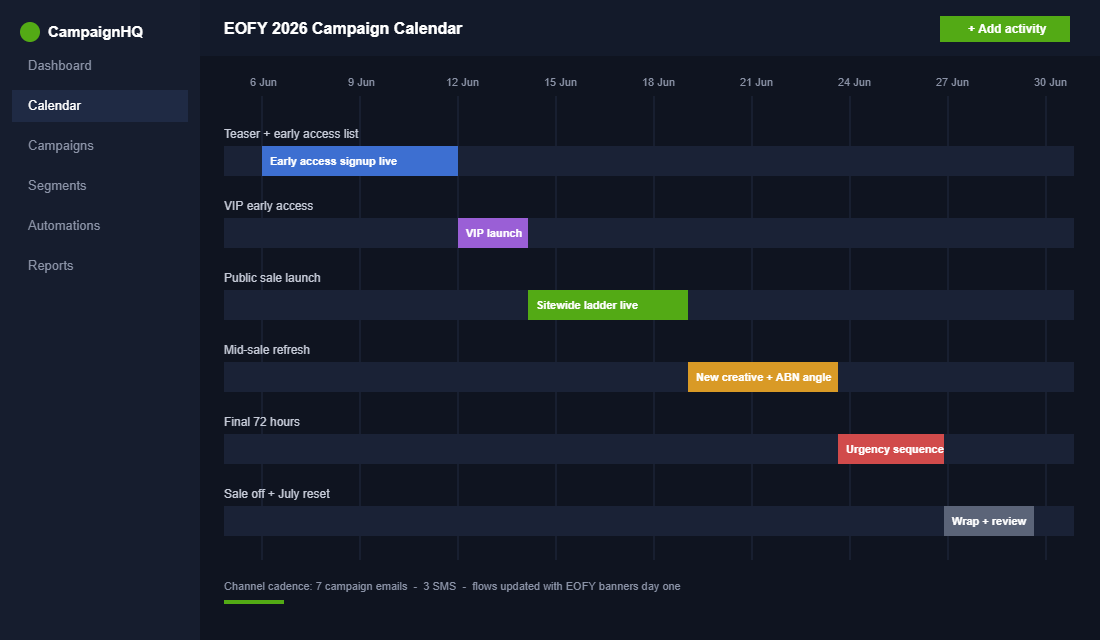
An EOFY sale is not an event, it is a sequence. Here is the calendar working back from Tuesday 30 June:
- Week 1 (now to 12 June): tease and build. Add an “EOFY early access” signup to your site and socials. You are building a high-intent segment before you spend a cent on launch ads.
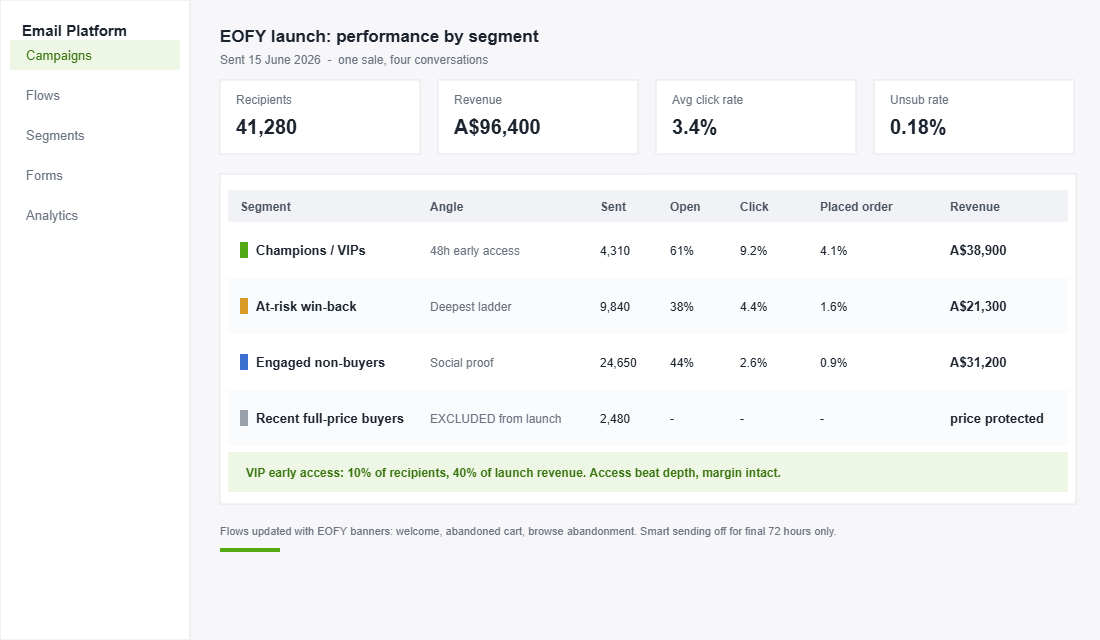
- Week 2 (13 to 19 June): VIP launch, then public launch. Open the sale to VIPs and early-access signups 48 hours before the public. Early access converts harder than a deeper discount and costs you nothing.
- Week 3 (20 to 26 June): the mid-sale refresh. This is where most campaigns die. Change the creative, rotate featured categories, push the ABN angle, drop customer reviews and UGC into the emails. Same sale, new reason to look.
- Final 72 hours (28 to 30 June): the urgency window. Last-chance email on the 28th, SMS on the 29th, final-hours email on the morning of the 30th and a closing SMS that evening. A huge share of total sale revenue lands in these three days, and it only works if the deadline is real.
Cadence-wise, that is 6 to 8 campaign emails and 2 to 3 SMS across the window. If that feels like a lot, remember the maths from Klaviyo’s benchmark data: the average campaign email gets a 1.69% click rate while automated flows get 5.58%, and flows generate around 41% of total email revenue from just 5.3% of sends. The lesson is not “send less”. It is: make sure the sale also shows up inside your flows. Update your welcome series, abandoned cart, and browse abandonment emails with EOFY banners on day one, because those automations out-convert every campaign you will send.
Phase 5: Segment the Send (Do Not Burn the List to Hit a June Number)
Blasting the identical offer to your whole list is how you train every customer to wait for sales. The fix is to run one sale with four different conversations, built on the segments from our RFM Segmentation Playbook:
- Champions and VIPs: lead with access, not depth. “You get in 48 hours early” beats an extra 10% off, and it protects the margin on your best customers, who would have bought anyway.
- At-risk and lapsed customers: this is your win-back excuse. Give them the headline depth and say it plainly: “We have not seen you in a while. EOFY is a good time to come back.”
- Recent full-price buyers (last 14 days): exclude them from launch sends, and honour the sale price if they email. A $25 goodwill refund is cheaper than a churned customer who feels punished for buying early.
- Engaged non-buyers: the standard sequence, with social proof doing the heavy lifting.
In Klaviyo, the whole structure takes about an hour to set up:
- Create the four segments above (Champions: 3+ orders or top 10% spend; At-risk: last order over 180 days ago; Recent buyers: order in last 14 days; Engaged non-buyers: opened or clicked in 60 days, zero orders).
- Clone your launch campaign four times and adjust the angle and subject line per segment, not just the discount.
- Set the recent-buyer segment as an exclusion on every send in week one.
- Add EOFY banners to your welcome, abandoned cart, and browse abandonment flows with an end-date condition so they switch off automatically on 1 July.
- Turn off smart sending for the final 72 hours only, so your closing emails actually land.
Site and Ops Readiness: The Unsexy 20% That Saves the Sale
Campaigns leak revenue at the site layer, not the email layer. Before launch day, work through the mechanics:
- One EOFY collection page, linked from the homepage hero and main navigation, sorted with Tier B and C products first (not just dead stock, or the page looks like a clearance bin).
- A countdown timer on the sale collection and announcement bar for the final 72 hours only. Permanent countdowns are urgency theatre and your customers know it.
- QA every discount in an incognito window before launch: code, automatic discount, spend tiers, and the exclusion list.
- Check stock buffers on Tier C and D items so the sale does not oversell inventory you cannot replace.
- Brief your support inbox with macros for the three guaranteed questions: “can I get the discount on last week’s order”, “when does it end”, and “do you do tax invoices”.
- Do not install new apps sale week. Site speed and stability beat one more widget every single time.
Point Paid Traffic at the Sale (Without Letting It Eat the Margin)
Email and SMS carry the heavy lifting because the margin on a discounted order rarely supports cold acquisition costs on top of the discount. But there are three paid moves that consistently pay their way during an EOFY window.
- Shift budget to retargeting. Your warm audiences (site visitors, video viewers, engaged social, email openers) already know the brand. A sale is precisely the nudge they were waiting for, and retargeting CPMs in June are nowhere near November levels.
- Defend your brand terms on Google. Search volume for “your brand + sale” and “your brand + discount code” spikes during EOFY. If you are not running brand search, affiliates and coupon sites will happily collect that traffic and charge you for customers you already owned.
- Run the ABN angle as its own ad set. Creative that says “Fit out the office before 30 June” with the business collection as the landing page hits a buyer mindset that generic sale creative misses completely.
One warning on creative: do not just export a red SALE graphic and call it done. The mid-sale refresh in Phase 4 applies to ads too. Fatigued sale creative burns budget faster than fatigued organic content, because you are paying for every impression of an ad people have already scrolled past twice.
And hold the line on measurement. During sale periods, ROAS flatters itself because warm buyers click whatever is in front of them on the way to a purchase they had already decided on. Judge the window on blended marketing efficiency ratio and contribution margin, the same way you would judge any other month, and you will avoid the classic July hangover of “record revenue, empty bank account”.
How the Five Phases Compound (and What to Do on 1 July)
None of these phases is impressive on its own. Together they multiply. The right job (Phase 1) produces an offer that protects margin (Phase 2). The ABN angle (Phase 3) adds a buyer segment your competitors ignore. The calendar (Phase 4) turns one announcement into 24 days of selling. Segmentation (Phase 5) means every send lands as relevant instead of noisy, so the list is still healthy in July.
Then finish hard. End the sale when you said you would. The brands that quietly extend “due to demand” are teaching customers that deadlines are fiction, and they pay for it at every future sale.
On 1 July, three moves. First, measure the campaign on margin dollars and marketing efficiency ratio, not topline revenue (a sale that grew revenue 40% while halving contribution margin is a failure). Second, tag every EOFY-acquired customer and drop them into your second-purchase flow while the brand is fresh. Third, write down what worked while it is still vivid. Your November BFCM plan just wrote its own first draft.
The EOFY Post-Mortem: Bank the Lessons While They Are Fresh
The most valuable hour of your EOFY campaign happens in the first week of July, and almost nobody books it in. By August the details are gone and you will rebuild next year from memory. Run the post-mortem while the data and the war stories are still warm.
Block 60 minutes and answer five questions with numbers, not vibes:
- What did the sale actually add? Compare June revenue to your trailing 3-month baseline, then subtract the discount cost. A sale that lifts revenue 40% but gives back 25 points of margin may have made you less than a quiet month.
- Who bought? Split new versus returning customers. If 70% of sale buyers were existing customers, you mostly discounted people who would have paid full price, and next year needs sharper acquisition targeting.
- Which channel carried the weight? Email typically drives 25% to 35% of revenue during a well-run sale window. If paid traffic carried everything, your list is underworked.
- What broke? Stock-outs, support backlogs, shipping delays. Write down the operational failure points while they sting.
- What happens to June buyers now? Tag the cohort in Klaviyo and watch their 60-day second-purchase rate. Sale buyers churn harder than full-price buyers, which makes your post-purchase flow the difference between a cohort and a one-off. Our guide on why the second sale matters more than the first covers exactly how to work that cohort.
Then save the answers as a one-page SOP. This becomes the opening brief for your BFCM planning in September, and the compounding starts: every major campaign you run gets smarter than the last because the lessons stopped living in your head. If you do not yet have a weekly habit of reading these numbers, start with the weekly metrics dashboard every Shopify owner should be checking.
The EOFY Campaign Checklist
Here is the condensed version to work through with your team this week:
- This week: pick the one job the sale must do, tier your stock A to D, set the discount ladder, run the margin math at each depth, launch the early-access signup.
- Before launch: build the EOFY collection and the EOFY-for-Business collection, set up the four Klaviyo segments and exclusions, add sale banners to your flows, QA every discount path, brief support.
- During the sale: VIP launch, public launch 48 hours later, mid-sale creative refresh on day 7, ABN-angle email in week three.
- Final 72 hours: last-chance email, urgency SMS, final-hours sends on 30 June, countdown timers live.
- 1 July: sale off everywhere (site, flows, ads), margin and MER review, EOFY cohort tagged into second-purchase flows, BFCM notes written.
Inside eCommerce Circle, campaign planning like this is one of the core pillars we work on with every member. If you want a second opinion on your EOFY plan before the window closes, let’s talk.