You spend most of your day feeding the ad machine. Every sale starts from zero: a fresh click, a fresh cost per acquisition, a fresh hope the customer comes back on their own. Most Aussie founders treat the repeat purchase as something that just happens if the product is good enough. It does not. It happens when you build a structure that makes coming back the default.
What’s in This Article
Here is the number that should reframe how you think about your store. Subscription customers deliver 3 to 5 times the lifetime value of one-time buyers at the same gross margin. A one-time buyer averages 1 to 1.5 orders before they vanish. A subscriber averages 8 to 18 orders before they churn. Same product, same margin, roughly five times the value from the same person.
Australia’s subscription ecommerce market hit USD 7.9 billion in 2025 and is forecast to compound at around 38% a year this decade. The brands capturing that growth are rarely the ones with the cleverest product. They are the ones who built a system that quietly converts a single purchase into a standing order. This playbook breaks that system into five parts you can implement on Shopify in a weekend.
Why Recurring Revenue Beats the Ad Treadmill
When every order is a fresh acquisition, your business is only ever as strong as last week’s ad account. One iOS update, one CPM spike, one creative that fatigues, and your revenue wobbles. Recurring revenue changes the shape of the business. You start each month with a known base of orders already committed, which means you can forecast cash, plan inventory, and buy ads against a number you can actually trust.
The maths compounds in your favour. If your blended cost to acquire a customer is $40 and a one-time buyer spends $60 once, you are running on fumes after shipping and fees. Turn that same customer into a subscriber worth $300 to $600 over their lifetime and the acquisition suddenly funds itself many times over. That is why brands with a real subscription base can outbid you on the same Meta auction and still make money.
You do not have to take it on faith. Chewy, the pet retailer, disclosed that its Autoship subscription now drives over 77% of total net sales, with net sales per active customer above USD 565 in 2025. The company credits recurring revenue and higher lifetime value compared with one-time purchasers. Closer to home, the brands quietly winning their categories are the ones treating subscription as the core model, not a checkbox.
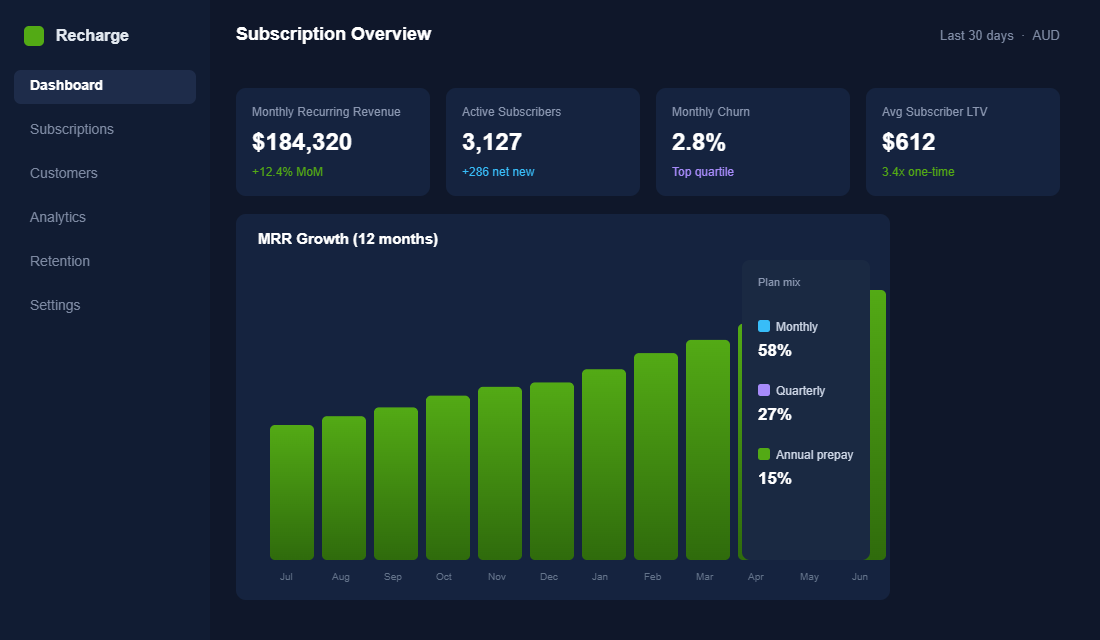
One benchmark to anchor on: top-quartile subscription brands hold monthly churn under 3%, while the average sits closer to 6 to 8%, and subscription boxes can run as high as 10 to 15%. The gap between those numbers is not luck. It is the difference between bolting a subscription widget onto your product page and engineering the full system below.
Part 1: Pick the Subscription Model That Fits Your Product
Not every product should be a subscription, and forcing the wrong model is the fastest way to high churn. There are three models that work on Shopify, and your product usually points clearly to one of them.
- Replenishment (Subscribe and Save). The customer buys the same consumable on a repeating schedule: coffee, supplements, pet food, skincare, cleaning products. This is the lowest-friction model because you are simply automating a purchase they already make.
- Curation (the box). A changing selection delivered on a cadence: a snack box, a wine club, a beauty edit. Higher churn because novelty wears off, but strong for discovery brands.
- Access (membership). Recurring payment for perks, pricing, or content rather than a physical refill. We cover this in depth in the Shopify Paid Membership Playbook.
If your product gets consumed on a predictable cadence, replenishment is almost always the place to start. The Aussie benchmark here is Who Gives A Crap, the Melbourne-founded toilet paper brand that built subscriptions into the model from day one in 2012. Customers choose delivery every 8, 12, or 16 weeks in boxes of 24 or 48 rolls, matched to how fast a household actually gets through them. The brand has since sold more than 300 million rolls and donated over AUD 11 million to sanitation projects.
The lesson is the cadence, not the product. Who Gives A Crap did not ask people to subscribe to toilet paper for novelty. They removed a boring, recurring chore and priced the convenience fairly. Map your own product to the real consumption rhythm of your customer, then set your default interval to match it. Guess the cadence wrong and you train customers to over-order, pile up stock, and cancel.
A quick gut-check before you commit to a model: would the customer have bought this again anyway? If yes, a subscription just removes friction from a decision they already make, and churn stays low. If you are relying on novelty or a one-off impulse to carry the recurring charge, expect the higher box-style churn and price the program accordingly. Honesty here saves you months of fighting a leaky funnel later.
Part 2: Engineer an Offer People Actually Want to Lock Into
The mistake most founders make is treating the subscription discount as the entire offer. Discount alone attracts the wrong subscriber: the deal-seeker who cancels the moment a competitor undercuts you. Your offer needs a discount that protects margin plus reasons to stay that have nothing to do with price.
- Discount that respects your margin. 10 to 15% off is the sweet spot for replenishment. Enough to move the decision, not so much that you are subscribing customers into a loss.
- Convenience framed loudly. “Never run out” is a stronger hook than “save 10%”. Sell the removed chore, not the saved dollars.
- Subscriber-only perks. Free shipping, early access to drops, a free gift on the third order, or a bonus product. These raise switching cost without touching your base price.
- Flexible frequency presets. Offer 2 or 3 sensible intervals rather than a confusing menu. Default to the cadence that matches real consumption.
- An annual prepay option. This is the quiet winner. Annual prepay subscribers retain at roughly 2.5 times the rate of monthly subscribers at month 12, and you get the cash upfront.
Build the offer around lifetime value, not the first transaction. If your average subscriber is worth $400, a free $15 gift on order three is one of the cheapest retention levers you will ever pull. For more ways to lift the value of every order, the Shopify Average Order Value Playbook pairs neatly with this.
Setting it up in Recharge
Recharge is the most widely used subscription app on Shopify and the fastest way to ship a Subscribe and Save offer without custom development. The setup is straightforward:
- Install Recharge from the Shopify App Store and authorise it to access your products and checkout.
- In the Recharge merchant portal, open Products and click Add products, then tick the items you want to offer as subscriptions.
- Open each product to set its subscription rules: charge frequency, the subscribe-and-save discount (for example 10%), and the delivery intervals you decided on in Part 1.
- Confirm a recurring-capable payment gateway is active (Shopify Payments, Stripe, or PayPal) so renewals charge automatically.
- Enable the customer portal so subscribers can pause, skip, swap, or reschedule on their own. This single setting prevents a large share of avoidable cancellations.
The Profit Maths: Price a Subscription Without Eroding Margin
A subscription only builds wealth if each recurring order makes money after the discount, the fulfilment, and the payment fees. Plenty of founders discount their way to a full subscriber list and a thinner bank account. Before you scale, run the unit economics on a single subscription order the way you would on a paid ad.
Start with contribution per order: subscription price minus product cost, minus pick-pack-ship, minus the roughly 2 to 3% in payment processing fees, minus the subscriber discount. If that number is healthy and you multiply it by the 8 to 18 orders an average subscriber places, you can see exactly how much you can afford to spend acquiring one. That is your real subscriber acquisition ceiling, and it is almost always far higher than your one-time CAC.
Two levers protect margin without scaring off subscribers. First, fund perks from lifetime value rather than the base price: a free gift on order three costs you once but lifts retention across every future order. Second, push the annual prepay plan, where the upfront cash improves your cash conversion cycle and the 2.5x retention lift means you are not constantly re-acquiring the same person. Price for the lifetime, not the first box, and the program funds its own growth.
Part 3: Win or Lose It in the First Two Billing Cycles
Here is the insight that separates a leaky subscription program from a compounding one. Most subscription churn concentrates in the first two billing cycles. If your month-2 retention is below 70%, no amount of polish on months 6 to 12 will get you to a healthy lifetime value. The early window is where the money is made or lost.
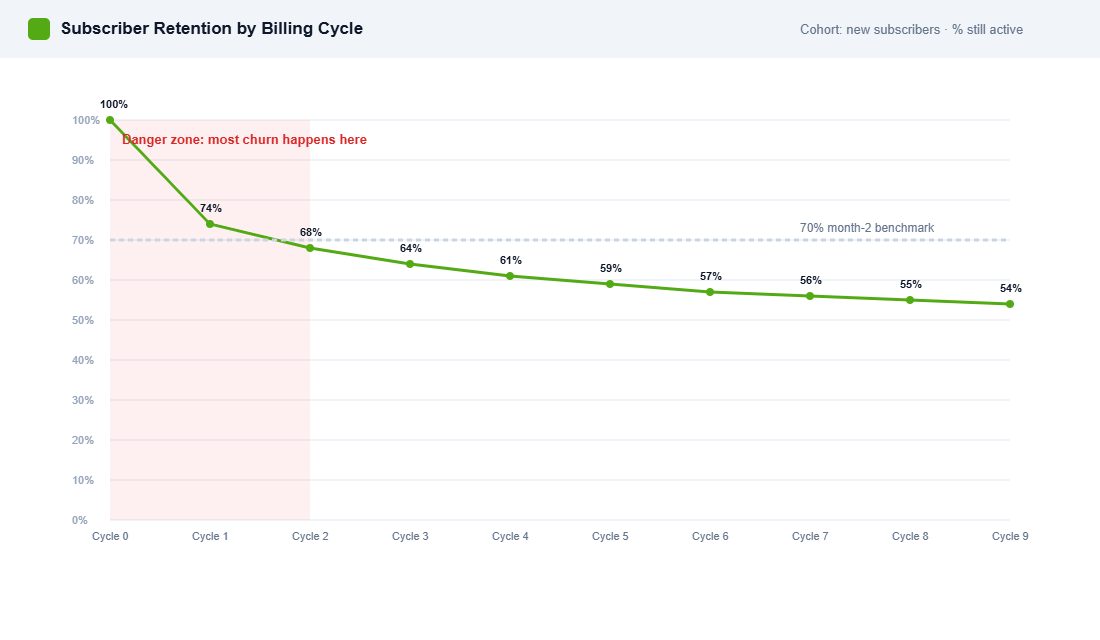
Why do those first cycles bleed? Usually three reasons: the customer forgot they subscribed, the second box arrived before they had finished the first, or the product did not land the way the ad promised. All three are fixable with a deliberate onboarding sequence rather than hope.
- Send a clear welcome. Confirm exactly what they signed up for, the next charge date, and how to manage it. Confusion is the number one silent cancel.
- Warn before you charge. A “your next order ships in 3 days” email with a one-click skip button builds trust and kills bill-shock cancellations.
- Nail the first unboxing. The first delivery is your retention pitch. Include a quick-start card, a usage tip, and a reason to stay for order two.
- Right-size the cadence early. If support is fielding “I have too much” messages, your default interval is too tight. Make adjusting frequency effortless.
Part 4: Plug the Involuntary Churn Leak
This is the part almost every Aussie founder ignores, and it is pure money left on the table. Between 20 and 40% of all subscription churn is involuntary: the customer never chose to leave, their payment simply failed. Expired cards, insufficient funds, a bank declining a recurring charge. On average, subscription brands lose around 10% of top-line revenue to failed payments every year.
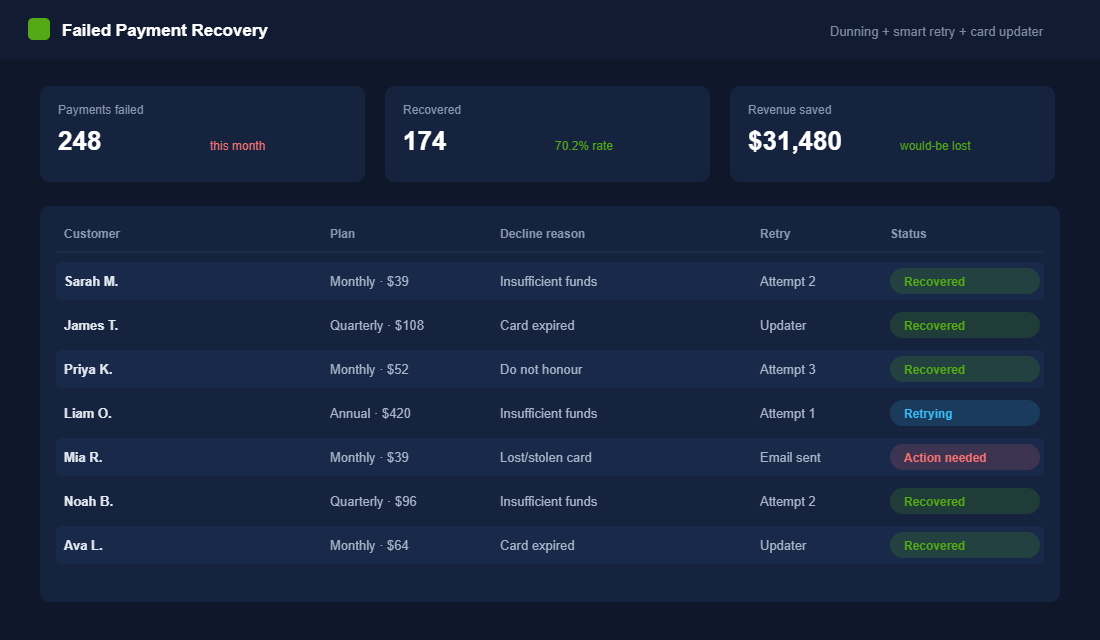
The good news is that because these customers wanted to stay, the revenue is highly recoverable. Industry data shows 60 to 80% of involuntary churn can be recovered with the right stack, and you can turn the whole thing on in an afternoon.
- Smart retry logic. Retrying a failed charge at optimised times recovers around 40% on its own. Recharge and most billing tools include this; switch it on.
- A card updater service. Automatically refreshes expired or reissued card details before the charge, recovering roughly another 25%.
- A dunning email sequence. A short series asking the customer to update their card adds another 15 to 20%. Keep it friendly, not threatening.
- Watch the threshold. If involuntary churn runs above 1% monthly or you recover less than 30% of soft declines, your dunning is leaving cash on the table.
Stack all three and recovery climbs to around 70% of failed payments. For a brand doing $180k in monthly recurring revenue, that is the difference between quietly losing tens of thousands a year and keeping it.
Part 5: Build a Save Flow, Not a Cancel Button
When a subscriber heads for the exit, most stores show them a single grey “cancel” button. That is a choice to lose revenue you did not have to lose. A save flow intercepts the cancellation and offers a smaller commitment before the customer leaves entirely. Plenty of people are not done with you. They are just busy, overstocked, or going through a tight month.
- Pause or delay. “Too much stock? Push your next order out 4 weeks.” Who Gives A Crap lets customers pause or delay in a couple of clicks, which keeps the subscription alive instead of killing it.
- Skip the next order. One skipped delivery beats a permanent cancel every time.
- Swap or downsize. Let them change product, size, or frequency. A smaller order is still recurring revenue.
- Targeted save offer. For price-sensitive cancels, a one-time discount on the next order can rescue an otherwise-lost subscriber.
- Ask why. A one-question cancellation survey tells you whether you have a product problem, a cadence problem, or a price problem. That data is gold.
For the customers who do cancel anyway, the relationship is not over. A structured reactivation sequence wins a meaningful share of them back, and we lay out the exact emails in the Shopify Win-Back Flow. Treat cancellation as a pause in the relationship, not the end of it.
The Compound Effect: Five Parts, One Flywheel
Each part is useful on its own. Together they become a flywheel. The right model attracts subscribers who actually fit. A strong offer locks them in for the long haul. A deliberate first-two-cycle onboarding gets them past the danger zone. Dunning quietly recovers the payments that would have leaked away. And a save flow catches the ones drifting toward the door.
The result is a base of recurring revenue that grows every month you add more subscribers than you lose. That predictable base lets you forecast cash, commit to inventory earlier, and outbid one-time competitors on ads because you know what a customer is truly worth. This is the same compounding model that lets brands like Chewy build the majority of revenue on autopilot. Build the flywheel once and it keeps turning while you sleep.
The brands that win subscription do not treat it as a feature they launched once. They treat it as a number they manage every week: how many subscribers came in, how many lapsed, how much was recovered, and where the curve is bending. Give one person ownership of that number and the flywheel keeps accelerating instead of quietly stalling.
Your Subscription Health Scorecard
Run your program against these targets every month. If a metric is off, the fix usually sits in the matching part of this playbook.
- Monthly churn: under 3% is top quartile, 6 to 8% is average. Above that, revisit your model (Part 1) and onboarding (Part 3).
- Month-2 retention: aim for 70% or higher. Below it, your first two cycles need work.
- Involuntary churn: keep it under 1% monthly. Higher means your dunning stack (Part 4) is not switched on properly.
- Failed-payment recovery rate: target 60% or more. Under 30% means real money is leaking.
- Subscriber LTV vs one-time LTV: you want at least a 3x multiple. Less means your offer or retention needs sharpening.
- Annual prepay mix: grow the share of prepaid plans. They retain about 2.5x better and pay you upfront.
Inside eCommerce Circle, building a subscription engine is one of the core Patrons pillars we work on with every member. If you want a second opinion on yours, let’s talk.