Most Aussie Shopify founders treat SMS as a box they ticked once. They switched it on in Klaviyo, wired a 10% welcome code to it, and went back to obsessing over Meta ads. The channel sits there doing maybe 2% of revenue when it should be doing 10 to 15%.
What’s in This Article
Meanwhile the numbers on this channel are absurd. SMS messages get opened around 98% of the time, and roughly 90% are read within three minutes of landing. Email, the channel you spend hours on every week, averages around 20% opens on a good day.
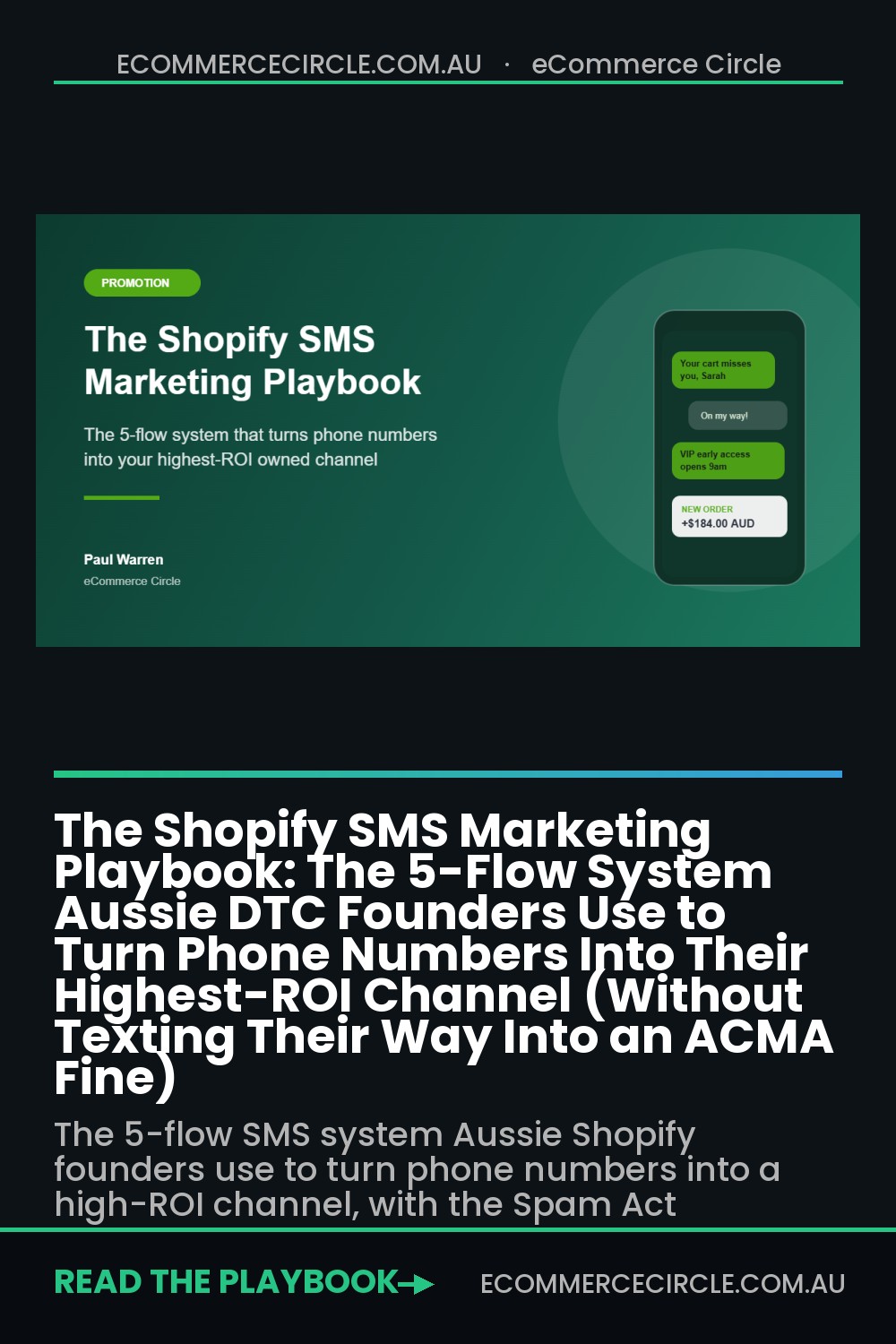
The gap between stores that print money with SMS and stores that annoy people with it is not talent. It is a system. Brands like LSKD, Princess Polly and Hismile treat SMS as a precision channel with a handful of core flows and strict rules about who gets texted and when. This playbook gives you that same 5-flow system, plus the Australian compliance layer most overseas guides skip entirely.
Why SMS Is the Channel Most Aussie Stores Are Still Sleeping On
Industry benchmark studies consistently put SMS marketing returns somewhere between $21 and $71 for every $1 spent. Ecommerce revenue per send averages around $0.71, and the best automated flows like abandoned cart texts generate between $3 and $10.78 per message sent. Those are not email numbers. Email earns cents per send. A well-built SMS flow earns dollars.
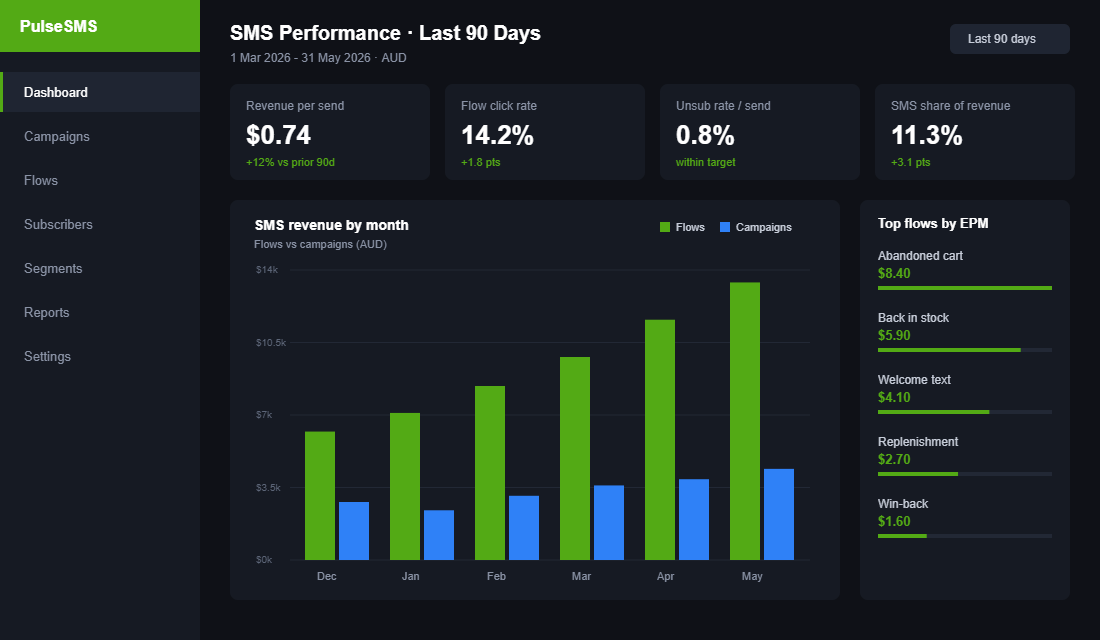
The catch is cost. In Australia you will pay roughly 7 to 9 cents per SMS segment through platforms like Klaviyo, versus fractions of a cent for an email. That single fact should shape your entire strategy. SMS is not a broadcast channel where you spray your whole list and hope. It is a sniper channel for high-intent moments: a cart sitting abandoned, a restock someone asked about, a VIP drop.
The proof is local. LSKD, the Queensland fitness apparel brand that has scaled past $100 million in revenue, moved its SMS program into Klaviyo so email and text could run off the same customer data. The result was cleaner attribution, no more double-messaging customers across channels, and a doubling of year-on-year flow revenue in 2024 alongside 45% growth in ecommerce revenue. The channel did not work because they sent more texts. It worked because every text knew exactly who it was talking to.
The Compliance Layer: Get the Spam Act Right Before Your First Send
Before you build a single flow, understand the rules. SMS marketing in Australia is governed by the Spam Act 2003 and enforced by the ACMA, and the regulator has been handing out seven-figure penalties to brands that got sloppy. Repeat corporate breaches can cost up to $2.1 million plus. This is not a “we will fix it later” item.
Here is what every text you send must get right:
- Consent first. You need express consent (they ticked a box, filled a form, or texted you a keyword) or inferred consent from a genuine ongoing customer relationship. A purchase alone is shaky ground for marketing texts. Capture express consent and keep the record: who, when, how.
- Identify yourself. Every message must carry your business name, or your name and ABN. “Mystery brand” texts are illegal and they tank trust anyway.
- One-tap opt-out. Reply STOP must work, must not require a login or extra personal details, and must stay functional for at least 30 days after the send. Action every unsubscribe within 5 business days. Good platforms do this automatically, but you are still the one legally on the hook.
- Register your sender ID. Since 15 December 2025, the ACMA SMS Sender ID Register applies to alphanumeric sender names. If your texts come from “YOURBRAND” rather than a number, register the name or risk carriers flagging and blocking your sends.
If your refund and returns wording needs the same tidy-up, the Shopify Consumer Law Playbook covers the ACL side of staying out of regulator trouble. Compliance sorted, now the fun part.
Flow 1: Capture Mobiles at Opt-In (Without Killing Your Email Pop-Up)
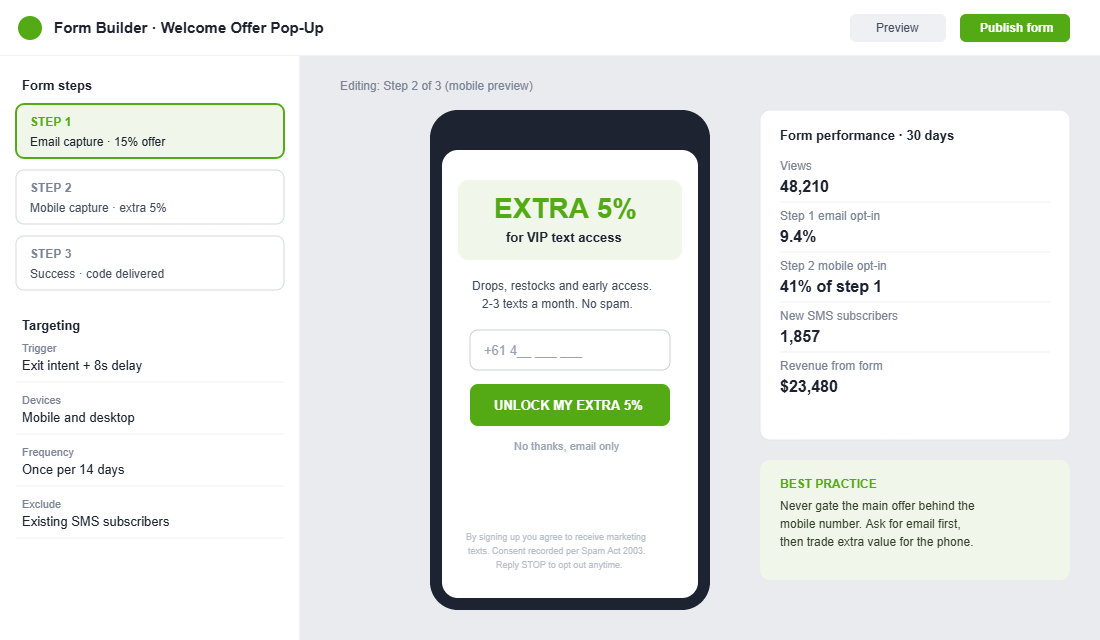
Your SMS program lives or dies on list growth, and the biggest mistake we see is gating the welcome discount behind a phone number. Demand the mobile upfront and your overall opt-in rate drops. Phone numbers feel personal. Emails feel disposable. Respect that hierarchy.
The fix is a two-step pop-up. Step one asks for the email and promises the offer. Step two, on a fresh screen, asks for the mobile in exchange for something extra: early access to drops, an extra 5% on the first order, or first dibs on restocks. The visitor has already said yes once, so the second yes comes easier. Run it this way and a meaningful chunk of your email opt-ins, often a third to a half, will hand over a mobile too.
Three more capture points most stores ignore:
- Checkout opt-in. Shopify lets customers tick SMS marketing consent at checkout. These are buyers, your highest-value subscribers. Switch it on.
- Back-in-stock requests. “Text me when it is back” converts ferociously because the intent is already there.
- Keyword opt-in. A “Text CIRCLE to…” call to action on packaging inserts and social bios captures people who never see a pop-up.
Your pop-up architecture matters as much as the incentive. The Shopify Email Pop-Up Playbook breaks down the 6-trigger capture system that pairs with this two-step approach.
Flow 2: The Abandoned Cart Text, Your Highest-Earning Message
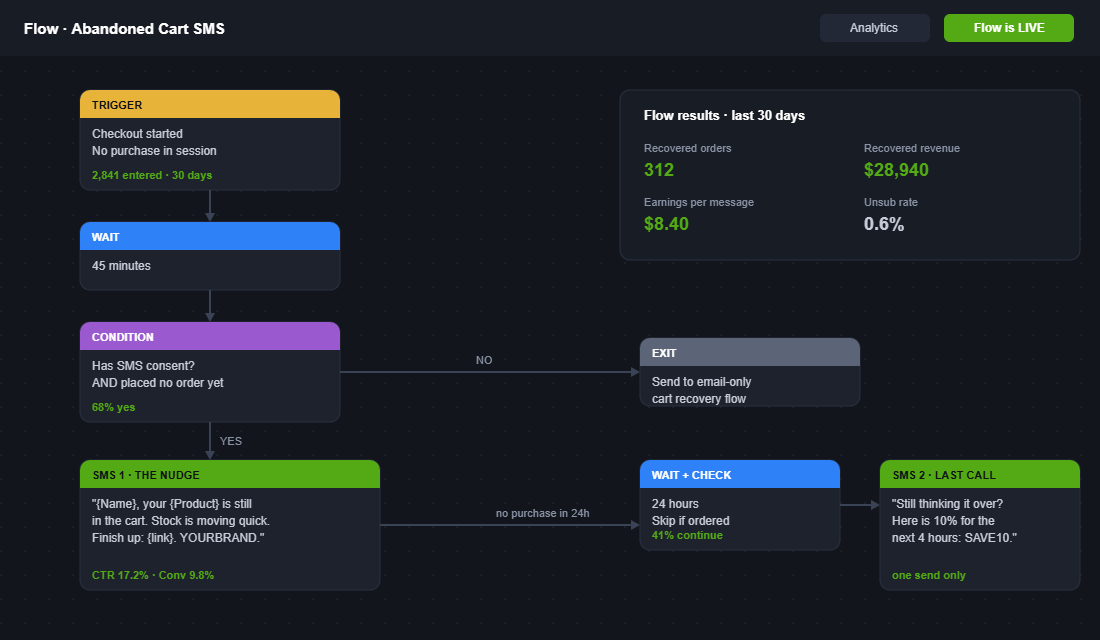
If you only build one SMS flow, build this one. Abandoned cart texts pull click-through rates of 11 to 19% and conversion rates of 7 to 14%, which is why their earnings per message sit at the top of every benchmark study. Around 70% of carts are abandoned, and the text message is the fastest recovery tool you own.
Timing beats cleverness. Send the text 30 to 60 minutes after abandonment, while the purchase intent is still warm and before your first recovery email lands. One text is the system. A second, 24 hours later with a soft incentive, is the maximum. Anything more starts costing you subscribers.
Copy that works follows a simple pattern: name, product, one line of personality, link. Something like: “Sarah, your Move Tee is still in the cart. We held it, but stock is moving quick. Finish up here: [link]. YOURBRAND. Reply STOP to opt out.” Short, identified, compliant, and straight to the point.
Do not lead with a discount. Train people that abandoning a cart earns 10% off and they will abandon carts professionally. Save the incentive for the second message, and only for first-time buyers.
Flow 3: The Welcome Text That Sets Up Everything After It
The first text someone receives from you decides whether they stay subscribed. Send it within minutes of opt-in, while your brand is still on their screen. It has three jobs: deliver the promised offer instantly, say who you are, and set expectations for what comes next.
A strong welcome text looks like: “Welcome to the inner circle. Here is your 15% code: WELCOME15. We text 2 to 3 times a month, drops and early access only, no spam. YOURBRAND. Reply STOP anytime.” You have delivered value, made a frequency promise, and pre-empted the unsubscribe.
Then let email do the heavy lifting. SMS opens the relationship; your welcome email sequence builds it. The two should run as one coordinated onboarding, which is exactly how the 7-email Klaviyo welcome sequence is structured. If the welcome email already converted the subscriber, your platform should automatically pull them out of the SMS push. Nobody should ever get a “use your code” text for a code they used yesterday.
Flow 4: Back-in-Stock, Price Drops and VIP Early Access
These are the highest-intent moments in your entire customer lifecycle, and they are where SMS embarrasses every other channel. Someone who asked to be told when the black size M is back does not need persuading. They need a text that arrives before the restock sells out again.
Back-in-stock texts should fire the moment inventory syncs, with the product name and a direct link to the variant they wanted. No creative required. Speed is the creative.
VIP early access is the retention play. Build a VIP segment from your top spenders and most frequent buyers, then give them genuine first access to launches and sales, 24 hours before email goes out. The exclusivity is real, so the channel feels like a privilege instead of an interruption. If you have not segmented your base yet, the RFM Segmentation Playbook shows you how to find those champions in an afternoon.
This is the layer where Princess Polly lives. After consolidating email, SMS and app messaging into one platform in 2025, the Gold Coast-born fashion brand grew global platform revenue 2.8x year on year, with more than 60% of that revenue coming from automations rather than manual campaigns. The lesson for a store doing $80k a month is identical: the money is in the triggered flows, not the Friday blast.
Flow 5: Post-Purchase, Replenishment and Win-Back
After the sale, restraint becomes your superpower. Shipping updates belong in email and your order tracking page, not marketing SMS. Use the text channel post-purchase for exactly three things:
- The review ask. Seven to ten days after delivery, one text: “How is the Move Tee going, Sarah? A 30-second review helps us heaps: [link]”. Response rates beat email review requests comfortably.
- Replenishment reminders. If you sell anything consumable (skincare, supplements, coffee, pet food), text when the product should be running low. A reminder at day 25 for a 30-day supply lands at the precise moment of need.
- The win-back. When a customer goes quiet past your usual repurchase window, a single “we miss you” text with your strongest offer will rescue a slice of them. Send it once. Lapsed customers who ignore two win-backs are telling you something. Listen, suppress, and stop paying 8 cents a message to be ignored.
Campaign Cadence: How Often to Text Without Burning the List
Flows are triggered by behaviour, so they almost never feel spammy. Campaigns, the manual sends, are where lists die. The rules that keep yours alive:
- Two to four campaigns a month, maximum. Launches, genuine sales, and not much else. Every text should pass the “would a VIP customer thank us for this?” test.
- Respect the clock. Send between 10am and 8pm in the recipient’s time zone. A 6am text is an unsubscribe with extra steps, and Australia spans three time zones on a good day and five during daylight saving.
- Segment before you send. Engaged-last-90-days gets the standard send. VIPs get early access. Everyone else gets left alone. Whole-list blasts are how you pay top dollar to generate unsubscribes.
- Watch two numbers. Unsubscribe rate per send above 1 to 1.5% means you are texting too often or too broadly. Revenue per send below your cost per send means the message should not have gone out.
One sneaky cost trap: an SMS segment is 160 characters, but add an emoji and the encoding switches, cutting segments to 70 characters. One innocent flame emoji can literally double the cost of a campaign. Write clean, plain texts and keep the emojis for Instagram.
The Five Mistakes That Kill Aussie SMS Programs
We see the same failure patterns on store audits over and over. Check yourself against this list before you scale spend on the channel:
- Treating SMS like email. Same message, same day, both channels. Subscribers notice, and the channel that costs 8 cents a send is the one they cut. Every text needs a reason to be a text: urgency, exclusivity, or a time-sensitive trigger.
- Importing your email list into SMS. Email consent is not SMS consent under the Spam Act. Full stop. Each mobile number needs its own opt-in record, or you are building your channel on a compliance landmine.
- No quiet hours for New Zealand and WA subscribers. Your 7pm Sydney campaign lands at 9pm in Auckland and 5pm in Perth. Set sends to local time zones in your platform, not your own clock.
- Ignoring the disengaged. Paying to text someone who has not clicked in six months is donating money to your SMS provider. Sunset anyone with no clicks across their last 8 to 10 sends.
- Measuring opens instead of dollars. The 98% open rate is a vanity metric since previews count as opens. Judge the channel on revenue per send, flow conversion rate, and list growth. Dollars, not dopamine.
The Tool Setup: Klaviyo SMS in an Afternoon
If you are already running email through Klaviyo, adding SMS there beats bolting on a separate tool, because suppression, attribution and profiles all live in one place. That single-platform decision is most of why the LSKD and Princess Polly numbers above were possible. Postscript and Attentive are solid SMS-first alternatives, but for most Aussie stores under $5 million, one platform for both channels wins.
The setup, in order:
- 1. Activate SMS in Klaviyo account settings, select Australia as a sending country, and review local pricing (expect roughly 7 to 9 cents per segment).
- 2. Sort your sender ID. Register your alphanumeric sender name with the ACMA register, or use the dedicated number Klaviyo assigns.
- 3. Switch on compliance defaults: quiet hours, automatic STOP handling, and the consent record-keeping that the Spam Act requires.
- 4. Rebuild your pop-up as two-step with the mobile ask on screen two, and enable the SMS consent tick-box at Shopify checkout.
- 5. Build the five flows in this order: abandoned cart, welcome, back-in-stock, review ask, win-back. The first two will pay for the rest.
- 6. Set a weekly scoreboard: list growth, revenue per send, unsubscribe rate per send, and SMS revenue as a share of total. That last number should climb toward 10% within a quarter.
The Compound Effect: One Conversation Across Two Channels
None of these five flows is impressive on its own. A cart text here, a restock ping there. The compounding starts when they run as one system with your email program: the pop-up feeds both lists, the welcome text opens what the welcome emails close, the cart text catches what the cart email misses, and the VIP texts protect the customers your win-back flows fought to keep.
That is the real reason the top Aussie brands moved everything onto one platform. Hismile manages over 8 million profiles across six Shopify stores from a single customer database, which means every text and every email knows the full history behind it. You do not need 8 million profiles to copy the principle. You need your two channels reading from the same playbook, starting this week.
Run the maths on your own store: if SMS is sitting under 5% of revenue, the five flows above are conservatively worth a 5 to 10% lift in total revenue within 90 days, mostly from carts and customers you were already paying to acquire.
Inside eCommerce Circle, owned channels like SMS and email sit at the heart of the Promotion pillar we work on with every member. If you want a second opinion on your flow setup, let’s talk.