Open ChatGPT right now and type the exact phrase a first-time buyer would use to find your product. Something like “best natural sunscreen Australia” or “most durable carry-on luggage for Aussie travel”. Read the answer carefully. If your brand is not in that list, you have a problem that no amount of Meta spend will fix.
What’s in This Article
This is not a distant threat. PayPal research found that 48% of Australians have already used an AI assistant for online shopping searches, and the 2026 Consumer Pulse Survey put 23% of Australian consumers on record saying large language models are now their primary product discovery channel. Meanwhile Google zero-click searches hit 68% in early 2026, and Ahrefs measured a 58% lower click-through rate on the top-ranking page when an AI Overview sits above it.
So the traffic you used to earn by ranking is being answered on the results page instead. The good news is that the traffic still coming through is better. Across 94 seven and eight figure ecommerce brands, ChatGPT referral traffic converted at 1.81% against 1.39% for non-branded organic search, which is a 31% lift. Shopify reported AI referral sessions growing more than eight times year over year in Q1 2026, with AI-referred orders up nearly thirteen times. Fewer clicks, much higher intent.
Most Aussie founders respond to this by writing a blog post with “AI” in the title and hoping. That does nothing. One 2026 audit of 17 established DTC brands across apparel, skincare, supplements and homewares found visibility of zero across ChatGPT, Perplexity, Gemini, Copilot and Google AI Mode. Not low. Zero. Being a good brand with a good site is no longer enough to get quoted.
Here is the six-layer system we work through with members to change that. It is ordered deliberately. Layers one and two are plumbing and take a weekend. Layers three to five are where the compounding happens. Layer six is the one everybody skips, and it is why AI work keeps getting defunded before it pays off.
Layer 1: Baseline Your Share of Model Before You Change Anything
You cannot improve what you have never measured, and “I asked ChatGPT once and it mentioned us” is not measurement. The metric that matters is Share of Model: how often your brand appears in AI answers across a fixed set of buying prompts, tracked over time.
Build the prompt set first. Aim for 30 to 50 prompts drawn from four buckets:
- Category prompts. “Best merino base layers Australia”, “top rated dog food delivery AU”. These are where new customers find you.
- Comparison prompts. “X versus Y for sensitive skin”, “is bamboo or recycled toilet paper better”. These decide the shortlist.
- Problem prompts. “how do I stop my linen sheets pilling”, “what supplement helps with shift work sleep”. These are the ones your competitors ignore.
- Brand prompts. “is [your brand] any good”, “[your brand] returns policy”. These check whether the model describes you accurately, which matters more than most founders realise.
Run every prompt across ChatGPT, Google AI Mode, Gemini, Perplexity and Copilot. Log three things per prompt: whether you appeared, what position, and which URL was cited. Then log the same for your three closest competitors. Do this manually in a spreadsheet the first time so you actually read the answers. It is uncomfortable and it is the most useful hour you will spend this month.
One thing to control for: a study of 20,000 responses by Visibility Labs found that 80.2% of ChatGPT product recommendations changed when web search was enabled. Recommendations pulled from training memory and recommendations pulled from a live crawl are two different games. Test both, but optimise for the live crawl, because that is the one you can influence this quarter.
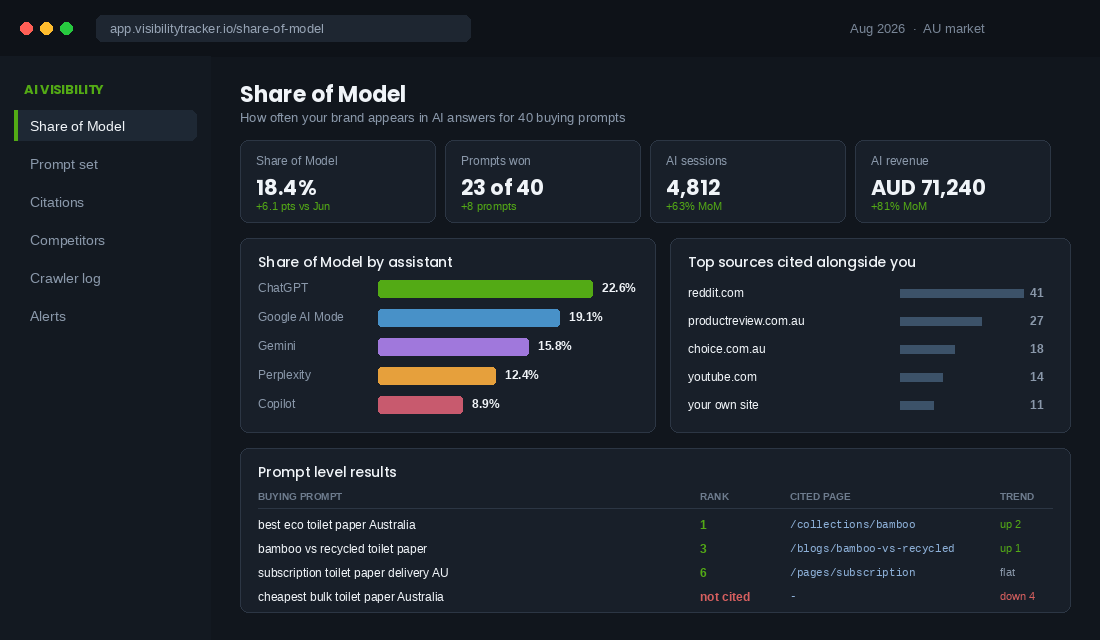
If you want this automated, Ahrefs Brand Radar and its free AI visibility checker will get you started, and Profound or Peec AI will give you prompt-level tracking with citation sources. Shopify app options like RankSight sit inside the admin if you would rather not add another login. Whichever you pick, take the manual baseline first so you know whether the tool is telling you the truth.
Layer 2: Make Your Store Readable To The Crawlers That Feed The Models
An analysis of 201,137 ChatGPT shopping prompt runs containing 812,190 product cards in June 2026 found that 87.3% of product cards were retrieved from web crawl, not from training data. That single number should reframe how you think about this. The models are not remembering you. They are reading you, live, at the moment of the query. If the crawl is broken, nothing else in this playbook works.
Check the four crawl gates
- robots.txt. Open yoursite.com.au/robots.txt and confirm you are not blocking GPTBot, OAI-SearchBot, PerplexityBot, ClaudeBot or Google-Extended. Plenty of Aussie stores blocked these in 2024 on a developer recommendation and never revisited it. That single line is costing you the whole channel.
- llms.txt. A plain Markdown file at the root of your domain that tells assistants what you sell, which pages matter, and where the specs live. Shopify does not generate one natively. Yoast SEO for Shopify has generated and weekly-refreshed it since its March 2026 update, or you can hand-write one in twenty minutes.
- Product schema. Every product needs price, availability, brand, GTIN and MPN in structured data. Missing GTINs are the single most common gap we see, and they matter because they are how a model confirms your listing is the same physical item another source reviewed.
- Machine readable policies. Shipping times, returns windows and warranty terms must exist as HTML text, not as an image or a PDF. An assistant asked “which Aussie brand has free returns” cannot read a JPEG.
Shopify also shipped Agentic Storefronts on 24 March 2026, which makes eligible merchant catalogues discoverable inside ChatGPT, Perplexity, Copilot, Google AI Mode and Gemini by default. Check whether your store is enrolled and whether your catalogue is actually flowing. Being in the pipe is not the same as being enrolled. We covered where this is heading in the Shopify Agentic Commerce Playbook, which is the transaction side of the same shift.
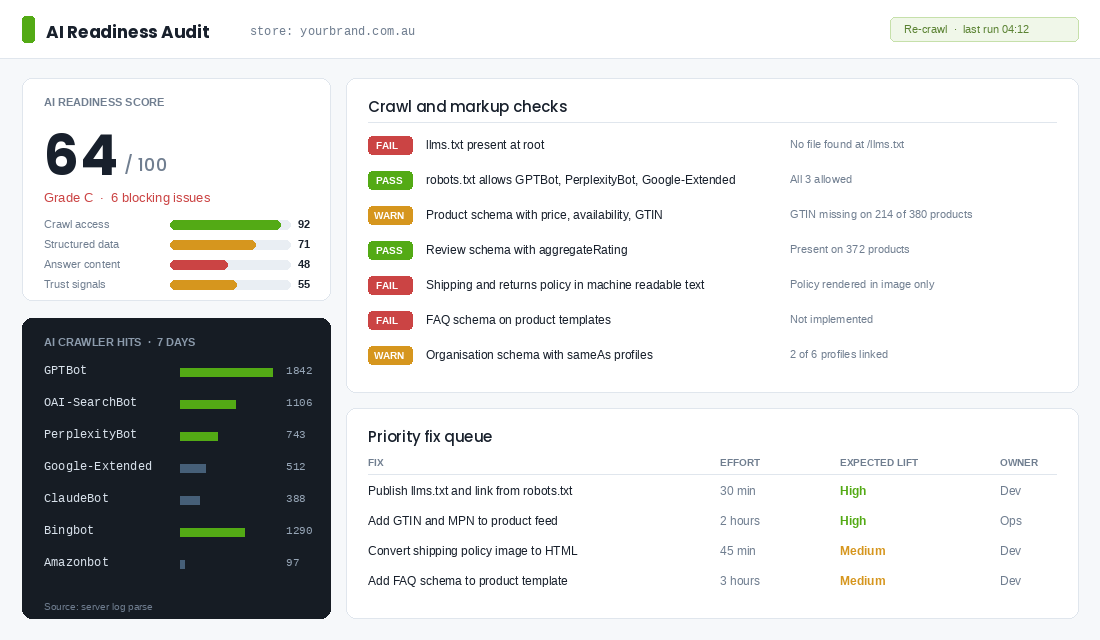
Then verify with server logs rather than assumptions. Pull seven days of logs and count hits by user agent. If GPTBot and PerplexityBot are not showing up at all, your problem is access, not content. Fix that before you spend a dollar on anything else.
Layer 3: Win The Third Party Sources The Models Actually Quote
This is the layer that separates brands that get recommended from brands that merely exist. Assistants do not trust your product page on its own. They triangulate. In ChatGPT beauty product tests, Reddit outranked every dedicated retailer as a citation source. Novi analysed 10.7 million citations across 98,000 source websites and found products with verified third party trust signals get recommended significantly more often.
Translated for an Australian operator: the model is asking “who else says this is good, and are they independent”. Your job is to make sure the answer exists.
- ProductReview.com.au. This is the highest-authority independent review source in the Australian market and it is routinely surfaced in AI answers about Aussie brands. If your listing is thin or has an old rating, that is what the model reads.
- Reddit and forums. Do not astroturf. Do participate honestly as the founder in r/AusFinance, r/australia, r/BuyItForLife and your category subs. A single detailed, useful comment thread outperforms a year of press releases in citation terms.
- Comparison and roundup content on other sites. Pitch yourself into “best of” lists on Australian publications and niche blogs. These are the pages models reach for when a prompt contains the word “best”.
- YouTube. Branded mentions on YouTube correlate strongly with AI brand visibility across ChatGPT, AI Mode and AI Overviews. A creator unboxing your product is a citable source in a way that your own video is not.
- Wikipedia-grade press. Melbourne-based Who Gives A Crap is a useful example. It has a Wikipedia entry and a decade of independent press coverage, which is precisely the source profile assistants weight heavily when asked about sustainable Australian brands. That authority was built through earned media, not ad spend.
One structural warning. A measurement of 22.5 million buy offers over ten days in March 2026 found Walmart taking 8.78% of all first-position retailer links on product cards. Marketplaces are being routed to aggressively. If you sell through a marketplace as well as your own store, the model may well recommend your product and send the click somewhere you earn less on it. That is a reason to strengthen your own citation footprint, not to abandon the channel.
Layer 4: Rewrite Your Pages As Answers, Not Brochures
Most Shopify product pages are written to feel premium. Assistants do not care how a page feels. They care whether it contains an extractable, specific answer to the question that was asked.
The test is simple. Take any 200-word block from your product page. Could a model quote it verbatim to answer a buyer question and be correct? If the block reads “crafted with care from the finest materials”, the answer is no. If it reads “220gsm Australian merino, machine washable at 30 degrees, shrinks less than 2% over 20 washes”, the answer is yes.
What to change this week
- Add a specification table to every product template. Dimensions, weight, materials, care, compatibility, country of origin. Plain HTML table, not an image.
- Write a genuine comparison page. “Bamboo versus recycled”, “our mid layer versus our heavy layer”. Comparison prompts are where purchase decisions get made and where most brands publish nothing.
- Answer the awkward questions on the page. Sizing between two options, what happens if it does not fit, how long delivery takes to WA and regional areas. Add FAQ schema so it is machine readable.
- Date and attribute your claims. “Tested by our team in June 2026” beats an undated superlative. Models increasingly favour content with clear recency signals.
- Fix your collection pages. A collection page with 40 products and no descriptive copy is invisible to a category prompt. Our Shopify SEO Playbook covers the structure that works here, and it applies directly to AI retrieval.
Australian specificity is an advantage worth pressing. When someone asks “best X in Australia”, the model needs signals that you are Australian: AUD pricing, local shipping detail, Australian Consumer Law returns language, state-level delivery times. Brands that write globally get filtered out of local prompts.
Layer 5: Give The Models The Trust Signals They Weight
Assistants are conservative about recommendations because a bad recommendation damages the assistant. They lean on proxies for reliability, and you can supply almost all of them.
- Volume and recency of reviews. A product with 340 reviews from the last twelve months reads as safer than one with 900 reviews that stop in 2024. Keep the flow going. The mechanics are in the Shopify Product Reviews Playbook.
- Verified purchase badges and aggregateRating markup. Both need to be present in schema, not just visually on the page.
- Certifications and standards. B Corp, Australian Made, ACO organic certification, OEKO-TEX. Name the certifying body and the certificate number where you can. Vague claims are now a compliance risk as well as a visibility one.
- A real about page. Founders, location, year established, manufacturing detail. Add Organisation schema with sameAs links to every social and directory profile you hold.
- Consistent NAP data. Name, address and phone identical across your site, Google Business Profile, ProductReview and every directory. Inconsistency reads as uncertainty.
Koala is a reasonable Australian reference point here. The brand publishes detailed specification and care content, carries a heavy independent review footprint, and is consistently described accurately by assistants as a result. That accuracy is earned through documentation, not messaging.
Layer 6: Measure The Traffic Properly Or You Will Underfund It
Here is the trap. GA4 misses somewhere between 35% and 70% of AI referral traffic by default, because the ChatGPT mobile app and Perplexity in-app browser frequently drop the referrer when opening an external link. Those sessions land in Direct. So you do the work, the revenue arrives, and your reporting credits it to nothing. Three months later the project gets cut.
The GA4 setup, step by step
- Go to Admin, then Data display, then Channel groups. Create a new custom channel group and name it something like “AI aware”.
- Add a channel called AI Assistants. Set the condition to Session source matches regex:
chatgpt\.com|openai\.com|perplexity\.ai|claude\.ai|gemini\.google\.com|copilot\.microsoft\.com|bing\.com/chat - Drag that channel above Referral in the priority order, otherwise Referral swallows it first.
- GA4 rolled out a native AI Assistant channel in May 2026 that became broadly available on 7 June. Keep it, but note it does not recognise Perplexity, so your custom group is still doing real work.
- Build a Free Form exploration with the custom channel group as the dimension and sessions, engaged sessions, conversions and revenue as metrics. Save it and check it weekly.
- For the Direct blind spot, segment Direct sessions that land on a deep URL rather than the homepage and have no prior session. That segment is a reasonable proxy for uncredited AI traffic. Watch it as a trend, not a precise figure.
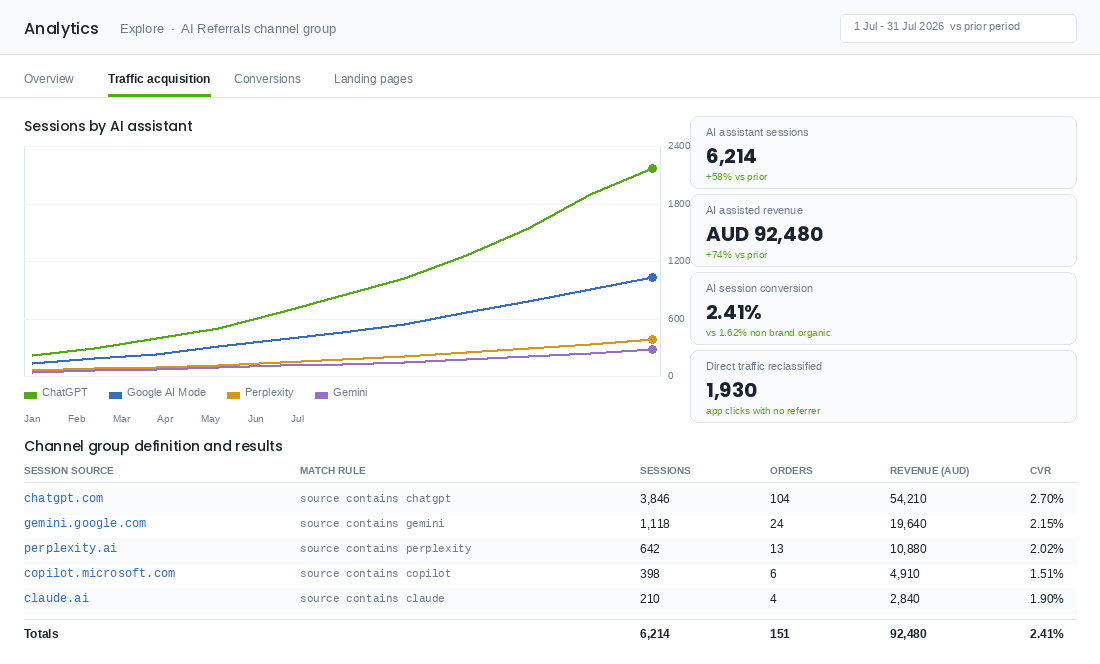
Pair this with UTM discipline on anything you seed yourself, and make sure your Shopify order attribution is not silently overwriting source data. If your UTM hygiene is shaky, start with the UTM Tracking Playbook before you build the AI reporting on top of it.
Why These Six Layers Compound
Run them in isolation and each one is worth a little. Run them in sequence and they multiply, because each layer makes the next one more effective.
Fixing the crawl gates in layer two means the third party citations you earn in layer three actually connect back to a readable store. The specification content in layer four gives the assistant something concrete to quote once it has decided you are credible. The trust signals in layer five are what tip a shortlist appearance into a first-position recommendation. And the measurement in layer six is what tells you which prompts moved, so the next quarter of work is aimed rather than guessed.
The timeline is realistic. Crawl and markup fixes show up in assistant answers within two to four weeks because the models re-crawl constantly. Citation building takes a quarter. Trust signal accumulation is a twelve-month exercise. Founders who start in August have a working AI channel by Christmas trading. Founders who wait until they see the revenue drop are starting from behind, against competitors who already own the prompts.
One more reframe worth holding onto. AI search does not replace SEO, it raises the bar on the same fundamentals. Clear structure, real specifics, independent proof, honest claims. Everything that made a page good for a human researcher in 2019 is what makes it quotable for a model in 2026. The brands that were already doing the work are the ones showing up.
Your 30 Day AI Visibility Sprint
Copy this into your project tool and work it in order. It is designed for one founder plus a developer with a few hours a week.
Week 1: Baseline and access
- Build a 40-prompt buying question set across category, comparison, problem and brand.
- Run every prompt across five assistants. Record appearance, position and cited URL.
- Repeat for your three closest competitors.
- Audit robots.txt for GPTBot, OAI-SearchBot, PerplexityBot, ClaudeBot and Google-Extended.
- Pull seven days of server logs and count AI crawler hits by user agent.
Week 2: Plumbing
- Publish llms.txt at the root and reference it in robots.txt.
- Audit product schema for price, availability, brand, GTIN and MPN. Fix the gaps.
- Convert any shipping, returns or warranty content trapped in images or PDFs into HTML.
- Add FAQ schema to the product template.
- Add Organisation schema with sameAs links to every profile you own.
- Confirm Shopify Agentic Storefronts enrolment status.
Week 3: Content and proof
- Add a specification table to your top 20 products by revenue.
- Publish one genuine comparison page for your two most-confused products.
- Claim and update your ProductReview.com.au listing.
- Pitch three Australian roundup or “best of” placements.
- Brief two creators for genuine YouTube coverage.
Week 4: Measurement and review
- Build the AI Assistants custom channel group in GA4 with the regex above.
- Create and save the Free Form exploration. Set a weekly calendar reminder.
- Build the Direct-deep-link proxy segment for uncredited AI traffic.
- Re-run the full 40-prompt set and compare against your week 1 baseline.
- Pick the five prompts closest to breaking through and aim next month at those.
If you only do three things: unblock the AI crawlers, publish llms.txt, and put a real specification table on your top 20 products. That is one weekend of work and it moves more brands into AI answers than anything else on this list.
Inside eCommerce Circle, AI search visibility is now part of the Promotion work we do with every member, because it is quietly reshaping where new customers come from. If you want a second opinion on where your store sits, let us talk.