Open your best-selling product page right now and read the description out loud. If it sounds like the back of a box (a list of materials, dimensions and a line the supplier wrote), you have a problem hiding in plain sight. The traffic is landing, the photos look sharp, and yet the page is leaking sales because the words are doing none of the persuading.
What’s in This Article
This matters more than most Aussie founders think. Nearly 8 in 10 shoppers say they have chosen not to buy a product because of poor or missing product content, and half have abandoned a purchase in the last six months simply because they could not find enough information. That is not a design problem or a traffic problem. That is a copy problem.
The good news: product descriptions are one of the cheapest levers you own. You do not need to rebuild your theme or double your ad spend. You need a repeatable way to turn specs into reasons to buy. This is the exact playbook we use with members inside eCommerce Circle, and you can run it on your top 20 products this week.
Why “good enough” product copy quietly costs you orders
Australians spent a record $82.6 billion online in 2025, up 13.9% on the year, but the average basket size actually dropped to around $96. Shoppers are buying more often and thinking harder about each purchase. When money is tight, weak copy gives them an easy reason to close the tab.
The cost shows up in three places. Around 30% of shoppers have abandoned a cart specifically because of poor product descriptions. Roughly 40% have returned an online order because the content was inaccurate or misleading, and returns quietly eat the margin you worked hard to win. Worst of all, 86% say they are unlikely to buy from a retailer again after receiving something that did not match the description.
So the description is not decoration. It sets the expectation that determines whether someone buys, whether they keep the item, and whether they ever come back. With the average Shopify store converting at just 2 to 3%, the words on the page are some of the highest-value real estate you have.
Start with the job your product gets hired to do
Before you write a single line, answer one question: what job is the customer hiring this product to do? People do not buy a 600 GSM towel. They buy the feeling of wrapping up in something plush after a beach swim. They do not buy a merino jumper. They buy being warm on the walk to the station without looking like they are wearing a doona.
This is the difference between describing the product and describing the result. Your description should make the reader picture their life with the thing in it. Lead with the outcome, then let the specs back it up. The order matters: outcome first, proof second.
A quick exercise for any product: finish the sentence “This is for the person who wants to ______ without ______.” For a reusable drink bottle that might be “stay hydrated through a full work day without refilling every hour.” That single line becomes the spine of your whole description. Everything else supports it.
Translate every feature into a benefit
Features tell, benefits sell. That sounds like a slogan, but it is the single habit that separates copy that converts from copy that fills space. A feature is a fact about the product. A benefit is what that fact does for the person reading. Your job is to translate every meaningful feature into the benefit underneath it.
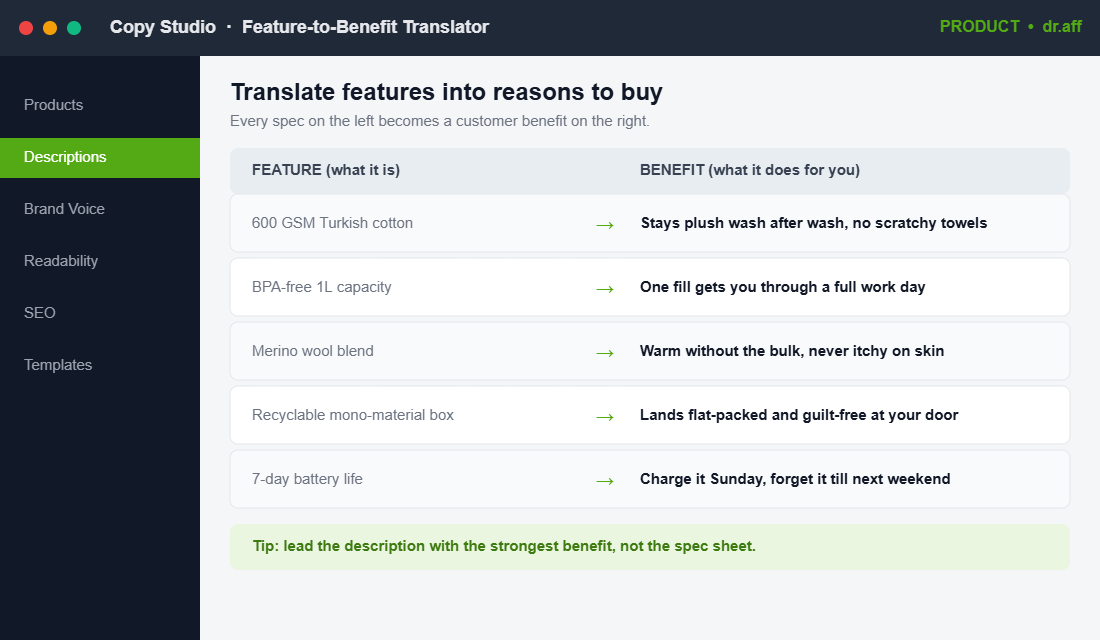
The fastest way to do this is the “so what?” test. Write the feature, then ask “so what?” until you hit something the customer actually cares about. “BPA-free 1L capacity” becomes “one fill gets you through a full work day, no chemical aftertaste.” “7-day battery life” becomes “charge it Sunday night and forget about it until next weekend.”
You do not throw the specs away. Buyers still want the GSM, the dimensions and the materials, especially for considered purchases. You just demote them. The benefit leads, the spec confirms. Keep the hard numbers in a tidy block near the bottom so the detail-oriented shopper can find them without the emotional buyer having to wade through them first.
Here is the same product written both ways. Spec-led: “Ceramic 350ml mug, dishwasher safe, available in four colours.” Benefit-led: “The mug that keeps your flat white warm to the last sip, survives the dishwasher every night, and comes in four colours that actually match your kitchen.” Same facts, completely different pull. The second version makes the reader picture Tuesday morning at their bench, and that picture is what gets clicked.
Write to one person, in a voice they remember
Generic copy is forgettable copy. The brands that win product pages write like a real person talking to one real customer, not a committee addressing a market. The clearest Australian example is Frank Body, the Melbourne brand built almost entirely on copywriting. Its “Frank” persona is cheeky, direct and a little flirty, and that voice turned a tub of coffee scrub into a business that has done tens of millions in sales.
Who Gives A Crap pulls the same trick in a category nobody wanted to talk about. Their product copy describes toilet paper as “as soft as unicorn kisses and as strong as 1,000 ponies.” It is silly, it is on brand, and it makes a commodity feel like a brand you want to be part of. The humour is not random. It does the selling by making the product memorable and the company likeable.
You do not have to be funny. You have to be consistent. Pick three or four words that describe how your brand should sound (warm, plain-spoken, expert, a bit irreverent) and hold every description to them. If you have not nailed down that voice yet, your About page is the best place to define it before it spreads across every product.
The 6-part description skeleton you can reuse
Once you have the job and the voice, you need a structure so you are not staring at a blank box for every SKU. This is the skeleton we hand members. It works for a $25 candle and a $900 sofa. You just dial the length up or down.
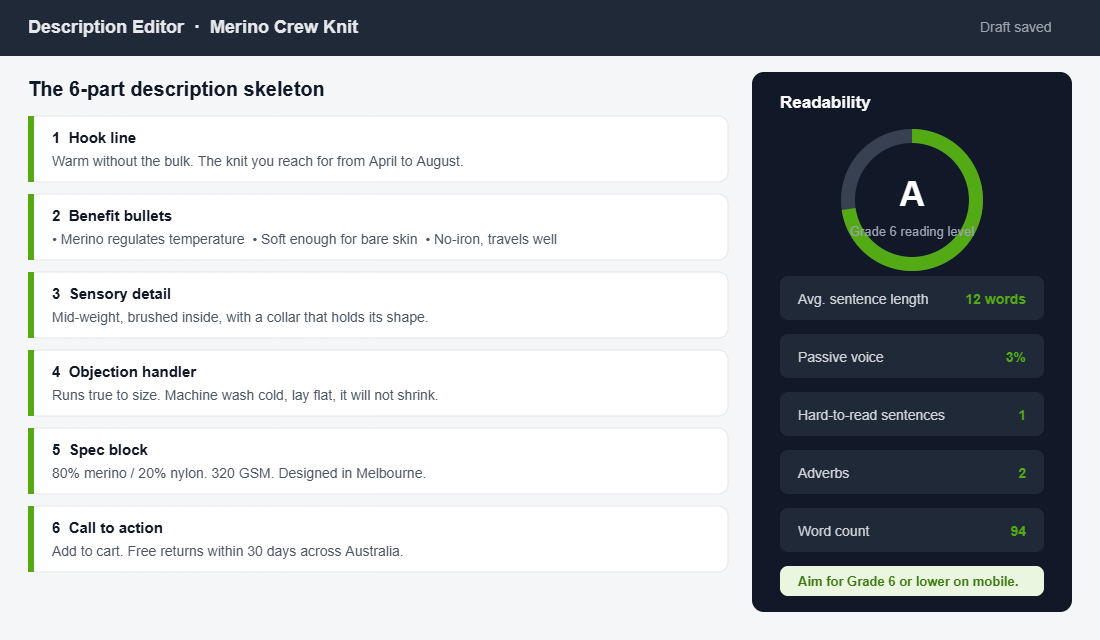
- 1. Hook line. One sentence that names the outcome. “Warm without the bulk, the knit you reach for from April to August.”
- 2. Benefit bullets. Three to five scannable points, each a benefit, not a spec.
- 3. Sensory detail. One or two lines that let the reader feel, see or smell it. This is what photos cannot do.
- 4. Objection handler. Answer the doubt that stops the sale: sizing, fit, care, compatibility, delivery.
- 5. Spec block. The hard facts in a tidy list for the detail-driven shopper.
- 6. Call to action. A nudge plus a risk reducer, like free returns within 30 days across Australia.
Save this as a template in a Google Doc or a Shopify metafield and your team can fill it in for new products in minutes. Consistency is a feature in itself. When every product page follows the same rhythm, shoppers learn where to look and your store feels more trustworthy.
Make it scannable or lose the mobile shopper
The majority of Australian Shopify traffic is on a phone, and nobody reads a wall of text on a phone. They skim. If your description is one dense paragraph, the skimmer bounces, and remember that poor descriptions already drive about 30% of cart abandonment. Formatting is not cosmetic, it is conversion.
- Short sentences. Aim for an average of 12 to 15 words. Long sentences hide the point.
- Bullets for benefits. The eye lands on bullets first, so put your strongest reasons there.
- Bold the phrase that matters. One or two bolded benefits per description, no more.
- Grade 6 reading level. Run the copy through a free tool like the Hemingway Editor and cut until it scores Grade 6 or lower.
Plain does not mean boring. Frank Body and Who Gives A Crap are both written at a primary-school reading level, and they are anything but dull. Simple language is what lets the personality come through. Complexity is where conversions go to die.
Stop pasting the supplier’s words
If you dropship or carry brands you did not make, the temptation is to paste the manufacturer description and move on. The problem is that every other retailer carrying that product has pasted the exact same paragraph. You are now competing on a page that says nothing different to a hundred other stores.
Google has confirmed there is no direct penalty for duplicate manufacturer descriptions, so this is not about avoiding punishment. It is about competitive advantage. Stores that write unique descriptions stand out in search results, target the specific language their customers use, and answer questions the generic blurb ignores. Same product, better page, more of the sale.
A practical split: hand the plain manufacturer copy to your shopping feeds for Google and Meta, and write a richer, original version for your own product page. Layer in your sensory detail, your objection handling and your voice. This is also where strong copy and strong imagery reinforce each other, so pair this work with your product photography and your broader product page conversion setup.
Use AI for the first draft, never the final word
AI can take the blank-page pain out of writing 200 descriptions, but used lazily it produces exactly the generic mush we just told you to avoid. The right way to use it is as a junior copywriter that drafts, while you direct and edit. Shopify Magic is built into the admin and is the easiest place to start.
- Open the product. In your Shopify admin, go to Products, choose the item, and click into the Description field.
- Launch Magic. Click the Shopify Magic icon above the description box and select Generate.
- Feed it the brief. Add keywords, your hero benefit and a tone (for example “casual, confident, Australian”). The more direction you give, the less generic the output.
- Edit hard. Treat the draft as raw clay. Cut the fluff, drop in your own sensory line, add the objection handler, and rewrite the hook in your real voice.
- Check it reads human. Run it through Hemingway, trim to Grade 6, and read it aloud. If it sounds like a robot, it is not finished.
The 80/20 rule applies. Let AI handle the first 80% (the structure and the obvious benefits) and spend your time on the 20% that makes it yours: the voice, the specific objection, the line that makes someone smile. That last 20% is what the algorithm cannot copy and your competitor will not bother with.
Three description mistakes that quietly kill conversions
Most underperforming product pages share the same handful of faults. Once you can spot them, you cannot unsee them, and fixing them is usually a 10 minute job per product.
Mistake one: opening with a feature. “Made from 100% organic cotton” is a fine fact and a terrible first line. It asks the reader to do the translation work themselves, and most will not bother. Open with the result (“the tee that survives 100 washes and still feels new”) and let the cotton earn its place two lines down.
Mistake two: writing for everyone. When you try to appeal to every possible buyer, the copy goes vague and speaks to no one. Pick the one customer your product is genuinely best for and write to them. A description that nails the right person beats a bland one that mildly suits everybody. If you have not mapped that buyer yet, a simple customer avatar exercise pays for itself fast.
Mistake three: ignoring the obvious objection. Every product has the one question that stalls the purchase. For apparel it is sizing. For food it is shelf life or allergens. For electronics it is compatibility. If your copy does not answer it, the shopper either bounces to a competitor or buys, gets it wrong, and returns it. Name the objection and disarm it in the description, and you remove the last reason to hesitate.
Run your top sellers against these three faults first. They are the products where a small lift in conversion produces the biggest dollar result, so the same edit is worth far more on a hero SKU than on a long-tail one.
How the pieces compound
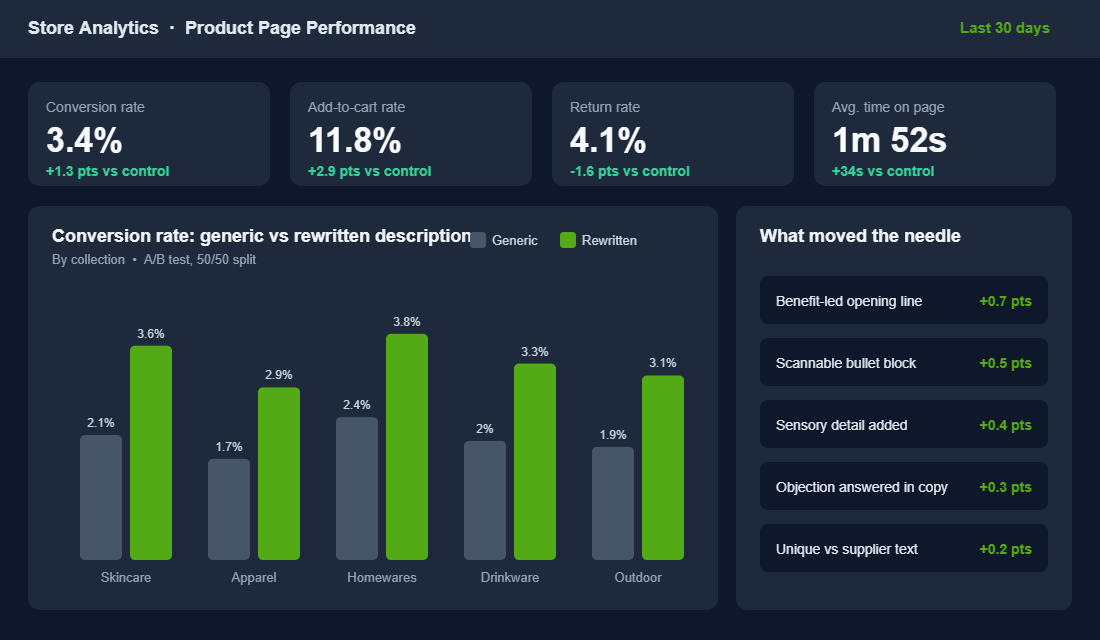
None of these moves is dramatic on its own. A benefit-led hook might add half a point of conversion. Scannable bullets add a bit more. A clear objection handler trims your returns. Unique copy edges you ahead in search. Individually they look small. Together they stack.
Picture a store turning over $80,000 a month at a 2.5% conversion rate. Lift that to 3.4% by rewriting your top 20 descriptions and you are looking at roughly a third more revenue from the same traffic, with no extra ad spend. Then add the quieter win: fewer returns because expectations match reality, and more repeat buyers because the first experience was honest. That is the compounding effect of getting your words right.
To prove it to yourself, do not rewrite everything blind. Pick five products, note their current conversion rate, rewrite the descriptions using the skeleton, and check the numbers four weeks later. When you can see a real lift on your own store with your own products, rolling the playbook across the rest of the catalogue stops feeling like a chore and starts feeling like found money.
You do not have to fix the whole catalogue at once. Start with the 20 products that drive 80% of revenue, run the skeleton across them this week, and measure the lift over the next month. Strong descriptions also do more work as your average order value grows, because better copy makes upsells and bundles an easier yes.
Your product description checklist
Before you hit save on any description, run it through this list. If it fails one, it is not ready.
- Job defined. The opening line names the outcome the customer is buying.
- Features translated. Every spec passed the “so what?” test and became a benefit.
- Voice consistent. It sounds like your brand, not the supplier or a template.
- Skeleton followed. Hook, bullets, sensory detail, objection, specs, call to action.
- Scannable. Short sentences, bullets, one or two bolded benefits, Grade 6 reading level.
- Original. Not pasted from the manufacturer, with your own angle and language.
- Objection answered. The number-one reason someone hesitates is handled in the copy.
- Risk reduced. Returns, shipping or a guarantee make the yes feel safe.
Inside eCommerce Circle, product copy is one of the core pillars we work on with every member, because it is the cheapest lever most stores are ignoring. If you want a second opinion on yours, let’s talk.