You are doing eighty grand a month and you are still the one packing the 4pm orders. You answer the “where is my order” emails. You schedule the EDMs. You reconcile the Shopify payouts against the bank on a Sunday night. And somewhere in the back of your head, a quiet voice keeps saying the same thing: I am the bottleneck.
What’s in This Article
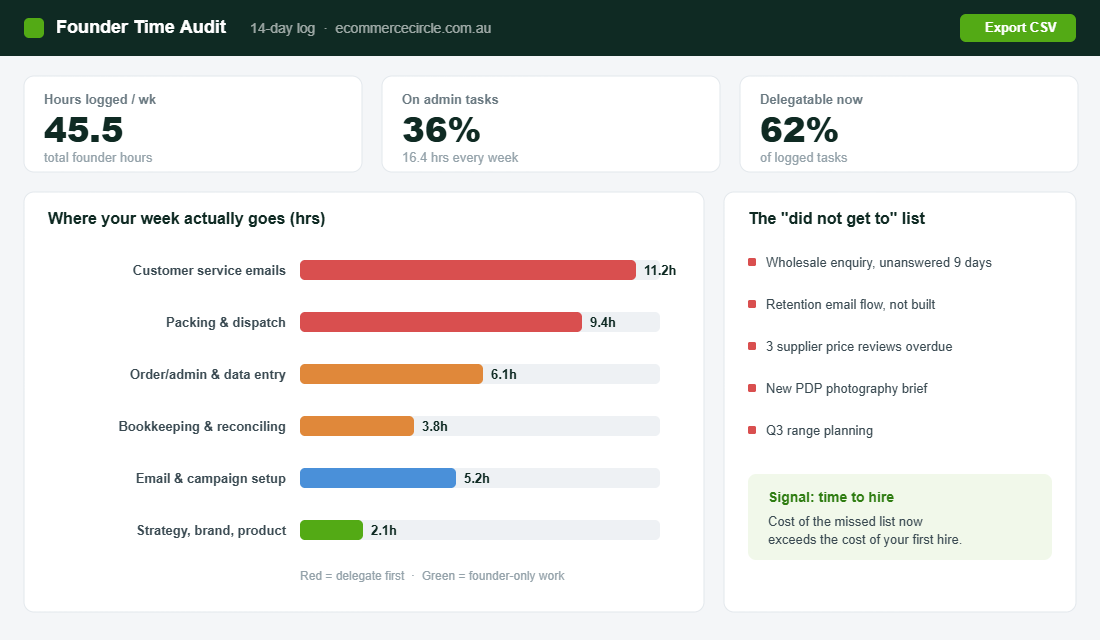
Here is the uncomfortable maths. The average founder works about 45.5 hours a week, and more than a third of that time, roughly 36%, disappears into small administrative tasks. Spend four hours a day on admin and that is 20 hours a week, half a full-time job, poured into work that does not grow the brand. You did not leave a job to become your own lowest-paid employee, but that is exactly what most founders quietly become.
Most founders know they need help. Where it goes wrong is the who and the when. They wait too long, hit the wall, then panic-hire a “marketing person” to fix a sales problem while the actual fire is burning in the inbox and on the dispatch bench. This playbook gives you the order to hire in, the signal that tells you it is genuinely time, and the system that makes a new hire stick instead of doubling your workload for a month.
Why Most Founders Hire the Wrong Role First
The instinct, when revenue plateaus, is to hire for growth. A media buyer. A “growth marketer”. Someone whose job is to make the number go up. It feels strategic and it feels like progress. At the first-hire stage it is usually a mistake.
Growth roles are the hardest in the business to manage when you have never managed anyone. You cannot brief what you cannot yet articulate, and most founders cannot describe their own marketing clearly enough to hand it to someone else. So the expensive hire flounders, you blame them, and you walk away convinced that “hiring does not work for us”. The problem was never the person. It was the sequence.
The right first hire almost always sits in operations: customer service, fulfilment, or admin. Small ecommerce businesses overwhelmingly hire into support and operations before growth, and there is a good reason. These roles have clear inputs and outputs. They are easy to train against a checklist. And they buy back the exact hours that are currently stopping you from doing the strategic work only you can do. You are not hiring to add capability you lack. You are hiring to reclaim the hours you are wasting on twenty-dollar work.
The Real Signal It Is Time (It Is a Log, Not a Revenue Number)
Founders love to ask “what revenue should I be at before I hire?” It is the wrong question. There is no magic number. The right signal is not on your P&L, it is in a log.
For two to three weeks, keep a rough daily record of every tactical task you touch and how long it takes. Packing orders, answering tickets, building emails, reconciling payments, chasing suppliers. Do not optimise anything yet, just record it. Then write a second list next to it: the things you did not get to. The wholesale enquiry you never replied to. The retention flow you keep meaning to build. The supplier price review that is three months overdue.
When the cost of that second list, the missed opportunities, is clearly bigger than the cost of a hire, you are not approaching the moment to hire. You are already late. A capable ecommerce VA from the Philippines typically costs somewhere between six and fifteen US dollars an hour depending on experience, which in Aussie terms lands a sharp, Shopify-literate support person well under the cost of a local casual. Against twenty reclaimed hours a week and a backlog of growth work you keep dropping, that number stops looking like an expense and starts looking like the cheapest leverage you can buy.
The 5-Role Order Aussie Founders Hire In
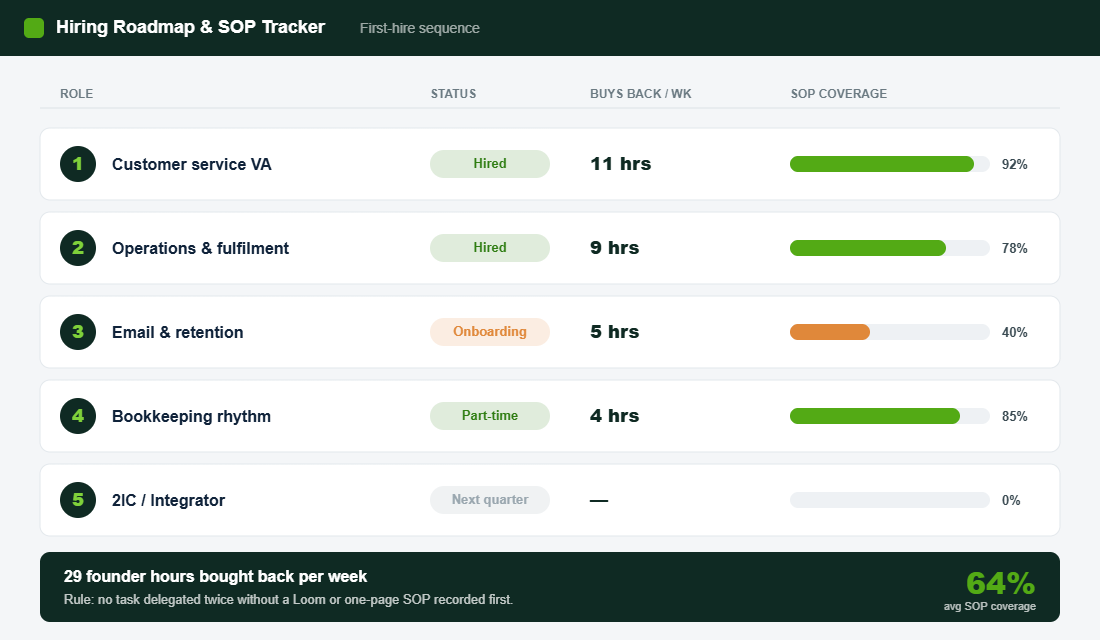
Across hundreds of Aussie Shopify founders, the same hiring order shows up again and again. You do not need all five seats filled at once. You need them in sequence, because each hire funds and frees you up for the next. Get the order right and every hire makes the following one cheaper and easier to manage.
- Role 1: Customer service. Highest volume, lowest judgement, direct line to revenue. Almost always first.
- Role 2: Operations and fulfilment. Picking, packing, inventory, 3PL and dispatch SLAs.
- Role 3: Email and retention. The owned channel with the best return, briefed once the data is clean.
- Role 4: Bookkeeping rhythm. Usually part-time, but non-negotiable. Stops the cash-flow surprises.
- Role 5: The 2IC. The integrator who runs the day-to-day so you can run the direction.
Role 1: The Customer Service Hire (Your Highest-Leverage First Move)
Customer service goes first for a reason. It is the highest-volume, lowest-judgement work on your plate, and it sits directly on top of revenue. Reply to a live chat within a minute and you convert roughly 15% higher than a brand that takes five minutes. Customers who get an answer inside 45 seconds are about three times more likely to buy. Move your pre-purchase first response from four hours to under one hour and email-attributed conversion can lift by around 18%. That is not “support”. That is sales happening in the inbox while you are stuck on the packing bench.
You are not hiring a career support lead yet. You want a sharp customer service VA with strong written English who can learn your brand voice and your policies. Start them at 20 to 25 hours a week, weighted to your peak inbox windows, and weighted to Australian business hours so customers are answered when they are actually shopping.
Before they start, deflect the easy stuff so they spend their time where a human is actually needed. A well-built FAQ page and a tight set of saved replies mean your new hire is not retyping the returns policy forty times a day. Then give them a real tool instead of a shared Gmail, because you cannot manage what you cannot measure.
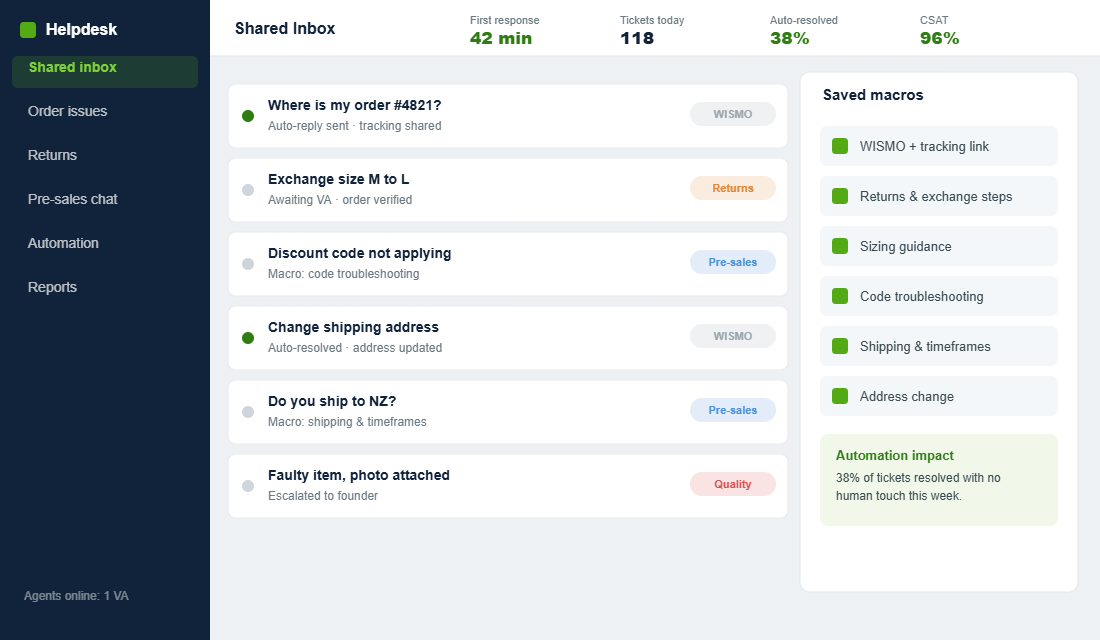
Tool spotlight: setting up Gorgias in five steps. Gorgias is the helpdesk most serious Aussie Shopify brands land on because it plugs straight into your store data. Here is the setup that makes a first hire productive from week one:
- Install and connect Shopify. Add Gorgias from the Shopify App Store and connect your store so order details, tracking, refunds and subscriptions appear inside every ticket. No tab-switching, no copy-paste.
- Pull every channel into one inbox. Connect support email, the contact form, live chat, and your Instagram and Facebook DMs so nothing important lives in a personal account only you can see.
- Build 8 to 12 macros. Write saved replies for your most common tickets: where is my order, returns, exchanges, sizing, code not working, address change. Use dynamic variables so each reply still reads as personal.
- Switch on automation rules. Auto-tag and route by intent, and let automation handle the truly repetitive tickets. Gorgias reports brands deflecting anywhere from 30 to 60% of incoming volume this way.
- Turn on agent metrics. Track first response time, resolution time and ticket volume per person. This is how you hold a remote hire accountable to a standard instead of a vibe.
Done properly, your first hire does not just clear the inbox. They protect conversion you were quietly bleeding every day you were too busy to reply. Fast, helpful service can lift conversion by as much as 30%, and the customers who get it stick around: excellent service correlates with about 87% retention versus 41% for poor service.
Role 2: The Operations and Fulfilment Hire
Once the inbox is handled, the next fire is usually the bench. If you are still picking, packing and chasing tracking yourself, you are spending founder hours on work you could pay twenty-five dollars an hour for. Worse, every hour on the bench is an hour not spent on the growth list that actually moves the business.
This hire owns the physical and logistical flow: picking and packing or managing your 3PL, inventory counts, restock alerts, supplier follow-ups, and dispatch service levels. The brief is concrete, which makes it the easiest role to train and the easiest to hold to account. Set the standards before you hand it over: a same-day dispatch cut-off time, a maximum pick-error rate, and clear restock trigger points per SKU.
This is also the person who keeps your supplier terms running day to day. If you have done the work on your supplier negotiations, the ops hire is who protects those terms, chases the late POs, and flags when a supplier quietly slips on lead time or quality. The founder sets the deal. The ops hire makes sure it actually happens.
Role 3: The Email and Retention Hire
Now, and only now, do you bring in marketing leverage. And even then you start with the channel you own rather than the channel you rent. Email and SMS are your highest-ROI dollars because you are talking to people who already raised their hand. Paid acquisition is a tax you pay to strangers. Retention is profit you already earned.
The maths sits firmly in your favour here. A 5% lift in retention can drive a 25% or greater increase in profit, and every dollar invested in keeping customers tends to return several times over in lifetime value and reduced churn. Your email hire owns the flows that capture that value: welcome, browse and cart abandonment, post-purchase, and win-back, plus the campaign calendar in a platform like Klaviyo.
Here is why this role works at position three and not position one. By now you have a customer service hire feeding you the real objections customers raise, and a clean operations process feeding accurate data. The marketer is no longer guessing at what to say or who to say it to. They are building on a foundation, which is the difference between an email hire who pays for themselves in a quarter and one who quietly spins their wheels.
Role 4: The Bookkeeping and Finance Rhythm
This one is less a full-time hire and more a non-negotiable rhythm, usually a part-time bookkeeper or BAS agent. The classic trap is treating finance as a once-a-year shoebox of receipts handed to the accountant in a panic the week before the deadline.
A weekly reconciliation of Shopify payouts against your bank, a monthly profit and loss statement you actually read, and clean GST and BAS handling stops the two things that kill otherwise-healthy stores: cash-flow surprises and tax-time scrambles. Plenty of brands that look like they are winning on revenue are quietly insolvent on cash because nobody is watching the timing.
You do not need to do this work yourself. You do need to read the one-page summary every single month and know your numbers cold. Delegate the data entry and the reconciliation. Never delegate knowing whether you are actually making money.
Role 5: The 2IC Who Finally Sets You Free
The final hire in the sequence is the one that genuinely changes your life: a second in command who owns the day-to-day so you can own the direction. This is not a VA and it is not a coordinator. It is someone who holds the team accountable, runs the weekly rhythm, and absorbs the hundred small decisions that currently bounce back to you.
Timing matters more here than anywhere. Hire this person too early and you are paying senior money for tasks a VA should own, and you will resent the cost. Hire them at the right time, once roles one to four are humming and documented, and they become the multiplier on everything you have built. They free you to step fully into the founder work, brand, product, partnerships and range strategy, that nobody else in the business can do.
What Frank Body and Who Gives A Crap Actually Did
The biggest Aussie DTC success stories did not scale by founders working harder. They scaled by deliberately building a machine and then stepping back from the controls. Frank Body launched in 2013 when five co-founders pooled ten thousand dollars and a cheeky tone of voice. By the end of year three the brand had hit twenty million dollars in sales, and it later carried a hundred-million-dollar valuation.
Here is the part founders miss. As Frank Body matured, several co-founders deliberately stepped back from executive roles into advisory and board positions, handing operational seats to a built-out team. They did not cling to the day-to-day. They hired and structured their way out of it so the founders could focus where they added the most value. Who Gives A Crap tells a similar story: three founders in 2011 who turned a single cheeky toilet-paper idea into a global operation donating half its profits, which only works at scale because they built the operational team to run it.
The lesson for a forty-to-five-hundred-thousand-a-month operator is not “raise capital and hire fifty people”. It is the mindset underneath it. The founders who break through treat getting out of operational seats as the job, not a luxury for later. The hiring sequence below is simply the small-brand version of what they did.
The SOP System That Makes Any Hire Stick
Here is the part most founders skip, and it is exactly why their first hire fails. They hand over a task by doing it once on a quick Zoom call, then wonder why it is done wrong for a month and conclude the hire was a dud. The hire was fine. The handover was the problem.
The fix is simple: document as you delegate. You do not need a polished operations manual gathering dust. You need three lightweight things in place before you hand anything over:
- A Loom for every recurring task. Next time you do the task, hit record and narrate it as you go. Ten minutes of screen recording beats an hour of live training, and unlike the Zoom call it exists forever and trains the next hire too.
- A one-page SOP per process. In a shared doc, capture the trigger, the steps, the standard for “done well”, and the common mistakes. Tools like Trainual or even a tidy Notion wiki keep them all in one place.
- A single source of truth. Macros live in the helpdesk, SOPs live in the wiki, the campaign calendar lives in your email tool. Nothing business-critical lives only in your head.
Make this your rule and never break it: you are not allowed to delegate a task twice without recording a Loom or writing a one-page SOP first. Do that once and your second hire onboards in days instead of weeks, and the quality of the work stops depending on whether you happened to explain it well that day. While you are tidying your stack, it is worth running an app stack audit so the tools your new team inherit are the ones that actually earn their keep.
The First Hire Audit: Your Five-Question Takeaway
Before you post a single job ad, run this audit and write the answers down. If you cannot answer the last two, you are not ready to hire. You are ready to document, and that is the work to do first.
- 1. The time log. Across two weeks, what are the three tasks eating the most of your hours? Be honest, use the real numbers.
- 2. The dollar test. Would you happily pay someone twenty-five to forty dollars an hour to do each of those tasks? If yes, it is delegatable right now.
- 3. The order check. Are you about to hire for growth before operations and support are handled? If so, stop and re-sequence.
- 4. The standard. For the role you are hiring, what does “done well” look like in numbers? Response time, dispatch SLA, error rate, flow completion.
- 5. The SOP gate. Do you have a Loom or a one-page SOP for the core tasks this person will own? If not, record it this week, before they start.
How the Sequence Compounds
Each hire funds and enables the next, which is the whole point of the order. Customer service protects the conversion that pays for operations. Operations frees your hours and cleans the data that makes the email hire effective. The email hire grows repeat revenue, and a 5% retention lift turning into a 25% profit jump is what funds the finance rhythm and eventually the 2IC.
Skip the order and the system breaks. Hire the growth marketer first, with no ops support and no SOPs, and you get an expensive person doing their own admin and quietly blaming the founder for the chaos. Follow the order and the opposite happens: every hire makes the next one cheaper, easier to manage, and faster to pay for itself.
The founders who escape the day-to-day are not the ones grinding the hardest. They are the ones who hired in the right order, wrote down how the work is actually done, and had the discipline to step back once the machine could run without them. That is not a personality trait. It is a sequence, and you can start it this week with a fourteen-day time log.
Inside eCommerce Circle, building your first team and the SOPs that make it stick is one of the core pillars we work on with every member. If you want a second opinion on who to hire next, let’s talk.