Here is how most Aussie founders hire their first media buyer. Revenue plateaus, the founder gets tired of running ads at 11pm, someone in a Facebook group recommends “their guy,” and within a week a stranger has admin access to the ad account and the credit card attached to it. No scorecard. No trial. No clear definition of what good looks like. Three months later spend has doubled, results have not, and nobody can explain why.
What’s in This Article
The hiring decision is not really about finding a talented buyer. It is about picking the right model for where your store is right now, then building a system that keeps whoever you hire accountable to numbers you actually understand. A freelancer charging 15% of spend, an agency on a $6,000 retainer, and an in-house hire on $87,000 a year are three completely different bets. Most founders pick the wrong one for their stage, then blame the person instead of the structure.
Digital now soaks up 74% of all ad spend in Australia, and for a Shopify store paid acquisition is usually the single biggest line item after cost of goods. Getting this hire right is worth more than almost any other operational decision you will make this year. So let’s pull it apart properly: when to use a freelancer, when an agency earns its fee, when to bring it in-house, and the exact weekly system that stops any of them coasting.
The Question Most Founders Get Backwards
The question is not “who is the best media buyer I can find?” It is “what is the smallest, cheapest arrangement that gets my spend managed properly at my current level?” Talent matters, but fit to stage matters more. A brilliant agency that handles $200k a month accounts will quietly deprioritise your $12k account, and a cheap freelancer who is great at $8k will drown when you scale to $60k.
Your monthly ad spend is the cleanest signal for which model you should be in. It tells you how much management the account genuinely needs, and how much fixed cost you can absorb without the arrangement eating your margin. Map your spend to the right model first, then go find the best person inside that model.
The Spend-Level Decision Framework
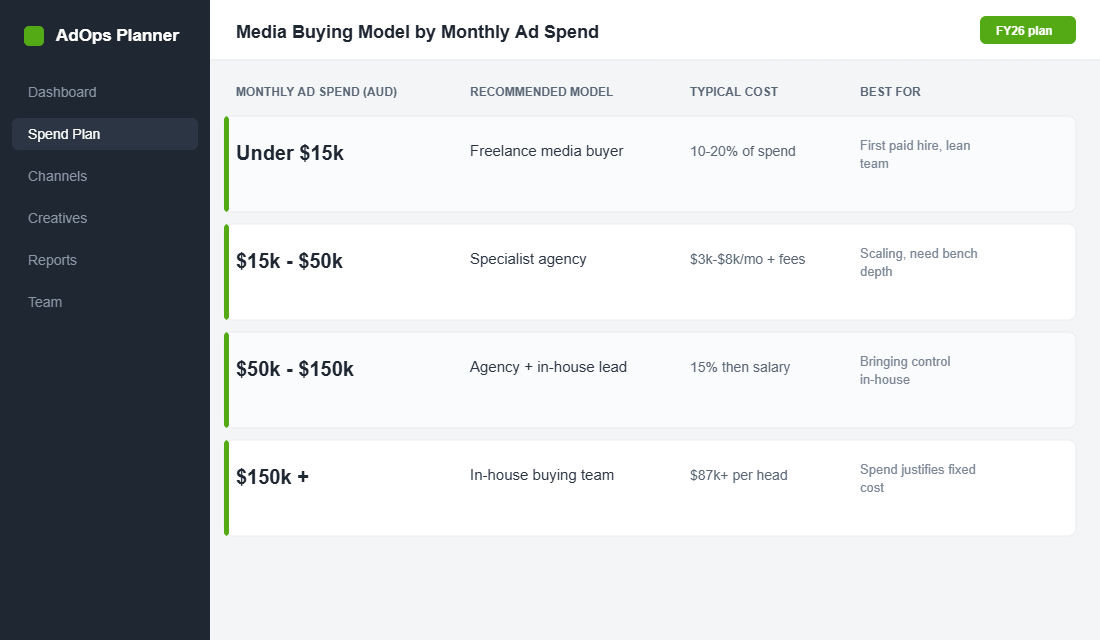
This is the framework we walk through with members before they hire anyone. Find the band your store sits in and start there. The dollar figures are monthly ad spend in AUD, not revenue.
- Under $15k a month: freelance media buyer. At this level you cannot justify a salary and you do not need a full agency bench. A good freelancer keeps you lean and costs 10 to 20% of spend.
- $15k to $50k a month: specialist agency or senior freelancer. The account now needs creative testing, structured scaling and proper reporting. An agency on a $3,000 to $8,000 retainer plus a spend fee usually earns its keep here.
- $50k to $150k a month: agency plus an in-house lead. Spend is large enough that paying 15% feels painful. Start hiring an internal owner while keeping agency firepower, then transition.
- $150k a month and up: in-house buying team. The fixed cost of salaries is now cheaper than a percentage of spend, and control of the data is worth more than any agency relationship.
The mistake is jumping a band too early because it feels like a status upgrade. Hiring an in-house buyer at $20k of monthly spend means paying a fixed salary to manage an account a freelancer could run for a fraction of the cost. Stay in your band until the numbers force you up.
Option 1: The Freelance Media Buyer
For most stores spending under $15k a month, a freelancer is the right first move. They are flexible, they are cheaper than an agency, and a strong one will treat your account like it is their own because their reputation lives on your results. In Australia freelance buyers typically charge 10 to 20% of ad spend, a flat retainer of $2,000 to $10,000 a month, or an hourly rate that runs from $80 up to $200 plus for senior operators.
The upside is obvious: low commitment and direct access to the person actually clicking the buttons. There is no account manager filtering your questions. The downside is fragility. A freelancer gets sick, takes on a bigger client, or goes quiet, and your entire acquisition engine sits with one person who has no backup. They also tend to be strong in one channel, usually Meta, so your Google and TikTok suffer.
- Use a freelancer when spend is under $15k a month, you mostly run one channel, and you want hands-on control without a fixed salary.
- Be careful when they refuse a trial, will not show you live dashboards, or want full spend control before proving anything.
- Protect yourself by keeping the ad account and payment method in your name and granting access, never the other way around.
Whoever you bring on, your creative pipeline has to keep up. The best buyer in the country cannot scale a brand on three tired ads, which is why a real creative testing system matters as much as the buyer themselves.
Option 2: The Specialist Agency
Once you are spending $15k to $50k a month, an agency starts to make sense. You are no longer buying one person, you are buying a team: a buyer, a strategist, a creative resource and a reporting layer. That depth is the point. When one person is away, the account does not go dark, and you get exposure to patterns across dozens of other stores.
Understand how they price before you sign anything. Agencies generally charge one of three ways: a monthly retainer (commonly $3,000 to $8,000 for a scaling Shopify brand, climbing well past $12,000 for larger accounts), a percentage of ad spend (most often 15 to 20%, frequently tiered so you pay 20% on the first $50k, 15% from $50k to $150k, and 10% above that), or a hybrid base fee plus a smaller spend percentage. None is automatically better. What matters is whether the fee shrinks as a share of spend while you scale, or balloons.
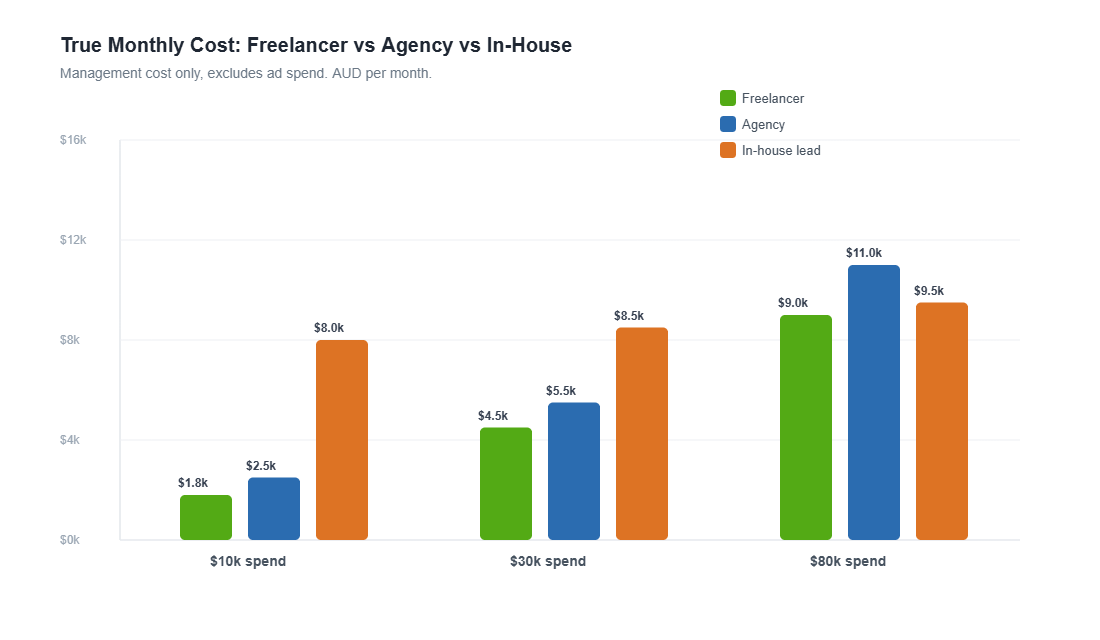
The risk with agencies is dilution. You are one logo on a wall of clients, and junior staff often run the day to day while the senior names you met in the pitch move on to the next sale. Ask directly who will touch your account every day, get their name in writing, and insist on the same level of structured Google and Performance Max management you would expect on Meta. A Meta-only agency at $40k of spend is leaving money on the table.
Option 3: The In-House Hire
Bringing buying in-house is where the serious operators end up, and the trend is clear. A WFA survey found 66% of brands now run an in-house agency function, with another 21% actively considering it. The logic is simple. The average media buyer salary in Australia sits around $87,000 a year. At $80k of monthly spend, a 15% agency fee is $12,000 a month, or $144,000 a year. The in-house hire is suddenly the cheaper option, and you keep every piece of learning inside the business.
Davie Fogarty, the Aussie founder behind The Oodie, has been openly evangelical about building in-house performance teams rather than renting capability, and it is no coincidence that the brands which scale past eight figures almost all own their buying. When the people learning your customer, your creative and your data are on your payroll, that knowledge compounds instead of walking out the door at the end of a contract.
The catch is that a salary is only part of the cost. An in-house buyer needs a creative engine feeding them, a reporting stack, and a manager who can tell whether they are any good. Hire one in isolation, with no creative support and no founder who understands the numbers, and you have simply moved the bottleneck onto a single internal employee. Build the system around the seat before you fill it. If you are not sure what good even looks like, anchor against current Shopify conversion benchmarks first.
How to Vet Whoever You Pick
The vetting process is identical whether you are interviewing a freelancer, an agency or a salaried hire. You are looking for one thing: do they think in terms of profit and your business, or in terms of platform vanity metrics. A buyer who opens with “we got the ROAS to 8x” without asking about your margins is a buyer who will happily scale you into a loss.
- Ask about a campaign that failed. Good operators talk openly about losers and what they learned. Anyone who claims everything they touch wins is either lying or has never managed real budget.
- Ask how they would spend the first $5k. You want to hear structure: testing creative angles, isolating audiences, reading data before scaling. Not “we will boost your best posts.”
- Ask what they need from you. The honest answer is creative, product margins and fast feedback. If they say they need nothing, they do not understand the job.
- Run a paid trial. One month, a defined budget, agreed targets. A trial tells you more than any portfolio, and a serious operator will welcome it.
Treat creative fatigue as a shared responsibility from day one. Plenty of buyer relationships fail not because the buyer is bad, but because the brand starved them of fresh assets and the same ads ran until they collapsed. Agree upfront on how many new concepts land each week, the same way you would tackle creative fatigue on your UGC ads.
The Weekly Scorecard That Keeps Them Honest
This is the system that separates founders who get burned from founders who get leverage. Whoever buys your media reports to one scorecard, every week, in the same format. It takes ten minutes to read and it removes every excuse. No more “the algorithm is learning” with nothing to back it up.
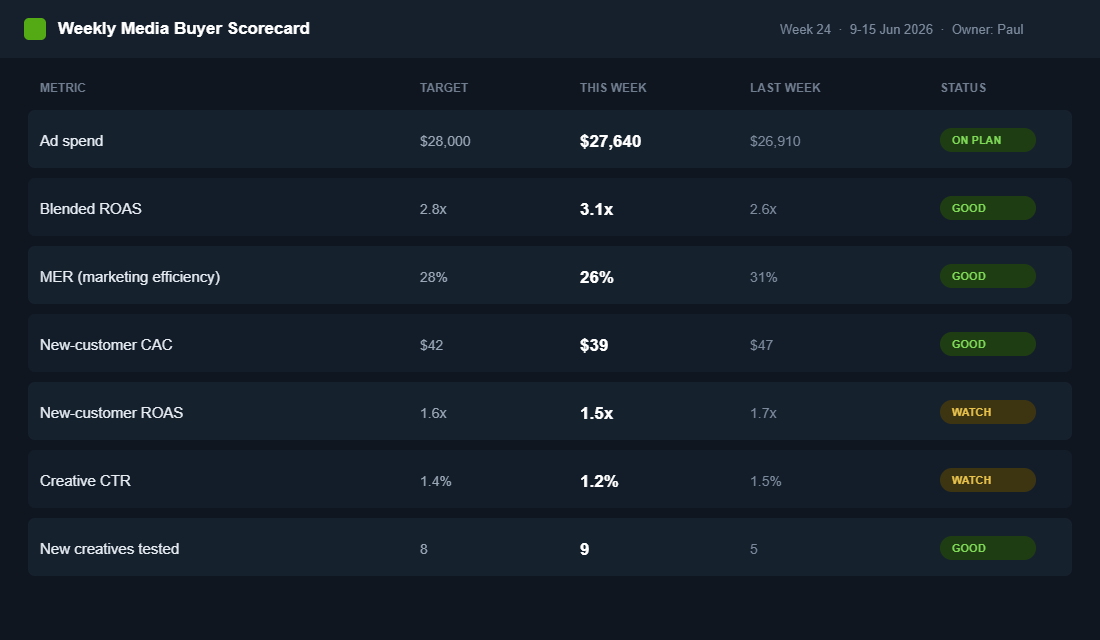
Build it in a simple Google Sheet so anyone can fill it in and you are not locked into a tool. Here is how to set it up in under thirty minutes:
- Create the rows. Ad spend, blended ROAS, MER (total ad spend divided by total revenue), new-customer CAC, new-customer ROAS, creative click-through rate, and new creatives tested. These seven cover both efficiency and the activity driving it.
- Add four columns. Target, This week, Last week, and Status. The status cell is a simple traffic light: green for on or ahead of target, amber for slipping, red for a problem.
- Set realistic targets with the buyer, not for them. If they help set the number they cannot argue with it later. Anchor targets to your actual break-even, not a vanity ROAS.
- Lock a standing 15-minute call. Same time every week. They walk you through the sheet, you ask why anything is amber or red, and you agree one focus for the week ahead.
- Track MER above everything. Marketing efficiency ratio is the founder’s number because it cannot be gamed by attribution settings. If MER is healthy and growing, the engine is working regardless of what any platform claims.
Layer a proper attribution tool such as Triple Whale over the top once spend justifies it, but the sheet comes first. A founder who can read MER, CAC and new-customer ROAS at a glance can manage a buyer twice their skill level, because the buyer knows they cannot hide.
Three Hiring Mistakes That Quietly Burn Founders
Even founders who pick the right model still trip on the same three things. They are worth naming because each one costs real money and none of them are obvious until the damage is done.
- Handing over the asset, not just access. Your Meta Business Manager, your ad account and the pixel data are some of the most valuable property your store owns. Create them under your own business account and invite the buyer in as a user. When the relationship ends, you revoke access and keep every dollar of audience and pixel history. Founders who let an agency “set it all up” on the agency’s account routinely lose years of data the day they leave.
- Paying on ROAS instead of profit. Reported ROAS is the easiest number in the building to inflate. Branded search, retargeting your warmest buyers and generous attribution windows all pump it up while adding little incremental revenue. Tie targets to MER and new-customer CAC so the buyer is rewarded for growing the business, not for decorating a dashboard.
- Hiring before the creative is ready. Paid acquisition is downstream of creative. If you cannot reliably ship fresh concepts every week, the best buyer alive will plateau within a month and you will wrongly conclude they are the problem. Sort your creative pipeline first, or hire the buyer and a creative resource together.
There is also a timing trap worth flagging. Founders tend to hire at the exact moment results dip, which is the worst possible time to judge a new buyer. A dip usually means creative fatigue or a seasonal lull, and a fresh buyer inherits that mess on day one. Give any new arrangement a clear 60 to 90 day window before you decide it is working, and judge it on the trend across the scorecard, not on a single bad fortnight.
The Compound Effect: You Own the Relationship and the Data
Here is where the pieces lock together. The spend-level framework puts you in the right model. The vetting process gets you a buyer who thinks in profit. The weekly scorecard keeps them accountable to numbers you control. Do all three and something quietly powerful happens: you stop being a hostage to whoever runs your ads.
Founders who skip this end up trapped. The agency holds the campaigns, the data and the institutional knowledge, so switching feels terrifying and renewal after renewal gets rubber-stamped. Founders who run the system can change freelancers, swap agencies or hire in-house with barely a wobble, because the account, the targets and the reporting were always theirs. The buyer is a seat you fill, not a single point of failure you pray about.
That is the real goal. Not finding a magic media buyer, but owning a media buying function that survives any one person leaving. Get the model right for your stage, vet hard, and run the scorecard every single week. Whoever sits in the seat, the engine keeps running and the learning stays with you.
Inside eCommerce Circle, getting the right people into the right seats is one of the core pillars we work on with every member. If you want a second opinion on your media buying setup before you hire, let’s talk.