You have a box of product, a pile of creator DMs, and a quiet suspicion that gifting is just an expensive way to give your margin away. So you send fifty units into the wild, three people post, two of them tag the wrong account, and you go back to throwing money at Meta. Sound familiar?
What’s in This Article
Here is the uncomfortable truth: most Aussie brands treat creator gifting like a raffle. They spray product at anyone with a follower count, hope for the best, and call it a strategy. Then they conclude gifting “does not work” when what actually failed was the lack of a system around it.
Run properly, gifting is one of the highest-return channels you have. Gifting programs returned an average of A$7.25 for every dollar invested heading into 2026, ahead of the broader influencer marketing average of A$5.78. Products discovered through a gifting post convert at 22.6%, close to three times the rate of a display ad. This playbook is the five-stage system we use with members to turn free product into a predictable engine for content, reviews and repeat sales, not a black hole you tip stock into.
Why gifting beats a paid post (and why most brands still get it wrong)
A paid post is a billboard the audience knows you bought. A gifted post is a recommendation. That difference in trust is the entire game, and the numbers back it up. Social posts featuring user-generated content drove roughly 10x higher conversion rates than non-UGC posts in late-2025 data, and 79% of people say UGC influences their buying decisions.
Creators know this too, which is why gifting is not the insult founders fear it is. 83% of creators say they are happy to work for product alone when they genuinely like it. That single fact is the lever the whole channel runs on, especially for nano and micro creators who are building a portfolio and want fresh product to film.
The catch is that “free product to anyone” is where the money leaks out. The brands winning at this are ruthless about who gets a box, surgical about the brief, and relentless about reusing the content afterwards. The rest of this guide is how you build each of those muscles. The Australian opportunity is real: 74% of Aussie marketers plan to increase influencer budgets, so the creators worth having are about to get more expensive to reach. Lock in relationships now while gifting still does the heavy lifting.
Stage 1: Score creators before you ship a single box
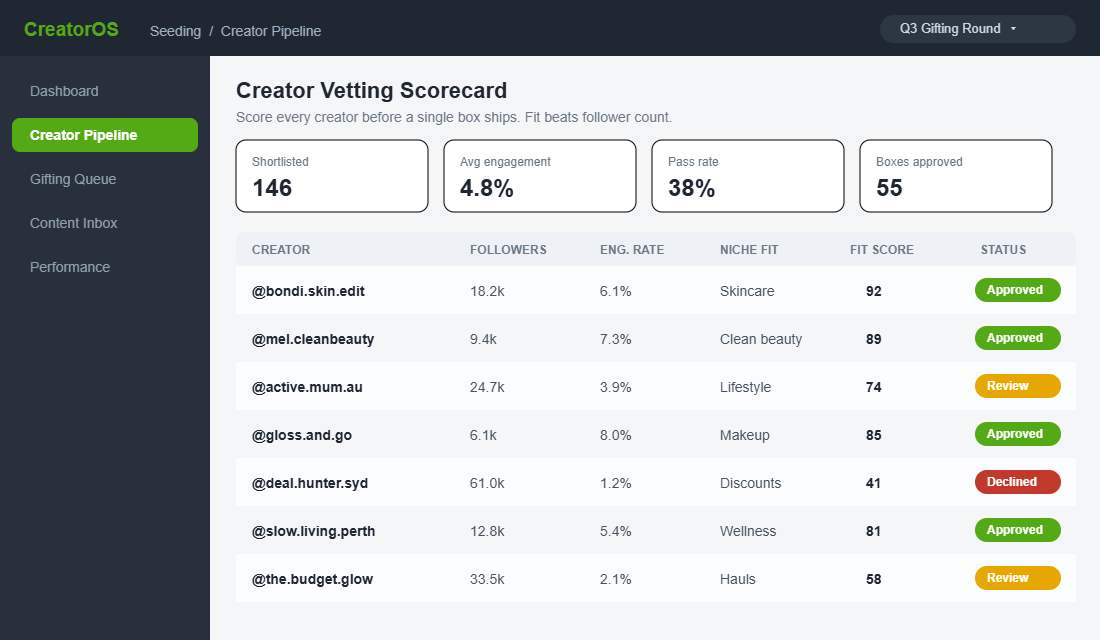
Follower count is the worst possible filter, and it is the one most brands lead with. A creator with 60k followers and a 1.2% engagement rate built on giveaway hunters will move zero product. A skincare creator with 9k genuinely engaged followers in your exact niche will sell out a SKU. Your job in Stage 1 is to tell those two apart before you spend a dollar on freight.
Build a simple creator scorecard and rate every prospect on four things before they go on the ship list:
- Niche fit. Does their content already live in your category? A gifted moisturiser on a fitness-deals page is wasted stock.
- Engagement rate. Aim for 3% or higher on micro accounts. Comments that read like real humans, not emoji spam.
- Audience location. An Australian product needs an Australian-weighted audience, or your shipping maths and conversion both fall apart.
- Content quality. Would you screenshot their last post and run it as an ad? If not, the UGC will not earn its keep later.
Score each out of 100, set a pass mark (we use 75), and only the creators above the line get a box. This one filter is the difference between a 12% post rate and a 35% one.
Where do you find creators worth scoring? Start with the cheapest source you already own: the customers tagging you and the reviewers leaving photos. Then widen out using Shopify Collabs Discover, your own follower list, and a search of the hashtags your category already lives under. Build a running shortlist of fifty names before you ship to anyone, so each round draws from a vetted bench rather than whoever happens to slide into your DMs that week.
Stage 2: The outreach that earns a 30%+ post rate
The fastest way to get ignored is a copy-paste DM that opens with “Hey hun, we love your vibe.” Creators get dozens of those a week. The fastest way to get a yes is to prove you actually watched their content and to make saying yes effortless.
A high-converting gifting outreach has four parts: a specific compliment that references a real post, a one-line reason they specifically fit your brand, a clear no-strings offer, and a single easy next step. Keep it short. Here is the shape we hand members:
“Hi Mel, your honest review of that vitamin C serum last week is exactly the kind of unfiltered take our customers trust. We make a clean, Aussie-formulated version and would love to send you one to try, no obligation to post. If you are keen, reply with your address and it is on its way this week.”
Notice what is missing: no demand for a post, no usage rights buried in the message, no discount-code haggling. You are removing friction, not adding it. The “no obligation” line lifts reply rates because it signals confidence in the product. The creators who love it will post anyway, and those are the only posts worth having.
One more lever most brands miss: gift your existing happy customers. Programs that seed people who already bought hit post rates above 50%, because they are not strangers, they are fans with a phone. Pull your five-star reviewers and repeat buyers into the same pipeline.
Stage 3: Build the gifting machine inside Shopify Collabs
Once outreach works, the bottleneck becomes logistics. Manually collecting addresses, raising orders and tracking who actually posted will eat your week. Shopify Collabs is the free native tool that turns that mess into a system, and because it lives inside your admin, every gift becomes a real order you can cost and fulfil.
Here is the setup, start to finish:
- Install Collabs from the Shopify App Store and open it from Apps in your admin.
- Open Programs, then the Gifts tab, and toggle the Gifting option on.
- Set a maximum order value per request (for example A$95) so a creator cannot claim your entire catalogue.
- Choose an eligible collection. Point it at your hero bestsellers, not slow stock you are trying to offload.
- Decide on manual approval. Keep approvals on early so you control exactly who gets product.
- Cap gifts at one to two products per creator so the program stays sustainable as your roster grows.
- Send the gift. From the Gifts tab, select your approved members, set the shipping method, and the claimed gift drops into your admin as an order to fulfil.
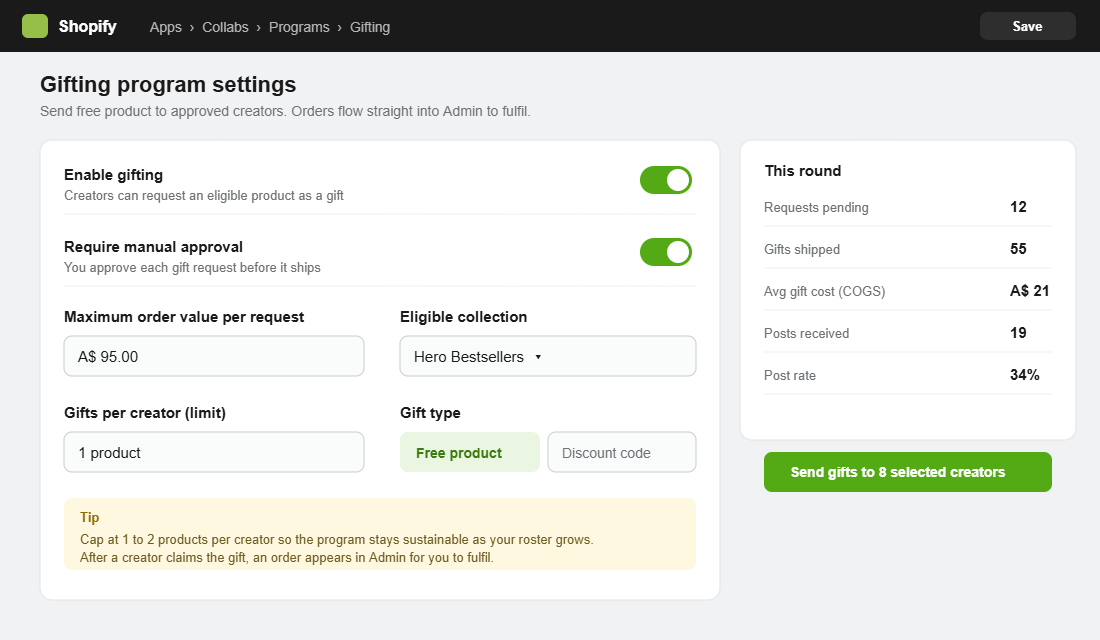
The reason this matters beyond convenience: when every gift is a real order, you can finally see the true cost of goods going out the door against the content and sales coming back. That is what turns gifting from a vibe into a channel you can put a return-on-investment number against.
Stage 4: Write a brief that gets content that actually converts
If you script a creator word for word, you kill the only thing that made their post valuable: it sounding like them. If you give zero direction, you get a blurry shelfie that mentions nothing. The brief sits in the middle. It sets the guardrails and lets the creator drive.
A good gifting brief is half a page and covers five things:
- One hero message. The single thing you want remembered, such as “fragrance-free and made for sensitive skin.” Not five features.
- A hook idea, optional. Offer a first-line prompt like “the serum I stopped travelling without,” but let them rewrite it.
- Do-not-say list. Any claims you legally cannot make. This protects you under Australian Consumer Law.
- Tag and handle. Exactly which account and hashtag, so the content is findable later.
- Format nudge. A 15 to 30 second vertical video outperforms a static for both organic reach and later ad use.
This is the discipline behind the Aussie brands that built empires on seeded content. Frank Body grew into a global cult brand largely on the back of customers and creators posting their own coffee-scrub photos with a shared hashtag, not on a giant ad budget. Sand & Sky did the same with its pink clay mask, turning thousands of gifted and organic before-and-afters into the engine that carried it overseas. Neither result was an accident. Both came from a consistent message repeated across hundreds of authentic posts.
Stage 5: Recycle every asset into a compounding engine
This is the stage almost everyone skips, and it is where the real money is. A gifted post that gets 4,000 views and then disappears is a rounding error. The same post, repurposed across your owned channels, can work for months. Treat every piece of creator content as a raw asset, not a one-off.
Here is where each asset goes to work:
- On-site social proof. Pull creator photos and clips onto product pages. UGC-enabled product pages convert up to 161% higher. Bank that content as part of your product reviews and social proof system.
- Paid ad creative. Your best gifted videos become your cheapest-to-test ads. Feed them straight into your Meta ads creative testing pipeline before you pay an agency to film anything.
- Email and SMS. Drop real customer content into welcome and post-purchase flows to lift trust at the moment of decision.
- Organic distribution. Re-share to your own channels, and use standout creators as the seed for a wider push such as a TikTok-led growth play.
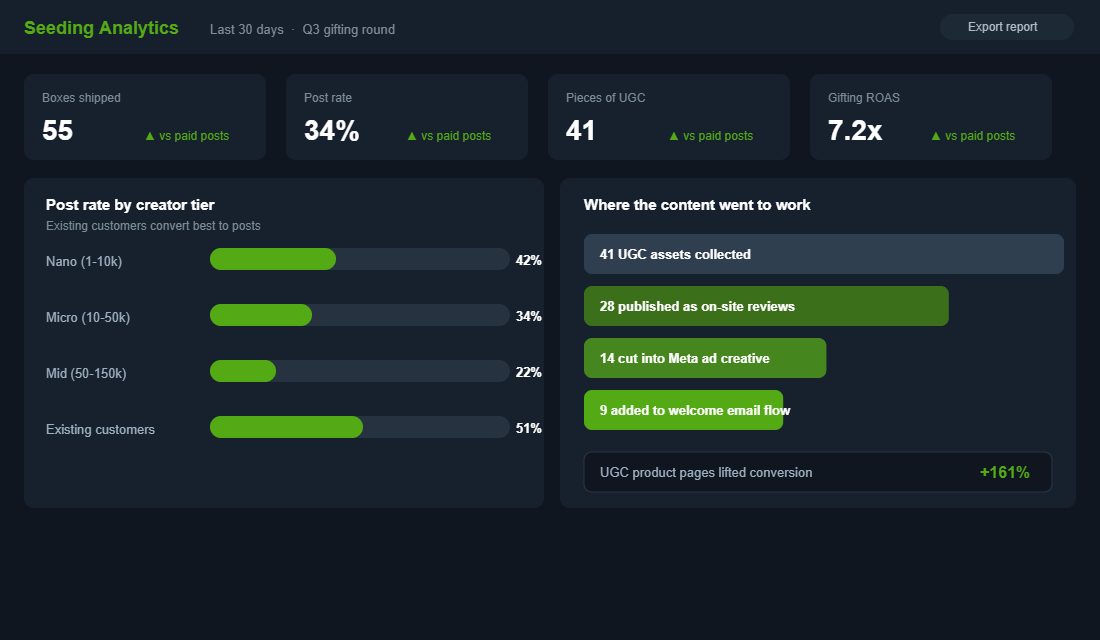
When you account for content reuse, the economics get silly in your favour. 92% of marketers say gifting increased brand awareness and 76% say it drove sales. Those numbers only show up for brands that treat the post as the start of the asset’s life, not the end.
What a gifting round actually costs (the AUD maths)
Founders freeze on gifting because “free product” feels like pure cost. It is not. It is the cheapest content and acquisition spend you will run, but only if you do the maths on goods rather than retail. The number that matters is your cost of goods, not your A$79 price tag.
Here is a realistic round for an Aussie skincare brand. Thirty boxes at A$21 cost of goods is A$630. Add local freight at roughly A$12 a parcel and you are at A$360, for a total outlay near A$990. At a 34% post rate that is about ten pieces of creator content, plus the organic reach those posts generate, plus the assets you will reuse for months.
Now compare that to the alternative. A single professionally produced UGC-style ad from an agency often runs A$300 to A$800 for one video. Your gifting round produced ten authentic clips for roughly the price of one, and those clips carry the trust signal a paid shoot never will. That is before a single sale is counted. This is the lens to bring to your numbers: gifting is a content line item that happens to also drive direct sales, and it should be measured next to your creative budget, not buried in marketing miscellaneous.
Set a monthly gifting budget as a fixed percentage of revenue, start small at 1 to 2%, and scale it only when your tracking shows the content is being reused and the sales are landing. Discipline here is what separates a channel from a hobby.
Three mistakes that quietly kill your gifting ROI
Most gifting programs do not fail loudly. They fade because of three avoidable errors that drain return without anyone noticing.
- Gifting slow stock instead of heroes. Sending creators the SKU you cannot sell is the fastest way to get content for a product nobody wants. Gift your proven bestseller. Let the winner do the talking.
- Chasing follower count over fit. A 60k deal-hunter account feels like a win until you see the 1.2% engagement and zero sales. A 9k niche creator with real comments will outperform it every time. Trust the scorecard, not the vanity number.
- Letting content die after one post. The post is the beginning of the asset’s life, not the end. Brands that stop at the Instagram story leave the majority of the value on the table. Recycling is where gifting goes from break-even to compounding.
Avoid those three and you are already ahead of most brands in your category, who are still running gifting as a raffle and wondering why it never pays.
The compound effect: why gifting gets cheaper every round
Run these five stages once and you get content. Run them every month and something better happens: the system compounds. Your scorecard gets sharper as you learn which creator profiles actually convert. Your outreach templates get tighter. Your content library grows, so each new product launch starts with proof instead of from zero.
The creators you gifted and treated well become repeat advocates who post without being asked. The content you banked keeps converting on product pages and in ad accounts long after the freight cost is forgotten. A box that cost you A$21 in goods is still earning twelve months later. That is the opposite of a paid post, which stops the second the budget does.
This is why gifting belongs in your operating system, not your “nice to have someday” list. It is one of the few channels that gets cheaper and more effective the longer you run it.
Your creator gifting checklist
Print this and run every gifting round against it:
- Score before you ship. Niche fit, engagement above 3%, Aussie-weighted audience, ad-grade content. Pass mark 75 out of 100.
- Personalise every DM. Reference a real post, make a no-obligation offer, ask for one easy next step.
- Seed your fans too. Add five-star reviewers and repeat buyers for post rates above 50%.
- Run it through Shopify Collabs. Manual approval on, value capped, gifts pointed at hero products, one to two units per creator.
- Brief, do not script. One hero message, a do-not-say list, the right tag, a vertical-video nudge.
- Recycle relentlessly. Product pages, paid creative, email and SMS, organic re-share. Every asset, four jobs.
- Measure the real ROI. Track box COGS out against content value and sales in, every round.
Get those seven right and gifting stops being a gamble. It becomes the most efficient content and acquisition channel on your roster.
Inside eCommerce Circle, creator gifting and turning UGC into a compounding asset is one of the core pillars we work on with every member. If you want a second opinion on yours, let’s talk.