Roughly 7 in 10 people who add something to their cart on your Shopify store never buy. The 2025 Baymard Institute average sits at 70.19%, and on mobile, where most of your traffic now lives, it climbs to 80.2%. For an Aussie brand doing $150k a month, that is not a rounding error. It is hundreds of thousands of dollars of demand you already paid to create, walking out the door at the final step.
What’s in This Article
Here is what most founders do about it. They leave Shopify’s single default abandoned checkout email switched on, never look at it again, and assume the problem is handled. It is not. One generic email sent hours late, with no SMS, no objection handling and no plan, recovers a fraction of what a proper flow does. The gap between an average abandoned cart program and an elite one is enormous: Klaviyo’s own benchmarks show average brands convert 3.33% of these flows while the top performers hit 7.69%, and revenue per recipient jumps from $3.65 to $28.89.
This playbook is the 5-step email and SMS system we use with eCommerce Circle members to recover 10 to 15% of lost checkouts. Not by blasting discounts at everyone. By building a flow that catches the right people, at the right moment, and removes the actual reason they hesitated. Let’s build it.
The Two Numbers That Decide Everything
Before you touch a single email, get clear on the only two metrics that matter for this program. Everything else is noise.
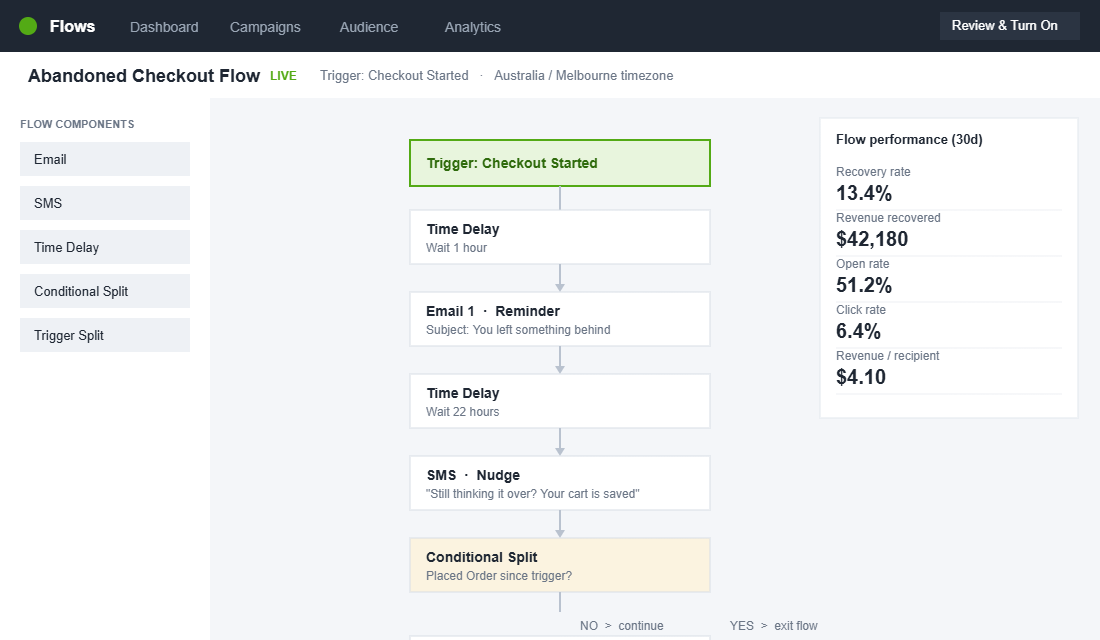
- Recovery rate. The percentage of abandoned checkouts that turn into a completed order because of your flow. Median brands sit at 3 to 5%. A tight email-only flow gets you to 8 to 10%. Add SMS and proper segmentation and 10 to 15% is realistic. That is the number you are optimising.
- Revenue per recipient (RPR). The dollars recovered divided by the number of people who entered the flow. This is your honesty check. A high recovery rate built on a 20% off code can still produce weak RPR once you account for the margin you gave away. Watch both together.
Write these two down and benchmark them monthly. If your recovery rate is under 5%, you do not have a recovery program, you have a switched-on default. The good news is the lift from here is the easiest revenue you will find this quarter, because the demand already exists. You are not buying new traffic. You are finishing a sale that nearly happened.
Stage 1: Capture the Cart (Get Identity Before the Timer Starts)
You cannot recover a cart you cannot tie to a person. This is where most flows quietly fail. If someone abandons before you have captured their email or phone, they are invisible and unrecoverable. So the first job is identity coverage: catching contact details as early in the journey as possible, not just at the checkout email field.
Two practical moves lift identity coverage fast. First, add an on-site capture tool (Klaviyo’s form, or a Justuno or Privy pop-up) so browsers who are not yet at checkout still become known contacts. Second, make sure your checkout email and phone fields fire an identify event the moment they are typed, not only on submit. Klaviyo’s “Started Checkout” and “Added to Cart” triggers both feed this.
Also separate your two trigger types. “Checkout abandoned” means they reached the checkout and entered details, so intent is high and you can be direct. “Cart abandoned” means they only added to cart, so intent is softer and the tone should be lighter. Treating both the same is why a lot of flows feel pushy. The person who only added a $49 serum to cart is not the same as the one who entered their address and bailed at the shipping cost.
Stage 2: The Email Sequence (Three Messages, Not One)
A single abandoned cart email is the most common setup and the weakest. One analysis found brands sending three recovery emails generate 69% more orders than those sending one. Three touches catch the person in different moods: the distracted one, the comparison shopper, and the one who needs a final reason. Here is the sequence that works.
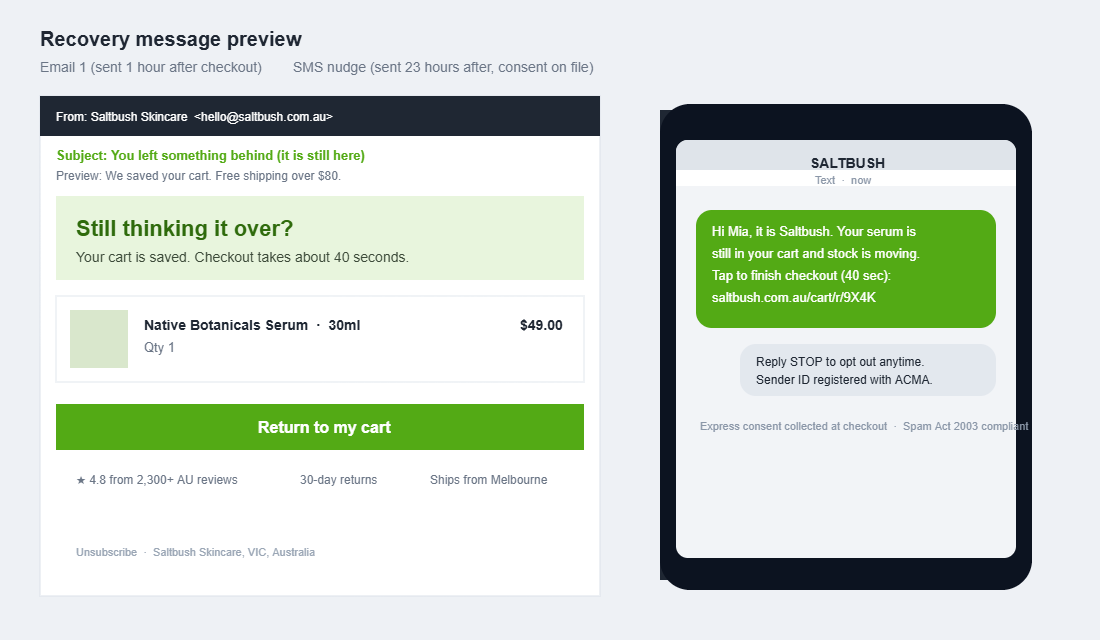
- Email 1, sent 1 hour after abandonment: the reminder. No discount. Assume they got distracted, because most did. Show the exact product with image, a one-line “your cart is saved”, and a single clear button back to checkout. Subject line that earns the 50.5% average open rate these flows see: “You left something behind (it is still here)”.
- Email 2, sent 24 hours later: overcome the objection. Now address why people actually leave. Lead with social proof (star rating, review count, an Aussie customer quote) and remove friction: free shipping threshold, easy returns, ships from Australia so no surprise customs. Still no code unless the cart is high value.
- Email 3, sent 48 hours after that: the close. This is where a modest, time-bound incentive can earn its place, and only here. Light urgency that is true: low stock if it is genuinely low, or “your cart expires soon”. Never fake a countdown. The ACCC takes a dim view of invented scarcity, and your customers can smell it.
Keep every email mobile-first. Single column, big tap target, product image above the fold. More than 80% of these will be opened on a phone, so a two-column desktop layout is a wasted send. If your slide cart and checkout are not pulling their weight in the first place, fix that before you scale the flow. Our Shopify slide cart playbook covers the cart-drawer side of this leak.
Stage 3: Layer In SMS (The 90-Second Channel)
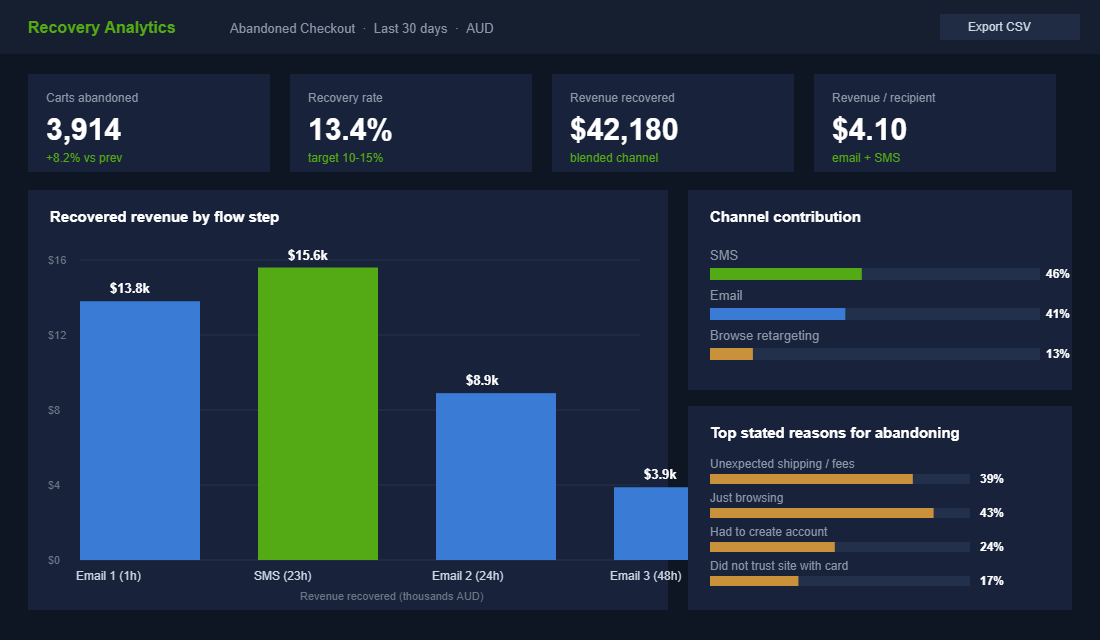
If email is the workhorse, SMS is the closer. Text messages see around a 98% open rate and are typically read within 90 seconds, versus roughly 90 minutes for email. That speed is why abandoned cart SMS converts so hard: well-built sequences regularly land in the 20 to 40% conversion range, far above email. Slotting one text into the gap between Email 1 and Email 2, at roughly the 23-hour mark, is often the single highest-ROI change you can make to the flow.
The message should be short, human and signed. “Hi Mia, it is Saltbush. Your serum is still in your cart and stock is moving. Tap to finish: [link]”. One link, one job. Do not send a paragraph. For the broader SMS strategy, including welcome and post-purchase texts, see our Shopify SMS marketing playbook.
Now the part Aussie founders cannot skip. SMS marketing here is governed by the Spam Act 2003, and it is stricter than email. You need express consent to text someone, and a checkout that was abandoned does not give you that on its own. Inferred consent generally does not cover abandoned cart SMS, so add a clear, ticked-by-choice phone opt-in at checkout that names marketing texts. Every message also needs a working, low-cost opt-out (Reply STOP) and clear sender identification.
Two more things on your radar. From 15 December 2025, Australia runs a mandatory SMS Sender ID Register, so if you text using your brand name in the “from” field, that name has to be registered. And the penalties are not trivial: ACMA can fine up to $220,000 for a single breach and into the millions for repeat offences. Get the consent mechanics right once and SMS becomes your best recovery channel. Get them wrong and it becomes a liability.
Stage 4: Fix the Reason They Left (Stop Nagging, Start Solving)
A recovery flow that only says “come back” ignores why people leave. The data is blunt: 39% of shoppers abandon when surprised by extra costs at checkout, and a large share leave because they were forced to create an account or did not trust the site with their card. Your flow should answer those objections, not just repeat the reminder louder.
- Surprise shipping cost. The single biggest killer. If your recovery email leads with a free shipping threshold, you are removing the exact reason most people bailed. Set the threshold just above your average order value so it lifts AOV while it rescues the cart. Our free shipping threshold playbook shows how to set the number.
- Trust and risk. Put reviews, a star rating, your returns window and “ships from Australia” into Email 2. For an Aussie buyer, local dispatch removes the customs and slow-delivery worry that kills offshore-looking stores.
- Friction. Make the return-to-cart link drop them straight back into a pre-filled checkout, not the homepage. Enable Shop Pay and express wallets so the second attempt takes seconds.
When you map your top three stated reasons against your flow and find each one answered somewhere in the sequence, you have a recovery program. When the flow just says “you forgot something” three times, you have a reminder. The difference shows up directly in recovery rate.
Stage 5: The Incentive Ladder (When to Discount, When to Hold)
The fastest way to wreck your margin and train customers to abandon on purpose is to fire a discount in the first email. Some shoppers learn that if they add to cart and wait, a code arrives. Do not teach that behaviour. Use an incentive ladder instead, escalating only as the person cools off.
- Rung 1 (Email 1 and SMS): no incentive. Just the reminder and the saved cart. A big chunk of carts recover here at full price.
- Rung 2 (Email 2): a value add, not a discount. Free shipping, a free sample, or a loyalty point boost. Protects margin while still moving the needle.
- Rung 3 (Email 3): a modest code, capped. 10% or $10, time-limited, and ideally only for carts above a set value. Never your storewide sale rate.
Segment the ladder by cart value too. A $300 cart deserves a different effort and a different incentive than a $40 one. High-value carts justify a personal touch, even a founder-signed text. Low-value carts should stay fully automated and discount-light, because the margin will not survive a code.
What the Best Aussie Brands Get Right
Look at the local brands who do this well and a pattern emerges: the recovery message sounds exactly like the brand, not like a system. Melbourne skincare brand Frank Body built its whole identity on a cheeky, first-person voice (“let’s get naked”), and that same playful tone carries straight into its lifecycle messaging, so a recovery text reads like a mate, not a robot. People reply to it because it does not feel automated.
Who Gives A Crap, the Aussie toilet-paper brand, leans the other way: warmth, humour and a clear reason-to-believe (half of profits to sanitation projects) woven into every touch. Their abandoned messaging does not just say “finish your order”, it reminds you what buying actually funds. Both brands prove the same point. The mechanics of the flow are table stakes. The voice and the reason-to-believe are what lift recovery rate above the 3 to 5% median.
Build It in Klaviyo: The Setup Steps
Klaviyo is the tool we reach for most with Shopify brands because it runs email and SMS in one flow with shared logic. Here is the build, start to finish.
- Connect Shopify. Install the Klaviyo app from the Shopify App Store and sync. This pulls in the “Started Checkout”, “Added to Cart” and “Placed Order” metrics automatically.
- Create the flow. Flows, Create Flow, choose the “Abandoned Checkout” template, triggered on Started Checkout.
- Set the steps. Time delay 1 hour, Email 1. Time delay 22 hours, SMS. Time delay 24 hours, Email 2. Time delay 48 hours, Email 3.
- Add the conditional split. Before each message, add a “has not Placed Order since starting this flow” filter so buyers stop receiving messages the instant they convert.
- Gate the SMS. Add a “consents to receive SMS” condition so only opted-in contacts get texted. This keeps you on the right side of the Spam Act.
- Turn on smart sending and quiet hours. Suppress texts outside 9am to 8pm local time, and cap message frequency. Then set the flow live and watch recovery rate weekly.
The Compound Effect: Why This Beats More Ad Spend
Here is why this program matters more than another $5k on Meta. Recovered carts are the cheapest revenue in your business. You already paid the acquisition cost to get that person to checkout. The flow just finishes the job, at near-zero marginal cost. Move recovery rate from 4% to 12% on 3,900 abandoned checkouts a month and you are recovering hundreds of extra orders without spending a cent more on traffic.
It compounds, too. Every contact the flow captures is now in your owned list, reachable by future campaigns for free. Every recovered first-time buyer can enter your post-purchase and win-back flows, lifting lifetime value down the track. And because the program runs on intent that already exists, it is one of the few growth levers that gets cheaper as your traffic grows, not more expensive. That is the opposite of paid acquisition, where costs only climb.
Your Abandoned Cart Recovery Checklist
Copy this into a doc and tick it off. If every box is checked, you have a genuine recovery program, not a switched-on default.
- Identity: on-site capture form live, checkout fields fire identify on type, separate triggers for cart vs checkout abandonment.
- Email 1 (1 hour): reminder, product shown, one CTA, no discount.
- SMS (23 hours): short, signed, one link, STOP opt-out, sender ID registered, express consent on file.
- Email 2 (24 hours): social proof plus the top objection answered (shipping, trust, returns).
- Email 3 (48 hours): capped, time-bound incentive only, true urgency only.
- Splits: “has not placed order” filter before every step; SMS gated on consent.
- Incentive ladder: no code early, value-add middle, modest capped code last, segmented by cart value.
- Measurement: recovery rate and revenue per recipient reviewed monthly, target 10 to 15%.
Worked Example: A $180K-a-Month Aussie Activewear Brand Rebuilds Its Flow
Imagine you run a Gold Coast activewear brand doing about $180K a month with a 72% cart abandonment rate. Klaviyo has a single abandoned cart email firing at four hours with a 15% code in the subject line. It “recovers” $9K a month, but 80% of those orders come from people who had already come back on their own and were simply waiting for the code they knew was coming.
The rebuild took nine days. Identity capture moved to a two-step email-first popup and the checkout contact field, which lifted identifiable carts from 31% to 54%. The single email became the three-message sequence in this playbook, with SMS at 23 hours for the 38% of the list with express consent. The 15% code disappeared from Email 1 and Email 2 entirely and came back only as a capped $15 off carts over $120 in Email 3.
- Recovery rate went from 4.1% to 11.8% of abandoned checkouts inside 60 days, measured on Shopify orders with the flow UTM, not on Klaviyo’s attributed number.
- Recovered revenue rose from $9K to $21K a month while discount cost on recovered orders fell by 63%, because most recoveries now happened at full price on Email 1 or the SMS.
- Revenue per recipient on Email 1 hit $1.92, against $0.41 for the old four-hour email. Speed and a product image did more than the discount ever had.
- Contribution margin on recovered orders improved by 14 points, which is the number the founder now reports to the board instead of the raw recovery figure.
The biggest single lift came from the identity step, not the copy. If you fix only one thing this week, fix capture. The checkout optimisation playbook covers the field order and express-pay changes that keep the second attempt frictionless once someone clicks back through.
Five Benchmarks to Hold Your Flow Against Each Month
A recovery flow is only healthy if you are checking it against numbers, not against a feeling that “email is doing alright”. These are the ranges we see across Aussie DTC brands on Klaviyo, Omnisend and Yotpo SMS. Pull them into your monthly review and look at the trend, not the single month.
- Identifiable cart rate: 45 to 60% of abandoned checkouts should have an email or phone attached. Under 35% means capture is broken and the flow is only reaching your existing customers.
- Email 1 open-to-click rate: 12 to 20% click-to-open. Under 8% usually means the email is arriving too late, lacks the product image, or the subject line is generic.
- SMS click rate: 8 to 15%. Under 5% means the message is too long, unsigned, or landing outside the 8am to 8pm AEST window.
- Recovery rate: 8 to 15% of abandoned checkouts. Above 20% is usually a sign of over-discounting, with buyers deliberately abandoning to trigger the code.
- Discount share of recovered revenue: under 40% of recovered orders should carry a code. If it is above 60%, your ladder starts too low and you are training people to wait.
One more number worth tracking: how many recovered buyers place a second order within 90 days. Repeat rate on recovered customers tends to sit 5 to 10 points below organic buyers, so send them through your welcome and post-purchase flows properly rather than treating the recovery as the end of the job. And if a large share of your abandoners never reached checkout in the first place, the browse abandonment playbook sits one step earlier in the funnel and catches the intent this flow never sees.
Inside eCommerce Circle, abandoned cart recovery is one of the core pillars we work on with every member, because it is the fastest profit lever most stores have sitting idle. If you want a second opinion on yours, let’s talk.