Every Shopify founder eventually gets the email. A customer opens their parcel, the zip is broken or the print is peeling, and you are now refunding an order you already paid to acquire, pack and ship. One faulty unit is bad luck. A faulty batch is a business problem, and by the time you find out about it, the whole production run is usually sitting in your 3PL.
What’s in This Article
Here is the uncomfortable maths. Damaged or defective items are the single biggest trigger for returns, with 81% of shoppers naming them as a reason they send products back. Processing one return costs 20 to 65% of the item’s original value once you count freight, labour and repackaging. Defects do not just annoy customers. They quietly eat the margin on orders you already won.
Most Aussie founders treat quality control as something the factory handles. The brands that scale past seven figures treat it as a system they own: a written standard, a defect classification, a statistical inspection method, and a feedback loop from returns data back to the supplier. This playbook walks through all five parts, with real costs in AUD, the exact tools to use, and a starter checklist you can set up this week.
Part 1: Set the Standard With a Golden Sample and a Spec Sheet Your Factory Cannot Argue With
Quality control fails at most brands before a single unit is made, because “good quality” was never defined in writing. If your standard lives in a WeChat thread and a vibe, your factory will define it for you, and their definition will always favour the factory.
The fix is two documents. The first is a product spec sheet: one page per SKU that states materials, dimensions with tolerances, weight, colours with Pantone codes, stitching or joinery requirements, packaging, barcode placement and labelling. If you covered your sourcing process using our product sourcing playbook, most of this already exists in your RFQ. Now it becomes your inspection standard.
The second is the golden sample: a physical unit you have approved, signed and dated, that represents the minimum acceptable quality. Serious founders keep two, one sealed at the factory and one at home. When a batch arrives and something feels off, the argument is no longer your memory against the factory’s. It is the unit in your hand against the sealed sample they signed.
- Put tolerances on everything measurable. “600D polyester, 210 to 220gsm” beats “good strong fabric”. Numbers are enforceable, adjectives are not.
- Photograph the golden sample from every angle and attach the photos to your purchase order. The PO should reference the spec sheet version number.
- Approve a pre-production sample for every new run, even repeat orders. Factories change sub-suppliers between runs more often than they tell you.
Part 2: Classify Defects Like an Inspector: Critical, Major and Minor
Professional inspectors do not ask “is this unit perfect?”. They ask “which class of defect is this, and how many are in the sample?”. Adopting the same three classes turns quality from an emotional argument into an operating metric.
- Critical defects make the product unsafe or unlawful to sell: exposed wiring, sharp edges, missing mandatory safety labelling. The tolerance here is zero. One critical defect fails the batch.
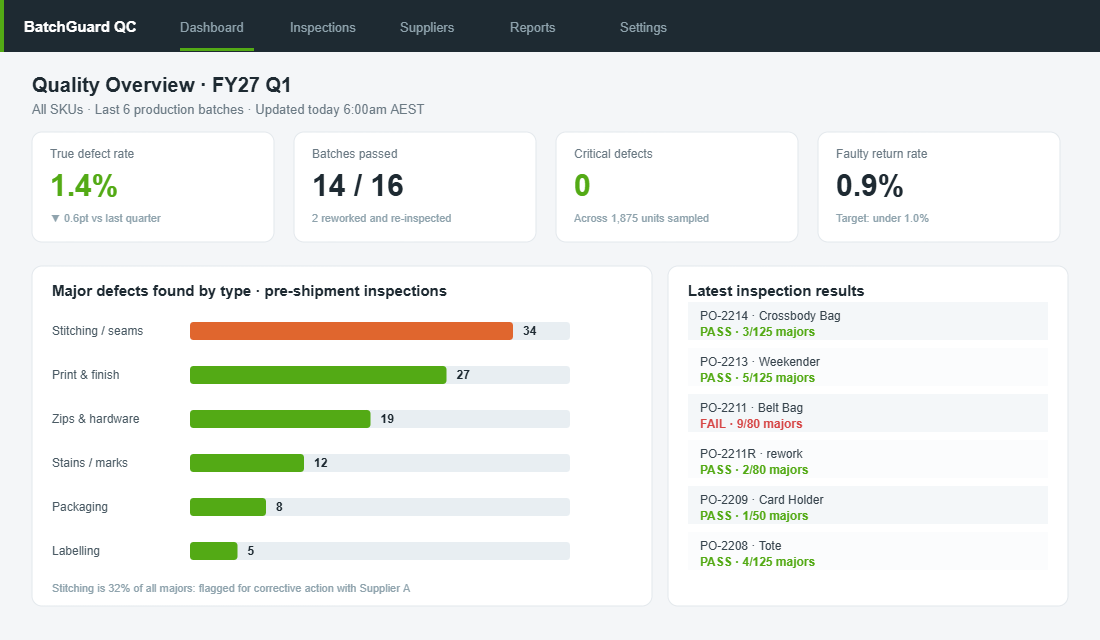
- Major defects mean a customer would likely return the unit: broken zips, stains on the visible face, prints that peel, buttons that fall off. This is where most of your returns risk lives.
- Minor defects are cosmetic issues a customer would probably accept: a loose thread inside a seam, a faint mark on the underside. They matter in aggregate, not individually.
For general consumer goods, the industry default tolerance is AQL 2.5 for major defects and AQL 4.0 for minor defects, with zero tolerance for critical ones. Premium brands often tighten majors to AQL 1.5. Write your chosen levels into the purchase order itself, next to payment terms. That one line turns your quality standard into a commercial term rather than a polite request.
Part 3: The AQL Inspection System: How to Check 3,000 Units by Inspecting 125
You do not need to open every carton to know whether a batch is good. AQL (Acceptable Quality Limit) sampling is the statistical method used across global manufacturing, and it is why a 3,000 unit production run can be judged from a random sample of just 125 units.
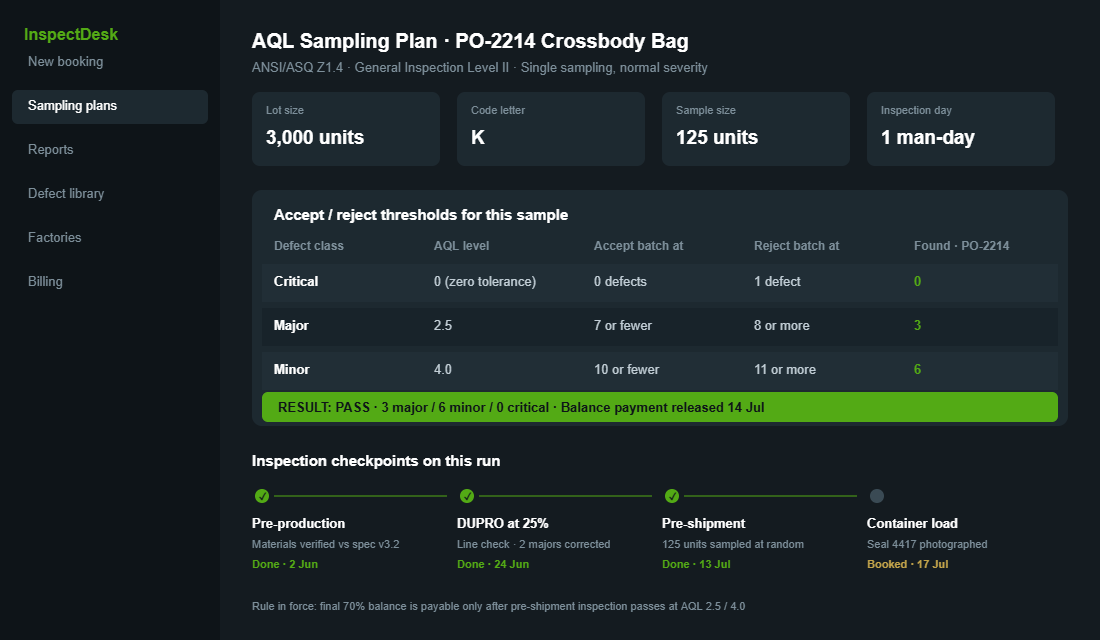
The method comes from a standard sampling table. Your lot size maps to a code letter, the code letter sets your sample size, and your chosen AQL level sets the accept and reject thresholds. For a 3,000 unit lot at general inspection level II, the sample is 125 units. At AQL 2.5 for majors, the batch passes with 7 major defects or fewer and fails at 8. At AQL 4.0 for minors, it fails at 11. Any critical defect fails the lot outright.
The table scales down gracefully for smaller brands too. A 500 unit run needs a sample of just 50, and a 1,000 unit run needs 80. Even at your first production order, statistically valid QC is a morning’s work for one inspector, not a week of opening cartons. And because the sample is random across the whole run, it catches the problems that cluster in the last 10% of production, when the factory is rushing to hit the ship date.
Just as important as the method is the timing. The founders who get burned are the ones who only ever inspect finished goods, after the final payment has left their account. Build three checkpoints instead:
- Pre-production check. Confirm the materials and components on the factory floor match your spec before the line starts. Catching the wrong fabric here costs nothing. Catching it after production costs the batch.
- During-production inspection (DUPRO) at 20 to 30% complete. Defects found here can still be fixed on the line, and the factory knows you are watching for the rest of the run.
- Pre-shipment inspection once at least 80% of units are finished and packed. This is the non-negotiable one. The golden rule: the final balance payment is only released after the pre-shipment inspection passes. Once you have paid in full, your bargaining power is gone.
Part 4: Book the Inspection: What It Costs and How to Brief a Third-Party Team
You do not fly to Guangzhou for this. Third-party inspection firms have local inspectors near every major manufacturing hub, and the economics are very accessible for a DTC brand. Expect around USD $309 to $380 per man-day for consumer goods in China (roughly AUD $470 to $580), and one man-day covers a standard pre-shipment inspection for most DTC-sized orders.
QIMA is the most common starting point for Aussie founders because everything is self-serve. Here is the setup, start to finish:
- Step 1: Create a free account at qima.com and load your product spec sheet, golden sample photos and purchase order against the SKU.
- Step 2: Select the inspection type (pre-shipment), your AQL levels (2.5 major / 4.0 minor is the default), and add any product-specific tests: zip cycle counts, seam strength, function checks, barcode scans.
- Step 3: Enter the factory contact details and pick a date 2 to 3 business days out. QIMA coordinates access directly with the factory.
- Step 4: The inspector samples to the AQL table, photographs every defect found, and you get a pass/fail report with photos the same evening, before you release the balance payment.
Tetra Inspection and Pro QC do the same job at similar rates if you want a comparison quote. Whoever you use, the discipline matters more than the vendor. The American Society for Quality found that companies who match inspection rigour to their actual risk profile cut defect rates by up to 35%.
When a batch fails, you have three moves, in order of preference: the factory reworks the defective units and pays for a re-inspection, you negotiate a discount that covers your projected returns cost on the defective portion, or you reject the shipment. All three only exist because you have not paid the balance yet.
The Five Mistakes Founders Make With Factory QC
Before the feedback loop, a quick detour. When we dig into quality problems with members, the same five mistakes show up over and over. If any of these feel familiar, fix them before your next run leaves the line.
- Trusting the factory’s own inspection report. Most factories do run internal QC, and their report will almost always say the batch passed. That is not malice, it is incentive. The party who profits from shipping the batch cannot be the only party who checks it.
- Inspecting only the first order. Quality is highest on order one, when the factory is courting you. Drift starts on order three or four, when a cheaper zip supplier or a rushed line slips in. Repeat orders need inspections more, not less.
- Skipping QC on “simple” products. Candles crack, labels smudge, pumps fail, seams split. There is no product too simple to have a major defect class, and simple products usually ship in bigger volumes, which multiplies the damage.
- Letting the factory choose the sample. A valid AQL inspection pulls units at random from sealed export cartons across the whole run. If the factory hands your inspector a pre-picked pallet, the sample is theatre.
- Treating a failed inspection as a relationship crisis. Good factories expect AQL inspections and respect buyers who run them. If a supplier pushes back hard on independent QC, that reaction is itself the data.
Part 5: Close the Loop at Home: Returns Data, Review Mining and Your Real Defect Rate
The inspection report tells you what left the factory. Your customers tell you what actually matters. The last part of the system is a feedback loop that runs in your own business, and most Shopify brands already have the data sitting unused.
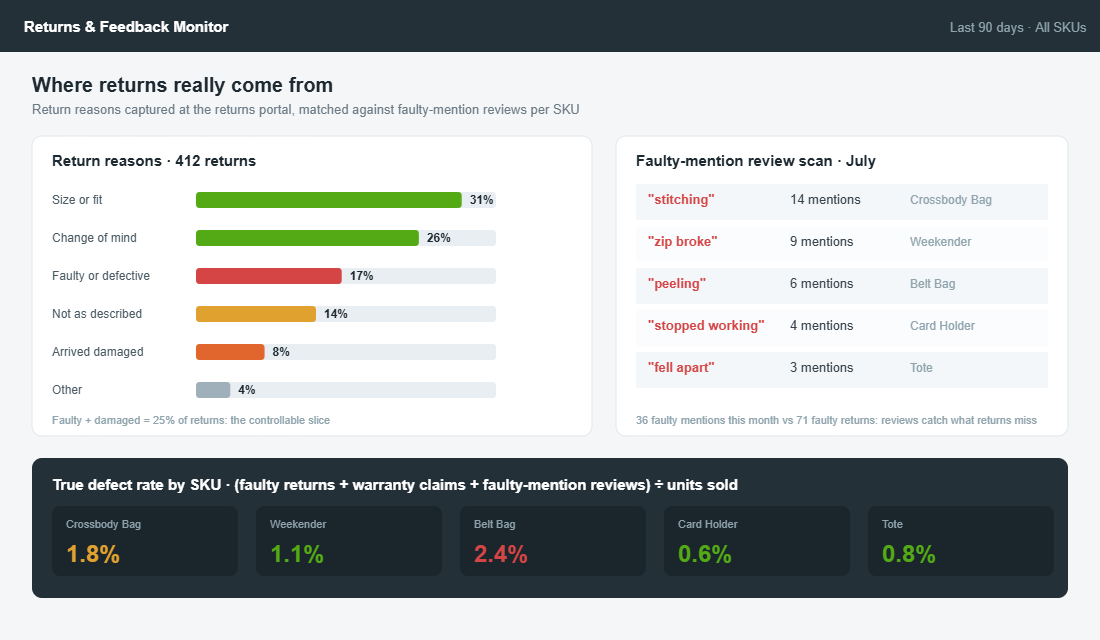
Start with returns reasons. Whether you process returns natively in Shopify or through an app like Loop or ReturnGO, make “faulty or defective” a distinct, non-negotiable return reason, separate from “not as described” and “change of mind”. Retail returns are projected to reach USD $849.9 billion this year, with around 19.3% of online sales coming back. You cannot stop all of it, but the faulty slice is the slice you control.
Then mine your reviews. Search your review platform and helpdesk each month for words like “broke”, “stopped working”, “ripped”, “stitching” and “fell apart”. Faulty-product mentions in reviews are defects your returns data never saw, because most unhappy customers do not bother returning, they just never buy again and tell everyone why. Our reviews playbook covers the collection side; this is the listening side.
Roll it into one number: true defect rate = (faulty returns + warranty claims + faulty-mention reviews) ÷ units sold, tracked per SKU per batch. Under 1% is strong for most consumer categories. Above 2% means your next production run needs a tighter AQL and a harder conversation.
That conversation is easier with a supplier scorecard: defect rate by batch, inspection pass rate, rework incidents and on-time delivery on one page. It becomes your strongest card in every renegotiation, and it pairs directly with the tactics in our supplier negotiation playbook. Factories sharpen their pencil for customers who measure them.
The Australian Consumer Law Makes Quality Your Problem, Not Your Factory’s
One more reason this system matters more for Aussie brands than most founders realise: under the Australian Consumer Law, every product you sell carries automatic consumer guarantees. If a product is faulty or not of acceptable quality, the customer’s remedy sits with you, the retailer, not with your factory in Ningbo. You cannot contract out of it, and “no refunds on sale items” signs do not override it.
For a major failure the customer chooses the remedy, refund or replacement, and for minor failures you choose, but you must still provide one. Every defective unit that reaches a customer is therefore a legal obligation you have already incurred, plus return freight you will likely wear. The ACCC has shown consistent appetite for pursuing retailers who mishandle faulty-goods claims, and the reputational cost of a public run-in dwarfs any inspection invoice.
Seen through that lens, a pre-shipment inspection is not an operations expense. It is the cheapest legal risk management your brand will ever buy, and it protects the returns policy work you have (hopefully) already done in our returns playbook.
The Compound Effect: What One Caught Batch Is Actually Worth
Run the numbers on a single 3,000 unit batch with a $22 landed cost and an $80 retail price. Say a quality slip pushes 4% of units out defective. That is 120 faulty units reaching customers. At an average processing cost of $25 plus the refund itself, you are staring at roughly $12,600 in direct costs, before you count replacement shipping, support hours or the ad spend to re-acquire the customers you just lost.
The inspection that would have caught the batch costs about $500. That is a 25 to 1 payoff on direct costs alone, and the indirect side is bigger. A product sitting at 4.2 stars converts meaningfully worse than the same product at 4.7, and defect complaints are the fastest route down. Every one-star “broke after a week” review sits on your product page arguing against every ad you run, forever.
This is why the five parts compound. The spec sheet makes the standard enforceable, the defect classes make it measurable, AQL makes measuring affordable, the third-party inspection makes it independent, and the home feedback loop catches whatever slips through while arming your next negotiation. Brands like July and Bellroy built their reputations on exactly this obsession: durability you can feel, backed by warranties they rarely have to honour. None of that is an accident of good taste. It is a system.
The 60-Minute QC Starter Kit
You can stand up the skeleton of this system in an hour. Here is the checklist:
- Write a one-page spec sheet for your best-selling SKU, with tolerances on every measurable attribute (15 minutes).
- Nominate and photograph a golden sample. Email the photos to your supplier and ask them to confirm it as the reference standard (10 minutes).
- Add a QC clause to your next purchase order: AQL 0 critical / 2.5 major / 4.0 minor, pre-shipment inspection required, balance payable on pass (10 minutes).
- Create a QIMA or Tetra account and load the spec sheet so booking takes minutes when the run is ready (10 minutes).
- Fix your return reasons in Shopify or your returns app so “faulty or defective” is tracked separately (10 minutes).
- Set a monthly 5-minute ritual: pull faulty returns and faulty-mention reviews per SKU and update your true defect rate (5 minutes to schedule).
Inside eCommerce Circle, product quality sits at the heart of the Product pillar we work on with every member, because no amount of ad spend outruns a defect rate. If you want a second opinion on your QC setup before your next production run, let’s talk.