Most Aussie founders think about selling their store exactly once: the week they are burnt out, cash is tight, and someone slides into their inbox with an offer. That is the worst possible moment to find out what the business is actually worth.
What’s in This Article
Here is the uncomfortable maths. Two Shopify stores can both do $412,000 in adjusted earnings and be worth wildly different numbers. One sells at 2.5x, around $1.03m.
The other sells at 4.6x, around $1.9m. Same profit. Nearly $900,000 difference.
The gap is not luck and it is not the niche. It is how the business is built underneath the revenue.
The research backs this up. Australian data shows 48% of Baby Boomer business owners plan to exit within one to five years, yet only about 24% of small and mid-sized businesses have a documented succession plan (ScaleSuite). Ecommerce is no different. Founders build for years, then discover in due diligence that the thing they built cannot be handed over.
The good news: every lever that raises your multiple also makes the business better to own right now. Cleaner books. Fewer 2am fires.
Less of you in the machine. You do not have to want to sell to want this. Here are the five levers, in the order I work through them with founders.
Lever 1: Know Your Real Number Before a Buyer Tells You
Under roughly $5m in revenue, buyers do not value your store on revenue. They value it on SDE (Seller’s Discretionary Earnings): net profit, plus your owner wage, plus genuinely one-off or personal costs that a new owner would not carry. Above about $5m the conversation shifts to EBITDA, where multiples climb from around 4x to 8x for brands with clean financials and a real team (FE International).
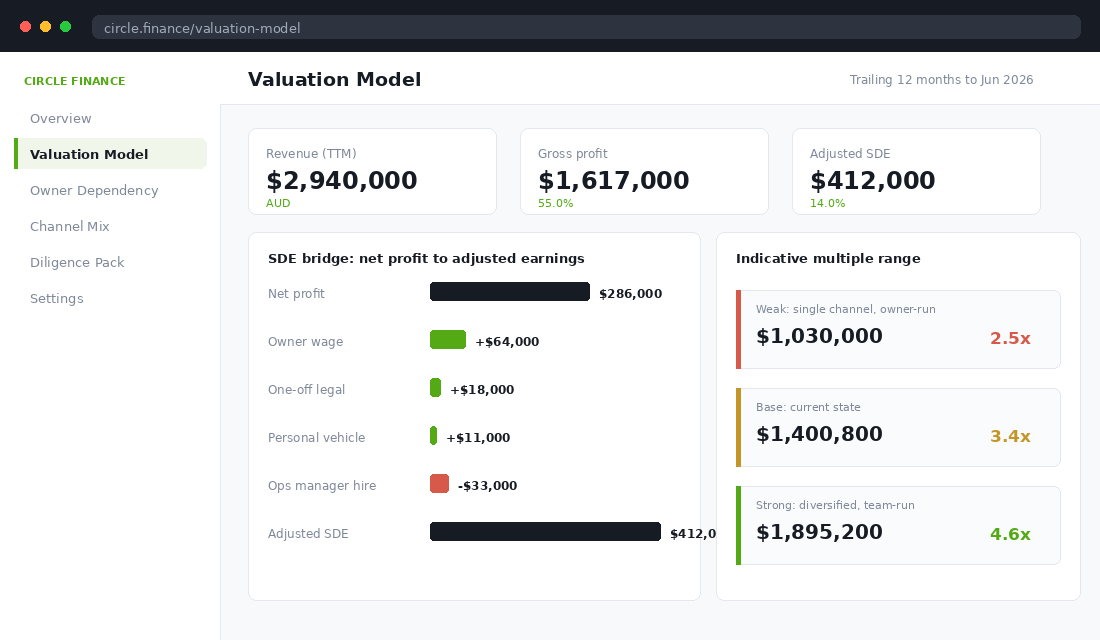
Build the bridge yourself, in a spreadsheet, before anyone else does it for you:
- Start with net profit from your last 12 months, not your best 12 months.
- Add back your own wage and super. This is the biggest single add-back for most founder-run stores.
- Add back true one-offs. Legal fees for a trademark dispute, a website rebuild, a written-off trade show. One-offs, not “things I would rather not count”.
- Add back personal costs running through the business. The vehicle, the phone, the family member on the payroll who does two hours a week.
- Then subtract the replacement cost. This is the step nobody does voluntarily. If you work 47 hours a week, a buyer has to hire someone. Deduct a realistic salary for that role, say $85,000 plus super for an operations manager.
That last line is where most deals get repriced. Brokers report that the contested owner-role add-back is one of the most common reasons a stated SDE gets cut in diligence (EcomSwap). Founders who present the deduction themselves come across as credible. Founders who hide it lose trust on every other number in the pack.
Run this once a quarter. Ninety minutes. You will find profit leaks long before you find a buyer.
Lever 2: Books a Stranger Can Read in an Afternoon
Messy financials kill more ecommerce deals than weak performance does. The usual pattern in an Aussie store: Shopify payouts landing in Xero as one lump sum, transaction fees buried inside revenue, COGS recognised when the supplier invoice is paid rather than when the stock sells, and three months of the year where the bank feed was never reconciled.
A buyer reading that cannot tell whether your gross margin is 42% or 55%. And gross margin is one of the strongest multiple drivers there is: brands above 50% command materially higher multiples than sub-40% brands, because margin signals pricing power and the ability to absorb cost shocks.
The tool: A2X for Shopify, connected to Xero. It sits between Shopify and your ledger and posts each payout as a proper journal entry, splitting gross sales, discounts, refunds, shipping collected, GST and payment processing fees. Setup takes about an hour:
- Connect both ends. In A2X, authorise your Shopify store, then authorise Xero. Set your base currency to AUD.
- Map your accounts. Point gross sales, discounts, refunds, shipping income, GST collected and processing fees to their own Xero accounts. Do not lump fees into “general expenses”.
- Set the start date to the beginning of your current financial year so you get a clean FY26 comparison.
- Turn on COGS tracking so cost of goods posts against the month the sale happened, not the month you paid the supplier.
- Reconcile the first payout manually against your Shopify payouts report to confirm it balances to the cent, then let it run automatically.
Then produce a monthly P&L by month across at least 24 months, in one sheet. That single artefact is what a buyer, a bank, or a broker asks for first. If you want the deeper version of this, our contribution margin playbook walks through separating true product profitability from blended numbers.
Lever 3: Take Yourself Out of the Critical Path
Owner dependency is the most underestimated risk in any acquisition. The business looks profitable because the founder works 60 hours a week, holds every supplier relationship, and carries the domain knowledge in their head. When the founder leaves, the value leaves with them. Buyers know this, so they price it in.
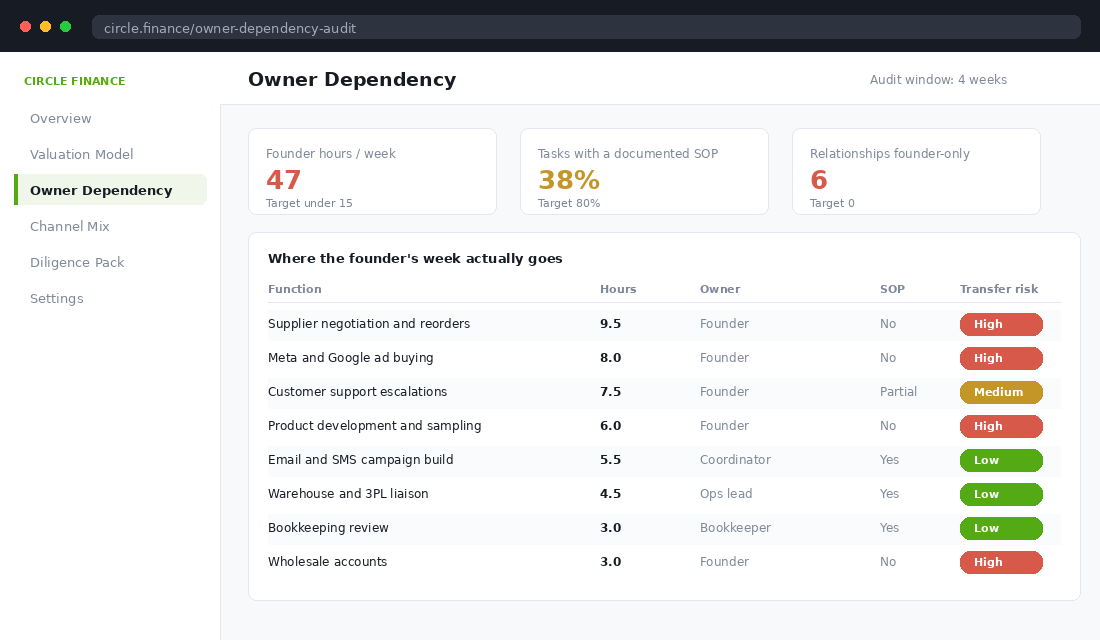
Run a four-week time audit. Log every task into a function, and score three columns: hours per week, who owns it, and whether a documented SOP exists. Most founders discover 40 to 50 hours sitting in six or seven functions, with SOP coverage under 40%.
Then attack it in this order, because not all founder-held tasks are equally dangerous:
- Relationships first. Any supplier, 3PL or wholesale account where you are the only contact is a single point of failure. Introduce a second person on the next call. Move the correspondence into a shared inbox, not your personal one.
- Then the recurring operational work. Reorders, campaign builds, support escalations. Write the SOP by recording yourself doing it once and having someone else follow the recording.
- Then the judgement work. Ad buying and product development are the hardest to hand over, so start the handover earliest. Twelve months of a media buyer running your account under your review is worth more at sale than a founder who “could train someone”.
- Leave nothing in your head. Supplier terms, MOQs, freight rates, seasonal ordering rules. Written down or it does not exist.
The benchmark to aim for is under 15 founder hours a week and 80% SOP coverage. Our SOP library has the 25 procedures most stores need first, so you are not staring at a blank page.
Lever 4: Break Every Concentration You Can Find
Buyers discount fragility harder than they discount slow growth. When one channel carries more than 70% of revenue, the discount is automatic. A store earning solid profit with 90% of revenue from a single paid channel and a founder-run operation prices closer to 3x, where a diversified equivalent reaches well past 4x.
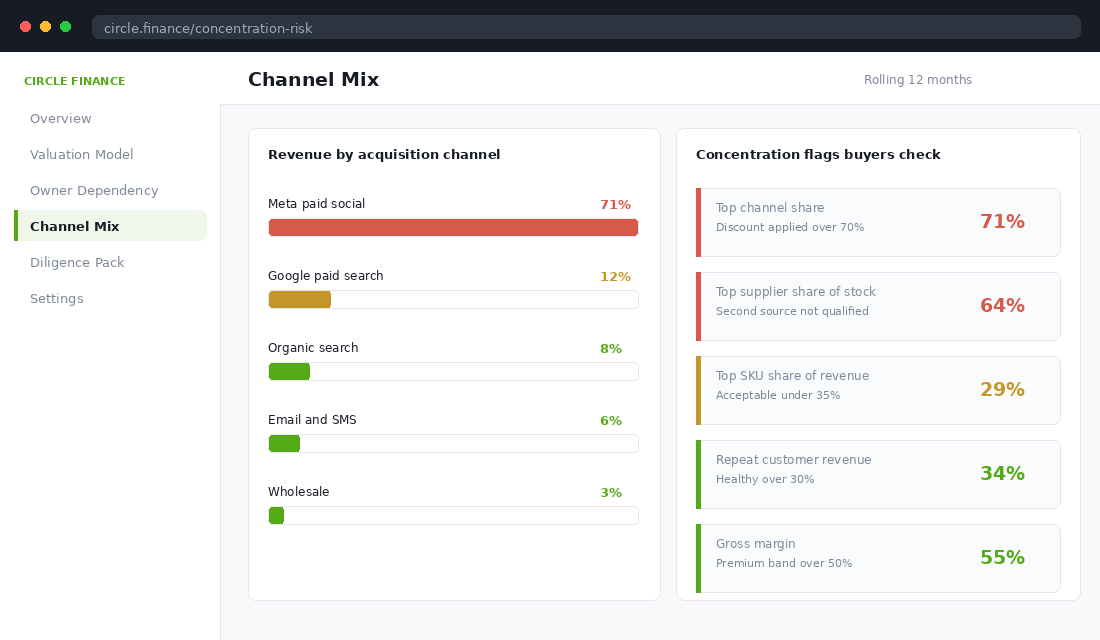
There are four concentrations worth measuring this month:
- Channel concentration. Target no single channel above 60%. Owned DTC plus a genuine second channel (Amazon Australia, retail stockists, or B2B wholesale) beats any single-channel story.
- Supplier concentration. If one factory makes 64% of your stock and you have never qualified a backup, you are one shipping dispute from a bad quarter. Qualify a second source and place one small real order with them, not a sample.
- SKU concentration. Under 35% of revenue from your top product is comfortable. Above that, buyers want to see a second product with its own traction, not a roadmap.
- Customer concentration. Mostly a wholesale problem. Any single account above 15% of revenue needs a written agreement, not a handshake.
You will not fix all four in a quarter. Pick the worst one, and move it 10 percentage points over six months. That is a real, defensible story to tell a buyer: “twelve months ago Meta was 78% of revenue, today it is 61%, and here is the email and organic build that did it”.
Lever 5: Prove the Earnings Are Repeatable, Not Rented
The 2026 buyer pool is smaller and more selective than it was three years ago. It pays for proven contribution margin, not top-line growth. That means the quality of your revenue matters more than the size of it.
Three numbers carry most of the weight:
- LTV to CAC of at least 3:1. Institutional buyers treat this as a floor. Below it, they read the business as buying revenue rather than earning it. Calculate it on contribution margin, not gross revenue, or you are lying to yourself.
- Repeat customer revenue above 30%. A store where a third of revenue comes from people who already bought is a fundamentally different asset to one refilling the bucket every month.
- Gross margin above 50%. Below 40% and every cost increase, freight spike or exchange rate move lands straight on the bottom line. Buyers price that volatility in.
Two practical moves. First, build a cohort view so you can show LTV by acquisition month over 12 and 24 months. Second, stop discounting your way to revenue targets in the final year before any sale.
A store that hit $2.9m at 55% margin is worth more than one that hit $3.4m at 41%, and the discount habit is visible in the numbers from a mile away. If retention is your weak spot, start with the customer lifetime value playbook.
Know Which Buyer You Are Building For
Not all buyers value the same things, and the levers you prioritise should follow the buyer you are most likely to meet. Three types show up for Australian DTC brands in the $1m to $10m range.
- The individual operator. Usually buying a job plus an asset, often through Acquire.com or Flippa, typically under $1m. They pay 2x to 3.5x SDE and they care most about lever 3. If you are still doing the ad buying, they either walk or ask you to stay on for twelve months. Documentation is worth more to this buyer than growth.
- The strategic buyer. A brand in an adjacent category, or an Aussie retailer wanting a DTC arm. They pay for your customer list, your supplier relationships and your channel that they lack. Levers 4 and 5 matter most here, because they are underwriting whether your customers will still buy under new ownership.
- The financial buyer or aggregator. Buying earnings, not vibes. They run a quality of earnings analysis, they will find every soft add-back, and they will not accept projections in place of history. Levers 1 and 2 decide whether you get taken seriously in the first call.
The practical takeaway: if you think you are three to five years out, build for the strategic and financial buyer, because those levers take the longest and pay the highest multiples. If you think you are twelve months out, put everything into documentation and clean books, because that is what you can actually finish in time.
One Australian wrinkle worth raising early. The small business CGT concessions can materially change what you keep from a sale, and eligibility depends on turnover, net asset value and how long you have held the business. That is a conversation to have with your accountant two financial years before you sell, not two weeks before settlement. I am not an accountant and this is not tax advice, but I have watched founders lose six figures by finding out too late.
The Five Things That Reprice a Deal in Diligence
Getting an offer is not the hard part. Holding the number through diligence is. Brokers consistently report the same handful of patterns behind deals that fall over or get renegotiated down, and every one of them is preventable if you start early.
- Revenue declining at the moment of listing. The single most common deal killer. A buyer will not pay a multiple on a trailing twelve months that is already stale. If you are planning an exit, do not list into a down quarter. Fix the trend first, then go to market with three to four months of growth behind you.
- Add-backs that cannot be evidenced. Every add-back needs a receipt, an invoice or a payroll record. If you claim a $22,000 one-off and cannot produce the paperwork, the buyer discounts that line and starts questioning the rest. Credibility is a single account, and you only get to overdraw it once.
- COGS recognised on payment rather than on sale. This makes your monthly margin swing wildly for no operational reason. Buyers see volatility and price risk. Fix it in your ledger (lever 2) and the noise disappears.
- Unverified platform data. Your P&L needs to reconcile to Shopify payouts, to your ad platform spend exports, and to your bank. If the three do not agree, expect a quality of earnings analysis and a lower number at the end of it.
- An owner who cannot answer operational questions without checking. This one is unfair but real. When a founder cannot state their landed cost per unit, their repeat purchase rate or their top supplier’s lead time from memory, the buyer concludes the business is not well understood, and prices accordingly.
None of that requires a broker to fix. It requires knowing your own numbers and keeping the evidence in one place, which is exactly what the next section is for.
The Diligence Pack: Your 12-Item Checklist
Assemble this in a single folder and keep it current. It takes a weekend the first time and an hour a quarter after that. Founders who have it ready close faster, negotiate from strength, and stay in control of the timeline.
- Monthly P&L, 24 months, one sheet, with COGS recognised on sale.
- Balance sheet and current stock on hand at landed cost.
- SDE bridge showing every add-back, plus the replacement salary deduction.
- Revenue by channel, monthly, 24 months.
- Revenue by SKU, top 20, with margin per SKU.
- Cohort table: LTV by acquisition month at 12 and 24 months.
- CAC by channel, on contribution margin.
- Supplier list with terms, MOQs, lead times and backup status.
- Org chart with role, cost and SOP coverage per function.
- Founder time audit, four weeks, by function.
- Contracts: 3PL, wholesale accounts, IP and trademark registrations, app subscriptions.
- A one-page growth thesis: the three things a new owner could do that you have not.
The 12-Month Exit Readiness Calendar
Most founders start thinking about exit readiness when a buyer or broker calls. By then, you are selling the business you have, not the one you could have built. Twelve months is roughly the minimum runway to move the numbers a buyer cares about, because they will want to see at least two or three clean quarters.
Here is how we map the five levers across a year with members:
- Months 1-3: Clean the numbers. Separate personal costs, move to accrual accounting in Xero, reconcile Shopify payouts monthly and build your SDE bridge. Aim for books your accountant can close in under five business days each month.
- Months 4-6: Remove yourself. Document the 20 tasks only you do, hand off at least half, and take a full week away without checking Slack. If revenue holds, you have evidence a buyer will pay for.
- Months 7-9: Reduce concentration. Target no single channel above 50% of revenue, no supplier above 60% of COGS and no SKU above 30% of sales. Our concentration risk audit shows how to find the weak points.
- Months 10-12: Prove repeatability. Build cohort reports showing returning customer revenue, and a margin trend that holds after paid media. This is the story that moves you from a 2.5x to a 3.5x multiple.
Imagine you run a Perth homewares brand with $380K of SDE. Moving the multiple from 2.6x to 3.3x through this calendar adds roughly $266K to the sale price, without growing revenue at all. And if you decide not to sell, you have a business that runs without you and pays you more.
Keep a monthly check on the basics with our break-even board so the improvements show up in the numbers a buyer will read.
Why These Five Levers Compound
Look at what happens when you run them together. Clean books (lever 2) let you calculate a true SDE (lever 1). A true SDE exposes which functions are eating your week, which drives the dependency work (lever 3).
Handing off ad buying frees the time you need to build the second channel (lever 4). A second channel lowers blended CAC, which lifts LTV to CAC and repeat revenue (lever 5). Which raises earnings, which is the thing the multiple gets applied to.
You are moving both sides of the equation at once. Earnings up, multiple up. On our example store, going from 2.5x to 4.6x on the same $412,000 is $865,000 of value created without adding a dollar of revenue.
And if you never sell, you still end up with a store that runs on 15 founder hours a week, books you trust, and revenue that does not evaporate when one ad account gets restricted. That is not exit preparation. That is just a better business.
Start this week with the cheapest lever: the four-week time audit. It costs nothing, and it will tell you exactly which of the other four to run next.
Inside eCommerce Circle, building a store that is worth something without you in it is one of the core pillars we work on with every member. If you want a second opinion on yours, let’s talk.