Your best performing marketing asset is sitting in a customer’s cupboard, unopened.
What’s in This Article
Not metaphorically. Somebody paid you money, the parcel landed, and then it went into a drawer, a bathroom cabinet, a shelf in the garage. They never used it. So they never formed an opinion about it, never ran out of it, never had a reason to mention it to anyone, and never came back. On your dashboard that customer looks identical to a delighted one. Same order value, same thank you page, same green tick in Shopify.
The average Shopify store sits at a 28.2% repeat purchase rate, and the broader DTC average lands somewhere between 25% and 30%. Consumables brands at the top end run 40% to 55%. Most Aussie founders try to close that gap with a discount code in email three. The brands that actually close it do something far less obvious and far cheaper: they get the customer to use the thing.
The Reason Your Second Order Rate Is Stuck
There is a gap between purchase and use that almost nobody in ecommerce measures. Call it the consumption gap. The customer bought, the parcel arrived, and then nothing happened.
It shows up differently depending on what you sell. Skincare gets used twice and abandoned because the customer expected results in a week. Supplements get taken for four days. The coffee sits in the pantry behind the old bag. The kitchen gadget stays boxed because assembly looked fiddly. The apparel gets worn once and then quietly returned. Around 45% of returns trace back to a size, fit or colour mismatch, which is another way of saying the customer’s expectation and the actual product never met.
Here is the part that should get your attention. Customers who receive genuine educational content after the sale show 20% to 30% higher product adoption and retention than customers who do not. Businesses running a formalised customer education program report a 7.4% lift in retention and roughly a 34.6% increase in average lifetime value from customers who complete the training. Support contacts drop around 16% at the same time, because the questions were answered before they were asked.
That is a retention lever hiding inside a cost line. And it does not need ad spend, a new product, or a bigger discount. It needs you to treat the fourteen days after delivery as an onboarding problem rather than a selling opportunity.
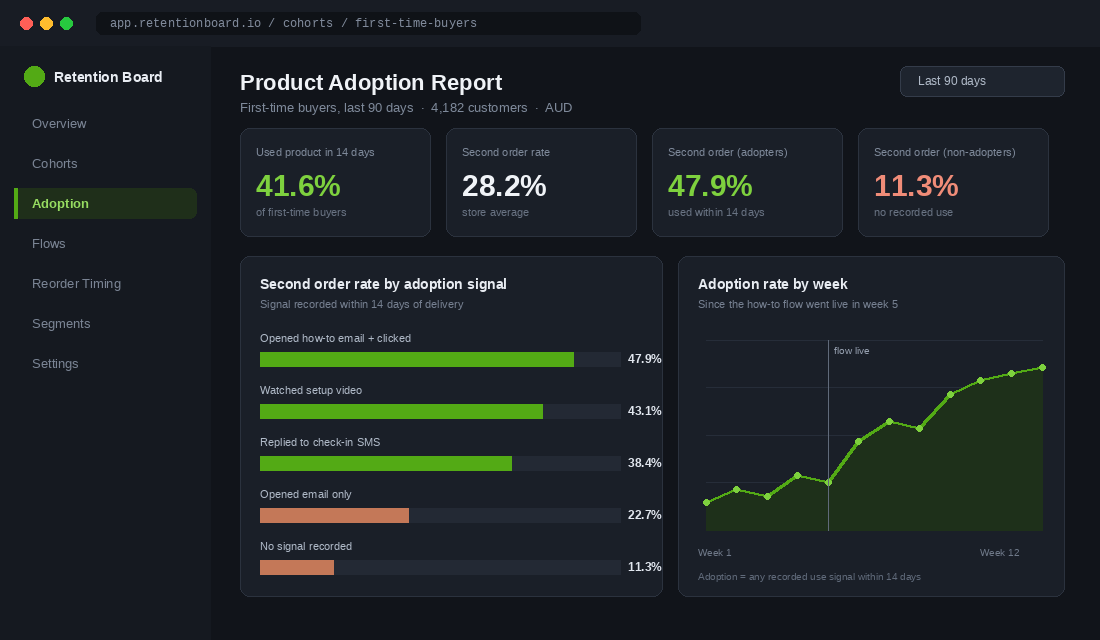
Build that split once for your own store and the conversation inside your business changes permanently. You stop arguing about whether email four should be 10% or 15% off, and start asking why 58% of your customers never opened the box properly.
Stage 1: Map the First 14 Days of Actual Use
Before you write a single email, you need to know what a successful first two weeks looks like for your product. Not what your flow says. What the customer physically does.
Sit down with a blank page and write the sequence out in plain language, hour by hour where it matters. Parcel arrives. Box opened. Product removed. First use. Second use. First noticeable result. Product runs low. Product runs out. Then mark the exact points where a normal person gets stuck, confused, or bored.
Three ways to get real data instead of guessing:
- Read your support tickets in order of frequency. Pull the last 200 post-delivery tickets and tag them by theme. The top three themes are your onboarding curriculum. If “how do I apply it” or “how long until I see something” appears more than a dozen times, that is a missing email, not a support problem.
- Call ten customers who never ordered again. Not a survey. An actual phone call, six to eight minutes, one question repeated: walk me through what happened after the parcel arrived. You will hear the same four sentences over and over.
- Time the product yourself. Buy your own product through your own store using a personal address, and log every friction point from the driver’s knock to first result. Founders who do this always find at least two things they had no idea about.
Out of that exercise you want three artefacts. First, a written definition of what “used it properly” means for your product, in one sentence. Second, the number of days it takes an average customer to get there. Third, the top three reasons they do not.
Frank Body, the Melbourne brand that turned a coffee scrub into a global body care range, is a good study here. The instruction to get in the shower, rub the scrub in circles, leave it on, then rinse is repeated on the packaging, on the product pages and across their social content. It is the same three steps everywhere. That is not brand consistency for its own sake. It is a company that decided the first shower is the moment the customer either becomes a repeat buyer or a one-off.
Stage 2: Rebuild the Post-Purchase Flow as a Use Flow
Most post-purchase flows in Australian Shopify stores are a shipping confirmation, a review request, and then a cross-sell with a code attached. That is a sell flow wearing a post-purchase costume.
The waste here is enormous, because post-purchase is the most attentive audience you will ever have. Post-purchase carries the highest median open rate of any flow, around 51.3% across the full flow and 58.0% on the entry email. Flows in general produce close to 41% of total email revenue from only 5.3% of sends. You have the customer’s full attention for about a fortnight and most brands spend it asking for another sale.
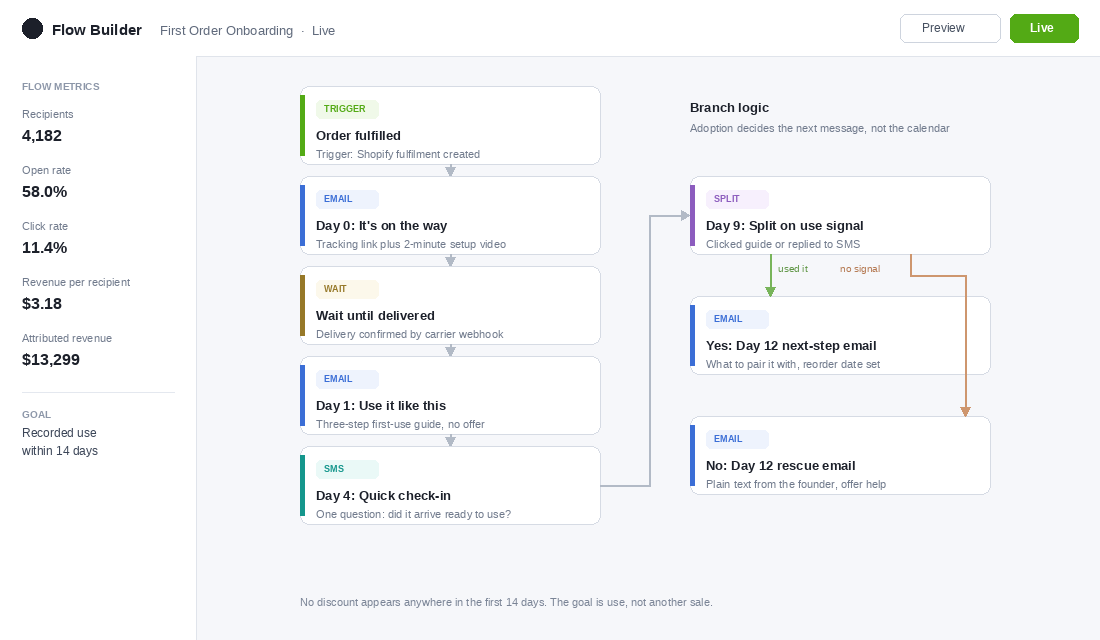
Here is how to build it in Klaviyo. The steps below assume Shopify is connected and you have the standard Klaviyo integration running.
- Create a new flow triggered on Fulfilled Order, not Placed Order. You want the clock to start when the parcel moves, not when the card is charged.
- Email one goes out immediately. Tracking link at the top, then a short setup guide underneath. Sixty to ninety seconds of video or three captioned images. No offer, no discount, no cross-sell.
- Add a conditional split on delivery. If you use a tracking app such as AfterShip, Parcel Panel or Shopify’s own delivery events, hold the next message until delivery is confirmed. If you cannot get the webhook, use a time delay set to your carrier’s realistic average. For most metro Australian routes that is three business days, and five to seven for regional.
- Email two lands one day after delivery. Subject line is instructional, not promotional. “Use it like this for the first week” beats “Thanks for your order” every time. Three steps, in order, with the single most common mistake called out explicitly.
- Add an SMS on day four. One question, replyable: did it arrive ready to use? Replies land in your support inbox and become your next round of research. Keep it under 160 characters and identify the brand in the first three words.
- Insert a conditional split at day nine on the use signal. Clicked the guide, watched the video, or replied to the SMS goes down the yes branch. Everything else goes down the no branch.
- Yes branch, day twelve: the next step. What to pair the product with, what to expect in week three, and the first mention of a reorder date.
- No branch, day twelve: a plain text email from you, no images, no header, asking if something went wrong and offering to help. This one email regularly outperforms every designed template in the flow.
The discipline that makes this work is boring and absolute: no discount code appears anywhere in the first fourteen days. The moment you put an offer in, the flow becomes about your revenue target rather than the customer’s outcome, and every metric you care about drifts. If you want the full architecture for what comes after this window, we mapped it out in the seven email post-purchase sequence.
Stage 3: Move the Teaching Upstream Into the Page and the Box
Email is the cheapest place to teach, which is why everyone starts there. It is not the most effective. Roughly half your customers will never open the flow at all, and those are disproportionately the ones who need the instruction.
So the same lesson has to exist in three more places.
- On the product page, above the fold on mobile. A short how-to-use block sitting directly under the buy button. This does double duty: it sells better and it pre-loads the instruction before the parcel even ships. One documented implementation of product video on PDPs took conversion from 1.8% to 4.4%, dropped total returns from 14% to 10%, and cut “not as described” returns from 9% to 4%.
- In the box, on one card. Not a folded pamphlet nobody unfolds. One card, three steps, large type, and a QR code that goes to a two minute video. Cost is a few cents per order at volume, and it reaches the customers your email never will.
- In the order tracking and thank you page. Both pages get opened repeatedly while the customer waits. Put the first-use guide there. The thank you page in particular is prime real estate that most Aussie stores leave as a default Shopify screen.
Go-To Skincare built an entire brand on this idea. The routine guidance is written in plain, funny, unpretentious language and it appears on the pack, on the site and in the emails. A customer who has read that copy three times knows exactly what to do on day one, which is precisely the point.
The test for whether you have done this properly is simple. Take a customer who ignores every email you send. Can they still work out how to use the product correctly and know when to reorder? If the answer is no, the teaching is trapped in a channel most of your customers will not use.
Stage 4: Time the Reorder Ask to the Consumption Date
This is where adoption converts into revenue, and it is the stage Australian founders get wrong most often, usually by picking a round number.
Day 30 is not a consumption date. It is a number somebody liked the look of. The actual date is a function of how much product is in the pack and how fast a customer who is genuinely using it gets through it. A 250g bag of coffee for a two-person household is twelve to eighteen days. A 100ml serum used morning and night is roughly six weeks. A 60-capsule bottle taken twice daily is exactly thirty days, and if your customer takes it once daily it is sixty.
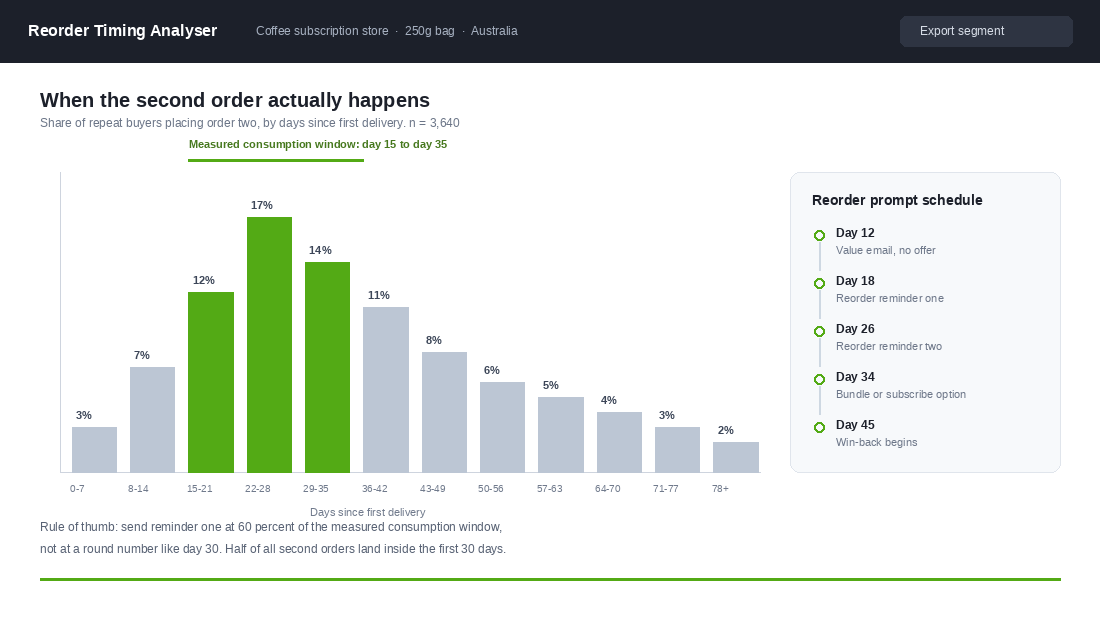
Timing matters more than almost any other variable in retention. Customers who place a second order within 60 days of the first are around three times more likely to become long-term repeat buyers than customers who wait 120 days or more. Half of all second orders land inside the first 30 days and three quarters inside 90. The window is much shorter than most founders assume, and it closes quietly.
To find your own number, export orders for customers with two or more purchases, calculate the gap in days between order one delivery and order two, and plot the distribution. Do it per product family, not store wide, because a candle and a coffee do not run out on the same schedule. Then set the first reorder prompt at roughly 60% of that window, the second at 85%, and a bundle or subscribe option at 110%.
The subscribe option matters more than it looks. A customer who has actually used the product and is now being offered a repeat delivery timed to their real consumption rate converts far better than one who saw a subscribe toggle on the product page before they had ever tried it. There is more detail on the mechanics in our guide to predicting the reorder date.
Stage 5: Measure Adoption, Not Opens
You cannot manage what you refuse to define. Almost no Shopify store has a field anywhere that says whether a customer used the product, which is why the consumption gap survives for years inside otherwise well run businesses.
Create a single custom profile property in Klaviyo called adoption_signal and set it to true when any of these fire inside 14 days of delivery:
- Clicked the how-to link in email one or email two
- Watched more than 50% of the setup video
- Replied to the day four SMS
- Submitted a review or a post-purchase survey response
- Logged into their customer account and viewed the order
Then track four numbers monthly and put them on the same page as your revenue dashboard:
- Adoption rate. Percentage of first-time buyers with a use signal inside 14 days. If you are starting from nothing, anywhere between 25% and 40% is normal. Getting it past 50% is where the compounding starts.
- Second order rate, split by adoption. The gap between adopters and non-adopters is the size of the prize sitting in front of you.
- Days to second order. Median, not mean, because a handful of superfans will distort the average badly.
- Support contacts per hundred orders. This should fall as the teaching improves. A 15% drop is realistic and it pays for the whole project on its own.
Review these in your monthly business meeting alongside revenue and contribution margin. Adoption rate is a leading indicator: it moves six to eight weeks before repeat revenue does, which makes it far more useful for decision making than the lagging numbers most founders stare at. If you want the wider framework for how these connect to lifetime value, start with the customer lifetime value playbook.
Why the Five Stages Compound
Run any one of these stages on its own and you will get a modest lift. Run all five and something different happens, because each stage feeds the next.
Mapping the fourteen days tells you what to teach. Teaching in the flow lifts adoption. Higher adoption means more customers reach a real result, which is the only thing that makes a reorder feel obvious rather than pushy. More customers reaching a result means better reviews and more user content, which lifts conversion on the product page for cold traffic. Better product page conversion lowers your acquisition cost. Lower acquisition cost gives you room to fund the video and the insert card that started the whole loop.
The maths on the other side is worth being specific about. Repeat customers spend more per order than first timers, with a typical spread of around $95 against $78. If you run 4,000 first orders a quarter and move the second order rate from 28% to 36%, that is 320 extra second orders. At $95 each, before any third or fourth order, before the improved review volume and before the reduced support load. And none of it came from more ad spend.
That is the quiet advantage of working on adoption. Everyone in your category is bidding against each other for the first order. Almost nobody is competing for the second one properly, because the work is unglamorous and it does not show up in a Meta dashboard.
The 14-Day Adoption Audit
Block ninety minutes this week and work through this list on your own store. Score each line honestly as yes or no. Anything under eight out of twelve means adoption is your biggest untapped retention lever.
- I can state in one sentence what “used it properly” means for my hero product
- I know the average number of days from delivery to first use
- I have read the last 200 post-delivery support tickets and tagged the top three themes
- My post-purchase flow triggers on fulfilment, not order placed
- The first instructional email lands within 24 hours of confirmed delivery
- No discount code appears in the first 14 days of the flow
- There is a how-to-use block on the product page, visible on mobile without scrolling past the buy button
- There is a printed instruction card in the box with a QR code to a short video
- I have a plain text founder email that fires when no use signal is recorded by day 12
- I have measured the real consumption window per product family, not store wide
- The first reorder prompt sits at roughly 60% of that window
- Adoption rate is on my monthly dashboard next to revenue
Start with the three cheapest lines: the trigger change, the instructional subject line, and the plain text rescue email. All three are an afternoon’s work in Klaviyo and they will move your adoption rate before the month is out. The insert card and the product page video are the following sprint. The measurement is the one that keeps it honest, so do not leave it until last.
The goal is not a cleverer email program. It is a customer who opened the box, used the product the way it was meant to be used, got the result they paid for, and came back without needing to be bribed. That customer costs you nothing to acquire the second time, and they are the entire difference between a store that plateaus and one that keeps climbing. For the broader picture on how this fits with everything else in retention, our repeat purchase playbook covers the surrounding system.
Inside eCommerce Circle, product adoption is one of the core pillars we work on with every member, because it moves retention without touching the ad account. If you want a second opinion on your first fourteen days, let’s talk.