It is the first week of August. Somewhere in your notes there is a line that reads BFCM: 30% sitewide? with a question mark you have not resolved since last year.
What’s in This Article
The question mark is not the problem. The problem is that the percentage is the only decision on the page. You are treating the biggest trading weekend of your year as a single number instead of a structure.
Australians spent a record $6.8 billion over the four day Black Friday to Cyber Monday weekend in 2025, according to the Australian Retailers Association and Roy Morgan, with around 6 million people taking part and average planned spend of $804 a head. That money is going to move through the market again this November. Whether any of it stays in your account after refunds, ad spend and cost of goods depends on work you do now, roughly sixteen weeks out, not on what you type into Shopify at 11pm on the Thursday before.
This is the offer architecture. Six layers, built in order. Here is how it works.
Why a Sitewide Percentage Is the Laziest Decision in Your Trading Year
A blanket discount does three things at once, and you only wanted one of them.
It buys you incremental orders from people who were undecided. Fine. It also hands the same discount to every customer who was going to buy at full price anyway, and it teaches your list that November is when your real prices appear.
The first effect is worth paying for. The second two are pure margin leakage, and they are usually much larger than founders expect.
Being at 30% does not even make you visible. Salesforce data put the average discount rate at its Black Friday peak at 28% in the United States and 27% globally in 2025, flat on the year before. Thirty percent sitewide is not a position. It is the middle of the pack, paid for out of your gross profit.
The longer term cost is worse. Academic work on acquisition promotions found that customers acquired with a 35% discount were worth roughly half the long term value of customers acquired without one, because deep discounts attract buyers who are uncertain about the brand and only return when the price drops again.
Meanwhile the customers who actually pay for your year are already on your list. Klaviyo reported that repeat shoppers drove BFCM 2025 revenue growth 45% higher than new shopper growth, and that email and text together accounted for 42% of GMV across their customer base. You are not short of demand. You are short of a structure that charges different people different prices for good reasons.
Layer 1: Set the Margin Floor Before You Pick a Number
Do this before you think about creative, before you brief the designer, before you look at what your competitor did last year.
Pull your contribution margin by collection. Not blended across the store. By collection, after cost of goods, inbound freight, payment fees and your average outbound shipping subsidy. Most Aussie stores discover a spread of twenty points or more between their best and worst performing groups.
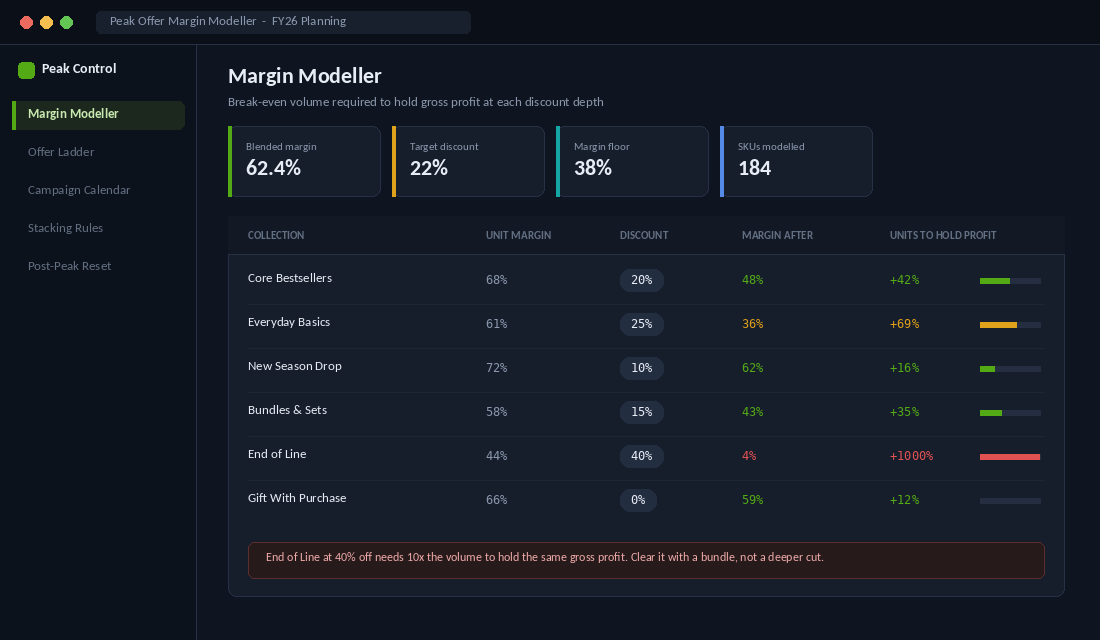
Then run the only piece of maths that matters in peak planning. To hold the same gross profit at a given discount, the extra unit volume you need is:
Required volume uplift = discount % divided by (margin % minus discount %)
A product on 68% margin discounted 20% needs 42% more units to stand still. The same product at 40% off needs 143% more units. A product on 44% margin discounted 40% needs ten times the volume. That is not a promotion, that is a donation with a countdown timer on it.
Set two numbers and write them down where the team can see them.
- Margin floor. The contribution margin below which no order is allowed to land, no matter how the discounts combine. Thirty five to forty percent is a common floor for Aussie DTC once freight is loaded in.
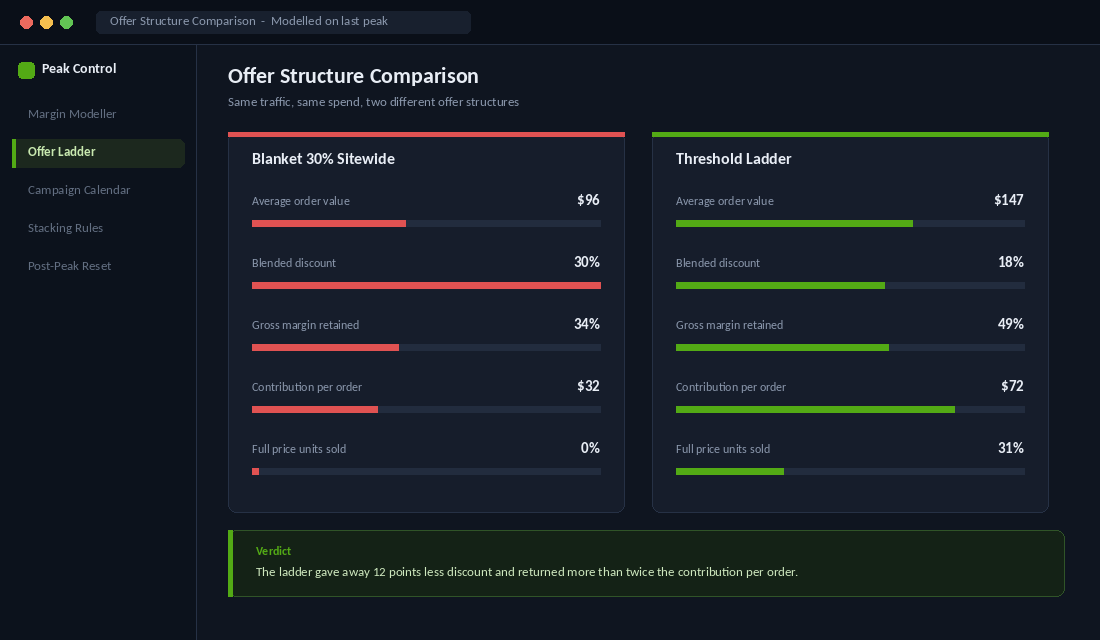
- Blended discount target. The average discount across all peak revenue. If your headline is 30% but your blended lands at 18%, your architecture is doing its job.
Every decision in the next five layers gets tested against those two numbers.
Layer 2: Segment the Offer by Customer, Not by Catalogue
Most stores segment the offer by product. Twenty percent off this collection, thirty off that one. It is the wrong axis.
The same jumper is worth a different discount depending on who is looking at it. Segment by relationship first, then decide what each group sees.
- Past buyers and VIPs. They already trust you. Give them access and priority rather than depth. Early entry, first pick of limited stock, free express upgrade. Access costs you almost nothing and converts harder than another five points off.
- Engaged non-buyers. On your list, opening emails, never purchased. This is where a genuine headline offer earns its keep, because the discount is buying a first order rather than subsidising one you already had.
- Cold prospecting traffic. Expensive, sceptical, comparison shopping. Give them a clear entry offer and a strong risk reversal, then hand them straight to the post-purchase flow.
- Deal seekers. They arrive through coupon sites and only convert at depth. Point them at end of line stock and clear the warehouse. Do not let them near your hero products.
Deciem built its whole peak strategy on this idea. Rather than fight on Black Friday, it runs Slowvember, offering 23% across the month and closing its stores and website on Black Friday itself. The offer is not deeper than the market. It is longer, calmer and pointed at people who already know the brand.
Everlane went further and took its site dark on Black Friday under a Buy Less, Buy Better message. Patagonia has run Buy Less, Demand More alongside its Worn Wear repair programme and has previously donated 100% of Black Friday sales. You do not have to copy the positioning. The point is that all three decided who the weekend was for before they decided what it cost.
Layer 3: Build a Ladder, Not a Blanket
A blanket discount has one rung. Everyone steps on it and steps off. A ladder gives the customer a reason to add one more item, which is the only mechanic that improves your margin and your revenue at the same time.
Shopify merchants turned over a record US$14.6 billion across BFCM 2025, up 27% on the year, at an average cart value of US$114.70. Cart value is the number your ladder is designed to move.
How to set the rungs
- Take your current average order value. Set the first rung about 15 to 20% above it, so the typical shopper is one small item short of qualifying.
- Space the next two rungs at roughly 1.6 times and 2.4 times your AOV. Three rungs is plenty. Four confuses people and five gets ignored.
- Increase the value at each rung, not just the percentage. Rung one is money off. Rung two adds free express shipping. Rung three adds a gift with purchase or a bonus size.
- Cap the top rung at your margin floor. Model it against the formula in Layer 1 before it goes live.
Gift with purchase deserves a special mention because it is badly underused in Australia. A gift costs you its cost of goods, not its retail value. A $30 retail item that costs you $7 to make reads as a $30 benefit and takes seven points off a 66% margin instead of the twenty five points a comparable discount would take. It also moves slow stock without putting a sale price next to it.
Bundles work on the same principle. A three pack priced at a 15% saving reads as better value than 15% off a single unit, because the customer is comparing it to buying three at full price. You get a higher order value, one pick and pack cost, and a customer with enough product to form a habit.
Layer 4: Sequence Six Trading Windows, Not One Weekend
Black Friday falls on 27 November in 2026, with Cyber Monday on 30 November. If your plan is a four day event, you are competing at the exact moment ad costs peak and inboxes are at their fullest.
Klaviyo found that nearly half of shoppers had started buying before the Thanksgiving weekend even opened. The weekend is the peak of the event, not the whole of it. Build six windows and give each one its own offer and its own audience.
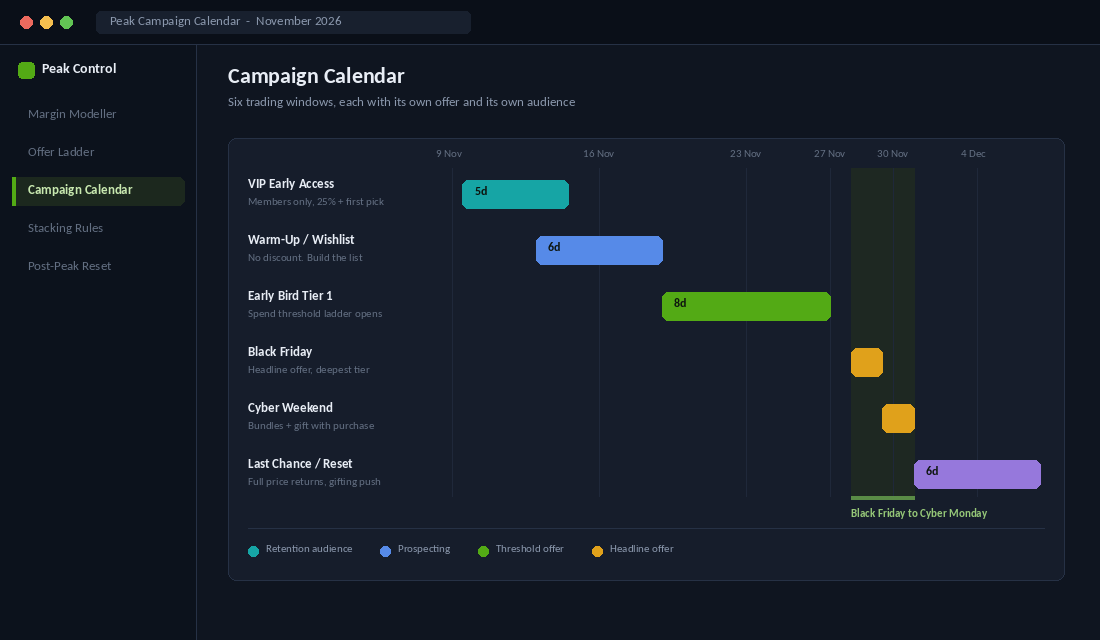
- VIP early access (mid November). Past buyers and top segment only. Access and first pick, not extra depth. This window tells you which products are going to move.
- Warm-up and wishlist (mid to late November). No discount. Publish the gift guides, run the quiz, get people to save products. You are building the send list you will monetise in two weeks time.
- Early bird ladder (the week before). Threshold ladder opens at shallower rungs. Catches organised shoppers and spreads your warehouse load away from the weekend.
- Black Friday (27 November). Headline offer, deepest rung, heaviest send. One clear message, repeated.
- Cyber weekend (28 to 30 November). Rotate to bundles and gift with purchase so the offer feels new without going deeper. This is where you protect the blended number.
- Last chance and reset (from 1 December). Full price returns. Pivot the message to Christmas gifting and delivery certainty.
Spreading the load has an operational payoff as well as a margin one. Your support queue, your pick and pack team and your carrier all get a flatter curve, which is the whole point of a proper peak season staffing plan.
Layer 5: Write the Stacking Rules Before the Traffic Arrives
This is where good plans die. The architecture is sound, then a VIP code stacks on an automatic threshold discount on a bundle that already carries a saving, and you ship a $180 order at 4% margin with free express.
Decide the mechanics now, in August, while you have time to test them properly.
Setting it up in Shopify
Native automatic discounts handle simple cases. Anything with tiers, bundles, free gifts or conditional logic wants Shopify Discount Functions, which is the supported path now that Shopify Scripts is frozen for edits from 15 April 2026 and stops executing entirely on 30 June 2026. If you still have Scripts running your peak logic, migrating is not optional this year.
- Audit what you have. In Shopify admin go to Discounts and export the active list. Note anything created by an app and anything still running on Scripts.
- Choose your engine. Either install an app built on Discount Functions (Kite and similar no-code tools cover tiered, BOGO, free gift and shipping promos) or have a developer deploy a custom function. You can activate up to 25 discount functions per store, and a single function can apply product, order and shipping discounts together.
- Set combination rules explicitly. For each discount, set whether it combines with product, order and shipping discounts. Default to off, then switch on only the combinations you have modelled.
- Build an exclusion list. Gift cards, subscription first orders, new season drops and any SKU under your margin floor. Tag them in Shopify so the function can read the tag instead of a hardcoded list you will forget to update.
- Test with draft orders. Create a draft order for each customer segment, apply every combination a real shopper could construct, and check the final contribution against your floor. Include an order that hits the top rung, uses a VIP code and qualifies for free express.
- Set an end date on every discount. Peak discounts that outlive the campaign are one of the most common margin leaks in December.
Lock the code once this is tested. A pre-peak code freeze from about a week before your first window means nobody ships a theme change into a discount function that is already live and working.
Layer 6: Decide What Happens on 2 December
Peak is not the finish line. It is the largest customer acquisition event of your year, and most stores waste it by treating the first of December as the end of the project.
You have just acquired a large cohort at a discount. The research says that cohort will repeat at a lower rate than your full price buyers unless you do something about it. So do something about it, and plan it now while you are thinking clearly.
- Return to full price cleanly. No quiet extension, no surprise flash sale on 5 December. If the sale ends, it ends. Extensions are how you train a list to wait.
- Switch the message to certainty. From early December the buying question changes from price to whether it arrives in time. Australia Post domestic Parcel Post cut offs landed around 19 December for interstate and 22 December for same state last year. Publish your own cut off dates prominently and beat them.
- Build a second purchase flow for the peak cohort. Tag every peak order. Two to three weeks after delivery, send a flow that is about the product and the brand, not another offer. Education, care instructions, the story. Give them a reason to like you at full price.
- Run the cohort report in January. Compare 60 day repeat rate for peak acquired customers against your baseline. That single number tells you whether this year’s architecture was an investment or a write-off, and it sets your depth for next year.
Watch your paid search too. Competitors bid hardest on brand terms in December, so your brand search defence matters more in the fortnight after peak than at almost any other time.
How the Six Layers Compound
Taken alone, each layer is worth a couple of points. Stacked in order, they change the shape of the whole quarter.
The margin floor stops you from choosing a number you cannot afford. Segmenting by customer means your deepest offer only reaches people who need it to buy. The ladder lifts average order value so the discount you do give is spread across more revenue. Sequencing six windows means you are not paying peak ad rates for all of your volume. Stacking rules stop the whole thing unravelling in the checkout. The December plan converts a discounted cohort into a full price one.
A store running a flat 30% at a $96 average order value on a 64% margin keeps around $32 of contribution per order. The same store running a ladder at an 18% blended discount and a $147 average order value keeps around $72. Same traffic, same ad spend, same products. The difference is entirely structural, and it is decided in August, not November.
Your Peak Offer One-Pager
Open a document today and fill in these eleven lines. If you cannot answer one, that is the next thing to work on.
- Margin floor. No order lands below ___% contribution.
- Blended discount target. Average discount across all peak revenue: ___%.
- Headline offer. One sentence a customer could repeat to a friend.
- VIP offer. What past buyers get that nobody else does.
- Ladder rungs. Three thresholds, three escalating benefits, all modelled against the floor.
- Excluded SKUs. The tagged list nothing can discount.
- Stacking matrix. Which discounts combine, confirmed by draft order tests.
- Six windows. Start date, end date, offer and audience for each.
- Inventory commitment. Units backing the headline offer and the gift with purchase, ordered by ___.
- Cut off dates. Your published last order dates for each state.
- December plan. Full price return date, second purchase flow, January cohort report owner.
Eleven lines. Sixteen weeks. Most of your competitors will still be arguing about the percentage in the second week of November.
Start With the Floor
If you do one thing this week, pull your contribution margin by collection and run the break-even formula against the discount you ran last year. Most founders find at least one collection where last year’s promotion needed volume they never came close to hitting.
That single spreadsheet usually changes the plan more than any amount of creative work.
Inside eCommerce Circle, peak offer architecture is one of the core pieces we build with every member before the November rush. If you want a second opinion on yours, let’s talk.