Australians spent a record 6.8 billion dollars over the Black Friday to Cyber Monday weekend last year, according to the Australian Retailers Association and Roy Morgan. Around 6 million Aussies took part, spending an average of 804 dollars each. If you sell on Shopify, that four day window is probably the single biggest revenue event on your calendar.
What’s in This Article
Here is the problem. Most Aussie founders arrive at that window with no audience of their own and try to buy one at the worst possible moment. November is the most expensive month of the year to advertise. Superads’ CPM tracker puts the global median at its annual peak in November, running roughly 41 per cent above the yearly average, and Black Friday week regularly costs two to three times normal levels.
You cannot control the auction. You can control how many people already know your name when the auction gets expensive. It is early August. You have roughly sixteen weeks. That is enough time to build a prospect pipeline, and this is the six stage system I walk members through to do it.
Stage 1: Count the People You Are Already Losing
Every founder I speak to knows their conversion rate. Almost none of them know their identification rate. That second number is the one that decides how expensive your November will be.
Identification rate is simple: of every 100 sessions on your store, how many end with a name, an email address or a phone number attached? For most Shopify stores running paid traffic, the honest answer sits between 3 and 7 per cent. Everything else walks out anonymous, and the only way to reach those people again is to pay the auction a second time.
Compare that with the number everyone quotes. Baymard Institute puts the average cart abandonment rate at 70.19 per cent, rising to 80.02 per cent on mobile. Cart abandonment feels like the big leak because you can see it in your reports. It is not. Cart abandoners already gave you their details. The far bigger leak is the 93 per cent of visitors who never got that far.
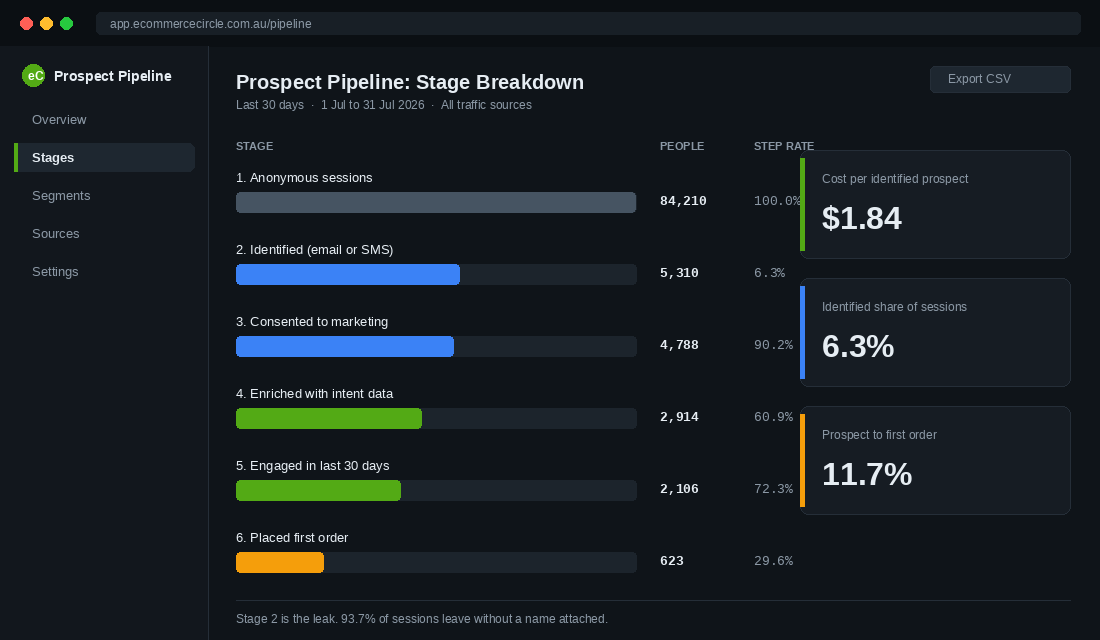
Build this view before you do anything else. In Shopify Analytics, pull total sessions for the last 30 days. In Klaviyo, pull profiles created in the same window with a valid email or SMS consent. Divide one by the other. Write the number on a whiteboard.
Your target: lift identification rate by two percentage points before 1 October. On 80,000 monthly sessions, that is an extra 1,600 named people a month, or roughly 4,800 before peak. At a typical Aussie DTC customer value, that pipeline is worth more than any single ad creative you will test between now and then.
Stage 2: Capture at the Moment of Intent, Not the Moment of Arrival
The default Shopify setup fires one pop-up, on page load, offering 10 per cent off, to everybody. It is the laziest capture strategy in ecommerce and it produces exactly what you would expect: low quality subscribers who joined for a discount and unsubscribe in January.
The data backs the fix. Across roughly a billion pop-up displays, ecommerce sites average 5 to 8 per cent capture on email sign-up forms, while the all-industry average sits closer to 2 to 3.5 per cent. The difference is almost always targeting and timing:
- Delay 6 to 10 seconds. Immediate displays consistently underperform. Give the visitor a moment to work out where they are.
- Design mobile first. Pop-ups built for mobile convert at 2.2 per cent against 1.4 per cent for desktop-only designs, and most Aussie DTC traffic is now 70 per cent plus mobile.
- Offer something, but not always money. Pop-ups with an incentive convert at 2.4 per cent against 1.7 per cent without. A size guide, a fit quiz or a restock alert often outperforms a discount and attracts better buyers.
- Change the ask by page type. Homepage gets the welcome offer. Product pages get the back-in-stock or price-drop alert. Collection pages get the quiz. Blog pages get the guide.
Melbourne brand Frank Body ran a spin-to-win capture form and reported a welcome flow with a 61 per cent open rate against a 30 per cent benchmark, converting at 21.7 per cent. That is what a well matched capture and follow-up pair produces. The pop-up is not the win. The pop-up plus the sequence behind it is the win.
If your capture layer is a single form doing all the work, start with our six-trigger pop-up architecture and rebuild it by page type before you touch anything else in this list.
Stage 3: Get Consent That Still Works in November
A captured email is not the same as a usable one. Under the Spam Act, Australian senders need consent, accurate sender identification and a working unsubscribe on every commercial message. Beyond the legal floor there is a commercial one: a list full of people who do not remember opting in will wreck your deliverability at exactly the moment you need inbox placement most.
Three things to fix in August so November works:
- Separate email and SMS consent. Do not bundle them into one checkbox. Ask for SMS as a second step after the email is captured, and make the value explicit: early access, restock alerts, order updates.
- Warm the sending domain now. If you have been sending to 4,000 people and plan to send to 30,000 in November, ramp volume gradually from September. Sudden volume spikes are the fastest way into the promotions tab or the spam folder.
- Sunset the dead weight before peak. Profiles that have not opened in 180 days drag your sender reputation down. Run a two-email win-back in October, then suppress the non-responders. A smaller engaged list beats a bigger silent one every time.
The habit that saves you here is boring: never add a profile to your main sending list without a consent timestamp and a source tag. When something goes wrong in November, source tags are how you find the leak in ten minutes instead of two days.
Stage 4: Enrich With One Question at a Time
An email address on its own is close to worthless. An email address attached to “shopping for someone else, budget under 100 dollars, first heard about us on TikTok” is a segment you can sell to.
The trap is asking too much. Survey data is unambiguous on this: two to three question microsurveys hit a median response rate around 16 per cent, while surveys of seven or more questions fall under 7 per cent. A single well placed question on the order confirmation page can clear 40 per cent. Timing matters as much as length, because response rates drop sharply within a day of the purchase.
Pick three enrichment questions and no more:
- On the thank you page: “How did you first hear about us?” This is your cheapest attribution signal and it does not care about iOS tracking rules.
- In the welcome email, question two: “What brought you here today?” with four clickable answers. Each click writes a profile property in Klaviyo. No form, no friction.
- On the product page, for out of stock lines: “Notify me when this is back.” That single click is the strongest intent signal on your entire store.
Every answer becomes a profile property. Every property becomes a segment. Every segment becomes a message that does not need to shout.
Stage 5: Sort by Intent, Not by Source
Most Shopify stores segment by where someone came from. Meta list, Google list, TikTok list. It feels organised and it is nearly useless, because channel tells you how you paid for someone, not how close they are to buying.
Sort by intent depth instead, and rank each tier by revenue per profile over the last 90 days.
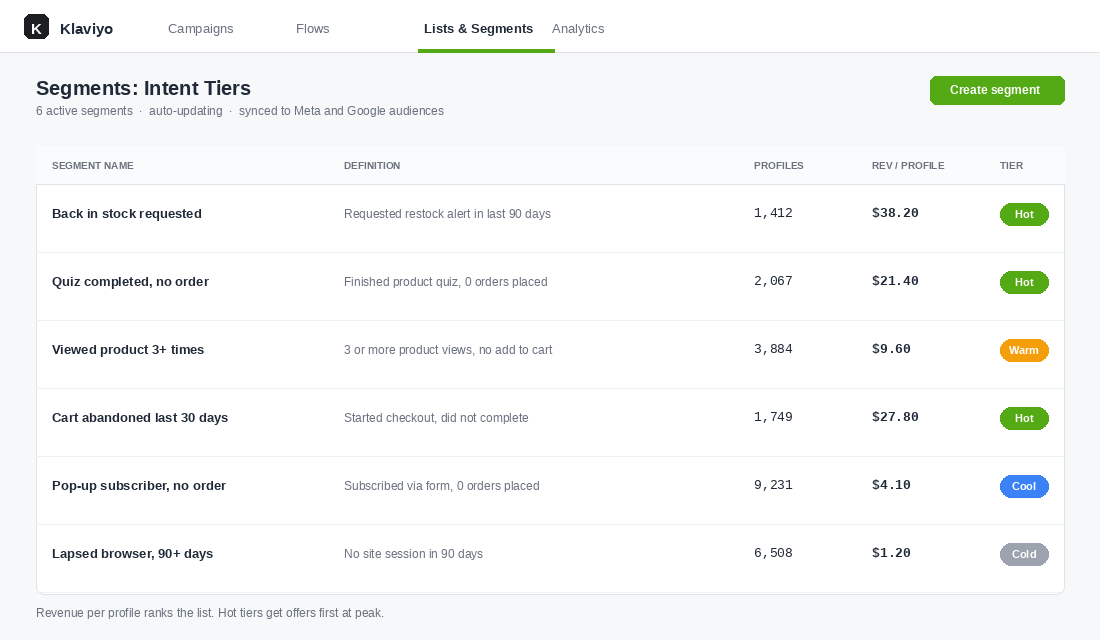
Four tiers is plenty:
- Hot. Requested a restock alert, finished a quiz, or abandoned a checkout in the last 30 days. These people have told you what they want. Send them the offer first and do not bury it in a general campaign.
- Warm. Viewed the same product three or more times, or opened the last four emails without buying. Something is blocking them. Usually price, delivery timing or sizing confidence.
- Cool. Subscribed through a form, never ordered, still opening. This is the biggest tier and the one most founders mistake for their whole list.
- Cold. No session in 90 days. Suppress before peak or you are paying deliverability tax on people who will not buy.
If you want the full logic for building and maintaining these tiers, our customer segmentation playbook covers the definitions in detail. The point for peak season is narrower: by 1 November you want every prospect sitting in exactly one tier, updating automatically, ready to receive a different message.
Stage 6: Nurture on a 90 Day Clock, Then Harvest
Capture without nurture is just a bigger list of strangers. The brands that win peak have been talking to their prospects since winter.
Aussie founded Who Gives A Crap grew their email list by 640 per cent over three years, unifying capture, subscription and shipping data in one place, and now sees around 75 per cent open rates on notifications by adjusting send times to where the customer actually lives. That is not a clever campaign. That is three years of pipeline discipline showing up in a single metric.
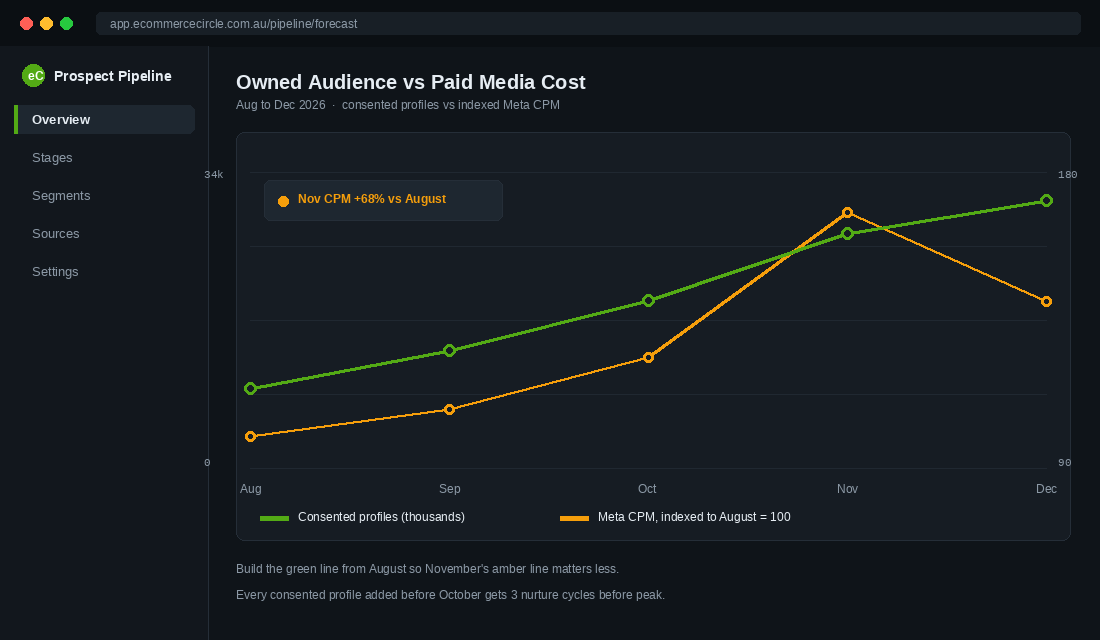
Run your sixteen weeks in three blocks:
- August and September, build. Fix capture, fix consent, add the three enrichment questions. Send education and story content weekly. No discounting. You are earning the right to sell in November.
- October, qualify. Run the win-back, suppress the cold tier, and start seeding the peak offer. Open a genuine early access list and let hot prospects join it. The join itself is a purchase signal.
- November, harvest. Early access goes to the hot tier first, then warm, then cool. Klaviyo customers generated 3 billion dollars in attributed value across BFCM from more than 157,000 brands, and those who added SMS to the mix saw a 20 per cent lift on the prior year. That revenue goes to lists that already existed in August.
Your welcome sequence carries most of this load, so it needs to be better than a discount code and a logo. Our welcome email sequence playbook maps the five emails that turn a fresh subscriber into a first order.
The Tool Setup: Building This in Klaviyo This Week
You do not need new software. If you are on Shopify and Klaviyo, the pipeline is a two hour build. Here is the order:
- Turn on the Shopify onsite tracking snippet. In Klaviyo, go to Integrations, open Shopify, and confirm Active on Site Tracking is enabled. Without it you get no viewed product or browse data, and stages 4 and 5 do not work.
- Build three forms, not one. Under Sign-up Forms create a homepage welcome form with a 7 second delay, a product page back-in-stock form, and an exit intent form for collection pages. Set each to mobile responsive and give each a distinct source name.
- Add the source property. In each form’s settings, add a hidden field named capture_source with values homepage, restock and collection_exit. This is what lets you audit quality later.
- Create the four intent segments. Under Lists and Segments, build Hot (Requested Back In Stock at least once in the last 90 days, or Started Checkout at least once in the last 30 days), Warm (Viewed Product at least 3 times in the last 60 days and Placed Order zero times), Cool (in any list and Placed Order zero times), Cold (has not been Active on Site in 90 days).
- Add the one click question to welcome email two. Use four link blocks, each with a tracking parameter, then build a flow filter that writes a profile property when the link is clicked.
- Sync the Hot and Warm segments to Meta. Under Integrations, connect Meta Ads and push those two segments as custom audiences. In November you will run offers to people who already know you at a fraction of cold prospecting cost.
Do the tracking snippet and the segments first. Everything else can wait a week. Nothing else can.
Why the Six Stages Compound
Run any one of these stages on its own and you get a modest lift. Run them in order and they multiply, because each stage raises the input quality of the next.
Work an example on 80,000 monthly sessions. Lift identification from 4 to 6 per cent and you go from 3,200 to 4,800 new prospects a month. Hold consent quality so 90 per cent stay mailable rather than 70 per cent, and the usable number moves from 3,360 to 4,320. Enrich 60 per cent of them with a single question and you have 2,592 people you can sort by intent instead of by channel. Nurture those for three months and the hot tier alone is a five figure November, before you have bought a single impression.
Now look at the cost side. Against a November CPM running 41 per cent above the annual average, and two to three times normal during Black Friday week itself, every order you take from an owned list is an order you did not overpay for. The pipeline does not just add revenue. It changes what your peak season costs.
That is also why starting in August matters more than starting well. A perfectly built pipeline switched on in late October gets one nurture cycle. A rough one switched on this week gets three.
The 16 Week Prospect Pipeline Checklist
Copy this into your project tool and put a name and a date against every line.
- Week 1. Calculate identification rate. Record sessions, new profiles and the percentage. Confirm Klaviyo onsite tracking is active.
- Week 2. Replace the single sitewide pop-up with three page-type forms. Add capture_source to each.
- Week 3. Split email and SMS consent. Add consent timestamps. Audit unsubscribe and sender details against the Spam Act.
- Week 4. Add the thank you page attribution question and the one click question in welcome email two.
- Weeks 5 to 8. Build the four intent segments. Publish weekly non-promotional content. Track identification rate every Monday.
- Weeks 9 to 10. Begin sending domain ramp. Increase volume no more than 30 per cent week on week.
- Weeks 11 to 12. Run the win-back to the cold tier, then suppress non-responders. Open the early access list.
- Weeks 13 to 14. Sync hot and warm segments to Meta and Google as custom audiences. Finalise the peak offer.
- Weeks 15 to 16. Send early access to hot, then warm, then cool. Hold cold suppressed.
- After peak. Report revenue per profile by tier and by capture_source. Kill the sources that produced volume without value.
One number tells you whether the whole thing worked: the share of peak revenue that came from owned channels rather than paid. Under 25 per cent and you are renting your customers. Over 40 per cent and you own an asset that will still be there next November.
If your peak offer is still undecided, pair this with our peak offer architecture playbook so the audience you build has something worth turning up for.
Inside eCommerce Circle, building the prospect pipeline is one of the core pillars we work on with every member, and August is when we run it. If you want a second opinion on yours before peak, let’s talk.