You have probably had this conversation. An agency promises 20 backlinks a month. Six months and a few thousand dollars later you have 20 links from sites no human has ever visited, your rankings have not moved, and nobody can tell you what changed.
What’s in This Article
The links were not the problem. The brief was. Aussie shoppers spent a record $82.6 billion online in 2025, up 14% year on year, and the average Australian household now buys from 16 different brands a year according to the Australia Post eCommerce Report 2026. Getting into that set of 16 is not a link-count problem. It is a “has anyone credible ever mentioned you” problem.
And in 2026 the scoreboard shifted again. Branded web mentions correlate 0.664 with visibility in Google’s AI Overviews. Backlinks correlate 0.218. That is roughly three times the pull, from the thing most Shopify founders never deliberately chase. The link has become a by-product of the mention, not the goal.
This is the six-step system for earning those mentions on purpose, built for a store doing $40k to $500k a month with no PR agency and no media budget.
Why “Build More Links” Is the Wrong Brief in 2026
Links are not dead. Ahrefs analysed over a billion pages and found 66.31% have zero external links from referring domains, and that pages with at least one backlink perform roughly 10x better in organic search than pages with none. If your product pages sit in that 66%, you are competing with one hand behind your back.
What has changed is the ceiling. Brand search volume now shows a 0.334 correlation with the likelihood of being cited in an AI answer, materially stronger than backlinks. YouTube mentions, meaning your brand name appearing in video titles, descriptions and transcripts, showed the single strongest correlation with AI visibility at 0.737 in 2026 data. Freshness matters too: across nearly 17 million citations, cited content ran about 25.7% newer than the organic top 10.
Read those three numbers together and the strategy writes itself. Chase coverage, not links. A real mention in a real publication gives you the link, the brand-name repetition that feeds AI models, and a piece of social proof you can put on your product page. A link-building package gives you one of those three, badly.
Step 1: Build Something Worth Writing About
Nobody has ever linked to a collection page out of generosity. Journalists link to a story, a number, or a thing that photographs well. If you have none of those, your outreach is asking a stranger to do you a favour, and the reply rate reflects it.
Who Gives A Crap is the textbook case. The brand launched in July 2012 with an Indiegogo campaign where co-founder Simon Griffiths sat on a toilet in a warehouse for 50 hours until the first $50,000 was raised. The stunt was the story, and the story was the distribution. More than a decade on, the brand has donated over $13 million to WaterAid and other sanitation charities, which means there is always a fresh, checkable number for a journalist to write about.
July, the Melbourne luggage brand founded by Athan Didaskalou and Richard Li, took the other route: borrowed authority. Becoming the official luggage supplier for Team Australia’s Olympic team is not a marketing campaign, it is a fact that every travel and business writer in the country can hang a paragraph on.
You do not need an Olympic deal. You need one asset from one of these three lanes:
- Data you already own. Anonymise your order data and turn it into a claim. Which postcode spends the most on gifting. How far in advance Melbourne shoppers buy compared with Brisbane. What the average Aussie spends on a Father’s Day present in your category. You have this in Shopify Analytics right now.
- A verifiable first. First Australian brand in your category to do a specific thing. Certification, material, take-back scheme, local manufacturing. It has to be checkable or a good journalist will bin it.
- A partnership with a trusted institution. A charity, a sporting club, a university, a well-known local maker. You are renting their credibility and giving them reach.
One discipline before you build anything: write the headline you want to see, word for word, first. If you cannot write a headline a real outlet would run, the asset is not ready.
Step 2: Fix the Home Base Before You Pitch a Single Outlet
Earning a mention and then sending that journalist to a store with a stock About page is how you burn a relationship you only get once. Worse, AI models assemble their picture of your brand from repeated, consistent references. Contradictory or missing facts on your own site make you a weak entity, and weak entities do not get recommended.
Run this before your first pitch. It takes an afternoon.
- A real About page. Named founders, founding year, where you operate from, why the business exists. Not brand poetry.
- A press page. Every mention you have ever had, with outlet logo, headline, date and outbound link. Journalists check whether other journalists have covered you.
- A facts sheet. One page with founding year, head office suburb, team size, units shipped, notable stockists, product categories, founder bios and two downloadable images. Writers copy straight from this.
- Organization schema with sameAs. Point it at your social profiles, your ABN listing and your press coverage so machines connect the dots.
- One reachable human. A monitored press email address, not a contact form that routes to customer service.
This is the same entity work that decides whether ChatGPT names you when someone asks for the best Australian brand in your category. We broke that side of it down in The AI Search Visibility Playbook, and the two projects share about 70% of the same tasks. Do them together.
Step 3: Work the Fast Lane, Ten Minutes a Day
The cheapest mentions in Australia come from journalist request platforms, where reporters post what they need and sources reply. SourceBottle is the Australian one. Qwoted, Featured and Muck Rack cover the same ground internationally. Replying costs nothing but time.
Speed is the whole game. Responding within the first hour of a query going out increases placement rates by over 60% compared with slower replies. Journalists file on deadline and take the first usable quote that lands.
Set it up once, in about 15 minutes:
- Create a free SourceBottle account and select only the categories you can credibly speak to. Retail, small business, and your product category. Not everything.
- Turn on email alerts and add the sender to a filter that skips the inbox and lands in a folder called Fast Lane.
- Block ten minutes at 8am. Scan, reply to anything you can answer with a real number, close the folder.
The reply is four lines, never more. Who you are and why you are qualified in one sentence. The answer in about 60 words, written so it can be pasted straight into the article. One specific number from your own business. An offer of images and a follow-up call. No attachments, no pitch deck, no brand story.
Three replies a week is a realistic starting cadence for a founder. Expect roughly one placement a fortnight once you get the speed and the specificity right.
Step 4: Pitch the Story Only You Have the Data For
The fast lane is reactive. Step 4 is where you go and get the coverage you actually want, and it is worth being honest about the odds. The average cold outreach reply rate in 2026 sits at 3.43%, down from 8.5% in 2019. Anything above 5% is good. Targeted, signal-triggered outreach runs between 5% and 18%.
Which tells you exactly what to do: build a small list by hand instead of a big one with software. Forty names you have personally read beats four hundred scraped addresses every time.
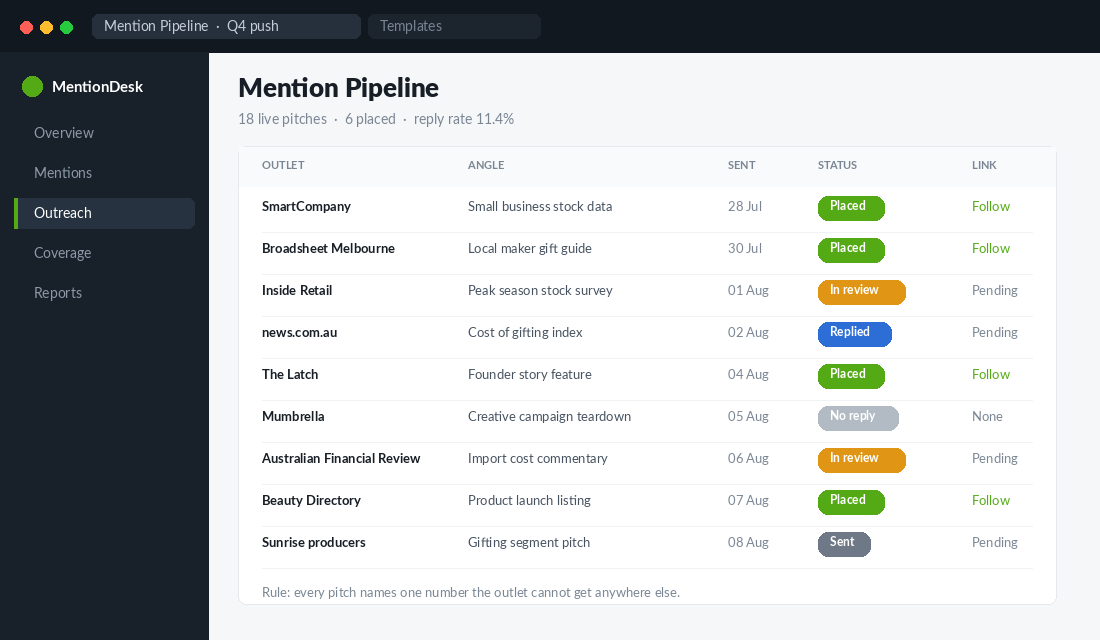
- Trade press. Inside Retail, SmartCompany, Ragtrader, Power Retail. They cover Australian retail businesses daily and need data.
- Lifestyle and city media. Broadsheet, Time Out, The Latch, Concrete Playground, plus your capital city’s newspaper lifestyle desk.
- Category media and newsletters. The niche site or independent newsletter your customers already read. Smaller audience, far higher intent, far easier yes.
- Podcasts and YouTube reviewers. Given that YouTube mentions correlate more strongly with AI visibility than anything else measured, treat these as tier-one targets, not leftovers.
The pitch itself is short and structured. Subject line is the number, not your brand name. Two sentences of context. The finding. One line on method so it can be trusted. Then the offer: the full data set, a founder quote already written, and two press-ready images. Under 150 words total.
Timing decides more than copy. Gift guides for Q4 are commissioned 8 to 12 weeks out, which means the guides that run in November are being built in August and September. If you are reading this in the second week of August, you are exactly on time for one round of pitches and one follow-up before the desks close their lists.
Follow up once, four working days later, in the same thread, adding one new fact. Then stop. A second chase costs you the next opportunity.
Step 5: Harvest the Unglamorous Mentions Nobody Chases
Founders fixate on the dream placement and ignore the twenty easy mentions sitting in their own supply chain. These links are unglamorous, permanent, and almost never rejected, because the other party gets something from saying yes.
- Your suppliers and manufacturers. Ask to be added to their stockist, partner or case study page. They want proof their product sells.
- Your stockists and wholesale accounts. If a retailer carries you, their brand directory should link to you. Most will if asked.
- Your app and platform partners. Klaviyo, Rebuy, Shopify agencies and 3PLs all publish customer stories. A 30-minute interview buys a permanent link from a strong domain.
- Charities and community partners. If you donate product or a percentage of sales, ask for the partner page listing.
- Industry bodies and awards. Membership directories, finalist lists, local chamber listings. Entering three relevant awards a year is cheap coverage even when you lose.
- Local and alumni media. Council business features, university alumni profiles, your suburb’s paper. Small audiences, real editorial links.
Send one of these asks per week for twelve weeks. It is 20 minutes of work and it typically returns 6 to 10 links, most of which will still be live in five years. Then get on podcasts. Six to ten relevant shows a year puts your brand name into transcripts, show notes and YouTube descriptions, which is the exact material AI systems are reading when they decide who to recommend.
Step 6: Measure the Three Numbers That Compound
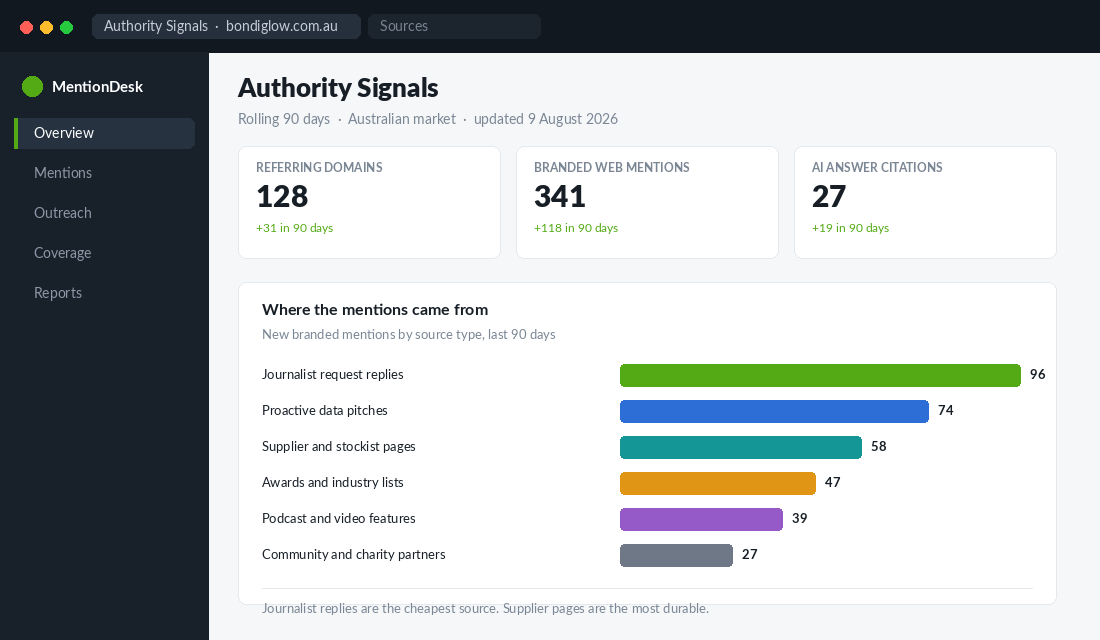
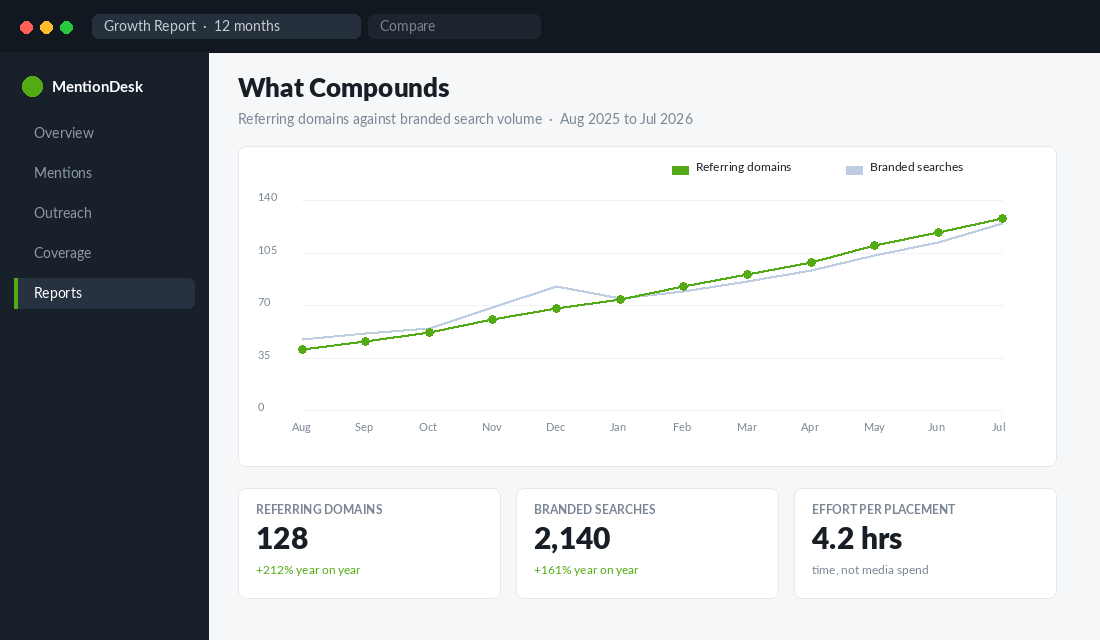
Most founders measure domain rating, which moves slowly and tells you nothing about revenue. Track these three instead: referring domains, branded search volume, and AI citations.
Ahrefs Webmaster Tools is free for verified site owners and covers the first two. Setting it up properly takes about 20 minutes:
- Verify your domain in Google Search Console first, since Ahrefs can use that verification.
- Create an Ahrefs Webmaster Tools account and add your store as a project.
- Open Site Explorer, go to the Referring Domains report, and note today’s number. That is your baseline.
- Set a weekly email alert for new and lost referring domains so you catch a placement the day it goes live.
- In Search Console, filter Performance by queries containing your brand name and export the monthly total. That is your branded search baseline.
- Write ten buying-intent prompts a customer would actually type into ChatGPT, run them on the first of each month, and record whether you were named.
For a store turning over around $100k a month, three to six new referring domains a month is a healthy pace. Branded search should be climbing quarter on quarter, and if it is not, your mentions are landing in places your customers never see. Within two quarters you want your brand named in at least one of every ten tracked prompts. If branded search is climbing but competitors keep bidding on your name, that is a separate fix, covered in The Brand Search Defence Playbook.
How the Six Steps Compound Over One Quarter
Run in isolation, each step is underwhelming. Run together for 12 weeks, the maths gets interesting.
Month one you build the home base and one data asset. Month two you run the fast lane daily and send your first 40 pitches. Month three you sweep the partner list and record four podcasts. Assume ordinary numbers, not hero numbers: 36 journalist replies converting at 8% gives you 3 placements. Forty pitches at an 8% reply rate gives 3 conversations and 2 placements. Twelve partner asks returns 7 links. Four podcasts add four sets of show notes.
That is roughly 15 new referring domains and somewhere between 30 and 60 fresh brand mentions in a quarter, from a founder spending about three hours a week. None of it required a media budget.
The second quarter is where it stops being linear. Journalists who used you once come back, because a reliable source is rarer than a good story. Your press page now makes the next pitch easier. Your brand name appears often enough that AI assistants start naming you when someone asks for options in your category, which puts you into the consideration set before a search even happens. That is the same mechanism we cover in The Category Entry Points Playbook, arriving through a different door.
The Earned Mention Scorecard
Score your store out of 10. One point each. Under 5 and your outreach will not work no matter how good the pitch is.
| Check | Pass condition |
|---|---|
| Story asset | One data set, first, or partnership a journalist could write about today |
| About page | Named founders, founding year, location, reason the business exists |
| Press page | Live page listing every mention with outlet, date and link |
| Facts sheet | One page a writer can copy from, with two downloadable images |
| Schema | Organization markup with sameAs pointing at profiles and coverage |
| Fast lane | SourceBottle alerts filtered and reviewed daily |
| Target list | 25 to 40 named outlets, journalists and shows, built by hand |
| Partner sweep | Suppliers, stockists, apps and charities asked in the last 90 days |
| Audio and video | At least two podcast or YouTube appearances in the last six months |
| Measurement | Referring domains, branded search and AI citations tracked monthly |
Work top to bottom. The first five are a one-week project you do once. The last five are a weekly habit that quietly becomes the cheapest acquisition channel you own.
Inside eCommerce Circle, earned coverage is one of the core pillars we work on with every member, because it is the one growth lever that does not get more expensive as you scale. If you want a second opinion on yours, let’s talk.