Your last giveaway probably looked like a win. Six thousand entries, a jump in Instagram followers, a list that grew by a third in a fortnight. Then the next campaign went out and your open rate fell off a cliff.
What’s in This Article
That is the giveaway trap. Most Shopify brands score a competition on the day it closes, when the only number that matters shows up 90 days later: how many of those entrants actually bought something.
Run the maths on a typical Aussie DTC competition and the gap is brutal. A raw import of entrants converts at roughly 1% inside 90 days. The same brand’s pop-up subscribers convert at 9%. You did not grow your list. You grew your Klaviyo bill, your spam complaint rate and your unsubscribe count, all at once.
Giveaways are not the problem. Unfiltered giveaways are. Below is the six-stage system we work through with members before they run one, built around the two things most brands skip: the legal architecture and the quarantine step.
Stage 1: Decide What the Giveaway Is Buying Before You Pick a Prize
A giveaway can buy exactly three things. Email and SMS subscribers who might buy. Reach into an audience that has never heard of you. Or first-party data you cannot get any other way, such as skin type, room size or fit preference.
Pick one. A campaign built to maximise entries will not produce buyers, because the mechanics that drive volume (tag three friends, follow five accounts) are the same mechanics that attract people who enter 40 competitions a week.
Set the target before you brief the designer. If your blended customer acquisition cost sits at $48 and your welcome sequence converts new subscribers at 12 to 25%, a subscriber is worth paying real money for. Work backwards:
- Total campaign cost. Prize cost at wholesale, app fees, paid amplification, design and copy time.
- Target cost per qualified subscriber. Aim for a quarter to a third of your CAC. At $48 CAC, anything under $12 is defensible, and a well-filtered campaign should land closer to $2.
- The number that gets reported. Not entries. Not followers. Subscribers who passed your quality screen and are still opening email at day 90.
Write that target on the brief. Every decision that follows, prize, mechanic, entry form, exists to protect it.
Stage 2: Make the Prize the Filter, Not the Magnet
The single biggest driver of list quality is the prize, and most brands get it backwards. They pick something broadly appealing to maximise entries. An iPhone. A thousand dollars cash. A Coles voucher. Every one of those prizes is a signal to Australia’s competition-aggregator sites that your entry form is worth syndicating.
The right prize is close to worthless to someone who is not your customer. Your own product, bundled to roughly three to five times your average order value, does that job. A skincare brand giving away a full routine attracts people who want the routine. A skincare brand giving away an iPad attracts people who want an iPad.
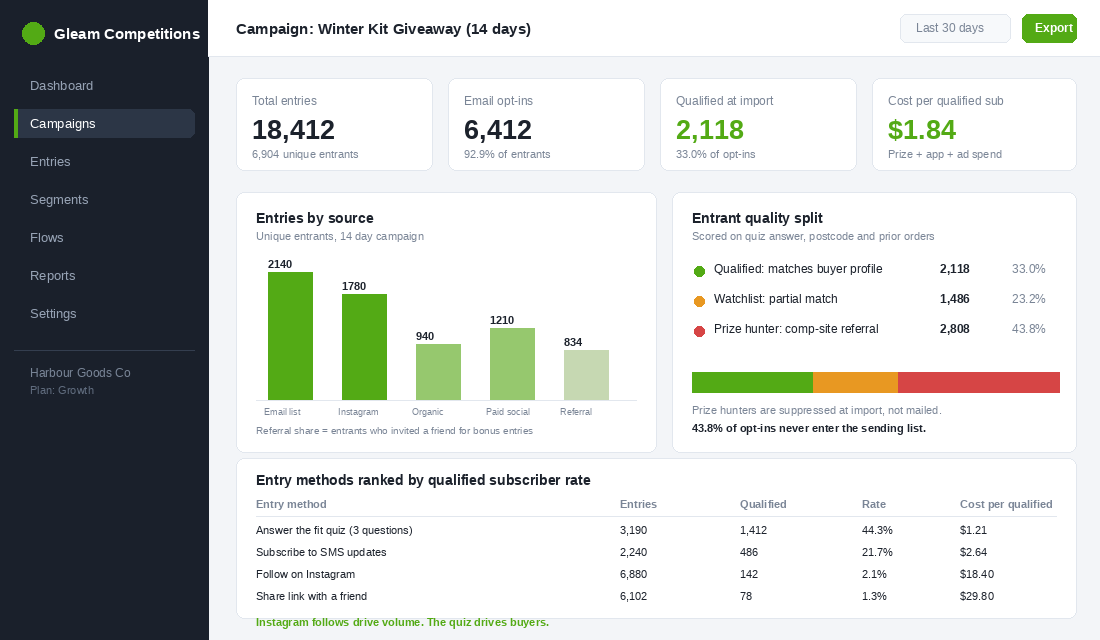
Frank Body’s “Pit Stop” competition is a clean example of this done properly. Entrants had to complete a short “what’s your pit problem?” quiz to get a deodorant match, then submit their email on the results page. The prize pool sat at roughly AUD $2,292: a $1,000 gift card, a year of product and the full deodorant range. Nobody outside the target market grinds through a product-fit quiz for that.
Two tests before you lock the prize in:
- The comp-site test. Search “win” plus your prize category. If the first page is full of aggregator listings, your prize is generic and your entries will be too.
- The regret test. Would a winner who has never bought from you be disappointed? If yes, the prize is too specific to your category, which is exactly what you want.
Stage 3: Choose Skill Over Chance and Cut Your Compliance Load
This is where Australian brands trip over rules that do not exist in the American playbooks most giveaway advice is copied from. In Australia, how you pick the winner determines whether you need a permit.
A game of chance is a random draw. Winners are picked at random, and that makes it a trade promotion lottery. The thresholds differ by state and territory:
- New South Wales. An authority is required once the total prize value exceeds $10,000. The old per-promotion permit system was replaced with duration-based authorities from 1 July 2020 under the Community Gaming Regulation 2020, so a single authority can cover multiple promotions if you meet the notification and record-keeping conditions.
- Australian Capital Territory. A permit is required once the total prize pool exceeds $3,000. This is the lowest threshold in the country and the one most brands miss.
- South Australia. A permit is required at $5,001 and above, and also for any printed scratch-and-win mechanic regardless of prize value.
- Everywhere else. No permit for standard trade promotions, but Australian Consumer Law still applies to how you advertise the prize and the odds.
A game of skill is judged, not drawn. If the winner is chosen by applying judgement to an entry, no trade promotion permit is required in any Australian state or territory. That is a meaningful saving in time and application fees, and it is why so many Australian brands run “tell us in 25 words or less” or “post your best photo” mechanics.
Skill also happens to be the better marketing decision. Writing a sentence or uploading a photo is friction, and friction is a filter. You will get fewer entries and a far higher proportion of people who actually want the product.
If you do run a random draw, keep the prize pool under $3,000 and you are below every threshold in the country. Publish your terms and conditions on their own page, state the judging criteria if it is a skill competition, name the promoter and ABN, list the draw date and how the winner will be notified. Treat this as general information rather than legal advice, and get a lawyer across the terms if the prize pool is significant.
Stage 4: Build the Consent Architecture Before the First Entry Lands
Entering a competition is not consent to receive marketing. Under the Spam Act 2003 you need consent, you need to identify yourself as the sender, and every message needs a functional unsubscribe. Bundling marketing consent into the act of entering is exactly the shortcut the regulator looks for.
The ACMA is not shy about it. Outdoor Supacentre was penalised $302,500 for sending more than 83,000 marketing text messages in breach of the Spam Act. Betfair paid $871,660 after sending marketing to customers who had either never consented or had withdrawn consent, with messages that lacked working unsubscribe links. Penalties reach $2.1 million for repeat breaches.
What good looks like on the entry form:
- Separate, unticked boxes. One for email marketing, one for SMS. Never pre-ticked, never bundled with “I accept the terms”.
- Plain wording next to the box. “Yes, email me new product drops and offers. Unsubscribe any time.” Say what they will get and how often.
- SMS as a bonus entry, clearly labelled. Koala does this well. Its Valentine’s Day sofa bed giveaway offered an extra entry for signing up to SMS updates, with the exchange stated up front rather than buried.
- Consent records stored against the profile. Timestamp, source campaign, the exact wording shown and the IP address. In Klaviyo, write these to custom properties at import so you can prove consent two years later.
One more thing worth stating plainly to your team: entrants who tick nothing still get the competition emails they asked for, because that is transactional to the entry. They do not get your Black Friday campaign.
Stage 5: Quarantine Every Entrant for 14 Days
This is the stage almost nobody runs, and it is the one that decides whether the campaign pays for itself. Never import competition entrants straight into your main sending list.
The reason is deliverability. Gmail and Yahoo require bulk senders to keep spam complaint rates below 0.3%, and Google recommends staying under 0.1% for reliable inbox placement. Those rules bite once you send 5,000 messages a day, which most brands do during a promotional period. Dump six thousand cold entrants into a Black Friday send and you can blow past that threshold in a single campaign, then spend three months rebuilding sender reputation. We covered the recovery process in the Shopify deliverability playbook, and prevention is a great deal cheaper.
The quarantine is a 14-day prove-out flow that entrants must pass before they touch your campaign list.
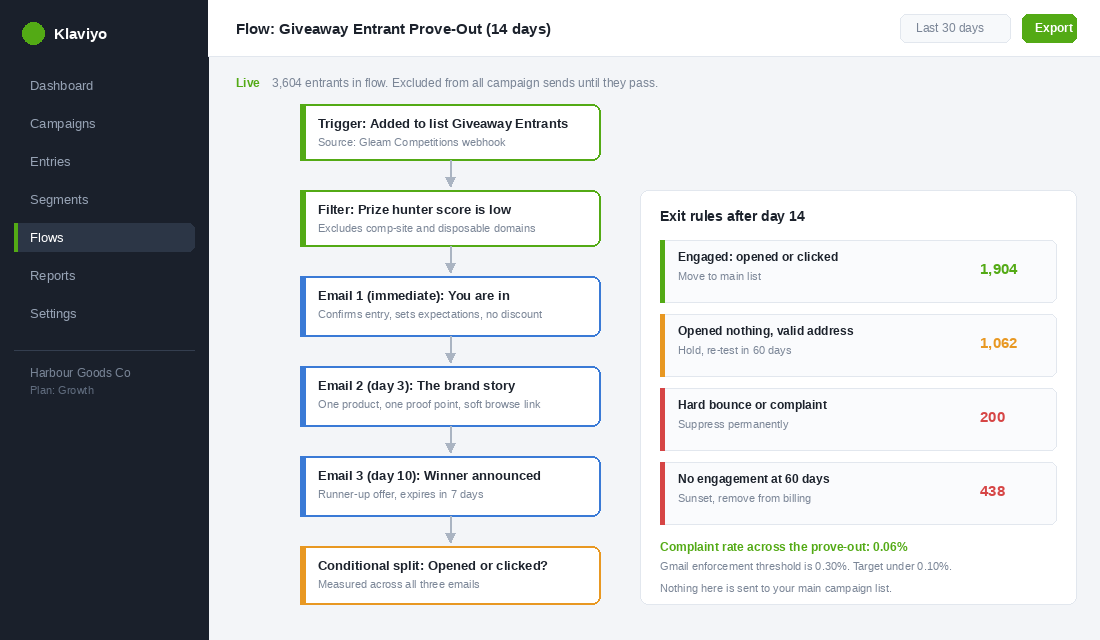
The three emails do specific jobs. Email one confirms the entry and sets expectations, with no discount attached, because a discount at this point simply teaches prize hunters to stay subscribed. Email two, on day three, tells the brand story through one product and one proof point. Email three, on day ten, announces the winner and carries a runner-up offer with a seven-day expiry.
Then the exit rules fire:
- Opened or clicked anything. Move to the main list. These are your qualified subscribers.
- Valid address, zero engagement. Hold in a suppressed segment and re-test once in 60 days with a single re-engagement email.
- Hard bounce or spam complaint. Suppress permanently, immediately.
- Still nothing at 60 days. Sunset. Delete them from the profile count so you stop paying for people who will never buy.
The tool setup, step by step
Gleam is the practical pick for Australian stores. It is a Melbourne company, used by more than a million businesses, with a free Competitions tier and paid plans from around $19 a month, and it installs as a Shopify app. Setup takes an afternoon:
- Install Gleam Competitions from the Shopify App Store and connect it to your store so entrants are matched against existing customer records.
- Build the competition with entry methods weighted by value. Give the fit quiz or written answer the most entries, social follows the fewest.
- Turn on email verification and block disposable domains in the entry settings. This alone removes a large slice of junk before it reaches your ESP.
- Add the separate marketing consent checkboxes as custom entry fields, unticked, and map them to Klaviyo consent properties.
- In Klaviyo, create a list called Giveaway Entrants and add a global suppression condition so that list is excluded from every campaign send by default.
- Build the prove-out flow triggered on that list, with the four exit rules above, and only add profiles to your main list from inside the flow.
If you already run a quiz for personalisation, use it as the entry mechanic. The declared answers become the segmentation you will use for the next twelve months, which is the argument we make in the zero-party data playbook.
Stage 6: Score the Cohort at 90 Days, Not on Closing Day
Closing-day numbers flatter every giveaway ever run. Entries, followers, list growth percentage. None of them survive contact with a P&L.
Set a calendar reminder for 90 days after the competition closes and pull five numbers on the entrant cohort alone.
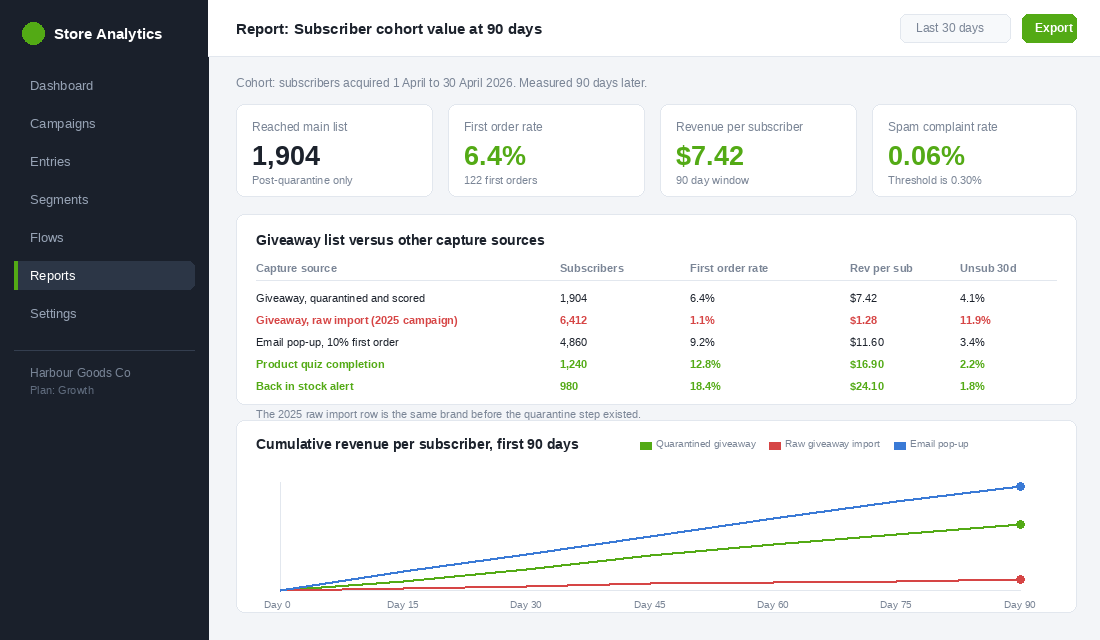
- Cost per subscriber who reached the main list. Total campaign cost divided by the number who passed the prove-out, not by total opt-ins.
- First order rate at 90 days. Anything above 5% from a cold competition audience is respectable. Above 8% and the prize was well chosen.
- Revenue per subscriber. Compare it directly against your pop-up and back-in-stock cohorts from the same month.
- Spam complaint rate. Must sit well under 0.1%. If it does not, the quarantine step failed and you need tighter import scoring.
- Unsubscribe rate at 30 days. Expect around 10% to leave immediately once the winner is announced, which is healthy self-selection. Sustained above 5% across the following month means the prize was too broad.
Benchmarks are useful, but the comparison that decides your next campaign is internal. If entrants return less per subscriber than your email pop-up at a similar cost, the pop-up wins and the giveaway budget belongs somewhere else.
Partner Giveaways: How to Co-Host Without Inheriting Another Brand’s Junk List
The multi-brand giveaway is the version most Aussie DTC founders get pitched. Five brands, one $2,000 prize pool, every entrant supposedly lands on all five lists. It can work, and it can also hand you 6,000 contacts who wanted a free Dyson and have never heard of you. The six stages above still apply; the partner version adds three rules on top.
- Pick partners by customer overlap, not follower count. A skincare brand and a linen brand share a buyer. A skincare brand and a gaming-chair brand share a prize. Ask each prospective partner for their average order value and their top three postcodes. If AOV is within 30% of yours and the postcodes overlap, the entrants will look like your customers. If not, you are buying the wrong list at any price.
- Consent must be per brand, and it must be explicit. Under the Spam Act, a customer consenting to hear from “the giveaway partners” is a grey area you do not want to test with the ACMA. Use a separate, unticked checkbox per brand on the entry form, and only sync the contacts who ticked yours. Expect 40 to 60% of entrants to tick every box and the rest to tick one or two. The Spam Act compliance playbook covers the exact wording that keeps you inside the rules.
- Run one entry form, owned by one brand, exported once. Tools like Gleam, KingSumo and ViralSweep let one host own the form and share filtered exports. Never let five brands each build their own form for the same prize; you will get duplicate entrants, mismatched consent records and no way to prove who consented to what if a complaint lands.
Contribution should be proportional to list size. A brand with 40,000 subscribers promoting to its list is contributing five times what a brand with 8,000 is, so either weight the prize contribution accordingly or agree that every brand sends the same number of emails and posts. Unequal promotion is the number one reason partner giveaways end in a Slack argument.
Then quarantine the partner cohort separately from your own entrants. Tag them by source brand in Klaviyo, run the same 14-day holding pattern from Stage 5, and score each partner’s cohort at 90 days on its own. In our experience the spread is enormous: one partner’s entrants might buy at 4% inside 90 days while another’s sit at 0.3%. That score tells you exactly who to co-host with next time and who to politely decline. If a partner brings creators rather than a list, the creator playbook covers how to structure that side of the deal so their audience arrives already warm.
How the Six Stages Compound
Any one of these stages on its own produces a modest lift. Run them as a system and the effect multiplies, because each stage removes a different kind of waste before it reaches the next.
A category-specific prize means fewer aggregator entries arrive at all. A skill mechanic adds friction that filters again, and removes the permit requirement while it does. Consent architecture means the people who do reach your list actually asked for it. The quarantine flow strips out the ones who asked but never engaged. By the time a profile lands on your main list, it has passed four independent filters.
That is why the numbers diverge so sharply. Giveaway landing pages convert visitors at around 34% against roughly 6.6% for a standard landing page, so the traffic is cheap. The problem was never acquisition cost. It was that unfiltered volume made the list less valuable, not more, and the damage showed up in your deliverability three campaigns later.
Filter properly and a giveaway becomes one of the cheapest subscriber acquisition channels available to an Australian DTC brand. Skip the filters and it is a tax you pay monthly to your email platform.
Your Pre-Launch Checklist
Work through this before the campaign goes live. If you cannot tick all twelve, the launch waits.
- One primary objective written on the brief, with a target cost per qualified subscriber.
- Prize is your own product, bundled at three to five times AOV, with no cash or third-party gift cards.
- Prize passed the comp-site search test.
- Mechanic decided: skill (judged, no permit) or chance (random draw, check thresholds).
- If chance, prize pool checked against ACT $3,000, SA $5,001 and NSW $10,000 thresholds, and any required authority applied for.
- Terms and conditions live on their own page with promoter, ABN, dates, judging criteria and notification method.
- Separate unticked consent boxes for email and SMS, with plain-language wording.
- Consent metadata mapped to profile properties at import.
- Email verification and disposable-domain blocking switched on in the entry app.
- Giveaway Entrants list created and globally suppressed from campaign sends.
- Fourteen-day prove-out flow built and tested with a seed profile, including all four exit rules.
- Calendar reminder set for the 90-day cohort review.
The whole system takes about a day and a half to build the first time and roughly two hours on every campaign after that. Against a list that quietly costs you deliverability for a year, that is the best trade in your marketing calendar.
Inside eCommerce Circle, list quality is one of the core pillars we work on with every member, because it sits underneath email, SMS and paid media all at once. If you want a second opinion on yours, let’s talk.