On 17 June 2026 Shopify shipped the biggest release of its year, a 150 plus update drop it called the Summer ’26 Everywhere Edition. Buried in the noise about AI agents and checkout was the thing that will actually change how your store gets built: a new theme system called Horizon.
What’s in This Article
Since then I have had roughly the same conversation two dozen times with Aussie founders. It usually opens with “should we move to Horizon” and it usually comes from someone whose homepage has not been touched in fourteen months and whose product page still has the theme’s default trust badges on it.
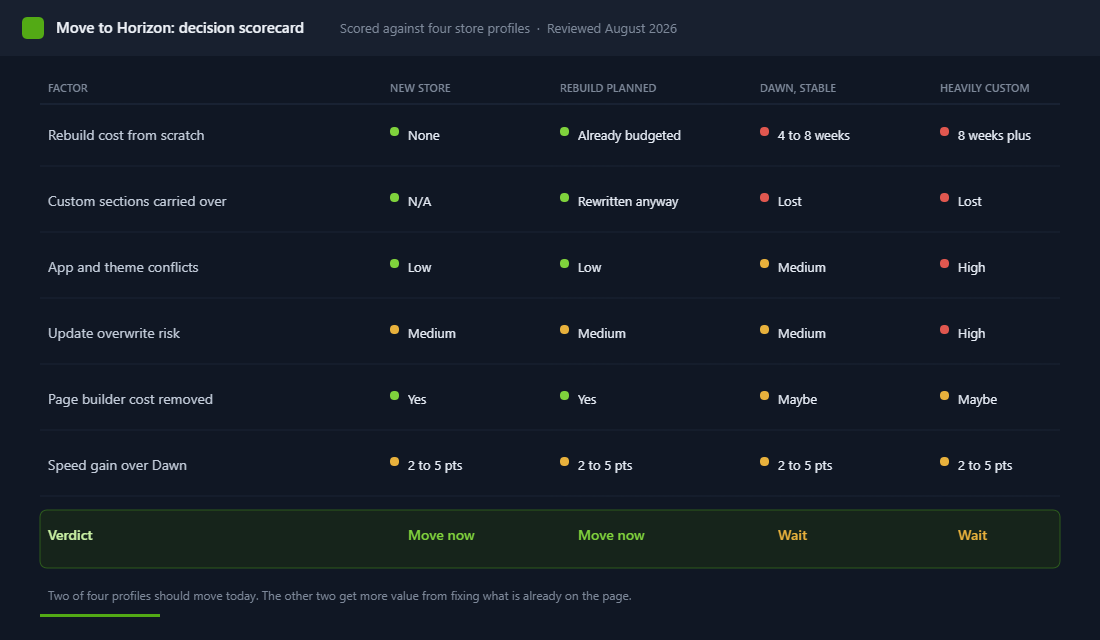
Here is the short version, and then I will show you the working. Horizon is genuinely better architecture. It is also, as of August 2026, sitting at about 35% positive across roughly 190 Theme Store reviews, with the most common complaints being theme updates overwriting merchant customisations and mobile bugs after new versions. There is no one click migration from Dawn. And the speed gain over Dawn is 2 to 5 Lighthouse points, which is real but is not the thing that has been holding your conversion rate back.
So this is not a “here is how to install Horizon” article. It is the test we run with members to work out whether moving is the highest value thing they could do with four to eight weeks of build time, and what to do instead if it is not.
What Horizon Actually Is
Horizon is not a theme. That is the first thing most people get wrong.
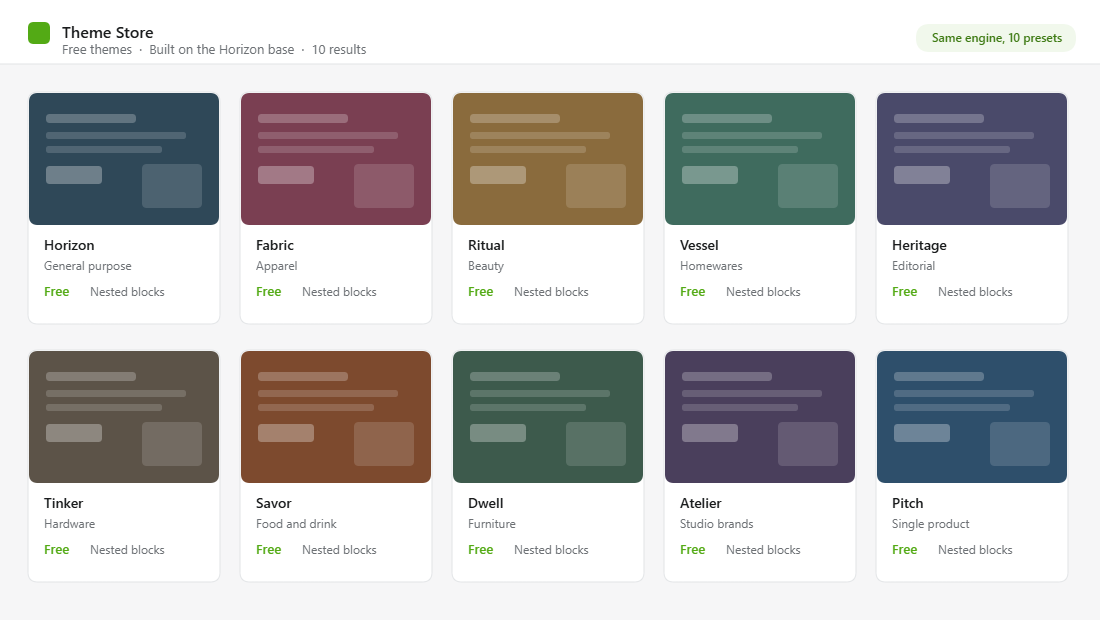
Horizon is a theme system, and there are ten free themes built on it: Horizon itself, plus Fabric, Ritual, Vessel, Heritage, Tinker, Savor, Dwell, Atelier and Pitch. They are not ten different engines. They are ten design presets sitting on one shared architecture, each styled for a different kind of store. Fabric leans apparel, Savor leans food and drink, Pitch is built for a single hero product.
That matters for a practical reason. Choosing between them is a design decision, not a technical one. You are not locking yourself into different capabilities, so pick the preset whose default styling is closest to where you want to end up and save yourself the customisation work.
All ten are free, install once, and get lifetime updates. For a founder who has been quoted five figures for a custom theme, that is worth understanding properly before signing anything.
The Real Change Is Nested Blocks
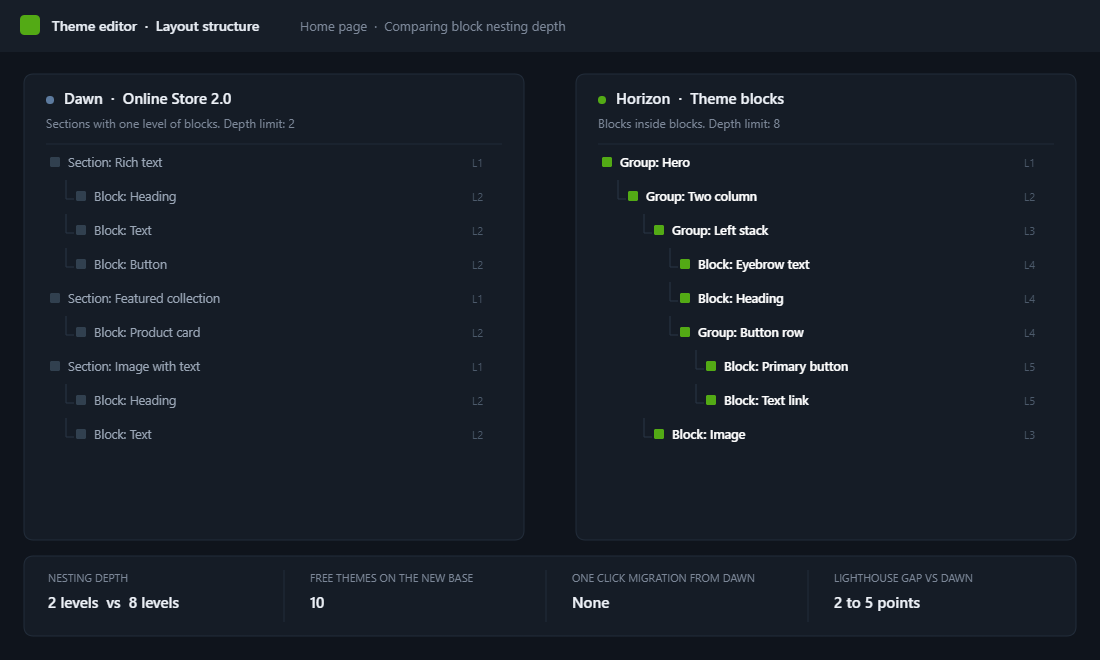
Under Online Store 2.0, which is what Dawn and almost every theme you have used since 2021 runs on, your page is made of sections. Each section can hold blocks. And that is where it stops. Two levels of depth, and the structure of any given section is whatever the theme developer decided it should be.
That constraint is the reason your homepage looks like every other Shopify homepage. It is also the reason you are probably paying for a page builder app.
Horizon replaces that with theme blocks that nest inside other theme blocks, up to eight levels deep. A group holds a two column layout, which holds a stack, which holds an eyebrow, a heading and a button row, which holds two different button styles. You compose the page instead of choosing from a menu of pre built sections.
Shopify has also wired AI block generation into the theme editor, so you can describe a change to Sidekick rather than hunting for the setting. In practice it is useful for scaffolding and unreliable for anything precise, which is roughly where you would expect it to be a few months in.
The Ten Themes Are One Theme
Because every Horizon theme shares the same block engine, the choice in the Theme Store is much lower stakes than it used to be. You are picking a starting aesthetic, not a set of capabilities.
Two practical implications for how you brief this work:
- Stop paying for theme evaluation. If an agency quotes you a discovery phase to work out which Horizon theme suits your brand, that is a design conversation you can have in an afternoon with your own eyes.
- Switching presets later is cheap. Because the underlying block structure is shared, moving from Fabric to Ritual is nothing like moving from one third party theme to another. Your layout logic survives.
There Is No Migration Path, and Nobody Says That Loudly Enough
This is the part that turns a “let’s just switch” conversation into a real project plan.
The architectural gap between Dawn’s section model and Horizon’s nested block model means there is no automatic translation between them. Switch themes and your homepage resets to Horizon defaults. You rebuild it. Every page.
For a store running stock Dawn with four homepage sections, that is a weekend. For a typical Aussie DTC store at 100k a month with a customised theme, it is closer to four to eight weeks once you account for the parts nobody puts in the quote:
- Custom Liquid sections do not carry over. Every bespoke section a developer built for you gets rewritten. If you have six of them, that is six small projects, not one.
- App embeds and script tags need re-installing and re-testing. Reviews widgets, upsell apps, subscription widgets, size guides, currency switchers. Each one needs a placement decision in a structure that did not exist before.
- Metafield and metaobject wiring gets re-pointed. If you have built product data into custom sections, that plumbing is rebuilt, not moved.
- Your conversion rate is unproven on the new build. This is the cost founders forget. You are not migrating a theme, you are relaunching a store, and relaunches move conversion in both directions.
None of that is an argument against Horizon. It is an argument for treating it as a rebuild with a budget and a test plan, which is exactly how we frame it in the five phase theme upgrade process. What it is not is a settings change you knock over on a Sunday.
The Reviews Are Telling You Something
Roughly 35% positive across about 190 reviews is not a number you ignore, and it is not the number you would expect from Shopify’s flagship free theme.
Read the actual complaints and a pattern shows up. The two that come up most are theme updates overwriting merchant customisations, including colours, settings and page changes, and mobile bugs appearing after new versions ship. Both are symptoms of a system being actively developed underneath live stores.
That is normal for a platform release this early, and it will settle. But it changes the risk calculation if you are trading through spring and into peak. A theme that occasionally reverts your settings is an annoyance in March. It is a very expensive afternoon in late November.
If you do move now, two defences are non negotiable: duplicate the theme before every update, and keep a written record of every custom setting so you can restore it. Treat theme updates like deploys, not like notifications.
Where Horizon Genuinely Wins Right Now
Three situations where I would move today without much hesitation.
- You are launching a new store. There is nothing to migrate and no legacy to protect. Horizon benchmarks slightly ahead of Dawn and gives you a better ceiling for the next three years. Start there.
- You have already committed to a rebuild. If a redesign is funded and scheduled, doing it on the old architecture is spending 2026 money on 2021 foundations. The rebuild cost is sunk either way.
- You are paying a page builder to do what Horizon now does natively. This one is the sleeper. If you are spending 40 to 90 dollars a month on a builder purely for flexible landing page layouts, nested blocks may remove that line item entirely, and remove the render weight that came with it.
That third case is worth doing the arithmetic on. A builder at 79 dollars a month is roughly 950 dollars a year, plus a performance tax, plus the fact that your pages are locked inside a third party app. If nested blocks cover 80% of what you use it for, the migration pays for itself faster than most people assume.
The Move Test: Four Questions Before You Commit
Run these in order. If you fail one, stop and deal with that instead.
- Is the layout the constraint? Go and look at your last three months of conversion data. If your product page converts at 3.1% and your homepage bounce is fine, layout flexibility is not your bottleneck. Traffic quality, offer, or page speed probably is. Rebuilding the theme will not fix any of those.
- What does the rebuild actually cost you? Count custom sections, app integrations and templates. Multiply by a realistic day rate. Add a 30% buffer, because everyone underestimates app re-integration. If the number is over 15,000 dollars, it needs to compete with every other use of that money.
- When is your next quiet trading window? You need six clear weeks with no campaign, no peak, and enough post launch runway to read the numbers. In Australia that means roughly February to April, or a tight window right now before Q4 planning locks. It does not mean October.
- Can you A/B the launch? If you cannot run the new build against the old one on real traffic, at minimum hold your reporting flat for four weeks and compare conversion, AOV and revenue per session against the same period last year. Launching blind and calling it a win because the site looks better is how stores quietly lose 8% of revenue for a quarter.
The Page Builder Question
Nested blocks close a lot of the gap between a native theme and a page builder, but they do not close all of it, and the honest comparison depends on what you use the builder for.
Horizon covers you well for flexible layout composition, reusable content structures and one off landing pages that use standard content types. Where builders still lead is on animation and interaction, form building, and A/B testing baked into the tool. If your builder is doing split testing for you, removing it means finding that capability elsewhere.
The test is simple. Open your builder, list the last ten pages you built with it, and mark each one as “layout only” or “needs the extra features”. If eight or more are layout only, Horizon replaces it. If four or more genuinely need the extras, keep it and move for other reasons.
Worth remembering that every app you remove is also render weight you remove. Apps typically drag a Shopify Lighthouse score down by 30 to 50 points, which dwarfs the 2 to 5 point theme difference. The speed argument for Horizon is not the theme, it is the apps the theme lets you delete. That is the same principle we work through in the site speed process.
If You Are Staying on Dawn, Do This Instead
Most of the stores I talk to should not move this quarter. The trap is that “not moving” turns into “not doing anything”, and the theme conversation becomes a way to avoid harder work.
If you are staying put, here is where the same six weeks produces more revenue than a theme migration would:
- Rebuild the product page above the fold. Price, delivery promise, social proof and the add to cart button, all visible on a mid range Android without scrolling. This moves conversion in a way a nicer homepage never does.
- Fix the cart drawer. It is the highest intent surface on your store and most Aussie stores are still running the theme default. We have written up the eight element cart drawer framework that lifts AOV 15 to 25%, and none of it requires a theme migration.
- Audit your app stack. Remove anything that is not earning its render weight. This is the speed win you were hoping Horizon would give you, and it is available today.
- Get your product data into metafields properly. Structured product data is what makes any future migration cheap, and it feeds the AI shopping surfaces that are quietly becoming a channel.
That last point is the strategic one, and it deserves its own paragraph.
The Bigger Story Behind the Same Release
Horizon got the headlines, but the same Summer ’26 drop turned on the Universal Commerce Protocol by default across every Shopify store. Eligible products now syndicate automatically to ChatGPT, Microsoft Copilot, Google AI Mode, Gemini and the Shop app, which means a shopper can find and buy your product without ever landing on your theme.
Sit with that for a second, because it reframes the whole theme question.
If a growing share of discovery happens inside an assistant reading your structured product data, then the quality of your product titles, descriptions, attributes and metafields starts to matter as much as the quality of your layout. Your theme is the conversion surface for the traffic that still comes to your site. Your product data is the conversion surface for the traffic that never does. We go deeper on that shift in the agentic commerce work.
A founder spending eight weeks perfecting nested blocks while their product data is a mess has optimised the wrong surface for 2027.
What to Do in the Next 90 Days
A concrete sequence, whichever way you land.
- This week. Install a Horizon theme as an unpublished duplicate. It costs nothing. Spend an hour in the editor building one landing page so your opinion is based on using it rather than reading about it.
- Week two. Run the four question Move Test above and write the answers down. Get an actual number on the rebuild cost, not a feeling.
- Week three. Run the page builder test. Ten pages, layout only or not. Decide whether an app comes out of your stack.
- Weeks four to twelve. If you are moving, book it for February and spend the run up getting product data and metafields clean, because that work carries across regardless. If you are not moving, ship the cart drawer, the product page above the fold, and the app audit before peak.
- Diarise a review for February 2027. By then Horizon will have had another two or three major versions and the review sentiment will tell you whether the update overwrite problem got solved.
The Part That Compounds
New platform capability always arrives with a pull to adopt it immediately, and that pull is strongest for the founders who have the least slack to absorb a failed relaunch.
The stores that win these transitions are not the fastest movers. They are the ones who keep a clean, well structured store, so that when they do move, the move is cheap. Structured product data, a documented app stack, a theme without six years of accumulated custom Liquid: those things make every future migration a two week job instead of a two month one.
Horizon is the right direction. Shopify will keep building on it and in two years it will be where everyone is. The question is not whether you end up there. It is whether you spend your best six weeks of 2026 getting there early, or spend them on the four or five things that would move revenue this quarter and make the trip cheaper when you take it.
For most Aussie stores turning over between 40k and 500k a month right now, it is the second one.
Inside eCommerce Circle, platform decisions like this are one of the core pillars we work on with every member, because the cost of getting them wrong is measured in quarters, not dollars. If you want a second opinion on yours, let’s talk.