Somewhere this week, a shopper asked ChatGPT which sheets to buy for a cold Melbourne winter. The answer named three brands. If yours was not one of them, you were not in the running, and no amount of Meta budget changed that.
What’s in This Article
This is no longer a fringe behaviour. ChatGPT now handles roughly 50 million shopping queries a day. Shopify reported that AI-driven traffic to its stores grew 8x year on year in the first quarter of 2026, with orders from AI-powered searches up nearly 13x. Closer to home, the Australia Post eCommerce Report found 32% of Aussie shoppers are already using AI for shopping advice, and 6 in 10 are comfortable doing so.
And yet the loudest version of this story, the one where AI agents autonomously buy things while you sleep, mostly stalled this year. Both things are true at once. That is exactly why founders are confused.
Most founders are making one of two mistakes right now. Some are panic-buying “AI readiness” services and rebuilding stores for robot buyers that barely exist yet. Others heard that in-chat checkout flopped and filed the whole thing under hype. Both camps are misreading what actually happened.
This playbook gives you the sober version: what changed, what did not, and the five moves that make your Shopify store the one the agents recommend, without betting the business on a trend.
A note on timing before you dive in. The window that matters is not “before agents take over”. It is before your competitors finish the same boring homework. Right now, being properly agent-readable in an Australian niche is genuinely rare. In eighteen months it will be table stakes, the way basic SEO went from edge to entry fee. The 44% of Australian businesses that AusPost describes as advocates of agentic commerce are mostly still at the slide-deck stage. Beating them to the data layer costs you a few focused afternoons.
What Actually Happened With Agentic Commerce (The Honest Version)
Quick recap, because the headlines whiplashed. In late 2025, OpenAI and Stripe launched the Agentic Commerce Protocol and “Instant Checkout”: buy a product inside ChatGPT without visiting the store. Etsy sellers went live, and more than a million Shopify merchants, including Glossier, SKIMS and Vuori, were announced as coming soon. By February 2026 the feature was open to all US ChatGPT users.
Then reality reported in. Forrester noted only around 30 Shopify merchants ever went properly live on Instant Checkout. Walmart measured that checkout inside ChatGPT converted about 3 times worse than simply sending the shopper to walmart.com. By March, OpenAI had pivoted: instead of finishing the sale in chat, AI surfaces now mostly hand the shopper to the retailer’s own site to buy.
So the model that won 2026 is not “the robot buys it for you”. It is discover in AI, buy on your site. And that model is growing ferociously: AI-referred retail traffic grew 393% year on year in Q1 2026, and it converts roughly 42% better than traditional search traffic, because the shopper arrives pre-sold by the recommendation.
One more number to keep you honest: only 14% of consumers say they trust an AI to place orders on their behalf. The human still clicks buy. Your job is to win the recommendation and then close the sale on a store that deserves it. Every part below serves one of those two jobs.
What the Early Movers Teach Us
Watch what the named brands in this saga actually did, because the lessons are cheap when someone else paid for them.
Etsy went live at launch and its sellers got months of exclusive in-chat exposure while everyone else waited. Whatever you think of in-chat checkout, Etsy bought cheap learning at the front of the queue: real data on what AI shoppers ask for, straight from the source.
Glossier, SKIMS and Vuori lent their names early without rebuilding anything. Being on the announced list cost them almost nothing and positioned them as the default examples of agent-ready DTC brands in a thousand articles, this one included. Positioning is a flywheel: models learn from what gets written.
Walmart measured instead of believing. When in-chat checkout converted about 3 times worse than its own site, it said so and pushed the traffic home. That is the discipline to copy: instrument the channel, trust your own numbers over the keynote, and be willing to redirect fast.
For a $2m Aussie Shopify brand, the translation is simple. Join new surfaces early when the cost is low, never rebuild around them, and measure everything against your own baseline. Early, cheap and instrumented beats first, expensive and faithful.
Part 1: Treat AI Referrals as a Channel, Because They Already Are
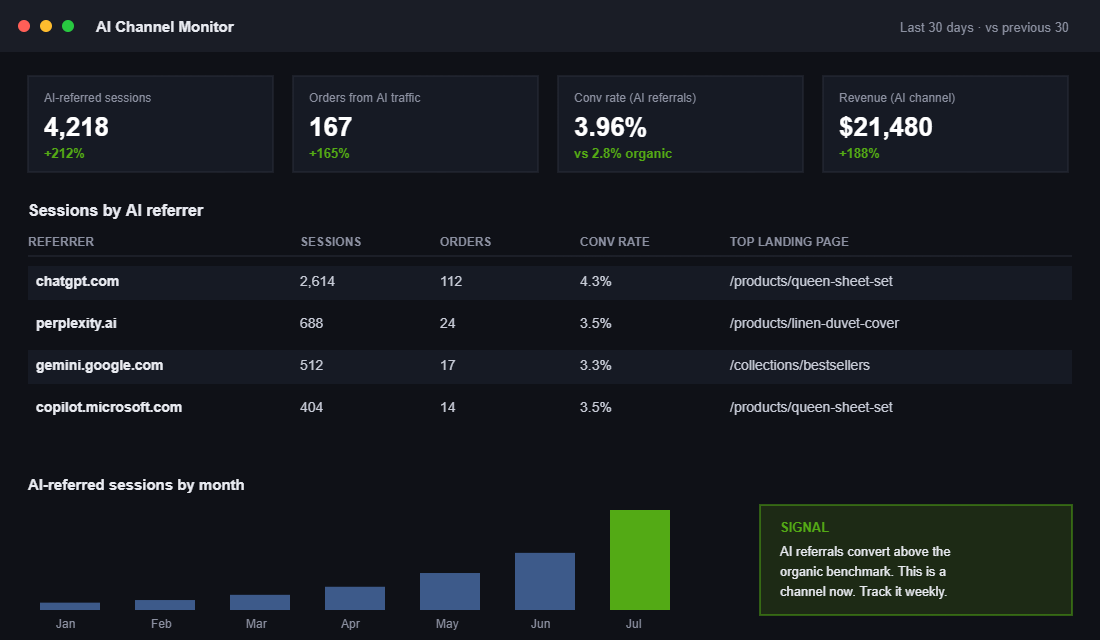
You cannot manage what you have never segmented. Most founders have AI referral traffic right now and cannot see it, because it hides inside “direct” or “referral” buckets in their reports.
The fix takes 20 minutes:
- In GA4, build a custom channel group for sessions where the referrer contains chatgpt.com, perplexity.ai, gemini.google.com or copilot.microsoft.com.
- In Shopify, check Analytics then Sessions by referrer for the same domains, and note which landing pages they hit.
- Benchmark conversion rate for this segment against your organic search rate. If your store matches the wider data, AI referrals should convert at or above organic.
- Review it weekly. Five minutes. You are watching for which products the agents send people to, because that tells you what the models believe you are best at.
This is the cheapest strategic intelligence you will gather this year. When 73% of AI-using shoppers cite it as a primary product research tool, the referral logs are literally your future customers introducing themselves.
Part 2: Win the Answer Before You Worry About the Checkout
Before an agent can send you a buyer, it has to recommend you. That is an answer-engine problem, and it is the piece most Shopify stores are furthest behind on.
We covered the full citation strategy in the Shopify AEO playbook, so here is the commerce-specific short version. Language models recommend brands they can verify. They lean on comparison content, buying guides, spec tables, review counts and consistent third-party mentions. They cannot lean on your beautiful hero video, because they cannot watch it.
Three moves matter most for product recommendations:
- Publish genuinely useful buying guides for your category, with real specifications and honest trade-offs. “Best linen sheets for hot sleepers Australia” is an agent’s raw material.
- Get your reviews machine-visible. Review schema with rating counts is one of the strongest trust signals a model can parse. A 4.7 average across 2,000 structured reviews is an argument an agent can repeat.
- Chase consistent mentions, not just links. Media features, comparison articles and community threads teach models your brand exists and what it is for.
The Australian angle matters here too. Agents localise. When a shopper asks for recommendations “in Australia”, models weight local availability, AUD pricing and local shipping promises. A US giant with no AU fulfilment story is beatable in that answer, which is precisely the gap a sharp Aussie brand should occupy.
Part 3: Make Your Product Data Answer Every Buying Question
Here is the mental model that makes agentic readiness simple. An agent is a very fast, very literal shop assistant that has never seen your store. It can only sell what your structured data can prove.
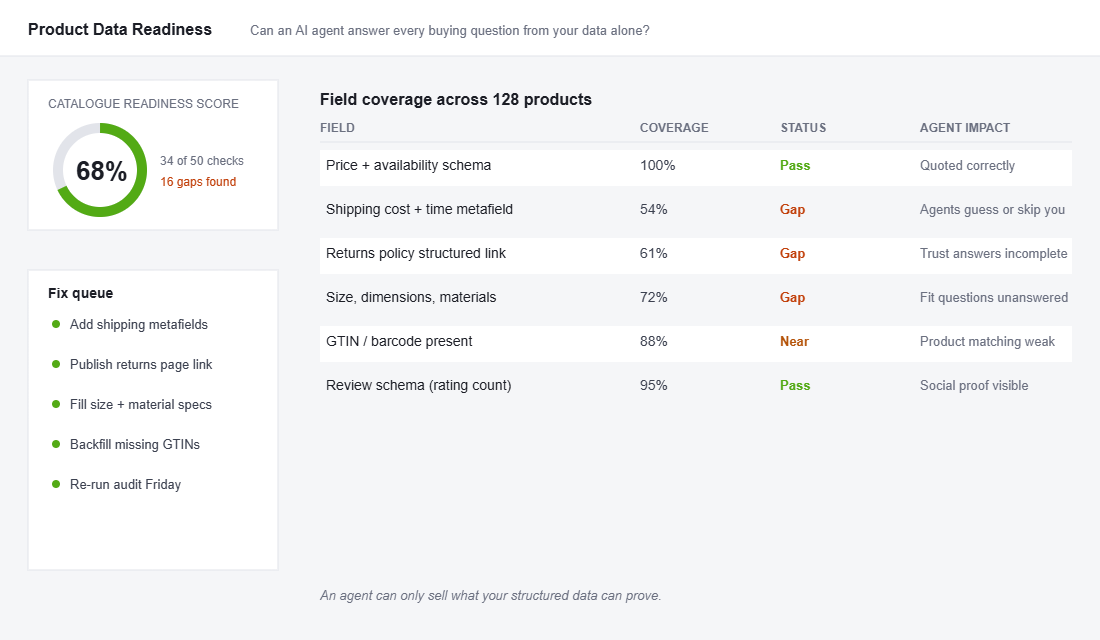
When a shopper asks “does it ship to Perth before Friday and what if it does not fit?”, the agent goes hunting through your product data, your policies and your schema. If the answer is not machine-readable, the agent either guesses or, more likely, recommends the competitor whose data answered cleanly.
Work through this in Shopify, in order:
- Validate product schema on your top 20 PDPs. Run them through Google’s Rich Results Test. Most modern themes output price and availability correctly; many mangle variants.
- Fill the boring fields. Dimensions, materials, care, fit notes and GTINs, in metafields, not buried in a description paragraph. Shopify’s Search & Discovery app surfaces metafields as filters, and the same discipline feeds agents.
- Put shipping and returns in reachable, stable URLs. One page for shipping with real timeframes by state, one for returns in plain English. Agents quote policy pages constantly.
- Keep feeds truthful. Your Google Merchant Center and Shop channel feeds must match on-site price and stock exactly. An agent that catches your feed lying about availability will discount your whole catalogue’s credibility.
None of this is exotic. It is the unglamorous product data work most stores deferred for years, suddenly carrying a commercial price tag.
Part 4: Open the Gates to the Right Crawlers
You cannot be recommended by a model that is not allowed to read you. A surprising number of Shopify stores block AI crawlers, sometimes deliberately from a 2023-era privacy reflex, sometimes by accident via an app or a copied robots.txt edit.
The checklist:
- Check robots.txt at yourstore.com/robots.txt. Unless you have a considered reason, allow GPTBot, OAI-SearchBot, PerplexityBot, Google-Extended and ClaudeBot. Blocking them is opting out of the answer.
- Keep the Shop channel and Google channels active and synced. These structured feeds are already agent food, and they are the rails Shopify keeps building on.
- Watch your app stack. Some bot-blocking and performance apps quietly reject AI user agents. If your AI referral traffic flatlines while rivals grow, test how your store responds to those crawlers.
While you are in the neighbourhood, check your site speed. Agents hand off mid-decision shoppers, and a slow handoff burns them; our site speed playbook covers the fixes in order of impact.
Part 5: Fix the Landing, Because the Agent Hands You a Warm Buyer
Remember the model that won: discover in AI, buy on your site. The agent does the persuading, then delivers a shopper who is 42% more likely to convert than a search visitor. What happens next is entirely on you.
An AI-referred shopper lands with a specific claim in their head: “this brand has the best cooling sheets under $200 with free returns”. Your product page has one job: confirm the claim in five seconds. If the price, the benefit and the returns promise the agent quoted are not visible above the fold, you manufacture doubt at the exact moment trust was highest.
Three practical checks:
- Match the promise. Whatever your buying guides and structured data emphasise is what agents repeat, so your PDP hero must repeat it too. Consistency closes; novelty confuses.
- Surface policy trust signals on the PDP. Shipping time, returns window and warranty, in plain sight, not behind an accordion on page four. Only 14% of shoppers trust the agent to buy for them, which means 86% arrive verifying.
- Hold the standard on mobile. The AI-referred click overwhelmingly lands on a phone. Our product page playbook is the full system if your PDP needs deeper surgery.
Founders who nail this get a compounding prize: agents notice which recommendations end in happy purchases. Conversion is not just revenue anymore. It is training data for the next recommendation.
Straight Answers to the Questions Founders Keep Asking
“Should I block AI crawlers to protect my content?” You can, but understand the trade. For a content publisher, that debate has two real sides. For a product brand, blocking the crawlers mostly means your competitor gets recommended instead. Your product data is not your moat; your brand, supply chain and customer experience are. Let the models read the catalogue.
“Do I need to integrate the Agentic Commerce Protocol?” Not this quarter. The protocol exists, Stripe and OpenAI keep iterating, and Shopify will productise whatever wins, the same way it did with every payment and channel standard before. When agent checkout matures, it will arrive as a toggle in your admin, not a dev project. Your job now is the data layer underneath, which every version of the future needs.
“Is this just SEO with a new name?” Close enough to start, different enough to matter. The overlap is real: structured data, useful content, fast pages. The differences are the referrer mix, the way answers collapse ten results into three names, and the premium on quotable policies and specs. Think of it as SEO where the searcher reads only the featured answer, every single time.
“How much should I spend?” Almost nothing. Every move in this playbook is time and discipline, not licences. The moment someone quotes you five figures for “agentic transformation”, ask them which of the ten audit checks it fixes.
The Quarterly Agent-Readiness Audit
Here is the whole playbook compressed into a routine. Run it once a quarter, 90 minutes, ten checks. Score each pass or fail, fix the fails, book the next audit before you close the sheet.
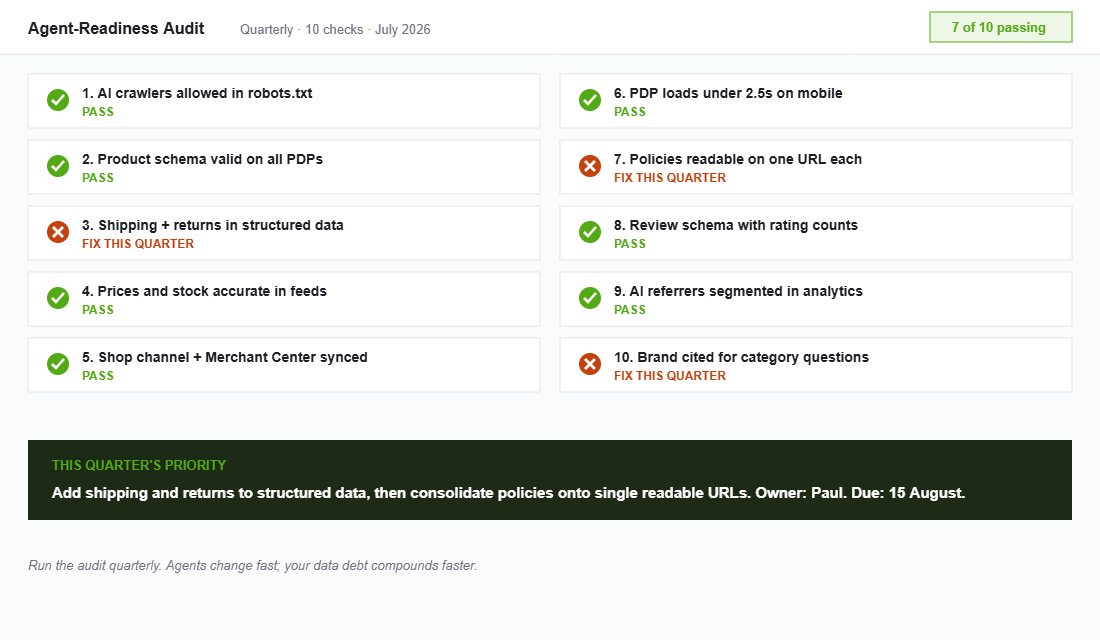
- AI crawlers allowed in robots.txt, verified, not assumed.
- Product schema valid on every template, tested on your top sellers.
- Shipping and returns in structured, quotable form with real Australian timeframes.
- Feeds match the store on price and availability, to the dollar.
- Shop channel and Merchant Center connected and syncing without errors.
- PDP mobile load under 2.5 seconds on your best seller.
- One canonical URL each for shipping, returns and warranty policies.
- Review schema live with visible rating counts.
- AI referrers segmented in GA4 and reviewed weekly.
- Citation check: ask ChatGPT, Perplexity and Gemini your category’s top three buying questions and record whether you are named.
That last check is your scoreboard. The AusPost report found 85% of Australian businesses say they are taking steps to prepare for an agentic future, but preparation that never gets audited is a press release, not a strategy. Ten questions, quarterly, keeps you honest.
The Compound Effect: Boring Data Work, Unfair Advantage
Notice what this playbook did not ask you to do. No store rebuild. No speculative apps. No betting margin on a checkout standard that has already pivoted once this year.
Everything on the list, clean product data, quotable policies, visible reviews, fast pages, measured channels, makes your store better for human customers today. That is the test of a sane bet on an uncertain trend: it pays off even if the trend stalls. If agent-driven buying reaches the 10 to 20% of ecommerce that Morgan Stanley projects by 2030, you are early. If it takes longer, you spent the time improving conversion for the 9.8 million Australian households already shopping online. Either way you win.
The founders who lose this decade will be the ones who ignored it entirely, and the ones who chased every shiny protocol. The ones who win will do what winners always do: systematise the fundamentals early, measure honestly, and let the compounding do its job.
Inside eCommerce Circle, platform readiness is one of the core pillars we work on with every member. If you want a second opinion on how agent-ready your store really is, let’s talk.