A customer in Geelong orders on a Tuesday. Your site promises two to four business days. On day six the parcel has not moved past the depot scan, and she emails you at 9:41pm asking where it is. What happens in the next few hours decides whether she ever buys from you again.
What’s in This Article
Most Aussie brands handle that moment badly. Not because they do not care, but because there is no system. The email sits until someone opens the inbox the next morning. The reply is a copy-paste line about courier delays. No apology that sounds human, no remedy, no follow-up. She gets her parcel four days later, never complains again, and quietly stops opening your emails.
That silence is expensive. Data across ecommerce support teams shows brands that reply to a customer email within one hour hold on to roughly 71% of those customers, while brands that take 24 hours hold on to about 48%. Same failure, same product, same refund. The gap is entirely in how you handled the hour after things went wrong.
Service recovery is not customer service. Customer service is answering questions. Service recovery is what you do when you have already let someone down, and it is one of the most profitable retention systems a Shopify brand can build.
What a Stuffed-Up Order Actually Costs You
Founders tend to price a failed order at the refund amount. A 90 AUD order goes wrong, you refund 90 AUD, done. That number is wrong by a factor of three or four once you count the real line items.
- The refund or replacement. Product cost plus the freight you already paid, plus the freight to send it again.
- The support time. Three to six messages at ten to fifteen minutes of a real person’s attention, usually your most experienced one.
- The acquisition cost you already spent. If your CAC is 45 AUD, a customer who churns after one bad order takes that spend with them.
- The second order you never get. On most Aussie stores the second order is worth more than the first, because there is no acquisition cost attached to it.
- The review risk. One angry Google or Trustpilot review sits on your brand name for years and quietly taxes every ad dollar you spend after it.
Now put volume against it. Gorgias data drawn from more than 12,000 ecommerce stores shows most brands field 20 to 50 support tickets per 100 orders, and 30 to 40% of those tickets are WISMO, the where-is-my-order question. If you ship 2,000 orders a month, you are having hundreds of conversations where the customer is already mildly annoyed before you type a word.
The volume is not going down either. Australians spent 82.6 billion AUD online in 2025, up 14% year on year according to Australia Post. More parcels through the same courier network means more depot delays, more failed delivery attempts, more chances for you to be the brand that either fixed it or did not.
Do Not Bet Your Retention on the Service Recovery Paradox
You have probably heard the idea that a customer who has a problem fixed brilliantly ends up more loyal than one who never had a problem at all. It is called the service recovery paradox, and it gets repeated at conferences because it makes support teams feel heroic.
Be careful with it. A meta-analysis of the research found the effect is real and consistently positive for satisfaction, but it does not reliably carry through to repurchase intention, word of mouth or brand perception. Translation: recovering well makes people feel better about the interaction. It does not automatically buy you the next order.
What the research does support strongly is the downside. Complaint-handling satisfaction explains a large share of loyalty variance, with one study attributing 34.7%, and studies of resolution quality consistently find that only full resolution protects repeat patronage. Partial fixes and unresolved issues actively push people away.
So run recovery as damage control done exceptionally well, not as a growth strategy. Never engineer failures to create recovery moments. Prevent everything you can, then make the ones that slip through disappear cleanly.
The 5R Framework: Respond, Regret, Resolve, Restore, Record
Every recovery conversation that goes well contains the same five moves in the same order. Every one that goes badly is missing at least one of them. Here is the shape of it before we get into detail.
- Respond. Acknowledge fast, before the customer chases you a second time.
- Regret. Apologise in plain English and own the failure without hedging.
- Resolve. Fix the actual problem with a remedy the customer would have chosen.
- Restore. Add a gesture sized to the harm and to your economics.
- Record. Tag the root cause so the same failure does not bill you twice.
Most teams do two and four. They apologise and throw a discount code at it. That combination is the worst of both worlds, because it costs you money and still leaves the customer holding the original problem.
R1: Respond Before the Customer Has to Chase You
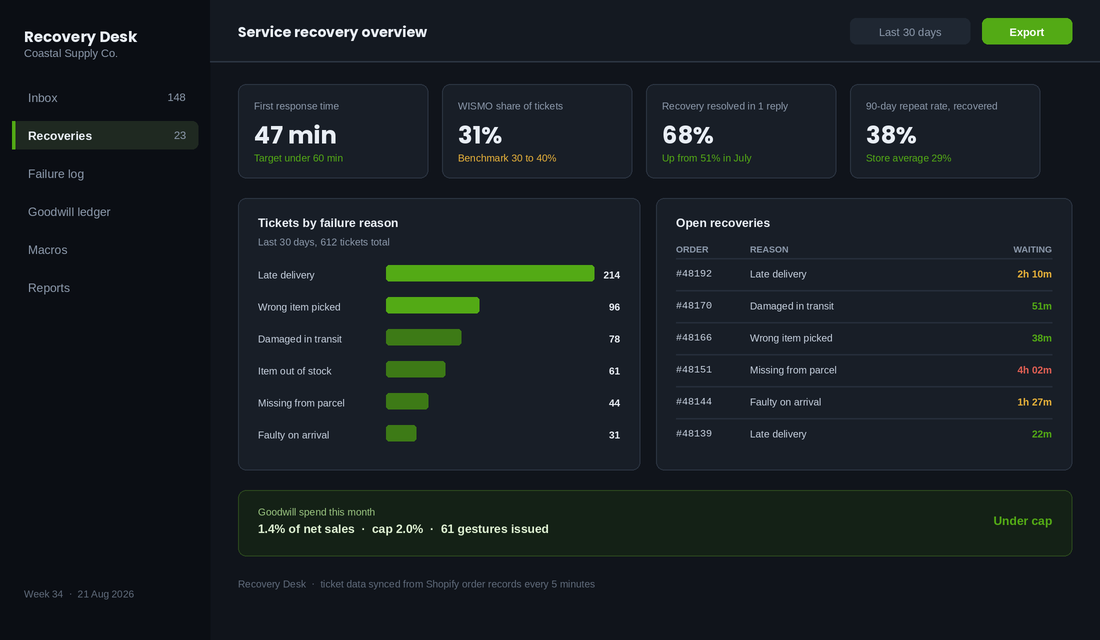
Speed is the single variable you control most easily and the one that moves retention most. The industry average first response time in ecommerce sits at four to six hours. Best-in-class teams answer in 30 to 60 minutes. Around 89% of customers say they expect a response inside an hour.
You do not need a 24-hour team to hit that. You need three things.
- Defined coverage windows. Pick your real hours, publish them, and hit them. “We reply 8am to 6pm AEST, Monday to Saturday” beats a vague promise you miss on a Sunday night.
- An auto-reply that carries information. Not “we have received your message”. Instead: current reply time, a link to live tracking, and the one thing that resolves most cases without a human. That alone deflects a chunk of WISMO.
- A failure trigger that fires before the complaint. This is the big one. If an order has not scanned in 72 hours, you email first. Getting in front of the customer changes the entire tone of the conversation, because now you are the brand that noticed.
Proactive contact is worth building even if nothing else in this article gets done. A customer who receives “your parcel is stuck at the Melbourne depot, here is what we are doing” has been converted from complainant to spectator. They are watching you solve it rather than fighting you for it.
R2: Regret in Plain English, Not Corporate Fog
Most apology copy is written to reduce legal exposure rather than to repair a relationship. It reads like a bank. Your customer bought candles from a founder-led brand in Brunswick, and now they are being addressed by a compliance department.
Three phrases to ban from your macros today:
- “We apologise for any inconvenience caused.” It apologises for a hypothetical. Name the actual problem instead.
- “Unfortunately, our courier partner has advised…” The customer bought from you, not the courier. Blame-shifting reads as weakness.
- “As per our policy…” Policy language tells someone you have stopped listening and started defending.
Here is the structure that works, and it is four sentences long.
Hi Sarah, you ordered on the 12th and we told you two to four days. It is now day seven and that is not good enough, I am sorry. I have sent a replacement out on express this morning, tracking is below, and you do not need to send the original back if it turns up. I will check in Friday to make sure it landed.
Read it again and notice what it does. It states the facts back, so she knows you actually read her message. It owns the failure without excuses. It resolves before she has to ask. It commits to a follow-up with a specific day, which is the part almost nobody does.
One more rule: match the channel and the intensity. A short, calm email gets a short, calm email. Someone who has written 400 furious words at midnight gets a phone call if you have their number. A two-minute call resolves what six emails cannot, and it is the fastest way to stop a review being written.
R3: Resolve With a Remedy Ladder, Not a Coin Toss
Ask five people on your team what to do when a 240 AUD order arrives damaged and you will get five answers. That inconsistency is what turns support into a negotiation, and customers who sense negotiation push harder.
Fix it with a remedy ladder: a written table that maps failure type and order value to a preset remedy. Decide it once, calmly, with a spreadsheet open. Then your team never has to make a commercial judgement call at 4pm on a Friday.
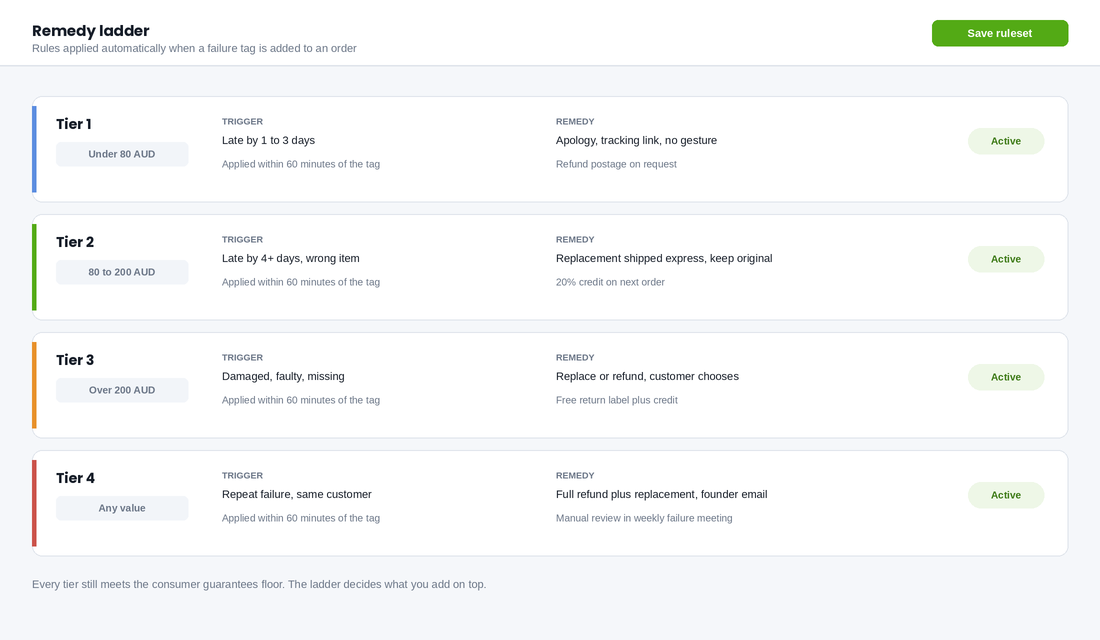
Two design rules matter more than the specific tiers.
Never ask for the item back when the return freight costs more than the item. If a 22 AUD product fails, telling the customer to print a label, repack it and get to a post office is a punishment for your mistake. Replace it and write off the unit. The return freight would have cost you more than the stock anyway.
Let the customer choose on the big ones. Under Australian Consumer Law, when a product has a major failure the customer chooses between a refund or a replacement, and you cannot force store credit on them. For a minor failure you can choose to repair first. The ACCC is clear on this, and getting it wrong is both a compliance problem and a trust problem. Build the legal floor into your ladder, then decide what you add on top of it.
Speed applies here too. Set an internal rule that any Tier 3 remedy is actioned within 60 minutes of being tagged, not “within two business days”. The remedy is only half the value. The other half is how quickly the customer stops worrying about it.
R4: Restore With Goodwill You Can Actually Afford
Goodwill is the gesture on top of the fix. Done well, it is the part the customer tells their friends about. Done badly, it is a 10% off code that reads as an insult and trains people to complain.
Three principles keep it honest.
- Size the gesture to the harm, not to the order. A birthday gift that missed the birthday is a bigger harm than a restock order that arrived late, even if the late one was worth more.
- Prefer product over percentages. A free full-size item costs you cost price and feels like a gift. A 15% code costs you gross profit on a purchase they were going to make anyway and feels like marketing.
- Cap it and watch it. Set a monthly goodwill budget as a percentage of net sales. Somewhere between 0.5% and 2% suits most Aussie DTC brands. If you are running above the cap, you do not have a goodwill problem, you have an operations problem.
That last line is the one to sit with. Goodwill spend is a smoke alarm. When it climbs, something upstream is broken in picking, packing, freight or stock accuracy, and no amount of generous support will fix a warehouse.
Aussie brands with strong reputations here tend to make the gesture structural rather than improvised. Koala’s 120-night trial with free returns and pickup means a mattress that does not suit is never a fight. Bellroy’s three-year warranty with repair or replacement means a failed zip is a process, not an argument. Both decided in advance what they would do, which is exactly what a remedy ladder does at a smaller scale.
R5: Record the Root Cause or You Will Pay for It Twice
This is where nearly every brand under 10 million AUD falls over. The ticket gets resolved, the customer is happy, the ticket is closed, and absolutely nothing is learned. Three weeks later the same SKU gets picked wrong again because the two 500ml variants still sit in the same bin.
Make one rule non-negotiable: no recovery ticket closes without a root cause tag. Not a category like “shipping”. A cause, like “courier delay metro”, “pick error similar SKU”, “carton too light for item”, “oversell after stocktake”, “supplier batch fault”, “address missing unit number”.
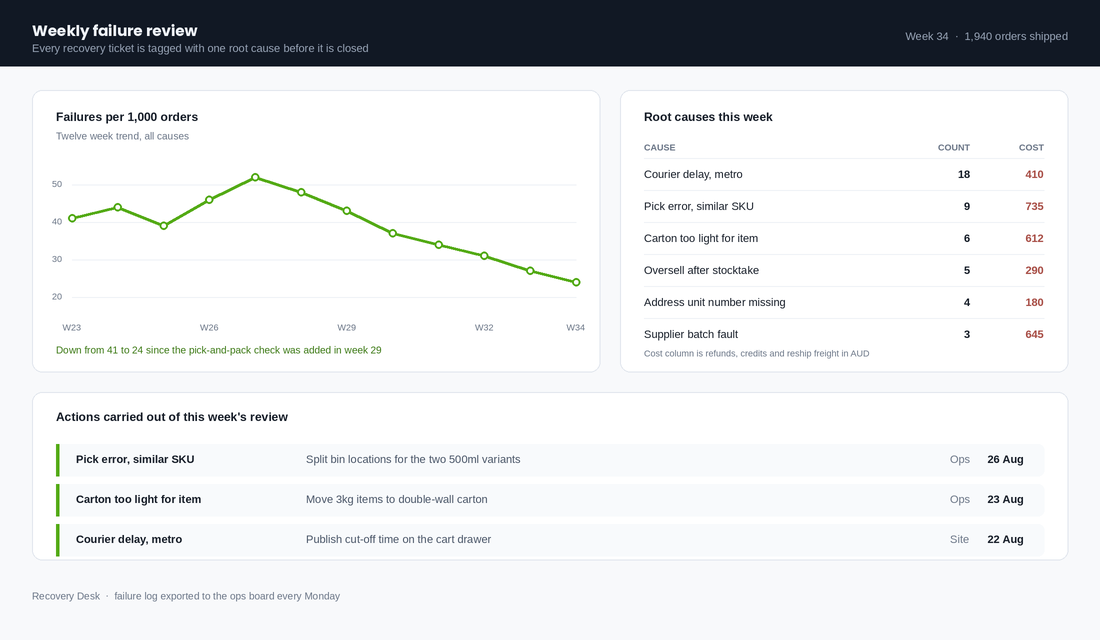
Then run a 20-minute weekly failure review. It has three agenda items and no slides.
- Failures per 1,000 orders this week against the last four weeks. Use the rate, not the count, so growth does not hide a worsening problem.
- Top three root causes by cost, where cost is refunds plus credits plus reship freight. Frequency is interesting, cost is what you act on.
- One fix, one owner, one date. Pick the top cause and assign a specific change. Not “improve picking”. Instead: “split bin locations for the two 500ml variants by Tuesday”.
One fix a week is 50 fixes a year. That is how a store goes from 40 failures per 1,000 orders to under 15 without hiring anyone, and it makes every other retention effort work harder. It pairs directly with the operational hygiene in our delivery promise playbook, because most recovery tickets start with a promise your logistics could not keep.
Build the Recovery Kit Inside Your Helpdesk
None of this survives contact with a busy week unless it is wired into the tool your team actually opens. For Shopify brands, Gorgias is the most direct fit because it pulls Shopify order data into the ticket, so your team can refund, reship and edit orders without leaving the conversation. Re:amaze and Zendesk work too, and the setup logic below transfers.
Here is the build, in order, and it is a half-day job.
- Connect Shopify and turn on order data in the sidebar. Your team should see order status, tracking and fulfilment history next to every message. Most delays in recovery are just people hunting for information across tabs.
- Create six root cause tags. Match them to your real failure modes, not generic ones. Keep the list short enough that people use it correctly.
- Build a rule that auto-tags likely failures. Any message containing “still hasn’t arrived”, “wrong item”, “damaged”, “broken” or “missing” gets tagged and pushed to a Recoveries view with a one-hour target.
- Write four macros, one per remedy tier. Use the four-sentence apology structure, with merge fields for the customer name, order number and tracking link. Leave a blank line at the top for one personal sentence, and make writing that sentence a rule.
- Add a follow-up task on every recovery. Three days out, one line: “just checking that landed”. This is the single cheapest loyalty action in the whole system and almost nobody does it.
- Set up a Shopify Flow trigger for silent failures. When fulfilment is created but no carrier scan is recorded after 72 hours, tag the order and notify support so you contact the customer first.
- Export tags weekly to a shared sheet. Cause, count, cost, owner, fix, due date. That sheet is the agenda for the weekly review.
Teams that get the helpdesk wiring right typically report resolution times dropping 20 to 40%, mostly because information stops being hunted for. If you are still running recovery out of a shared Gmail inbox, that is your first fix, and our customer service playbook covers the foundation layer underneath this one.
The Four Numbers That Tell You If Recovery Is Working
Support teams love CSAT. It is fine, but it is a feelings metric collected from the people who bothered to answer. These four are harder and more useful.
- First response time on tagged recoveries. Not your whole inbox. Recovery tickets specifically. Target under 60 minutes inside your coverage window.
- Failures per 1,000 orders. Your operational truth metric. Track it weekly and expect it to be ugly for the first month.
- Repeat purchase rate at 90 days, recovered customers versus everyone else. This is the number that proves the system pays. Segment recovered customers in Klaviyo or your reporting tool and compare cohorts. If recovered customers repeat at or above your store average, your recovery is genuinely working.
- Goodwill spend as a percentage of net sales. Your early warning light on operations, reviewed monthly against your cap.
Set a baseline this week even if the data is messy. You cannot argue with your 3PL, your courier or your supplier about a problem you have not measured, and vague complaints get vague responses. A line saying “carton failures cost us 612 AUD last week across six orders” gets a meeting.
How the Five Pieces Compound
Look at what happens when all five Rs run together on that Geelong order.
Your Flow rule catches the missing scan on day four, before she emails. Support sends a proactive note with a replacement already on express. She replies “wow, thank you” instead of “where is my order”. The ticket is tagged “courier delay metro” and closed. Friday’s follow-up confirms it landed. Monday’s review shows metro delays are now the top cause by cost, so you publish an honest cut-off time on the cart drawer and stop over-promising two days on a route that reliably takes four.
That last step is where recovery stops being a cost centre. Every fix you make from the failure log lowers next month’s ticket volume, which lowers your support cost per order, which frees your best person to spend time on the customers who are about to spend more. Meanwhile the customers you recovered are still in your list, still opening emails, and still buying, rather than sitting in the win-back segment where they cost far more to reactivate.
Recovery done properly also protects your public reputation before it needs protecting. Fewer people write a one-star review when someone has already apologised properly and fixed it, which means less time spent on damage control in our negative review playbook territory.
Your Service Recovery Checklist
Copy this into your ops doc and work through it. Most brands can get the whole thing live in two weeks.
- Respond. Coverage windows published. Auto-reply carries tracking and reply times. Proactive trigger fires at 72 hours with no carrier scan.
- Regret. Four-sentence apology structure in every macro. Banned phrases removed. Phone call rule set for high-intensity messages.
- Resolve. Remedy ladder written with four tiers. Consumer guarantees built in as the floor. Tier 3 actioned within 60 minutes.
- Restore. Goodwill sized to harm, product preferred over discount codes, monthly cap set as a percentage of net sales.
- Record. Six root cause tags live. No ticket closes untagged. Weekly 20-minute review with one fix, one owner, one date.
- Measure. Baseline set for first response time on recoveries, failures per 1,000 orders, 90-day repeat rate for recovered customers, and goodwill spend.
Start with the proactive trigger and the root cause tags. Those two take an afternoon and change the shape of every conversation that follows. The ladder and the macros can come in week two.
Things will go wrong in your business this month. Parcels will vanish, a batch will be faulty, someone will pick the wrong variant. None of that decides whether those customers come back. What decides it is whether you had a system ready for the hour after it happened.
Inside eCommerce Circle, service recovery is one of the core pillars we work on with every member, because it sits right where retention and operations meet. If you want a second opinion on yours, let’s talk.