You spent 60 dollars acquiring the customer. You picked, packed and posted the order the same day. Then a driver knocked on a door where nobody was home, scanned a card, took the parcel back to the depot, and three days later your inbox has a message that starts with “Hi, I still haven’t received my order”.
What’s in This Article
Most Aussie founders treat that as a carrier problem. It isn’t. Globally, somewhere between 8 and 20 per cent of parcels fail to reach the recipient on the first attempt, and the two biggest causes are the customer not being home (36 per cent of failures) and an incorrect address (22 per cent). Both of those are decided at your checkout, not in the van.
The money is worse than it looks. In the US a failed delivery costs an average of 17.20 dollars per parcel once you count the redelivery, the support time and the refund exposure. Around 70 per cent of shoppers say they are unlikely to buy again from a brand after a failed delivery. So a 5 per cent failure rate on 12,000 orders a year is not a logistics annoyance. It is roughly 600 damaged relationships and a five figure hole you never see on a P&L line called “failed deliveries”, because no such line exists.
This is the playbook we run with brands inside eCommerce Circle when their support inbox is drowning in delivery questions. Five layers, in order, from checkout through to the policy you write before you need it.
What a Failed Delivery Actually Costs You
Before you fix anything, put a number on it. Most founders guess low because the cost is spread across four buckets that live in four different places.
- The freight you pay twice. Return to sender, then a reship. On a 12 dollar parcel that is 24 dollars of freight against a single order.
- The support time. A “where is my order” enquiry costs between 5 and 22 dollars to resolve once you count the agent time, the carrier enquiry and the follow up.
- The goods you write off. Perishables, personalised items and anything that gets damaged in the return leg.
- The customer you lose. This is the big one and the one nobody models. If your repeat rate is 28 per cent and your average lifetime value is 340 dollars, every lost customer is roughly 95 dollars of forward value gone.
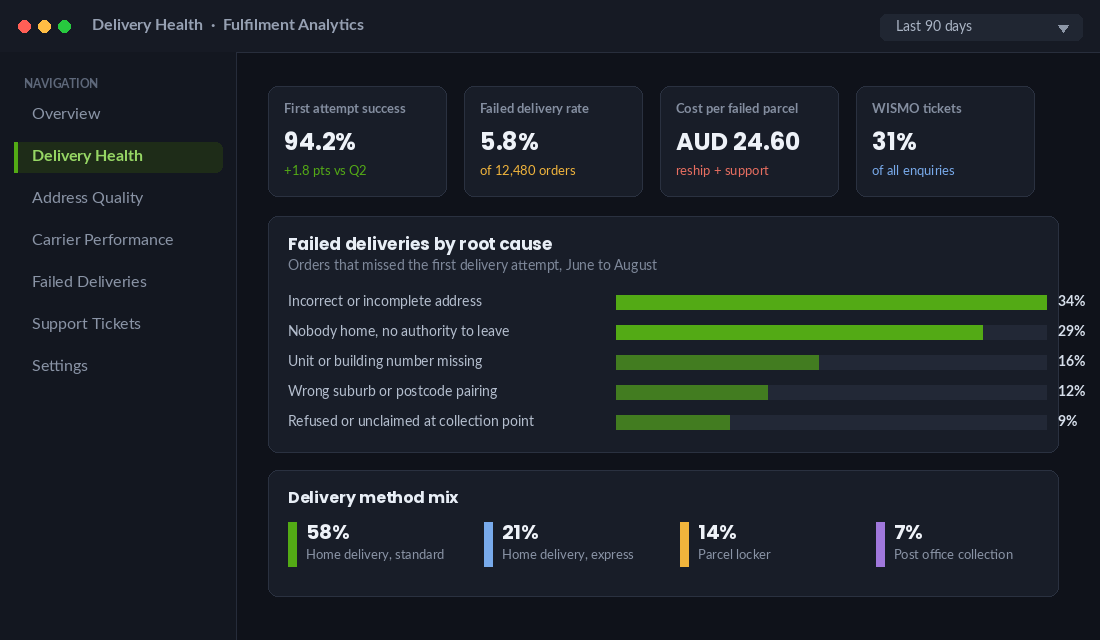
Add those together and a single failed delivery on a 90 dollar order can cost more than the order was worth. Now build the dashboard so you can see it. You want first attempt success rate, failure rate by root cause, cost per failed parcel, and delivery enquiries as a share of total support tickets. If you cannot pull those four numbers today, that is the first job.
Layer 1: Catch the Bad Address Before the Parcel Leaves
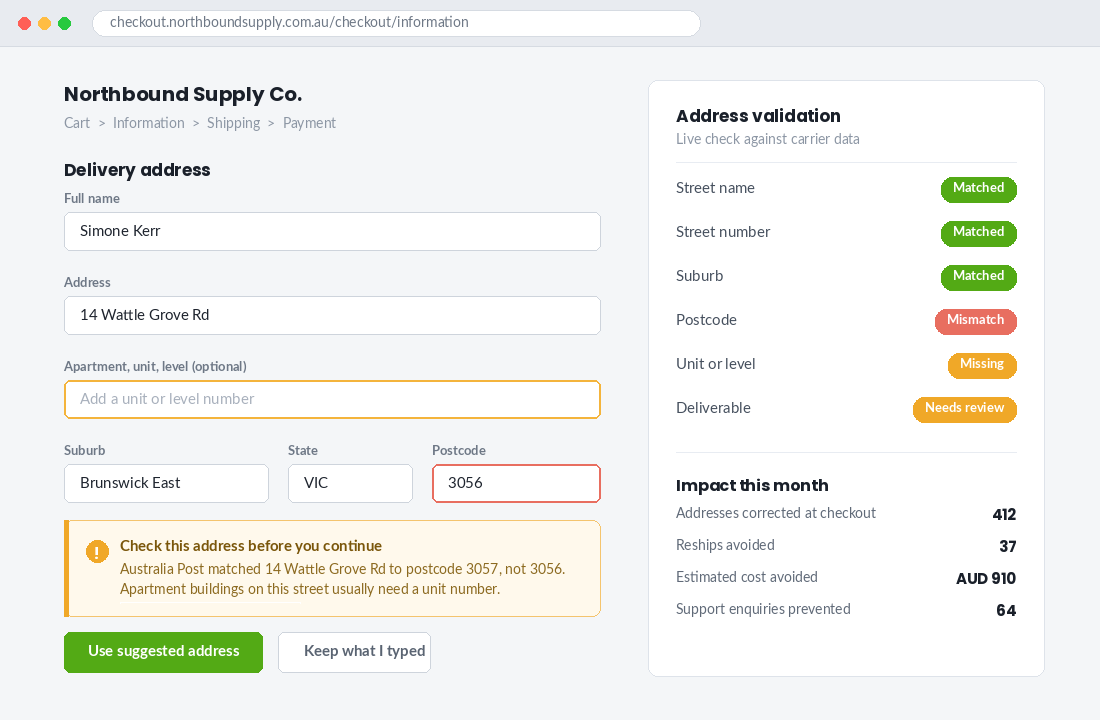
Roughly one in five failed deliveries traces back to an address the customer typed wrong. Missing unit numbers in apartment buildings. A suburb that does not match the postcode. A street type that puts the parcel two suburbs over because there is a Wattle Grove Road and a Wattle Grove Street.
Shopify has native address validation suggestions built into checkout, and if you have not turned them on, do that today. Go to Settings, then Checkout, then Customer information, and check your address collection preferences. It is free and it catches the obvious ones.
For anything past the obvious, you want a validator that checks against real carrier and postal data rather than a generic format check. Clearer.io Address Validator is the one we point most Aussie stores at first because the pricing is honest: the first 100 orders each month are free, then it runs at 6 cents per checkout. On 3,000 orders a month that is about 174 dollars, against reship freight that is usually several times higher.
How to set it up properly in about 20 minutes
- Install the validator and connect it to checkout. Most now run as a Shopify checkout UI extension, so it works on Shopify Plus and standard plans without editing checkout.liquid.
- Set the behaviour to suggest, not block. Hard blocking kills conversion. Show the corrected address, let the customer confirm or override in one tap.
- Turn on the unit number prompt for multi-dwelling addresses. This is the single highest value rule in Australia. If the postal data says the address is an apartment complex and there is no unit number, ask for it.
- Add a post-checkout catch. Validate again at fulfilment. If an order flags after purchase, email the customer before you print the label rather than after the parcel is in the network.
- Log every correction. You need the count of addresses fixed per month to prove the app pays for itself. Most validators expose this in their dashboard.
One warning. Do not let the validator quietly rewrite an address without telling the customer. If someone deliberately ships to a workplace with an unusual format and your app “corrects” it, you have created a failed delivery rather than prevented one. Suggest, confirm, then ship.
Layer 2: Give People a Delivery Option That Works When They Are Not Home
Australians spent a record 82.6 billion dollars online in 2025, up 14 per cent year on year, across 9.8 million households. That growth is not coming from people sitting at home waiting for couriers. It is coming from people at work, at school pickup, or out of the house from seven in the morning.
The Australia Post eCommerce Report 2026 puts hard numbers on what those shoppers want. 73 per cent say a good delivery experience makes them more likely to shop online. 69 per cent want a wider range of delivery options at checkout. And 32 per cent would switch retailers to get out of home collection options such as Parcel Lockers.
That last number should stop you. Nearly a third of the market will change brands over a delivery option most Aussie stores still do not offer.
The infrastructure is already there. Australia Post now runs more than 1,500 Parcel Lockers and over 5,000 out of home collection points nationally, after expanding the locker network more than 60 per cent year on year. Locker usage is up around 20 per cent, more than two million Australians are registered, and returns lodged through lockers grew 36 per cent.
Two Australian brands already doing this
THE ICONIC added the Australia Post collection point widget to checkout as part of a broader delivery experience upgrade, and reported a reduction in cart abandonment because customers felt more confident completing the purchase when they could choose where the parcel landed.
Oz Hair and Beauty report that Parcel Locker delivery is their highest rated delivery service on net promoter score. Not their fastest. Their highest rated. Certainty beats speed for a large slice of the market, and the Australia Post data backs this up: 87 per cent of Baby Boomers and 90 per cent of the Builder generation choose certainty over speed, and those two cohorts are the fastest growing online spenders in the country, up 14.8 and 16.9 per cent respectively with the biggest baskets.
Getting collection points live on your store
- Install the Australia Post Collection Points app from the Shopify App Store. It is close to plug and play and drops a location picker into checkout.
- Set a sensible search radius. Five kilometres in metro, twenty in regional. Showing a locker 40 kilometres away helps nobody.
- Label the option in plain English. “Collect from a 24/7 Parcel Locker near you” converts better than “Alternate delivery point”.
- Match the price to home delivery. If you charge extra for the locker, nobody picks it. If anything it should be your cheapest option, because it never fails.
- Segment your comms. Locker orders need a different post-purchase email, with the collection window and the access code front and centre.
If you have not already set the expectations that sit behind these options, read our Shopify delivery promise playbook first. Options without an honest promise just move the complaint from “it never arrived” to “it arrived late”.
Layer 3: Fix the Authority to Leave Problem
Authority to leave, or safe drop, is where most Australian stores lose control. Turn it off and every unattended delivery becomes a card in the letterbox and a trip to the post office. Turn it on blindly and you inherit every parcel left on a front step in an apartment block foyer.
The theft numbers are real and getting worse. A Finder survey of 1,006 Australians found 18 per cent had a parcel go missing in the past twelve months, which works out to around 3.9 million lost deliveries nationally and roughly 867 million dollars of goods. Break that down and 4 per cent were stolen from the property, 7 per cent vanished in transit and 7 per cent were delivered to the wrong place. Parcel theft has climbed from 0.06 per cent of deliveries in 2016 to 0.154 per cent, and 58 per cent of Australians say they worry about it.
The answer is not a blanket policy. It is a rule set based on order value and address type.
- Under 100 dollars, house or townhouse. Authority to leave on by default, with a photo on delivery. This is the bulk of orders and the safest segment.
- Under 100 dollars, apartment or unit. Authority to leave off. Default the customer to a collection point instead. Foyer drops are the highest theft risk in the country.
- Over 300 dollars, any address. Signature required, or route to a locker. The freight difference is trivial against the claim.
- Any order flagged by fraud screening. Signature required, no exceptions.
Then let the customer override it. A one line field at checkout, “Delivery instructions (optional)”, plus a simple toggle for “Leave in a safe place if I am not home” gives you consent in writing. That consent is what you rely on when someone claims a parcel never arrived and the carrier has a photo of it on their porch.
One more thing most stores miss. Capture a mobile number as a required field, not an optional one. Australia Post and most couriers use SMS to offer redirects and safe drop confirmations. No mobile number means no redirect, and no redirect means a failed attempt.
Layer 4: Kill the Where Is My Order Ticket Before It Is Written
Delivery enquiries sit at 20 to 50 per cent of ecommerce support tickets in normal trading and push past 50 per cent during peak. At 5 to 22 dollars a ticket, a store doing 3,000 orders a month with a 30 per cent enquiry rate is burning somewhere between 4,500 and 19,800 dollars a month answering a question the customer should never have needed to ask.
Almost all of it is avoidable, because the customer is not asking for information you do not have. They are asking for information you have and did not send.
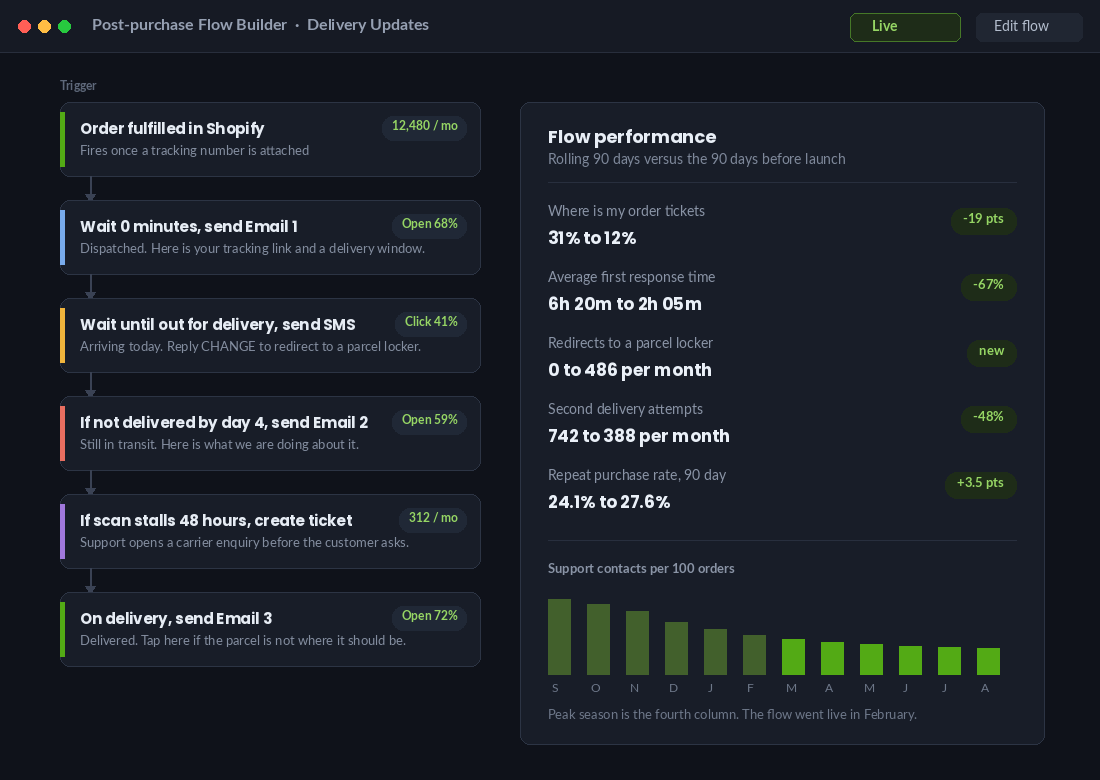
The five message sequence that does the work
- Dispatch email, sent immediately on fulfilment. Tracking link, a delivery window as a date range not a promise, and one line on what to do if it does not arrive.
- Out for delivery SMS, sent on the carrier scan. Short, with a redirect option. “Arriving today. Reply CHANGE to send it to a Parcel Locker instead.” This is the message that converts a failed attempt into a successful one.
- Day four still in transit email. Proactive, apologetic, specific. Tell them what you are doing, not just that you are sorry.
- Stalled scan alert, internal. If tracking has not updated in 48 hours, open a carrier enquiry automatically. Your team should be chasing the carrier before the customer chases you.
- Delivered confirmation. With a one tap “I cannot find this parcel” link that opens a pre-filled form instead of a blank email.
Shopify Flow handles the internal triggers on Plus, and Klaviyo handles the customer facing messages on any plan. If you are running Klaviyo, build these as a dedicated post-purchase flow triggered off the Fulfilled event rather than bolting them onto your welcome series. Then send the traffic somewhere useful: our order tracking page playbook covers how to turn that click into a branded page instead of dumping the customer on a carrier site.
For the enquiries that still land, your help centre needs a delivery section that answers the top five questions without a human. That work is covered properly in the support deflection playbook, and the two systems stack: proactive comms stop the ticket being written, self service handles what is left.
Layer 5: Write the Lost Parcel Policy Before You Need It
Every store eventually gets the message: “Tracking says delivered. I never got it.” What happens next is usually improvised by whoever is on the inbox that day, which means two customers with identical situations get different outcomes, and your team spends fifteen minutes deciding each time.
Write the decision tree once. Here is the version we hand to Circle members, adjust the thresholds to your own margins.
- Marked delivered, under 150 dollars, first claim from this customer. Reship immediately, no investigation. The support time costs more than the goods.
- Marked delivered, over 150 dollars. Lodge a carrier enquiry, ask the customer to check with neighbours and any building parcel room, resolve within five business days. Reship if unresolved.
- No delivery scan at all. Your problem, not theirs. Reship or refund at the customer’s choice after the carrier service window has elapsed.
- Second or third claim from the same customer inside twelve months. Signature required on all future orders, and a polite note explaining why. Track this in a customer tag.
- Returned to sender. Contact within 24 hours with the corrected address, reship at your cost the first time and at their cost the second.
Two things make this policy hold up. First, publish the customer facing version on your shipping page so nobody is surprised. Second, remember that Australian Consumer Law puts the risk of goods in transit on the seller until the customer takes possession, so a policy that says “not our problem once it leaves our warehouse” is not enforceable here. Build the reship cost into your freight assumptions instead of arguing about it.
Then set a budget. If your failed delivery rate is 5 per cent and your average reship cost is 24 dollars, on 3,000 orders a month that is 3,600 dollars. Put it in the freight line, review it monthly, and treat a reduction as a genuine profit improvement rather than a soft saving.
The Failed Delivery Scorecard: Five Numbers to Review Every Month
You cannot manage what you never measure, and none of these appear in Shopify Analytics by default. Build them once in a sheet, pull the data from your carrier portal and your helpdesk, and review them on the first Monday of the month.
- 1. First attempt success rate. Delivered on first attempt divided by total parcels shipped. Target above 95 per cent domestically. Under 90 per cent means you have a checkout problem, not a carrier problem.
- 2. Failure rate by root cause. Split into wrong address, nobody home, missing unit number, refused or unclaimed. This tells you which layer to fix next.
- 3. Cost per failed parcel. Reship freight plus support minutes plus written off goods, divided by failed parcels. Most Australian stores land between 20 and 35 dollars.
- 4. Delivery enquiries per 100 orders. Your WISMO proxy. Ten per 100 orders is poor. Four is good. Under three means the comms are doing their job.
- 5. Out of home delivery share. The percentage of orders choosing a locker or collection point. If it is zero, you are not offering it. Ten to fifteen per cent within three months of launch is a reasonable target.
Add one qualitative check. Every month, read five delivery complaints end to end. Not a summary, the actual thread. You will find the pattern your dashboard cannot show you, usually a specific suburb, a specific carrier service, or a specific product that will not fit in a locker.
Why the Five Layers Compound
Each layer on its own is worth doing. Together they multiply, because they attack the same failure from different ends.
Address validation removes the wrong address failures, which is roughly a fifth of the total. Collection points remove the nobody home failures, which is another third, and they bring in the older, higher spending shoppers who choose certainty over speed. Smart authority to leave rules cut the theft claims that used to arrive as refund requests. Proactive comms convert the near misses into successful deliveries, because a customer who gets an SMS at 9am can redirect a parcel at 10am. The policy stops the ones that still fail from turning into a slow, expensive argument.
Run all five and a store shipping 3,000 orders a month typically moves from around 5 per cent failures to under 2 per cent inside a quarter. On the numbers above that is roughly 2,100 dollars a month in avoided reship and support cost, plus around 36 customers a month who stay instead of leaving. At a 340 dollar lifetime value that second number is the one that matters, and it is worth more than most conversion rate tests you will run this year.
The order matters too. Start with layer one, because it is the cheapest and it changes the shape of every other number on the scorecard. Then add collection points, because that is where the growth in Australian shopper preference is heading. The comms and the policy can follow in the same quarter.
None of this is glamorous work. It will never look as exciting as a new creative test or a homepage redesign. But it is the rare kind of project where the customer experience improves and your costs fall at the same time, and there are not many of those left in a mature store.
Inside eCommerce Circle, the delivery experience is one of the core pillars we work on with every member, because it sits right where Platform and Patrons overlap. If you want a second opinion on yours, let’s talk.