On 1 July 2026, Australia Post lifted Parcel Post prices by an average of 4.95% for retail customers and 4.25% for contract customers. MyPost Business pickup went up 9.7%. Most Aussie Shopify founders read that news, sighed, and did nothing.
What’s in This Article
That is the expensive move. Freight is usually the second or third largest line item in a Shopify P&L after cost of goods and paid media, and it is the one founders touch least. You will spend three hours arguing about a $40 CPA and zero hours arguing about an eleven dollar parcel that ships nine thousand times a year.
Here is the number that should get your attention. Across ecommerce, shipping runs anywhere from 5% to 22% of revenue depending on weight and zone. Most operators should be under 12%. The best run at 6% to 9%. If you are above 15%, freight is quietly eating the profit you think your ads are making. Fashion brands average 12.73% of total revenue on shipping alone, which is more than most of them spend on their entire team.
The good news is that freight cost is one of the few levers in your business that improves without needing a single extra visitor. You are not chasing more revenue. You are keeping more of the revenue you already have. Below are the six levers we work through with operators inside the room, in the order they actually pay.
Lever 1: Work Out What a Parcel Actually Costs You
Ask most founders what a parcel costs them and you get a shrug and a rough number from memory. That number is almost always the base rate off the carrier quote, not the delivered cost. The delivered cost includes the fuel levy, cubic uplift, remote area fees, redelivery charges, the satchel or box, the void fill, the label, and the labour to pack it.
You cannot negotiate a rate card you have not measured. So the first job is boring and unavoidable: export three months of carrier invoices and three months of Shopify orders, and match them line by line.
- Cost per parcel, all in. Total carrier invoice plus packaging consumables, divided by parcels shipped. Not the quoted rate. The invoiced one.
- Freight as a share of revenue. Total freight cost divided by net revenue for the same period. This is your headline number. Track it monthly forever.
- Cost per parcel by zone. Metro same state, metro interstate, regional, and remote. Split these four ways or you will never see where the damage is.
- Recovery rate. What you charged customers in shipping revenue divided by what you paid carriers. Under 50% is common. Under 30% means your free shipping threshold needs work.
- Surcharge share. Everything on the invoice that is not the base rate, as a percentage of total spend. Across the industry this sits between 15% and 30%.
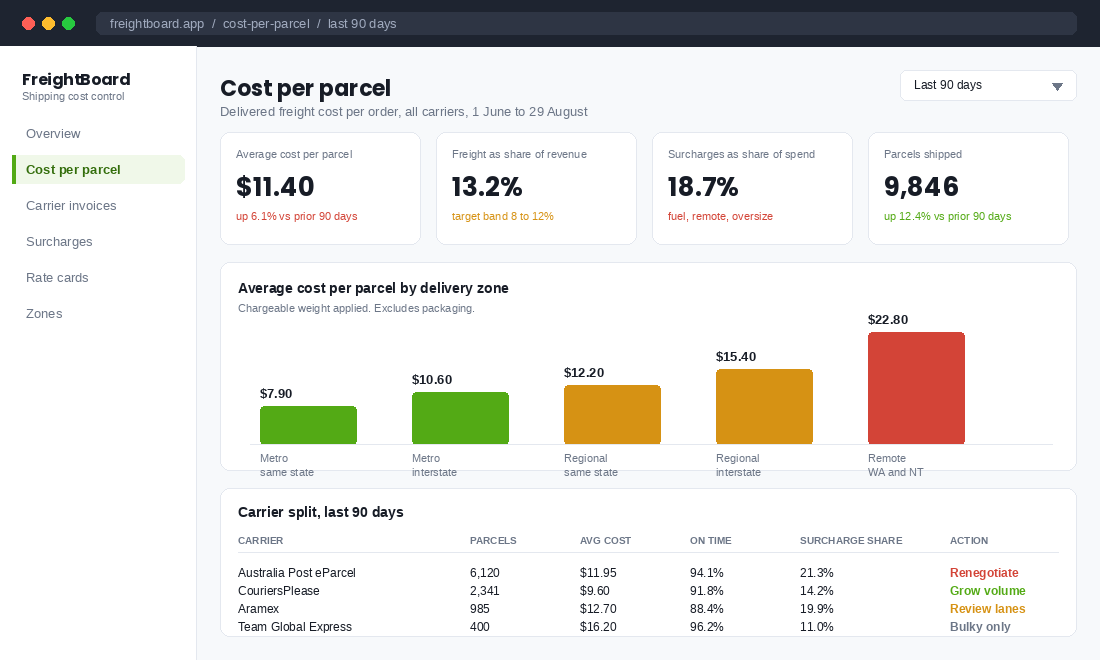
Do this once and you will find something you did not expect. Usually it is a single postcode range, a single oversized SKU, or a single carrier lane doing disproportionate damage. One brand we worked through this with found 4% of orders were carrying 19% of the freight bill because a bulky item was defaulting to the wrong service.
Lever 2: Find Out Which Pricing Structure You Are Actually On
There are three pricing worlds in Australian parcel delivery and most founders do not know which one they live in.
- Retail rates. Walking into a post office, or buying prepaid satchels. The most expensive money you will ever spend on freight. If you are still doing this above thirty orders a week, stop reading and fix it today.
- MyPost Business bands. Australia Post runs savings bands from 0 to 5. Your band is set by what you spent over the last four weeks or the last twelve months, whichever gives you the better outcome. The first discount starts at fifty dollars in four weeks. Band 5 sits at roughly two thousand dollars over four weeks or twenty thousand over twelve months, and is worth up to 35% off retail.
- A contract rate card. eParcel with Australia Post, or a negotiated agreement with CouriersPlease, Aramex, Team Global Express or DHL eCommerce. Zone based, weight break based, with your own fuel levy formula and your own surcharge schedule.
The jump that matters most is from bands to a contract. Bands are automatic and require no relationship, which is convenient and also means nobody is fighting for you. A contract rate card is negotiable in a way a band never is.
The threshold is lower than founders assume. If you are shipping a few hundred parcels a month with predictable volume, you are worth a conversation. Carriers are hungry right now. Australia Post grew parcel volume 5.3% in FY26 but still recorded a loss before tax of $107.6 million once property sales are stripped out. Everyone in the market is fighting for consistent, forecastable volume. That is exactly what a Shopify brand doing a thousand parcels a month provides.
Ask for a rate card even if you think you are too small. The worst outcome is that they say no and you stay on bands, which is where you already are.
Lever 3: Audit the Surcharges Before You Argue About the Base Rate
This is the lever almost nobody pulls, and it is usually the biggest one.
Founders walk into a carrier meeting and ask for a lower base rate. The account manager gives them 4% off the base and everyone shakes hands. Meanwhile 15% to 30% of the total spend sits in surcharges that were never discussed, and those surcharges have their own escalators that will quietly claw the 4% back inside a year.
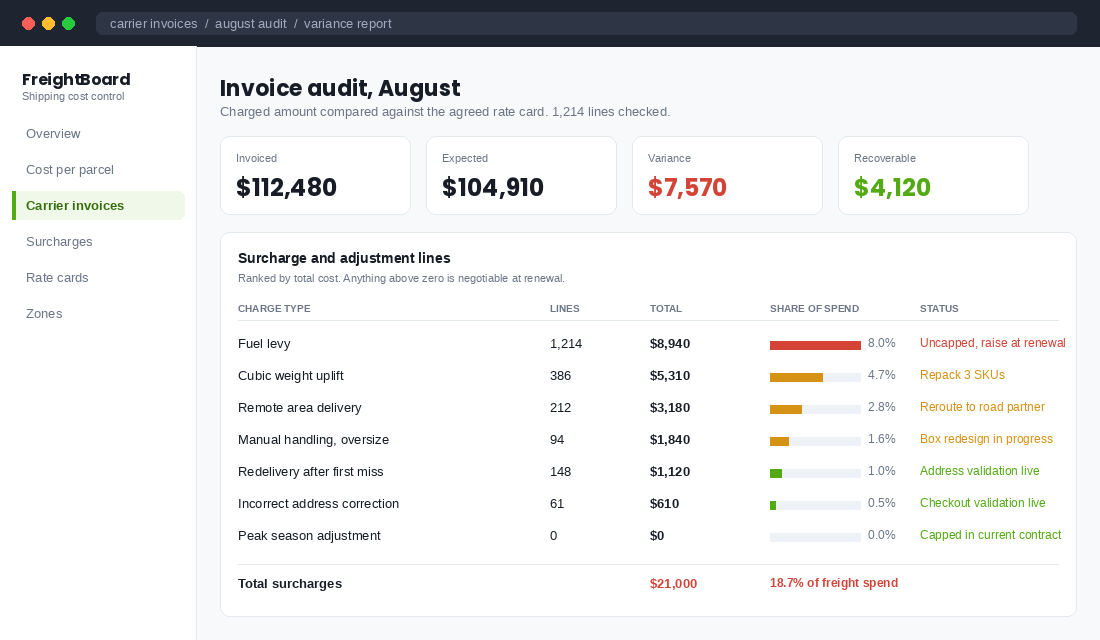
Rank every charge type on your invoice by total cost, largest first. Then work down the list with a specific ask for each one.
- Fuel levy. Usually the largest single surcharge and usually uncapped. Ask for a cap, a fixed formula tied to a published index, or a ceiling percentage. Australia Post cited fuel market volatility as a driver of the July increase, so this is live and worth pushing on.
- Cubic weight uplift. Charged when the space your parcel occupies exceeds its actual weight. See Lever 4.
- Remote area delivery. Fixed fee per parcel to certain postcodes. Get the postcode list in writing so you can route those orders differently.
- Manual handling and oversize. Triggered by a single dimension breach. One box redesign usually removes it entirely.
- Redelivery and address correction. These are your fault, not the carrier’s. Address validation at checkout kills most of them.
- Peak season adjustment. Some carriers apply a November and December uplift. Negotiate a cap on this in writing before October, not during BFCM.
Surcharges are only enforceable when they were specifically agreed in writing. That single fact turns your invoice into a negotiation document rather than a bill you pay.
Lever 4: Engineer the Parcel So the Rate Card Works for You
Australia Post uses a cubic conversion factor of 250kg per cubic metre. You are charged on the greater of actual weight or cubic weight. Which means a light, bulky product can be charged as though it weighs four times what it does.
Run the maths on your top ten SKUs by order volume. Length times width times height in metres, multiplied by 250. If that number beats your actual weight, you are paying for air. We covered the full calculation in our Shopify cubic weight audit, and it is the single fastest freight win available to most brands.
The fixes are physical, not commercial.
- Cut a box size. Most brands run three box sizes when they need five. Two more sizes can shave 10% to 15% off cubic charges across the range.
- Move to satchels where the product allows. Satchels are usually priced on flat rate or actual weight, which sidesteps the cubic penalty entirely on soft goods.
- Swap void fill for a smaller carton. If you are filling a third of the box with paper, you are shipping paper at eleven dollars a parcel.
- Check every dimension against the carrier limit. One centimetre over triggers a manual handling fee on every single unit that ships.
- Look at flat pack and nesting. If two units of the same SKU can share a carton, your multi-unit orders stop costing double.
Packaging changes feel small. They are not. A brand shipping ten thousand parcels a year that trims one dollar and forty cents off average cost per parcel finds fourteen thousand dollars of pure profit, with no extra traffic, no extra ad spend and no new customers.
Lever 5: Run Two Carriers, Always
On 11 January 2026, Sendle shut down its Australian operation. Thousands of small brands woke up with no carrier, no rate card, and a queue of orders they could not ship. The ones who recovered fastest already had a second carrier configured and a rules engine that could reroute volume the same morning.
Single carrier dependency is a risk position, not an efficiency position. It is also expensive. No carrier is cheapest on every lane. Australia Post tends to win on metro and light. CouriersPlease is often sharper on same state road, with domestic rates advertised from $8.10. Team Global Express and the freight specialists tend to win on bulky and remote.
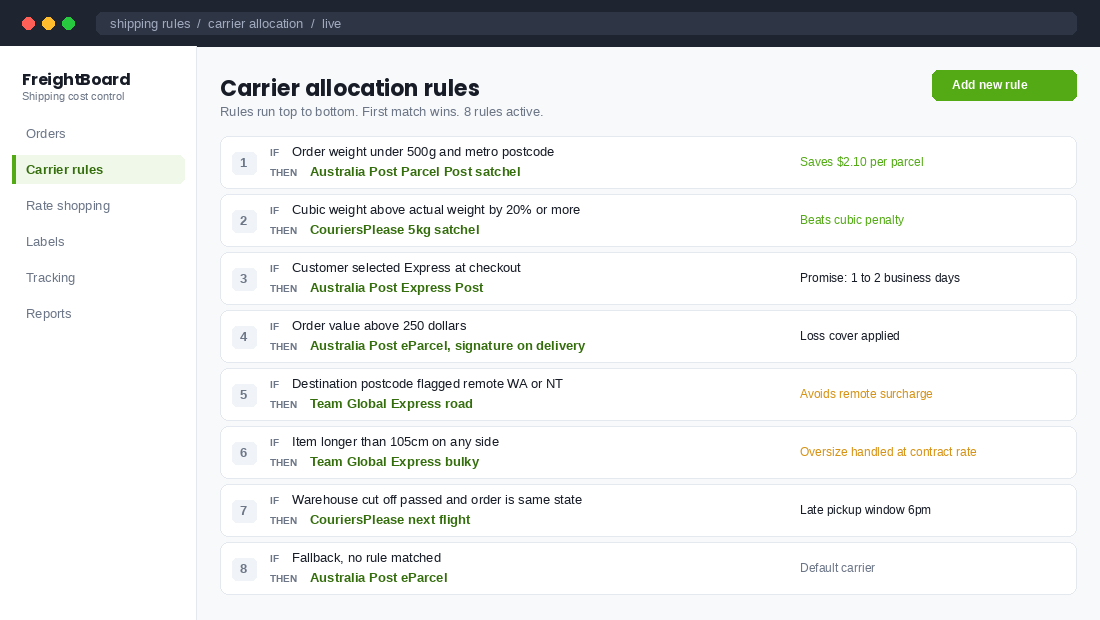
Setting up rate shopping with Starshipit
Starshipit is the shipping platform most Aussie and Kiwi Shopify brands land on, and it is what Showpo uses to run its fulfilment. It connects Shopify to Australia Post, CouriersPlease, DHL Express, FedEx, Border Express and a long list of others, then assigns each order to a carrier based on rules you control. Shippit is the other credible Australian option and works on the same principle.
- Install and connect Shopify. Add the app, authorise your store, and let it pull unfulfilled orders. Start in test mode so nothing ships while you configure.
- Load your carrier accounts. Enter the account credentials and rate card for each carrier. Load your real contract rates, not the published ones, or every comparison will be wrong.
- Set product dimensions and weights. Push accurate length, width, height and weight from Shopify for every SKU. This is the step people skip and it is the step that makes rate shopping work.
- Build rules top down. Rules run in order and the first match wins. Put your narrowest rules first, such as remote postcodes and oversized items, and your fallback carrier last.
- Turn on rate shopping for the middle band. For orders that no specific rule catches, let the platform compare live rates and pick the cheapest service that still meets your delivery promise.
- Run it in parallel for two weeks. Compare what the engine would have chosen against what you actually paid. Fix the rules that lose, then go live.
The point is not to chase the cheapest label on every order. It is to stop paying a premium rate on lanes where your second carrier is genuinely better, and to never again be one company failure away from not shipping.
Lever 6: Put the Renewal in Your Calendar Before the Carrier Does
Rate cards do not renegotiate themselves. They roll over, they escalate, and the escalation compounds while you are busy running the business.
Start the conversation 60 to 90 days before your contract renews. That gives both sides room to actually negotiate rather than scrambling to avoid a lapse. Turn up with three things: twelve months of shipping data, a twelve to twenty four month volume forecast, and a written quote from a competing carrier.
Carriers price on predictability. A brand that can say “we shipped 11,400 parcels last year, 62% metro, and we forecast 14,000 next year with this seasonal shape” is worth more to an account manager than a brand that says “we ship a fair bit”. Longer commitments also buy better pricing, so a two or three year agreement with a capped escalator often beats an annual deal you renegotiate from scratch.
- Ninety days out. Pull your invoice audit and cost per parcel by zone. Know your numbers cold.
- Seventy five days out. Request quotes from two competing carriers using your real volume and zone mix.
- Sixty days out. Book the meeting. Lead with your forecast, not your complaint.
- Forty five days out. Negotiate surcharges and caps separately from the base rate, and get every one in writing.
- Thirty days out. Sign, then update your rate card inside your shipping platform the same week so your rate shopping stays accurate.
Why These Six Levers Compound
Pulled individually, each lever is worth a few percent. Pulled together, they change the economics of the business.
Measuring cost per parcel by zone tells you which lanes to attack. Moving from bands to a contract gives you something to negotiate. The surcharge audit tells you what to negotiate. Packaging engineering lowers the chargeable weight the rate card is applied to. A second carrier gives you a real position in the room and cover if a carrier disappears. The renewal calendar makes sure none of it decays.
Then there is the part founders miss entirely: cheaper freight buys you a better offer. Showpo introduced free express shipping over fifty dollars and saw a significant lift in cart conversion, which showed up in their year on year growth. Koala runs same day delivery across Sydney, Melbourne, Adelaide, Brisbane and Perth, with a four hour window on orders placed before 3pm, across more than 1,200 postcodes. Neither of those is a marketing decision. Both are freight cost decisions that became marketing weapons.
Every dollar you take out of cost per parcel is a dollar you can put into a lower free shipping threshold, a faster service, or straight into contribution. Which one you choose depends on your category and your competitors, and it is the conversation worth having once the cost base is fixed. Our free shipping threshold playbook walks through how to set that number without destroying your contribution, and the delivery promise playbook covers how to communicate the speed you can actually hit.
Context matters here too. Australians spent $82.6 billion online in 2025, up 14% year on year, with roughly a quarter of all retail spend now happening digitally. Parcel volumes are growing, carriers are competing hard for that volume, and your bargaining position as an operator has never been better. The brands that use it will run at 8% of revenue on freight. The ones who do not will drift toward 15% and blame their ad account.
Your Freight Cost Review: The One Page Version
Run this once a quarter. It takes half a day the first time and about ninety minutes after that.
- 1. Measure. Cost per parcel all in, freight as a share of revenue, cost per parcel by zone, shipping revenue recovery rate, surcharge share of spend.
- 2. Classify. Confirm whether you are on retail rates, MyPost Business bands, or a contract rate card. Write down your current band or your contract expiry date.
- 3. Audit. Rank every surcharge line by total dollars. Flag anything uncapped, anything you did not agree to in writing, and anything caused by your own data quality.
- 4. Engineer. Run cubic weight against actual weight on your top ten SKUs. List every box or satchel change worth making and the annual saving for each.
- 5. Diversify. Confirm you have a second carrier configured and live, with at least one rule routing real volume to it every week.
- 6. Diarise. Put your renewal date in the calendar with a reminder ninety days ahead, and a second reminder to request competing quotes.
Set a target before you start. If freight is above 15% of revenue, your first goal is 12%. If you are at 12%, the next stop is 10%. Write the number down, because a target you have not written down is a wish.
Then check it monthly alongside your contribution numbers, not annually when the invoice looks scary. Freight cost drifts. It never improves by accident.
Inside eCommerce Circle, freight cost is one of the core Practice pillars we work on with every member, because it is the profit lever that sits closest to the door and gets opened least. If you want a second opinion on your rate card, let’s talk.