Most Aussie Shopify founders have not taken a real holiday since they launched. Not a long weekend with the laptop in the bag. A proper break: two weeks, phone on silent, nobody asking where the size medium is.
What’s in This Article
The numbers back that up. BizCover’s 2026 State of Australian Small Business Owners report found that almost one in three owners (32%) have never taken a single full week off while running their business, and 61% worked through illness in the past year rather than stepping away. AMP Bank GO’s survey of 2,000 Australian small business owners found one in four say they do not have time for a holiday, half are reluctant to take one at all, and 90% are preoccupied with work outside normal hours.
Here is the part nobody says out loud: if your store cannot survive two weeks without you, you do not own a business. You own a job with inventory. The founders we work with inside eCommerce Circle who eventually sell, scale, or simply sleep properly all passed the same test first. They took two weeks off and the store kept shipping. This is the 5-step system to make that happen, and to turn the holiday itself into the most useful stress test your operation will ever get.
Why the Two-Week Test Matters More Than the Holiday
Two weeks is the magic number for a reason. One week is easy to fake: you clear the decks, front-load the work, and let a few things slide until Monday. Two weeks is long enough that stock arrives, a supplier invoice falls due, a customer escalates, an ad account gets flagged, and a Klaviyo flow needs a decision. Two weeks forces the business to make calls without you.
That is exactly why it is valuable. The same AMP Bank GO research found two in five owners only step back to strategise once a year, or never. The reason cited most often was that planning felt “not important”, followed by “too much admin”. A founder who cannot leave for a fortnight is usually the same founder who cannot find a day to think about next year. Both problems have the same root cause: too many decisions still route through one person’s phone.
Treat the break as a diagnostic. Every message you get while you are away is a gap in a process, a permission, or a person. You come back with a list of exactly what to fix, in priority order, written by reality rather than by a consultant. We have covered how to build the SOP library that lets a store run without you. This article is the field test for it.
The cost of not doing it is real too. In hindsight, 43.5% of BizCover’s respondents said they would have set clearer work boundaries from the start, and a quarter named regular holidays as one of the biggest sacrifices they made. That is not a wellbeing footnote. Burnt-out founders make expensive decisions: panic discounts, rushed hires, and a supplier deal signed at 11pm because it was easier than pushing back.
Step 1: Decide Whether You Keep Selling, Slow Down, or Pause
The first decision is the one most founders skip: what happens to orders while you are gone? There are three honest options, and the right one depends on who is fulfilling.
- Keep selling at full speed. The right answer if you use a 3PL or have a team packing. Orders flow, dispatch continues, and the only thing that changes is who answers the escalations. If you are doing $80k a month or more, this should be your default. Two weeks of closed checkout on a store that size is a five-figure hole.
- Keep selling with a published dispatch delay. The right answer for owner-packed stores that still want the revenue. Checkout stays open, but a banner, a cart notice, and the order confirmation email all state the exact date orders will ship. Aussie brands do this every January. I Still Call Australia Home told customers its warehouse was closed until Tuesday 6 January 2026 and that orders placed in the window would dispatch from that date. Cambridge University Press’s Australian warehouse closed from 24 December and reopened 5 January with the same promise. Customers accept a stated delay. They do not accept a surprise one.
- Pause checkout entirely. The last resort. Shopify’s Pause and Build plan costs US$9 a month, keeps your storefront, domain, and SEO live, and hides the add-to-cart and checkout buttons. It also does not pause your app subscriptions, so you are still paying for Klaviyo, review apps, and everything else while making zero sales. Use it only if you have no fulfilment cover at all and a delay banner is not enough.
The maths usually favours option two over option three. A store doing $2,000 a day that stays open with a 12-day dispatch delay will lose some conversion, call it 30%, and keep roughly $19,000 in orders over two weeks. Paused, it keeps nothing and loses the ad momentum and email cadence on top. A published delay is not a compromise. It is a competent business telling customers the truth.
Whichever you choose, write the dates down now: last dispatch day, first dispatch day back, and the day you personally return to email. Those three dates drive everything in the next four steps.
Step 2: Name the Person Who Owns Each Decision While You Are Gone
A store does not run on tasks. It runs on decisions. Packing orders is a task; deciding whether to refund a $340 order that arrived damaged is a decision. Founders hand over tasks and keep the decisions, then wonder why the phone will not stop.
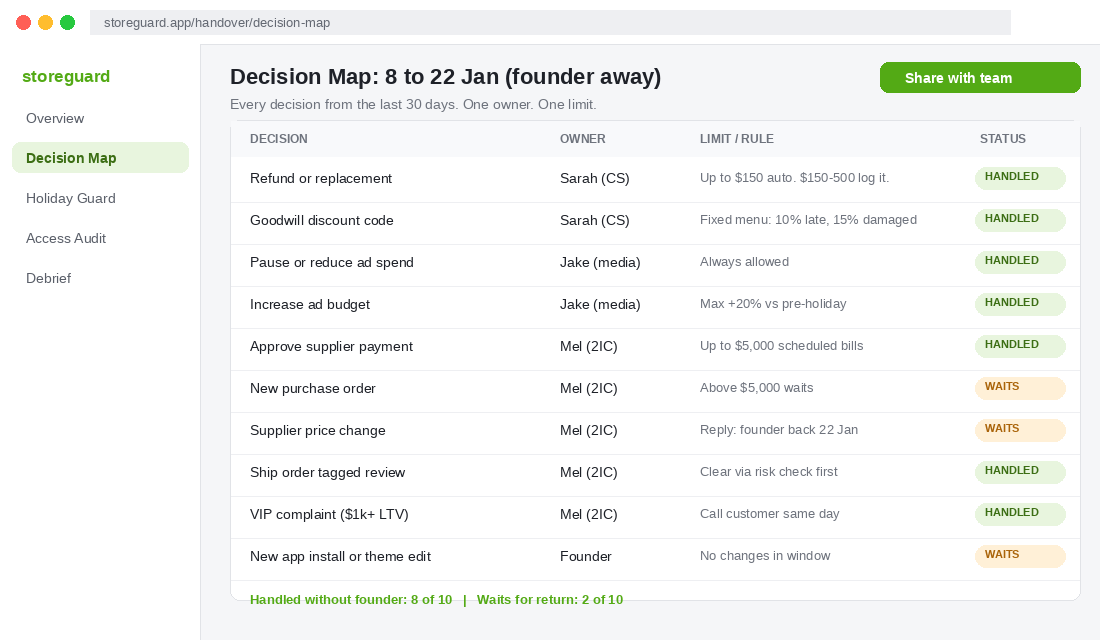
Build a one-page decision map before you leave. Down the left side, list every decision that came to you in the last 30 days. Go through your email, Slack, and WhatsApp to find them. Most founders land on 15 to 25. Then, for each one, assign a single owner and a limit. The limit is what makes this work.
- Refunds and replacements. Your customer service person (or VA) can approve anything up to $150 without asking. Between $150 and $500, they approve it and log it. Over $500, it waits for your return or goes to your second-in-command.
- Discount codes and goodwill credits. A fixed menu: 10% for a late delivery, 15% for a damaged item plus replacement, free shipping on the next order for a wrong item. No improvising, no bespoke deals.
- Ad spend. Your media buyer or agency can hold or reduce spend on any campaign at any time. They cannot increase daily budgets more than 20% above the pre-holiday level without sign-off. Killing a losing campaign is always allowed.
- Supplier and stock. Reorders that were already planned go ahead. New purchase orders above a set amount (say $5,000) wait. Any supplier asking for a price change gets a polite “the founder is back on the 20th”.
- Payments and payroll. Pre-schedule every known bill in Xero or your bank. Give one trusted person view-only access plus the ability to approve payments up to a cap.
If you do not have a second-in-command yet, the decision map still works. It just has a shorter list and more items in the “waits for return” column. If the “waits” column is longer than the “handled” column, that is your signal to read the 2IC hiring playbook when you get back. A business where every meaningful decision waits two weeks is not on holiday. It is on hold.
One more rule. Every decision has exactly one owner. “Sarah or Jake” means neither of them, and the message ends up on your phone at 9pm Bali time.
Step 3: Set Up the Store So the Obvious Things Handle Themselves
Most of what interrupts a founder’s holiday is not an emergency. It is a routine event with no automatic response. Stock hits zero and nobody pauses the ad. A customer asks where their order is and nobody replies for two days. A high-value order comes in from an unusual country and nobody checks it. All of these can be automated on Shopify with free tools, in an afternoon.
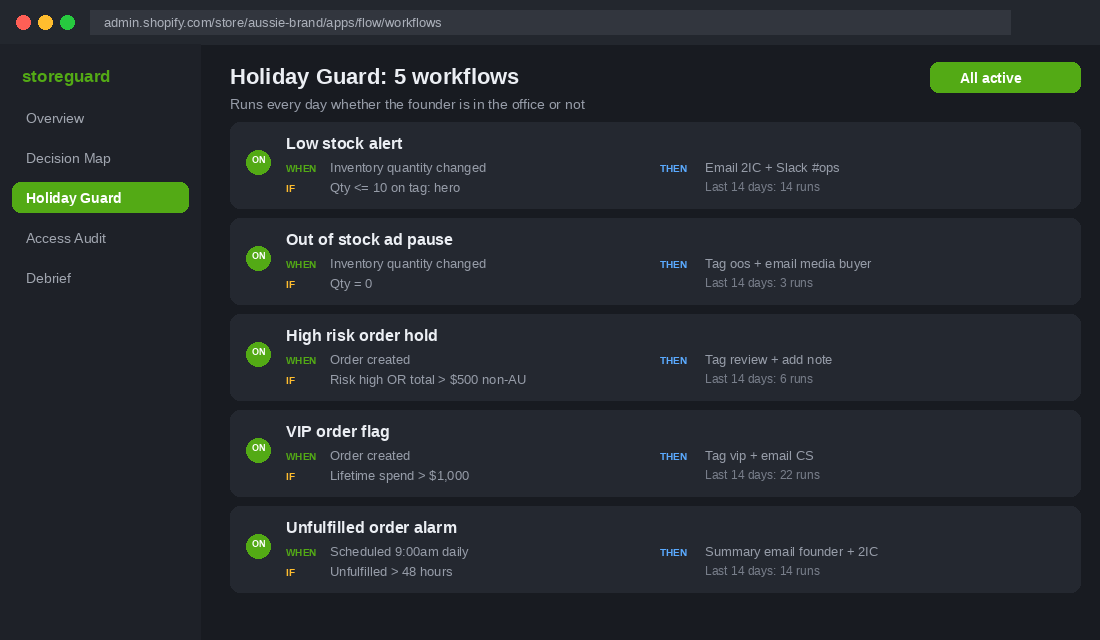
Shopify Flow is the tool for this, and it is free on every Shopify plan. Flow lets you build “when this happens, do that” workflows across orders, inventory, customers, and apps without code. Here is the five-workflow “holiday guard” we recommend building before you leave.
- Step 1: Low stock alert. Trigger: inventory quantity changed. Condition: quantity is 10 or less on any variant tagged “hero”. Action: send an email to your 2IC and post to a Slack channel. Set the threshold at roughly five days of sales for that SKU so there is time to act.
- Step 2: Out-of-stock ad pause. Trigger: inventory quantity changed. Condition: quantity equals zero. Action: add the product tag “oos” and email your media buyer. Any ad or Klaviyo flow featuring that product gets checked the same day instead of running for a week to a sold-out page.
- Step 3: High-risk order hold. Trigger: order created. Condition: order risk level is high, or order total is above $500 and shipping country is not Australia. Action: add the tag “review”, and add a note. Your fulfilment person knows not to ship anything tagged “review” until it is cleared.
- Step 4: VIP order flag. Trigger: order created. Condition: customer lifetime spend above $1,000. Action: tag “vip” and email your customer service owner. These are the customers whose problems must be handled well, and fast, whether you are in the office or not.
- Step 5: Unfulfilled order alarm. Trigger: scheduled time, daily at 9am. Action: get order data where fulfilment status is unfulfilled and created more than 48 hours ago; if any exist, send a summary email to you and your 2IC. This one workflow is worth the whole setup. It is the difference between finding a stuck batch on day two and finding it on day fourteen.
To build any of these: open Shopify admin, go to Apps, install Shopify Flow if it is not already there, click Create workflow, choose the trigger, add the condition, add the action, then click Turn on workflow. Test each one by placing a test order or adjusting a quantity manually. Budget two to three hours for all five.
Layer the customer-facing automations on top. In Shopify Inbox or Gorgias, set an away message that states the response window honestly (“we reply within one business day”) and answers the top three questions inline: where is my order, what is your returns policy, and when do you ship. Our support deflection playbook goes deeper, but the two-week version is simple: if the same question arrived more than five times last month, the answer belongs in the auto-reply.
Step 4: Run the Pre-Flight Week (Access, Money, Marketing, Comms)
The week before you leave has one job: remove yourself as a single point of failure. Work through these four areas in order. Each one takes an hour or two, and skipping any of them is how a holiday gets cancelled on day three.
Access. Make a list of every system the business touches: Shopify, Klaviyo, Meta Ads, Google Ads, your 3PL portal, Australia Post or Sendle, your bank, Xero, your domain registrar, and your email host. For each, confirm at least one other person can log in and act. Use Shopify staff accounts with limited permissions rather than sharing your owner login, and give your 2IC “Orders”, “Customers”, and “Products” access but not “Settings” or “Billing”. Move shared logins into a password manager like 1Password with a shared vault. The test is simple: could someone reset a broken Klaviyo flow or pause a Meta campaign at 7am Tuesday without texting you? If the answer for any system is no, fix it this week.
Money. Pre-schedule every bill that falls due in the window, plus a five-day buffer either side. Check the balance covers payroll, super, your Shopify bill, ad spend at the current daily rate for 16 days, and any supplier deposit due. Set a low-balance alert on your business account. If you run ads on a card, make sure it is not expiring and has headroom; a declined ad payment mid-holiday stops every campaign and takes days to fully recover. The AMP Bank GO survey found 70% of owners worry about cash flow. On holiday, that worry becomes a nightly habit unless you have already done this step and can see the numbers from your phone without touching anything.
Marketing. Do not launch anything new in the window. No new product, no new campaign structure, no site redesign going live “while it is quiet”. Schedule the campaign emails for the fortnight in Klaviyo before you leave, using content that does not depend on stock levels you cannot see. Set Meta and Google campaigns to their best-known stable configuration and tell your media buyer the rule from Step 2: reduce or pause is always allowed, increases above 20% are not. If you have a stock-dependent flow (back in stock, low stock urgency), check the Flow workflows from Step 3 are live so a sold-out product does not keep getting promoted.
Comms. Write three messages before you go. One for customers (the delay banner and order confirmation wording if you are slowing dispatch). One for suppliers and your 3PL (“I am away from the 8th to the 22nd; Sarah has full authority on orders and can be reached at…”). One for your team, which is the decision map from Step 2 plus one line: “If it is not on this page and it cannot wait, call Sarah. If Sarah says call me, call me.” Send the supplier message a full week early. Supplier surprises are the ones that turn into real emergencies.
Finally, set your own rules. Pick one 20-minute window every second or third day when you will look at a single dashboard, and put it in your calendar. Outside that window, the store does not exist. A founder who checks email “just quickly” 30 times a day is not on holiday and is also not useful to the business, because they are making half-informed calls from a beach instead of letting the process run.
Step 5: Come Back Properly and Mine the Fortnight for Fixes
How you return matters as much as how you leave. Two rules. First, block the first day back with no meetings and no email replies. Read everything, reply to nothing. Second, run a 45-minute debrief with whoever held the fort, in that first week, before the details fade.
The debrief has four questions, and the answers are your next quarter’s operations roadmap.
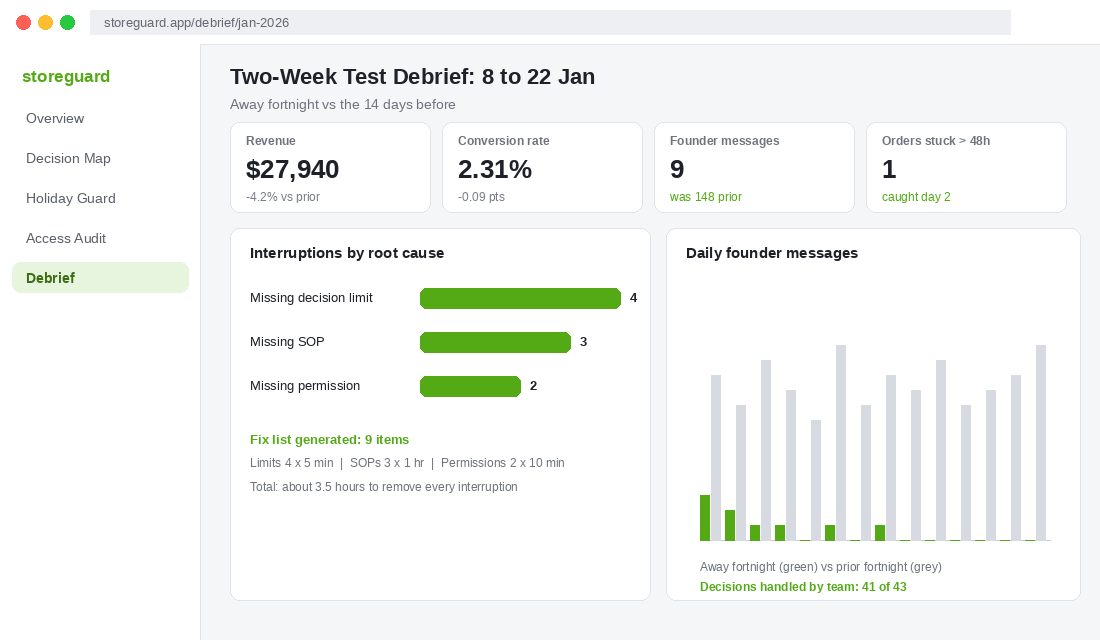
- What did you have to ask me about? Every message that reached you on holiday is either a missing decision limit, a missing SOP, or a missing permission. Write each one down and tag it with which of the three it was. Then fix the limits (five minutes each), write the SOPs (an hour each), and grant the permissions (ten minutes each).
- What did you decide without me, and what would I have done differently? This is where you learn whether your decision limits are set right. If your CS person approved 14 refunds and you would have approved 13 of them, the limit is correct. If you would have refused half, the limit needs a tighter rule, not a lower dollar figure.
- What broke that nobody noticed for more than a day? A stuck order batch, an email flow that stopped sending, a product that went out of stock while ads ran. Each of these becomes a Shopify Flow workflow or a line on the daily checklist.
- What did the numbers do? Pull revenue, conversion rate, ad spend, and ticket volume for the two weeks and compare to the two weeks before. If revenue dropped more than your dispatch delay would explain, find out why. If it held, you have just proven your store can run without you, and that number belongs in the story you tell a future buyer or investor.
Then book the next one. Founders who take two weeks off once a year and never repeat it drift back into being the bottleneck within about 90 days. Founders who book it every six months keep the pressure on their systems and their team to stay independent. The key person departure playbook is worth reading here for a related reason: everything that makes a holiday survivable also makes a resignation survivable.
The Four Ways Founders Wreck Their Own Holiday
We see the same mistakes every January and every July. Avoid these and you are ahead of most of the market.
- Going during your own peak. If you sell swimwear, do not leave in December. If you sell heaters, do not leave in June. Pick the quietest fortnight in your own sales calendar, not the one that suits the airline sale. For most Aussie DTC brands that is late January or early February, or mid-year outside EOFY.
- Handing over on the last day. A 40-minute handover in the car park is not a handover. Your stand-in needs a full week running things while you are still around to answer questions. Treat the week before you leave as their first week, not your last.
- Announcing it to nobody. Customers, suppliers, and your agency all cope fine with a founder being away. They do not cope with finding out by accident. Tell them early, tell them the dates, and tell them who is in charge.
- Checking in constantly. The team stops making decisions the moment they know you are watching. If you reply to a Slack message in four minutes from Fiji, you have just told them the decision map does not apply. Hold the line for the first three days and the messages stop coming.
The Compound Effect: A Holiday Is a Cheaper Audit Than a Consultant
Put the five steps together and something bigger than a holiday happens. The decision map from Step 2 becomes the permanent authority structure for your team. The Flow workflows from Step 3 keep running all year, catching stuck orders and sold-out ads every single day. The access audit from Step 4 is the same one you will need for a due diligence process, a new hire, or a bad week when you are sick. The debrief from Step 5 produces a prioritised fix list written by real events.
Consider a $1.5 million a year store where the founder currently touches every refund over $50, every ad budget change, and every supplier email. Running the two-week test typically surfaces 15 to 25 decisions that can be pushed down with a limit, three to five automations that remove daily manual checks, and one or two access gaps that were quietly a business risk. Founders in that position tell us they get back five to eight hours a week permanently. At 48 weeks, that is 240 to 380 hours a year returned to the work only the founder can do: product, brand, and strategy. It also produces a business a buyer will pay more for, because “runs without the founder” is worth real money in a sale.
And you got a fortnight off. That part is not a bonus. That part is the point.
Your Two-Weeks-Off Checklist
Copy this into your project tool and start four weeks out.
- Four weeks out: pick the quietest fortnight in your sales calendar; decide keep selling, slow dispatch, or pause; write down last dispatch date, first dispatch date back, and your return date.
- Three weeks out: build the decision map (every decision from the last 30 days, one owner, one limit); tell suppliers, 3PL, and agency the dates and the stand-in’s name.
- Two weeks out: build the five Shopify Flow holiday guard workflows; set up Inbox or Gorgias away message with the top three answers inline; schedule Klaviyo campaigns for the window.
- One week out: run the access audit across every system; pre-schedule bills and check cash cover for 16 days plus buffer; let your stand-in run the week while you shadow.
- Day before: publish the customer delay banner and confirmation wording if slowing dispatch; send the team the one-page decision map; set your own check-in window in the calendar.
- While away: one 20-minute dashboard check every two to three days; no replies unless your stand-in calls.
- First week back: day one read-only; 45-minute debrief with the four questions; convert every interruption into a limit, SOP, or permission; book the next fortnight.
Inside eCommerce Circle, building a store that runs without the founder is one of the core pillars we work on with every member. If you want a second opinion on whether yours would survive two weeks without you, let’s talk.