Somewhere in your Meta comments this month, a stranger has typed the seven words every Aussie founder has learned to dread: “You can get this on Temu for $9.”
What’s in This Article
Most brands react in one of two bad ways. They either drop price to close the gap, which torches the margin that pays for their ads, their team and their stock. Or they ignore it and hope their customers are “not Temu people”, which stopped being true a while ago.
The numbers say so. Roy Morgan’s March 2026 shopper data puts Temu at 5 million Australian shoppers in 2025, up 700,000 in a year, with Shein at 2.9 million and growing 28%. Between them and Amazon, that is close to $12 billion of Australian retail sales that used to be spread across a lot of other tills, some of them yours.
The brands that keep selling at full price while this happens are not lucky and they are not cheaper. They have built five specific moats that a $9 listing cannot cross. This is the system we work through with hundreds of Aussie Shopify founders, and it starts with a mindset shift most founders resist.
The Reference Price Reset: What Temu Actually Did to Your Customer
Temu did not steal your customers. It changed what “normal” costs in their heads. Roy Morgan’s Head of Retail Research, Catherine Jolley, put it bluntly in the same report: “The ‘middle’ of the market is rapidly eroding.” Her advice to retailers was to compete decisively on value or differentiate clearly through experience, brand, quality or exclusivity. There is no third door.
That is the whole game in one sentence. If your $49 candle is, in the customer’s mind, the same thing as the $7 candle with the same photo, you are in the middle and you will lose. If it is a different thing, the $7 candle is irrelevant.
Here is the uncomfortable part. Pattern’s 2026 marketplace report found 47% of Australians had bought from Temu in the past year. That is not a fringe of bargain hunters. That is your email list. Your job is not to avoid Temu shoppers. It is to make sure that when they shop your category, they do not see your product as interchangeable.
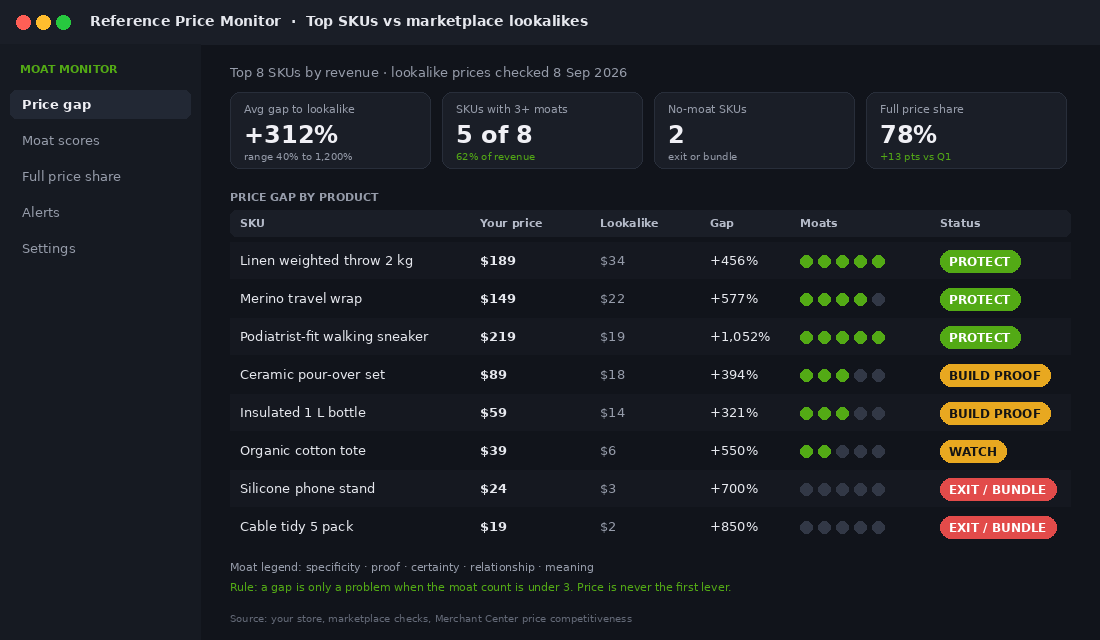
Start by mapping the gap without flinching. Pull your top 20 SKUs by revenue, search each one on Temu and Shein, and record the closest lookalike price. You will find three kinds of product: ones with no real equivalent (protect these, they are your future), ones where the lookalike is 50 to 80% cheaper (these need a moat, fast), and ones where the lookalike is basically identical and the gap is enormous (these are candidates for the exit, which we cover later).
Use the competitor analysis playbook for the wider teardown. For this exercise you only need one column: what does the customer think they are comparing you to?
Moat 1: Specificity (Build for a Person, Not a Category)
Temu wins on categories. It cannot win on people. A search for “yoga mat” returns 4,000 listings at $12. A search for “a mat for a 6 foot 3 bloke with bad knees who practises on floorboards in a Queenslander” returns nothing, because no factory in Guangdong is optimising for him.
Specificity is the cheapest moat you have because it costs research, not capital. The brands that survive the reference price reset have a painfully clear answer to “who is this for and why would a generic version fail them?” Bared Footwear built a national business on shoes designed by a podiatrist for people whose feet hurt in normal shoes. A Temu shoe at $19 is not a competitor to a customer with plantar fasciitis. It is a different product for a different problem.
Run this test on each of your top products:
- Name the person. Not “women 25 to 45”. A real situation: the person, the problem, the moment they realise the cheap version let them down.
- Name the failure mode. What specifically goes wrong with the generic version? Straps that stretch, colours that run, a battery that dies in a month. If you cannot name it, you have not earned the premium.
- Put both on the product page. Your PDP should read like it was written by someone who has seen the cheap version fail, because that is who your buyer is about to become.
- Design toward it. Every next product decision should make the product more right for that person and less right for everyone else. That is the opposite of what a marketplace listing does.
A useful benchmark: if a stranger can read your product title and hero image and not be able to tell you from the Temu listing, you have a specificity problem, not a pricing problem.
Moat 2: Proof (Turn the Trust Gap Into Revenue)
Temu’s biggest weakness is measurable. Pattern’s report found that in 2025 only 12% of Australians said they trusted Temu and 11% trusted Shein. Roy Morgan’s Risk Monitor named Temu the most distrusted online retailer in the country. CHOICE found that 80% of Temu shoppers were satisfied with what they bought, which sounds contradictory until you realise people were satisfied with a $7 purchase in the way you are satisfied with a $7 purchase: low stakes, low expectations.
That trust gap is worth money only if you fill it with proof. “Premium quality” in your hero copy fills nothing. These do:
- Warranty with a number attached. Bellroy’s three year warranty is not customer service, it is a pricing tool. A warranty says the maker expects the product to last, and Temu’s 90 day return window says the opposite. The warranty playbook covers how to structure one without creating a liability problem.
- Reviews that mention time. Set your review request (Okendo, Judge.me or Loox) to ask one extra question: “How long have you owned this?” A review that says “still perfect after 14 months” is the exact sentence a Temu listing can never show.
- Safety and compliance made visible. European consumer group testing reported by CHOICE found 65% of Temu products and 73% of Shein products failed EU safety standards. If you sell anything for kids, skin, food contact or electrical use, your compliance certificates belong on the product page, not in a drawer.
- Founder on camera with the product being used hard. Not a studio shot. A 40 second clip of you dropping it, washing it, wearing it for the 200th time.
Track one metric: the percentage of your reviews that reference durability, fit for purpose or longevity. Under 20% means you are collecting star ratings, not proof. Over 40% means your review widget is doing the job your ads cannot.
Moat 3: Certainty (The Delivery Promise Temu Cannot Make)
Temu has got faster. Since the Local Seller Program launched in Australia in March 2025 and fulfilment partners came online in Sydney and Melbourne, locally stocked items arrive in 4 to 6 days. But most of the catalogue still ships from China on an 8 to 20 day standard window, and the tracking is a guess.
Australia Post’s 2026 eCommerce Report gives you the opening. Among Baby Boomers, 87% chose delivery certainty over delivery speed, and among the Builders generation it was 90%. Those two cohorts are the fastest growing online spenders in the country, up 14.8% and 16.9% year on year, with the biggest baskets. They are not choosing the $9 option. They are choosing the option that turns up when it said it would.
Certainty is built from four things, and none of them are speed:
- A dated promise on the product page. “Arrives Thursday 18 September” beats “3 to 5 business days” every time. The delivery promise playbook walks through the setup.
- Local stock, said out loud. “Ships from our Melbourne warehouse today” is a sentence with real commercial weight in 2026. Put it under the add to cart button.
- Returns under Australian Consumer Law, explained in plain English. A Temu return means posting a parcel back to a facility overseas at your own cost. Your return is a prepaid label and a refund in 3 days. Say so.
- A human who answers. Chat hours, a phone number, a named person in the order emails. Trust is built in the boring moments after the sale.
Moat 4: Relationship (Community Is the Only Thing They Cannot Copy)
A factory can copy your product in six weeks. It cannot copy the 95,000 people in LSKD’s community group, or the customers who have been posting #thefrankeffect selfies for Frank Body since 2014. Relationship is the slowest moat to build and the only one that gets stronger when a competitor undercuts you.
It works because it changes the question the customer is asking. A marketplace shopper asks “what is the cheapest version of this?” A community member asks “what did the brand I belong to just release?” Nobody in a running club is price checking their club singlet on Temu.
You do not need 95,000 people. You need a few hundred who feel seen. The moves that build it fastest:
- Post-purchase invitation, not a discount. Email two after the first order should invite them somewhere (a group, a challenge, an early access list), not offer 10% off the next thing.
- Founder visibility on a schedule. One honest founder post a week, in your own voice, about the actual business. Supplier dramas, what you got wrong, what is coming. People buy from people they feel they know.
- Customer content as the main content. Repost customers more than you post products. The proof moat and the relationship moat feed each other here.
- A reason to come back that is not a sale. Drops, restocks, member previews, a monthly live. Retention driven by novelty and belonging survives a price war. Retention driven by discounts does not.
Measure it with one number: repeat purchase rate among customers who joined your community versus those who did not. In the brands we coach, community members typically repeat at 1.5 to 2 times the rate of non-members. That gap is your Temu insurance policy.
Moat 5: Meaning (Give Them a Reason That Is Not the Product)
Some customers will pay more for what a purchase says about them, and that is not shallow, it is human. Who Gives A Crap sells toilet paper, arguably the most commoditised product on earth, at a premium, because half the profit goes to sanitation projects and the customer knows it. There is no Temu version of that feeling.
Meaning does not have to be charity. It can be Australian made (worth more in 2026 than it has been in years, and the Australian made playbook shows how to claim it lawfully), a repair program, a founder story rooted in a real problem, or a stance on how the product is made. What matters is that it is true and specific. Vague “sustainability” copy is now a red flag to the same customers who used to reward it.
The test: could a customer explain to a mate, in one sentence, why they paid three times the Temu price without feeling silly? If the answer is “because it is better quality”, you are back on Moat 2. If it is “because of who makes it and why”, you have Moat 5.
The Products You Should Stop Defending
Now the hard conversation. Some of your SKUs have no moat and never will. Generic accessories, unbranded consumables, anything you buy from the same supplier catalogue the Temu sellers use. The reference price reset has permanently repriced those products, and every dollar you spend advertising them is a dollar spent teaching customers to compare you to Temu.
You have three honest options for a no-moat SKU:
- Bundle it into a moat product. The $12 accessory becomes a free inclusion with the $180 hero, where it adds perceived value instead of inviting comparison.
- Reposition it as a service. Same product, but with a fit guide, a replacement guarantee and next-day dispatch. Sometimes the moat is around the product, not in it.
- Sell it where the shoppers already are. Temu’s Local Seller Program is open to Australian businesses, and some are using it as a volume channel. Your Discount Chemist, a 13 store NSW pharmacy group, recorded more than 4,800 orders in its first eight months and now counts Temu among its top three online channels. That is a channel decision, not a surrender, as long as you keep your moat products off it.
Whatever you choose, take no-moat SKUs out of your prospecting ads immediately. Advertise the products that make the Temu comparison look absurd, and let the rest ride along in the cart.
Dupes, Copycats and the Listing That Uses Your Photos
If you are growing, you will eventually find your own product photography on a Temu listing at a fifth of your price. It has happened to designers, skincare brands and homewares labels across Australia, and it feels personal. It is not. It is a signal that you have built something worth copying, which is the best problem in this article.
Three things to do the same week you find one:
- File the takedown properly. Temu’s IP portal and Shein’s both accept trademark and copyright claims, and Temu’s vetting for local sellers is reported to be strict. Registered marks and dated original photography make claims fast. The brand protection playbook has the full process.
- Talk about it publicly. A founder video showing the original next to the copy, with the failure points, is the highest converting content most brands will ever make. It proves specificity, proof and meaning in one clip.
- Do not chase every one. Budget a fixed number of hours a month for enforcement. Spend the rest making the next thing they have not copied yet.
Regulators are moving too. The European Commission fined Temu 200 million euros under the Digital Services Act in 2026, and the ACCC has flagged dangerous goods on Temu and Shein as a priority. That pressure lifts the floor for compliant local brands. Make sure you are standing on it.
The Free Tool: Google Merchant Center Price Competitiveness
You cannot manage a price gap you have never measured, and the most useful benchmarking tool for this is one most founders already have and never open. Google Merchant Center’s price competitiveness report shows, for every product in your feed, how your price compares with what other advertisers (including the marketplaces) are charging for the same or matched products in Google Shopping.
Five steps to set it up and use it properly:
- Open Merchant Center and go to Analytics, then Price competitiveness. If it is empty, confirm your product feed has GTINs on every product where one exists. Without GTINs Google cannot match your items to competitors’ listings, and the report stays blank.
- Turn on market insights. In Settings, under Add-ons or Growth depending on your account version, enable the price competitiveness and best sellers reports. Data appears within a few days.
- Filter to your top 20 SKUs by revenue. Export the benchmark price for each. This is the same list you built in the Reference Price Reset section, now with Google’s view of the market added.
- Tag each SKU with its moat count. A product priced 60% above benchmark with four moats is fine. A product priced 60% above benchmark with zero moats is your next bundling or exit decision.
- Review monthly, not daily. Set a first Monday calendar block. The report is for strategy, not for reacting to every price move on a marketplace.
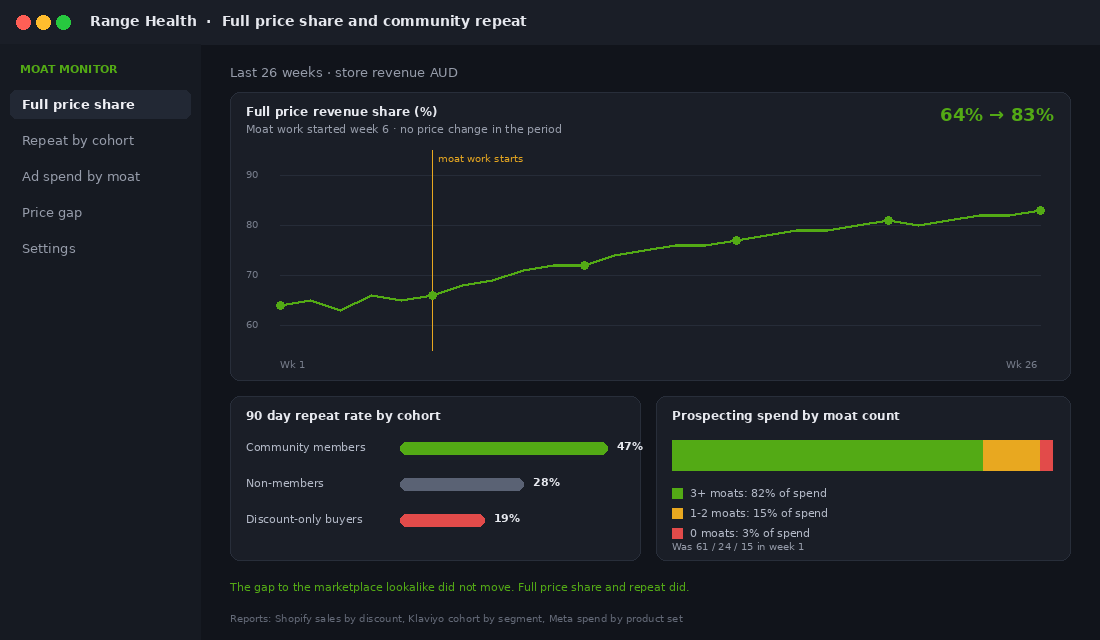
Pair it with a simple Shopify report: revenue sold at full price as a percentage of total revenue. That single number tells you whether your moats are working better than any ROAS figure will.
Four Mistakes That Put You Back in the Middle
- Matching on price “just for the sale”. A 40% off sale on a product that has a Temu lookalike is the moment you confirm to every customer that your normal price was inflated. The gap does not close. Your margin does.
- Copying the marketplace playbook. Countdown timers, fake scarcity, spinning wheels. These signal “cheap” to the exact customer you want, and they are increasingly a consumer law problem in Australia.
- Talking about Temu in your marketing. Never name them in an ad. You are introducing the comparison to people who had not made it. Show the failure mode of “cheap versions” without a logo.
- Assuming quality is self-evident. The customer cannot feel the fabric through a screen. Quality that is not converted into proof (warranty, durability reviews, testing, founder demonstration) does not exist commercially.
The Compound Effect: What Five Moats Do to a Two Million Dollar Store
Take a store doing $2 million a year, roughly 20,000 orders at a $100 AOV, with a 30% contribution margin and 35% of revenue currently sold on some kind of discount.
Building the five moats over two quarters typically moves three numbers. Full price share lifts from 65% to around 80%, because the moat products no longer need promotions to convert. On $2 million, that is roughly $300,000 of revenue that was discounted at an average 25% and now is not, worth about $75,000 in recovered margin.
Repeat purchase rate among community members runs at 1.5 to 2 times non-members. If you move 20% of your customer base into a community and they repeat at 1.7 times the base rate of 28%, that is roughly 1,100 extra orders a year, about $110,000 in revenue at near zero acquisition cost.
Then subtract the no-moat SKUs from your ad spend. Most stores find 15 to 25% of prospecting budget was going to products that could never win the comparison. On a $30,000 monthly ad budget, that is $4,500 to $7,500 a month redirected to products that convert at full price, which usually lifts blended MER by 0.3 to 0.5.
None of those moves touched your price. The Temu listing is still $9. It just stopped being relevant to your customer.
The Temu-Proof Checklist: 10 Things to Do This Month
- Search your top 20 SKUs on Temu and Shein and record the closest lookalike price.
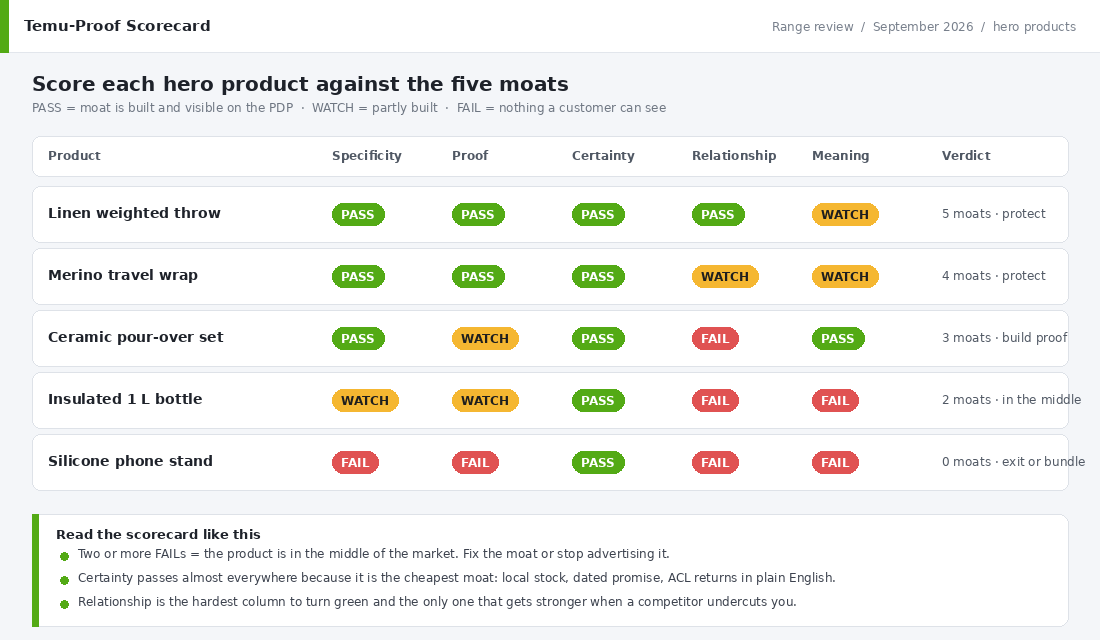
- Score every hero product against the five moats: specificity, proof, certainty, relationship, meaning.
- Rewrite one hero PDP so it names the person and the failure mode of the cheap version.
- Add an ownership duration question to your review request flow.
- Put a dated delivery promise and “ships from Australia” under every add to cart button.
- Publish your warranty with a number in it, and put it on the product page.
- Replace the discount in post-purchase email two with an invitation into your community.
- Record one founder video showing the product being used hard.
- Remove every no-moat SKU from prospecting campaigns and decide: bundle, reposition or marketplace.
- Switch on Merchant Center price competitiveness and book a first Monday review.
Temu and Shein are not going away, and the Aussie founders who thrive alongside them will be the ones who stopped trying to be a cheaper version of a marketplace and became a better version of themselves. That is a positioning job before it is a pricing job.
Inside eCommerce Circle, building moats that hold at full price is one of the core pillars we work on with every member. If you want a second opinion on where your range sits, let’s talk.