Most Shopify founders handle competitor analysis in one of two broken ways. The first group checks their rivals’ Instagram every morning, panics every time a competitor drops a sale, and ends up running a store that looks like a photocopy of three other stores. The second group proudly says “we don’t worry about competitors” and then wonders why their conversion rate is stuck while a rival with a worse product grows past them.
What’s in This Article
Here is the uncomfortable truth: your customers are doing competitor analysis on you every single day. Shopify’s holiday retail survey of 18,000 consumers found that 83% of shoppers compare prices before making a purchase. They have your product open in one tab and your competitor’s in the next. The only question is whether you understand that comparison better than they do.
This playbook gives you the 5-part system we work through with eCommerce Circle members: map your real competitive set, deconstruct their offers, reverse-engineer their marketing, mine their reviews for gaps, and turn all of it into a positioning decision instead of a copy list. Done properly, it takes about 90 minutes a quarter. Done poorly, it costs you orders every day.
Part 1: Map Your Real Competitive Set (It Is Not Who You Think)
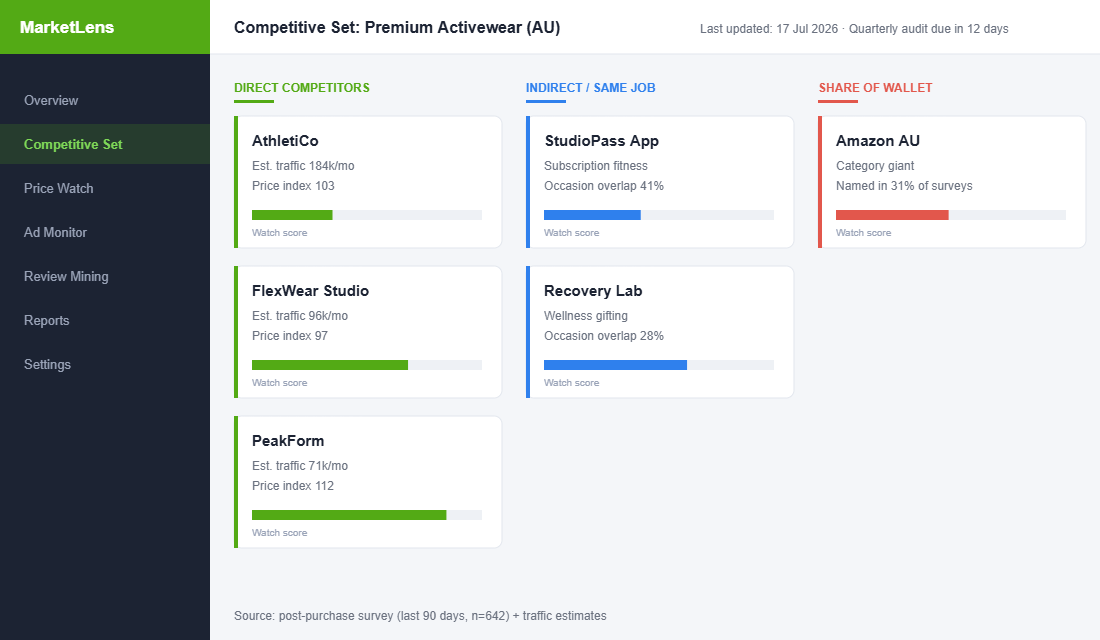
Ask a founder who their competitors are and they will usually name the two or three brands they personally watch. Ask their customers the same question and you get a completely different list. That gap is where orders quietly leak away.
Your real competitive set has three layers, and you need all three mapped before any other analysis makes sense:
- Direct competitors. Brands selling a similar product to a similar customer at a similar price. If you sell premium activewear, this is the other premium activewear labels shipping to Australian postcodes.
- Indirect competitors. Different product, same job. A customer buying a $120 candle gift set is also considering a $120 bottle of wine and a $120 restaurant voucher. You are competing for the occasion, not just the category.
- Share-of-wallet competitors. With Australians spending $82.6 billion online in 2025 (up 14% year on year, according to Australia Post’s eCommerce Report), the fight is often for a fixed monthly budget. Kmart, Amazon AU and Temu sit in this layer for almost every category, whether you like it or not.
The fastest way to build this map is not guesswork. Add one question to your post-purchase survey: “What other brands or options did you consider before buying from us?” Run it for 30 days and you will have a customer-verified competitive set. We covered the full survey setup in our customer research playbook, and it pairs perfectly with this one.
Keep the working list tight: three direct, two indirect, one share-of-wallet giant. Six brands is enough to see the whole board without drowning in tabs.
Part 2: Deconstruct Their Offer and Price Position
Once the set is mapped, the first thing to deconstruct is the offer. Not just the sticker price: the whole value equation a shopper sees in the 15 seconds before they choose a tab to close.
For each of your six competitors, capture five data points in a simple spreadsheet:
- Hero product price and the price of the closest equivalent to your bestseller.
- Shipping offer. Free shipping threshold, express options, and delivery promise to Sydney, Melbourne and regional postcodes.
- Guarantee and returns. Trial periods, free returns, exchange-first policies.
- Bundle and subscription structure. How they package their way to a higher average order value.
- First-order incentive. The discount or gift a new visitor is offered inside the first minute on site.
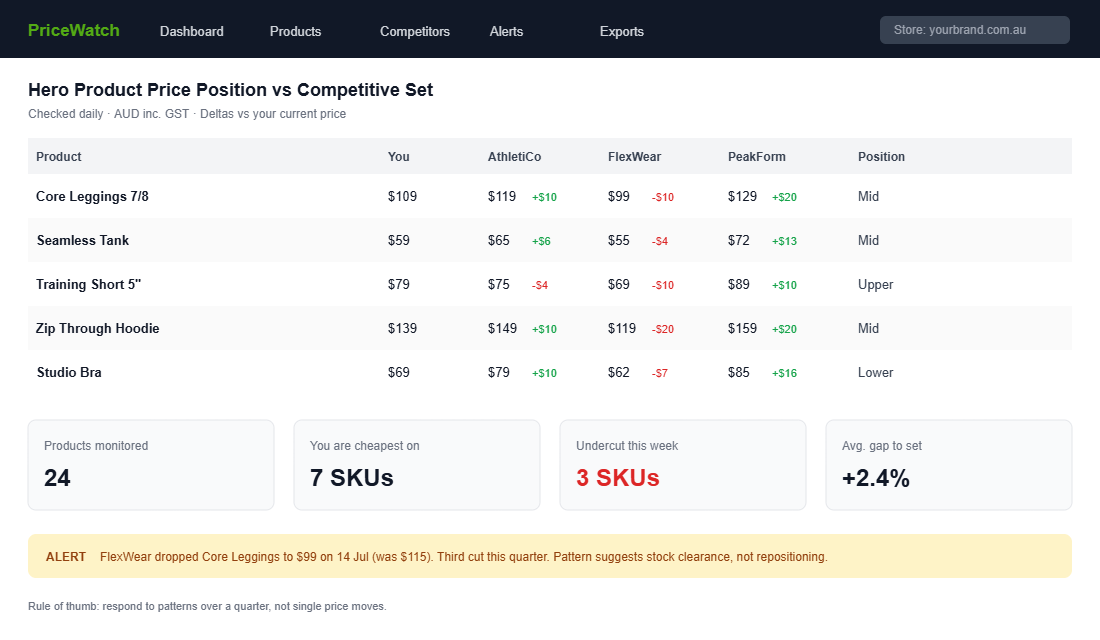
Why does this matter so much? Because on anything resembling a commodity, shoppers are ruthless. Research from the e-tailing group found that 94% of online shoppers invest time hunting the lowest price on commodity products. If your product reads as interchangeable, you are in a price war whether you signed up for one or not. The entire point of this exercise is to find the dimensions where you can win without touching price.
Melbourne luggage brand July is a masterclass here. They entered a market owned by Samsonite and global DTC players, and instead of undercutting, they deconstructed the category offer and out-positioned it: free personalisation on every case, a lifetime warranty, and a 100-day trial. Same category, completely different value equation. That is what offer analysis is for.
Businesses are investing heavily in exactly this discipline: the competitor price monitoring market was valued at USD $2.8 billion in 2025 and is forecast to reach $7.4 billion by 2033. Big retail already treats price position as a live data feed. As a DTC founder you do not need enterprise software, but you do need the habit. If you are considering moving your own prices in response, run it through the process in our price testing playbook first rather than reacting on gut feel.
Part 3: Reverse-Engineer Their Marketing Engine
Everything a competitor does in paid and owned media is public. Most founders just never look systematically. Three moves give you 90% of the picture.
Move 1: Audit their ads in Meta Ad Library (free, 15 minutes)
Meta Ad Library shows every active ad a brand is running on Facebook and Instagram. Here is the exact setup:
- Go to facebook.com/ads/library and set the country to Australia.
- Search the competitor’s brand name and open their page results.
- Filter to active ads, then sort by “started running” date. Ads that have run for 60 to 90 days or more are almost certainly profitable. New ads are tests.
- Screenshot the three longest-running creatives and write down the angle each one leads with (price, social proof, problem, founder story).
- Repeat quarterly and note what changed. Angles that survive are angles that convert.
Move 2: Subscribe to their email and SMS with a dedicated inbox
Set up a free Gmail account purely for competitor subscriptions. Join every list in your set, abandon a cart with each of them, and let the flows arrive. Within three weeks you will know their welcome offer, their discount cadence, their abandonment sequence and how aggressively they mark down. Label each sender in Gmail and the whole archive becomes a searchable swipe file.
Move 3: Find their content gaps
Run your domain and two competitor domains through the content gap tool in Ahrefs or Semrush. The report lists keywords they rank for and you do not. Ignore vanity keywords and pull out the buying-intent terms (“best [category] australia”, “[competitor] alternative”, “[category] review”). That short list is next quarter’s content calendar, already validated by someone else’s traffic.
Part 4: Mine Their Reviews for the Gaps They Leave Open
Competitor reviews are the cheapest market research in ecommerce, and almost nobody reads them properly. Your rivals have spent years and serious ad budget acquiring customers who are now telling the internet, in their own words, exactly where the product and experience fall short. That is a gift.
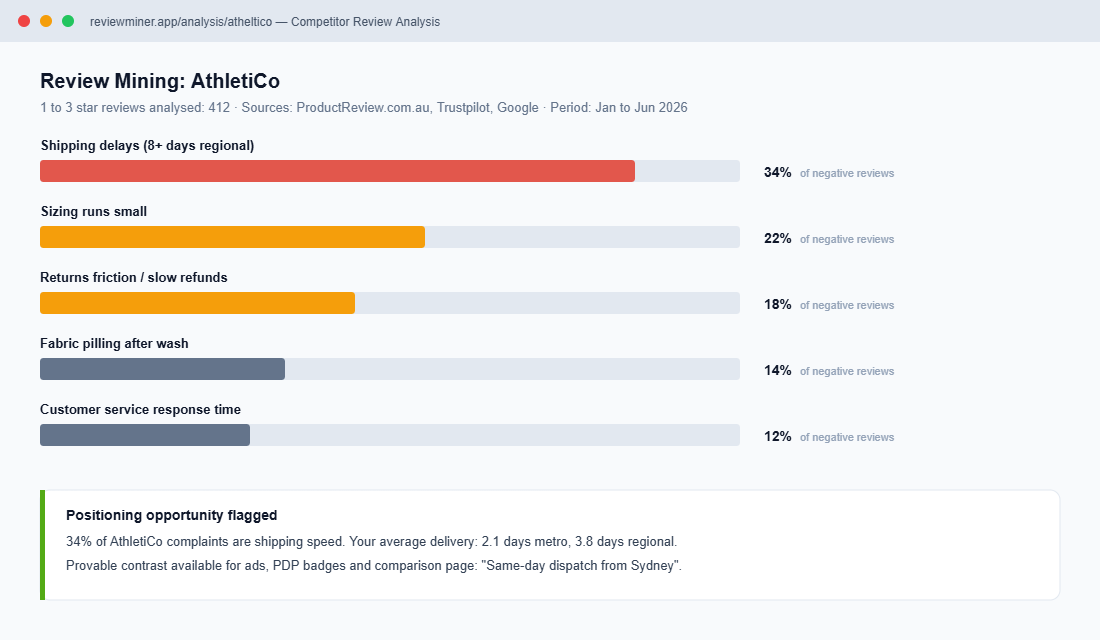
The process is simple and takes about 30 minutes per competitor:
- Pull up their reviews on ProductReview.com.au, Trustpilot, Google and their own product pages.
- Read the 1, 2 and 3 star reviews only. Five star reviews tell you what to match; low star reviews tell you where to attack.
- Tag every complaint into a theme: shipping speed, sizing, quality, customer service, returns friction, product gaps.
- Count the themes. Anything appearing in more than 15% of negative reviews is a structural weakness, not a one-off.
- Check your own reviews for the same theme. If they are weak where you are strong, that contrast belongs in your ads, your product page and your comparison content.
This is how the best positioning in Australian DTC actually gets built. Koala did not invent a new mattress; they studied everything shoppers hated about traditional mattress retail (pushy showrooms, slow delivery, no-risk-free trial) and built the opposite: fast metro delivery, a 120-night trial and simple returns. Who Gives A Crap took a commodity where 94% of shoppers would happily price-hunt and made price comparison irrelevant with brand, mission and subscription convenience. Both brands won on gaps their competitors left open, not on being cheaper.
One warning: mine reviews for positioning, not for panic. The goal is a shortlist of two or three provable contrasts (“they average 8-day delivery, we ship same day from Sydney”), not a 40-row spreadsheet of everything anyone ever complained about.
Part 5: Turn Intel Into a Positioning Decision, Not a Copy List
This is where most competitor analysis dies. The founder ends up with a pile of screenshots, feels vaguely anxious, and copies whatever the biggest competitor did last. Copying is the one move guaranteed to lose, because the brand you copied has more data, more budget and a head start.
Instead, run every finding through a three-option filter:
- Match it. Table-stakes features you cannot be without. If every serious competitor offers free returns and you do not, that gap is costing you conversions every day. Match and move on.
- Beat it. The one or two dimensions where you can be meaningfully, provably better: delivery speed, guarantee length, personalisation, local manufacturing, service. Concentrate your resources here and say it loudly everywhere.
- Ignore it. Everything else. Their rebrand, their podcast tour, their fourth colourway. If it does not touch why your customers buy from you, it is noise.
Context for that filter: the average ecommerce store converts at roughly 1.9 to 2% globally, while stores above 3.2% are outperforming most of the market (Triple Whale’s 2025 benchmarks). The distance between those numbers is rarely one big feature. It is a stack of small, deliberate positioning wins: a sharper hero promise, a stronger guarantee, comparison content that answers the exact question a shopper has open in the next tab. Your product page is where most of those wins get banked.
The Competitor Analysis Tool Stack (From Free to Serious)
You can run this entire playbook with a spreadsheet and free tools. As you scale past roughly $100k a month, some paid tooling starts paying for itself. Here is the stack we see working for Aussie Shopify brands:
- Meta Ad Library (free). Your paid social intel source. Follow the five-step process from Part 3 and revisit quarterly.
- Google Alerts (free). Set an alert for each competitor’s brand name plus terms like “review”, “launch” and “sale”. Five minutes to set up: go to google.com.au/alerts, enter the query, set region to Australia, frequency to weekly digest, and deliver to your competitor inbox so everything lives in one place.
- ProductReview.com.au and Trustpilot (free). Your review mining sources. No account needed to read, and both let you filter by star rating.
- Ahrefs or Semrush (from about $199 USD a month). Content gap and keyword overlap. If the subscription stings, run the analysis in a single month, cancel, and rerun twice a year.
- Prisync or PriceShape (from about $99 USD a month). Automated competitor price monitoring. Only worth it once you have a large catalogue overlapping directly with rivals, or you are in a fast-repricing category like consumer electronics or supplements.
Start free. The discipline matters far more than the software, and a founder with a tidy spreadsheet beats a founder with an unused enterprise dashboard every time.
Five Mistakes That Turn Competitor Intel Into Anxiety
Before you run your first audit, a few traps worth naming, because we see them constantly inside the Circle:
- Checking daily instead of quarterly. Daily checking produces reactions; quarterly analysis produces decisions. If competitor watching is affecting your mood, you are doing it too often.
- Treating their sale as your emergency. A competitor discounting hard is just as likely to be clearing dead stock or covering a cash crunch as executing a strategy. Watch the pattern over a quarter before responding.
- Copying what you can see and missing what you cannot. You can see their ad creative; you cannot see their margins, their returns rate or their repeat purchase data. What looks like genius from outside is sometimes a brand quietly bleeding out.
- Benchmarking only against giants. Measuring your two-person brand against a Shopify Plus store with a 40-person team produces despair, not insight. Keep at least half your set at or near your own stage.
- Collecting intel and deciding nothing. If an audit does not end with actions in your project tool with owners and dates, it was entertainment, not analysis.
The Compound Effect: Why the System Beats the Snooping
Each part of this playbook is useful on its own. Together they compound into something much bigger than the sum of the steps.
The competitive set (Part 1) tells you where to point the telescope. The offer teardown (Part 2) shows you the value equation you are actually being compared against. The marketing audit (Part 3) reveals which angles are already proven to convert in your category. Review mining (Part 4) hands you the weaknesses nobody is defending. And the match-beat-ignore filter (Part 5) converts all of it into a small number of decisions you can actually execute this quarter.
Run once, this is a useful audit. Run every quarter, it becomes a genuine moat: you start seeing competitor price moves before they hurt you, spotting winning ad angles while they are still fresh, and publishing comparison content that captures shoppers at the exact moment 83% of them are comparing. Meanwhile your competitors are still doing what most founders do: refreshing your Instagram and guessing.
Your 90-Minute Quarterly Competitor Audit Checklist
Block 90 minutes at the start of each quarter, and work through this list. Save it as a recurring calendar event with this checklist pasted in the description:
- Minutes 0 to 10: Refresh the set. Check your post-purchase survey responses. Any new brand named more than five times joins the watch list; anyone stale drops off.
- Minutes 10 to 30: Offer scan. Update the six-competitor spreadsheet: hero prices, shipping thresholds, guarantees, first-order offers. Flag anything that moved.
- Minutes 30 to 50: Ad Library pass. Screenshot each competitor’s three longest-running ads. Note new angles and dead angles.
- Minutes 50 to 65: Inbox review. Skim the competitor inbox. Count discount emails per sender. Note any change in cadence or depth of discounting.
- Minutes 65 to 80: Review mining. Read the newest 1 to 3 star reviews per competitor. Update your theme counts.
- Minutes 80 to 90: Decide. Run findings through match, beat or ignore. Commit to a maximum of three actions for the quarter and put owners and dates on them.
Three actions a quarter does not sound like much. Twelve deliberate, intel-backed positioning moves a year is more than most of your competitors will make this decade.
Inside eCommerce Circle, competitive positioning is one of the core pillars we work on with every member, and this audit is one of the first exercises new members run. If you want a second opinion on your competitive set or your positioning, let’s talk.