If you sell perfume, reed diffusers, nail polish, dry shampoo, essential oils or anything with a lithium battery in it, there is a good chance some of your parcels are travelling illegally right now. Not because you are dodgy. Because nobody told you that half your catalogue is classed as dangerous goods, and your checkout is happily selling Express Post on products that are not allowed anywhere near a plane.
What’s in This Article
Most Aussie founders find out the hard way. A parcel gets pulled from the network, a customer in Perth waits two weeks for a candle diffuser, or a carrier account manager sends an awkward email. The brands that get this right treat dangerous goods as a system: they classify every SKU once, route it to the right network automatically, and set a delivery promise they can actually keep. They lose nothing on conversion and they sleep better through peak.
Australia Post’s current Dangerous Goods Guide took effect on 15 July 2026, and Christmas is about to push more gift sets, fragrances and gadgets through the network than any other time of year. This playbook gives you the 5-step system to get compliant before the rush, plus a checklist you can work through with your team this week.
Why This Is a Protection Problem, Not Just a Shipping Problem
It is tempting to file this under logistics and hand it to whoever packs orders. That is a mistake, because the legal responsibility for a dangerous goods consignment sits with the sender. That is you, not Australia Post and not your 3PL.
Here is what is actually at stake:
- Criminal liability. Under section 23 of the Civil Aviation Act 1988, consigning dangerous goods for carriage on an aircraft outside the rules carries a maximum penalty of 7 years’ imprisonment. There is also a strict liability offence with a 2-year maximum, which means you do not need to have known the goods were dangerous to be caught.
- Seized or destroyed stock. Australia Post states plainly that dangerous goods can only be sent within Australia and cannot be sent internationally. Aerosols lodged in regular international post are a classic example of parcels that never arrive.
- Real fire risk. Fire and Rescue NSW recorded 332 lithium-ion battery incidents in 2025, up from 323 in 2024 and 272 in 2023. Batteries that are crushed, damaged or badly packed are exactly what ends up in a sorting centre.
- Broken delivery promises. Australia Post adds an extra transit day to delivery estimates for consignments containing dangerous goods, and additional charges apply. If your checkout does not know that, your customers get a promise you cannot keep.
This is why dangerous goods belongs in the Protection pillar of the More Orders Operating System. A single misrouted SKU can create legal exposure, a chargeback, a one-star review and a nervous carrier all at once.
Step 1: Classify Every SKU Using Section 14 of the Safety Data Sheet
You cannot route what you have not classified. The good news is that the classification work has already been done by your manufacturer. It lives in Section 14 (Transport Information) of the product’s Safety Data Sheet (SDS).
Australia Post is explicit that SDS are the customer’s responsibility to source. So your first job is to email every supplier and request the current SDS for each formulation. Then pull four fields into a spreadsheet for every SKU:
- UN number (for example UN1266 for perfumery products, UN1950 for aerosols, UN3481 for lithium ion batteries contained in equipment)
- Class or Division (Class 3 flammable liquids, Division 2.1 flammable gases, Class 9 miscellaneous)
- Packing Group (I, II or III, where I is the most hazardous)
- Net quantity per unit in mL or grams, plus the watt-hour rating for any lithium ion battery
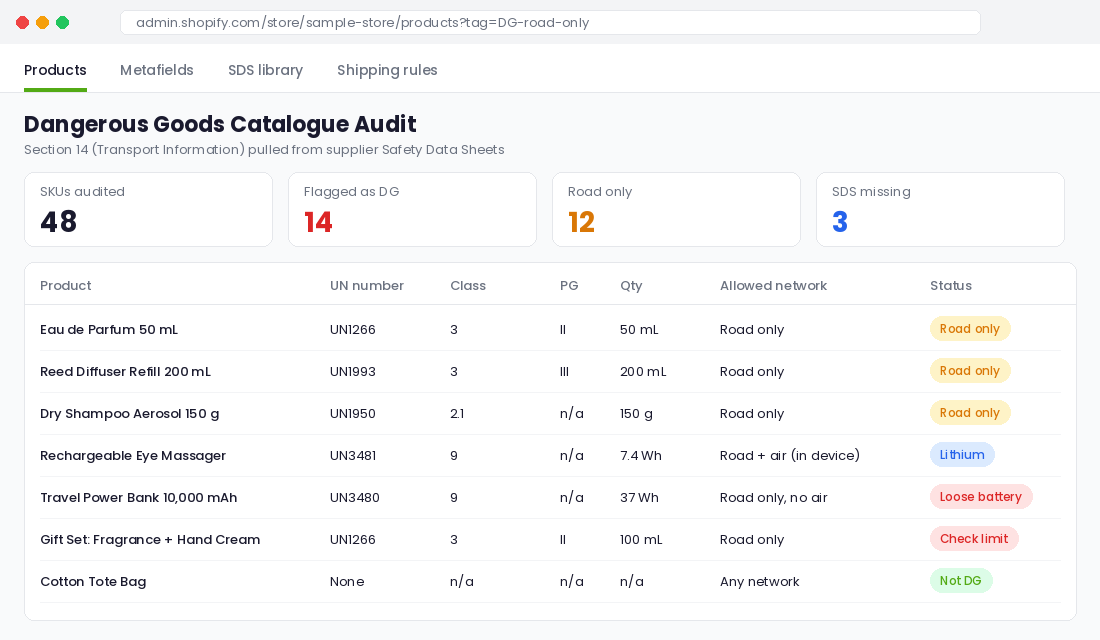
Most founders are surprised by what turns up. Perfume and body mist typically contain 60 to 90% alcohol, which is why DHL describes them as Class 3 flammable liquids. Many reed diffuser oils, essential oils, nail polishes and alcohol-based hand sanitisers land in the same class. Dry shampoo, hairspray and spray sunscreen are aerosols. Hair bleach and some developers can be oxidisers. Anything with a rechargeable battery, from a heated eye mask to an electric toothbrush, is a lithium question.
Once you have the data, tag each product in Shopify. A simple metafield such as custom.dg_class with values like “3-PGII”, “2.1-aerosol”, “9-lithium-in-equipment” or “none” is enough. Add a product tag such as DG-road-only as well, because tags are easier to use in automation and shipping apps.
Sanity check: if you sell fragrance, beauty, wellness or electronics and your audit flags zero SKUs, check again. Gift sets are the usual blind spot, because a set that bundles a 100 mL fragrance with a hand cream inherits the fragrance’s classification.
Step 2: Match Each Product to a Network That Can Legally Carry It
Classification tells you what the product is. The next step is knowing which delivery network is allowed to carry it. This is where most brands get tripped up, because the rules are different for road, air, sea and international.
Australia Post road network (the default for most Aussie DG)
Australia Post’s dangerous goods exemptions policy permits very small quantities of some dangerous goods, known as “exempted” dangerous goods, when they are carried on a contract basis and by road transport only. In practice, that means an eParcel contract account, not a casual counter lodgement.
The guide sets quantity limits per consignment by class and packing group. Those limits are small, measured in tens to hundreds of millilitres or grams per tracking number depending on the class. So a single 50 mL fragrance order is a very different proposition from a customer who buys six full-size bottles for Christmas. Check your bestselling bundles against the “Quantity Limits for Exempted Small Consignments” table in the guide before you promote them.
The air network (Express Post and next-day)
Exempted quantities are road and rail only. Australia Post’s guide states they must not enter the air network, which is why fragrance retailers cannot offer Express Post on perfume. Starshipit’s own documentation confirms it supports dangerous goods on eParcel Parcel Post but not Express Post, because of Australia Post’s restrictions.
The sea leg nobody thinks about: Tasmania
Here is the detail that catches Melbourne and Sydney brands out. The guide notes that exempted quantity rules are not recognised by the IMDG Code for movement by sea, and cannot be processed where a sea movement is required for last-mile delivery. Bass Strait is a sea movement. Before you sell a Class 3 product to a Hobart postcode, confirm with your account manager or carrier how that consignment will physically travel, or route it through a specialist.
Lithium batteries
Lithium has its own rules. Australia Post can only carry lithium ion batteries up to 20 Wh per cell or 100 Wh per battery, and lithium metal batteries up to 1 g per cell or 2 g per battery. By air, the limit is no more than four cells or two batteries per package, installed in the device. Loose power banks and spare batteries cannot go by air at all, because of Qantas restrictions, and lithium shipments are prohibited on Australia Post’s International Courier product. Australia Post also lists Germany, Italy, Thailand, Bhutan, Laos and Macao as destinations where lithium batteries will be refused.
International
Australia Post’s business help centre is blunt: dangerous goods cannot be sent internationally through its network. If you want to sell fragrance to New Zealand or the US, you need a carrier that is set up for dangerous goods by air, such as DHL Express, and you will need a Shipper’s Declaration for Dangerous Goods completed by a trained person.
Step 3: Rebuild Your Shopify Checkout So It Cannot Sell an Impossible Promise
This is the step that protects you at scale. You do not want a packer making a judgement call at 4pm on a Friday in December. You want your checkout to only ever offer options that are legal for what is in the cart.
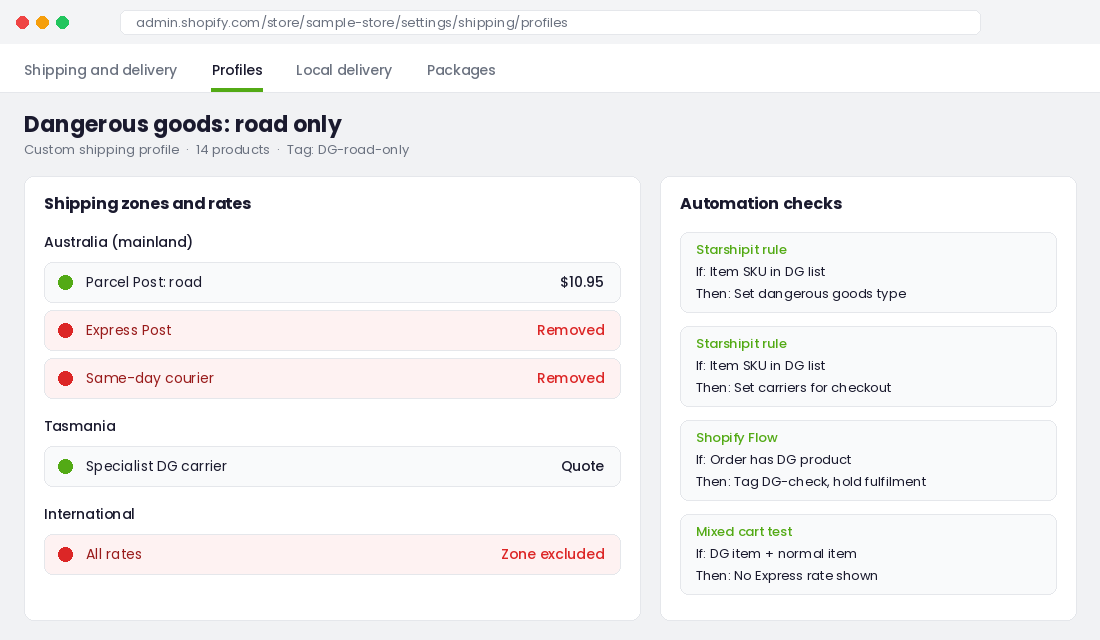
Here is the setup that works for most Aussie Shopify brands:
- Create a separate shipping profile. In Shopify Admin, go to Settings, then Shipping and delivery, and create a custom profile called “Dangerous goods: road only”. Add every product tagged DG-road-only.
- Only add road rates to that profile. Standard parcel rates for Australian zones, no Express Post, no same-day courier unless the courier has confirmed in writing that it carries your class by road.
- Exclude international zones. Remove international shipping zones from the DG profile entirely unless you have a DG-approved air carrier in place. Shopify will then block checkout for those products to overseas addresses instead of letting the order through.
- Handle mixed carts. When a cart contains a DG item and a normal item, Shopify combines the rates from each profile. Make sure the combined result cannot surface an Express option for the DG item. Test this with a real cart before you go live.
- Use your shipping app’s rules as a second lock. In Starshipit, you can build a rule with a condition on Item SKU and an action of “Set dangerous goods type” or “Set Contain Battery”, plus a second rule using “Set Carriers for Checkout” to remove couriers that will not carry dangerous goods.
One more gotcha from Australia Post’s Parcel Send help pages: shipments containing dangerous goods cannot be created via CSV import. If your warehouse batches labels by uploading a spreadsheet, your DG orders need a different workflow. A Shopify Flow that tags any order containing a DG product with “DG-check” and holds fulfilment until the label is created correctly is a cheap insurance policy.
Step 4: Pack, Label and Lodge It the Way the Guide Actually Says
Getting the routing right is pointless if the parcel itself is non-compliant. Australia Post’s guide is specific about what an exempted dangerous goods parcel must look like.
- Mark it “ROAD TRANSPORT ONLY”. The outer packaging must be clearly marked in red text next to the receiver’s address, or carry Australia Post’s “ROAD TRANSPORT ONLY – NOT TO BE MOVED VIA AIR/SEA” label.
- Remove old diamond labels. Parcels showing dangerous goods class diamond labels must not be accepted into the Australia Post road network, because those labels indicate declarable goods above the exempted limits. If you reuse supplier cartons, obliterate the old hazard labels before lodgement. Australia Post staff are instructed not to remove them for you.
- Pack for the conveyor, not the counter. The guide requires packaging strong enough to withstand the shocks of automated handling. For liquids, that means a leak-proof inner, absorbent material, bottles upright and a rigid outer carton.
- Switch devices off. For lithium, make sure the device cannot be turned on accidentally, and never pack loose batteries alongside a device.
- Split DG and non-DG shipments. Australia Post warns that mixing dangerous and non-dangerous goods in one shipment can cause extra delays and unnecessary charges. If a customer orders a perfume and a hoodie, it can be cheaper and faster to send two parcels.
- Declare it in the platform. In Parcel Send, answer “Yes” to “Does this parcel contain dangerous goods?” and select the correct UN number when prompted. Express and Premium services carry extra paperwork, including an IATA Shipper’s Declaration for Premium.
Train every packer on this, then put a laminated one-page card at the packing bench with photos of a compliant parcel. The cost is an hour of training. The alternative is a parcel pulled from the network in the middle of December.
Step 5: Reset Your Delivery Promise Before Customers Reset It for You
Once your DG products are travelling by road, they will be slower to some parts of Australia. Pretending otherwise is how you end up with “where is my order” tickets and chargebacks.
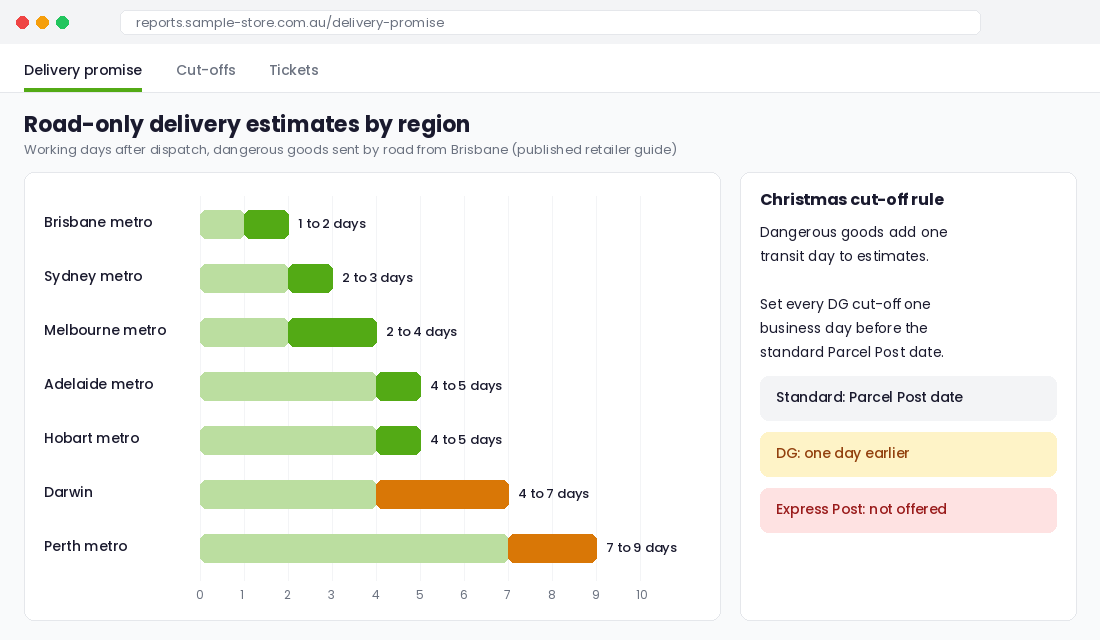
Perfume Clearance Centre, a Brisbane-based Shopify retailer, is a good example of doing this well. Its delivery page states that perfume is classified as dangerous goods, must be transported by road and cannot be sent via Express Post. It then publishes a guide by region: 1 to 2 working days for Brisbane metro, 2 to 4 for Melbourne metro, 7 to 9 working days for Perth metro and up to 10 to 17 working days for remote Tasmania. Customers know what they are buying before they pay.
MECCA handles a similar constraint on its own delivery page: orders containing an item declared as an aerosol need extra care in packaging and do not qualify for its 2pm same-day dispatch option. The retailer builds the exception into the promise rather than hiding it.
Here is how to apply the same thinking to your store:
- Show state-based estimates on DG product pages. A short line under the Add to Cart button such as “Ships by road: 2 to 4 business days to VIC and NSW, 7 to 9 to WA” does more for trust than a generic “fast shipping” badge.
- Set separate Christmas cut-offs. Because dangerous goods add a transit day, set your DG cut-off at least one business day earlier than Australia Post’s published Parcel Post cut-off for each state. Publish both dates side by side.
- Fix your gift guides. If your hero Christmas gift is a fragrance set, do not put it in an email headed “Order by Monday for express delivery”.
- Brief customer service. Give your team a two-line script explaining why a fragrance cannot go Express, so they sound confident instead of apologetic.
Measure it: tag every delivery-time ticket that involves a DG product and review the count weekly through November and December. If it climbs, your promise is out of step with your network.
Common Mistakes That Put Aussie Brands Offside
Across beauty, wellness, homewares and electronics, the same mistakes come up again and again:
- Assuming “small” means exempt. A 10 mL rollerball is still a Class 3 liquid. Exemption depends on the class, packing group and total quantity per consignment, not on the bottle looking harmless.
- Selling bundles that break the limit. A “build your own fragrance wardrobe” bundle can quietly push a single consignment over the exempted quantity for its class.
- Leaving Express Post as a default rate. One general Express rate across the whole store is the most common way DG products end up in the air network.
- Using the free counter service for DG. The exemption applies to contract customers. If you are still lodging at the Post Office counter without an eParcel contract, talk to Australia Post before you ship another bottle.
- Forgetting returns. A customer posting a perfume back to you is also consigning dangerous goods. Your returns portal should generate a road-only label for DG items, not a generic prepaid satchel.
- Not re-checking after a reformulation. When a supplier changes a formula, the SDS can change. Make an SDS refresh part of every new product and every restock from a new batch.
The Compound Effect: How the Five Steps Protect Your Orders
Each step on its own is useful. Together, they build a system that protects your revenue instead of just ticking a compliance box.
Classification (Step 1) feeds routing (Step 2). Routing feeds your Shopify shipping profiles and app rules (Step 3), which means the checkout can only offer options that are legal for what is in the cart. That makes packing and labelling (Step 4) a repeatable process instead of a guess. And an honest delivery promise (Step 5) turns a constraint into trust, which is what keeps conversion rates steady even when a product cannot go Express.
The payoff shows up where founders least expect it. Fewer “where is my order” tickets. Fewer chargebacks from late Christmas gifts. A carrier relationship that stays friendly when you need a favour in peak. And no 7-year offence hanging over a parcel you never meant to put on a plane.
This also connects to the rest of your shipping economics. If you have not yet checked how carriers bill your parcels, the Cubic Weight Audit pairs well with this playbook, because DG surcharges and cubic charges often stack on the same orders. For the product side of compliance, the Product Compliance Check covers the ACCC mandatory standards that sit alongside transport rules. And if your delivery promise needs a full rebuild, start with the Delivery Promise Playbook.
Your Dangerous Goods Readiness Checklist
Work through this with your ops lead or 3PL. Anything you cannot tick is a job for this week, before the Christmas volume arrives.
Classify
- Current SDS on file for every SKU and every gift set component
- UN number, class, packing group and quantity recorded for each product
- dg_class metafield and DG-road-only tag applied in Shopify
- Lithium products recorded with watt-hour rating and whether the battery is installed, packed with or loose
Route
- eParcel contract confirmed and your Australia Post account manager aware you ship exempted DG
- Bestselling bundles checked against the exempted quantity limits per consignment
- Tasmania and other sea-leg deliveries confirmed with your carrier
- International DG either switched off or routed through a DG-approved air carrier
Checkout
- Separate “Dangerous goods: road only” shipping profile live
- No Express Post or air rates available on DG products, including in mixed carts
- Starshipit or shipping app rules flag DG SKUs and remove unsupported carriers
- Shopify Flow holds DG orders for a label check if you batch via CSV
Pack and lodge
- ROAD TRANSPORT ONLY marking in red, or the official label, on every DG parcel
- Old hazard diamonds removed from reused cartons
- Leak-proof inner, absorbent material and rigid outer for liquids
- DG and non-DG items split into separate shipments where practical
- Returns portal issues road-only labels for DG items
Promise
- State-based delivery estimates on every DG product page
- DG Christmas cut-offs published one business day earlier than standard
- Customer service script ready for “why can’t this go Express?”
A quick note: this playbook is general information to help you ask the right questions, not legal or regulatory advice. For anything above exempted quantities, talk to your carrier’s dangerous goods team or a qualified DG consultant.
Make It a System, Not a Scramble
Dangerous goods is one of those problems that stays invisible until the day it becomes urgent. The brands that handle it well are not the ones with the biggest compliance budgets. They are the ones that did the classification once, built it into their checkout, and stopped relying on memory at the packing bench.
Inside eCommerce Circle, protecting the business behind the orders is one of the core pillars we work on with every member. If you want to see exactly where your store is being capped, take the free More Orders Scorecard. It takes two minutes and shows you which of the 10 P’s to fix first.