Every November, the same thing happens in Aussie Shopify inboxes. Twenty brands send the same email: 20% off sitewide, then 25%, then “final hours”. Your customer can’t tell them apart, so they buy from whoever is cheapest and forget the rest by December.
What’s in This Article
A small group of brands do something different. Instead of only cutting the price, they tie part of the week to a cause their customers care about. A fixed amount per order to a local charity. A round-up at checkout. A Giving Tuesday match. And when it’s done properly, it gives people a reason to choose you that has nothing to do with being the cheapest.
Done badly, it’s a legal and reputational grenade. In 2020 the Federal Court ordered Australian eyewear brand Oscar Wylee to pay $3.5 million in penalties after it claimed “buy a pair, give a pair” but donated about one set of frames for every 100 pairs sold. The ACCC called it a betrayal of socially conscious customers.
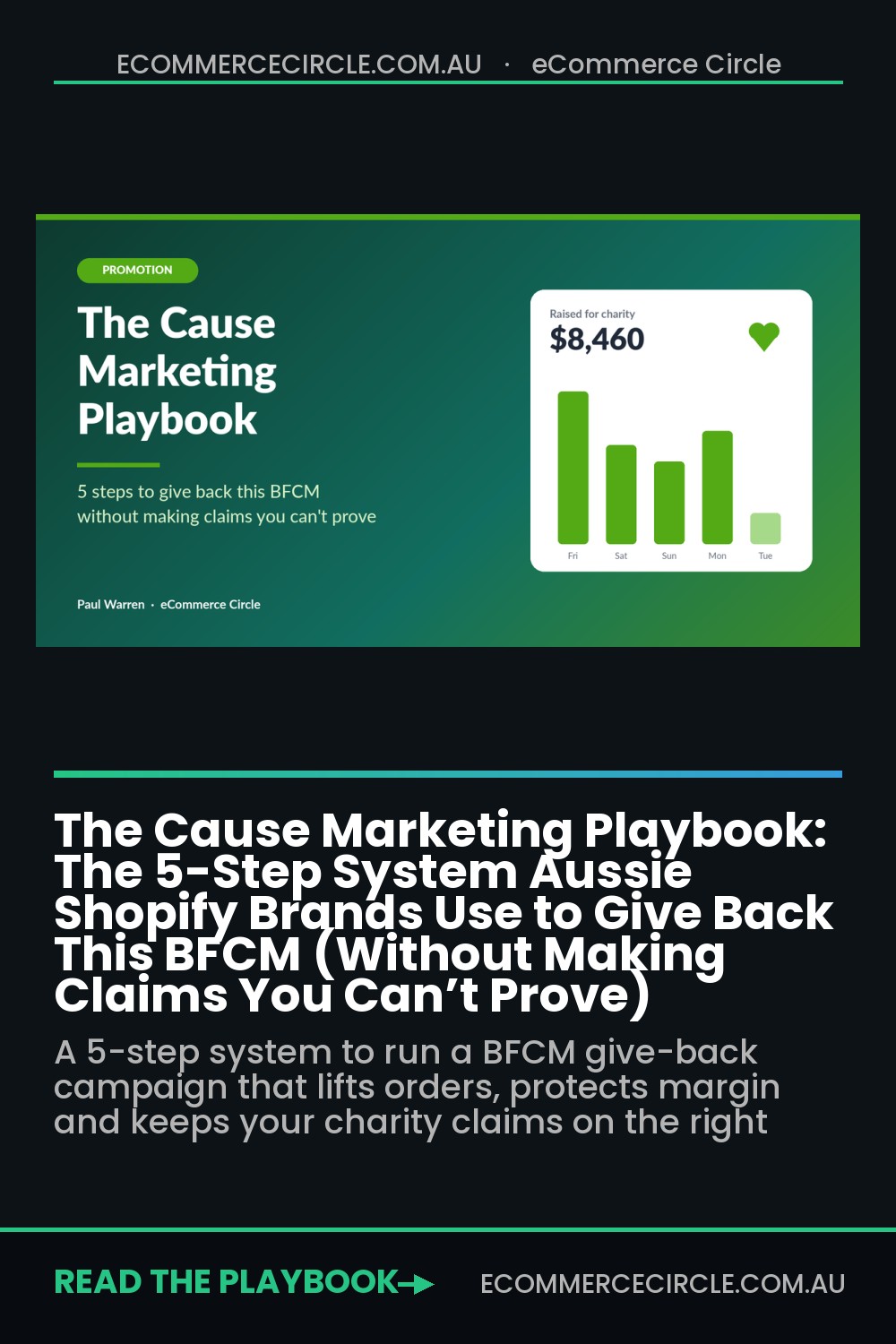
This playbook gives you a five-step system to run a give-back campaign this BFCM that lifts orders, protects your margin and stands up to scrutiny. You’ll get the margin maths, the claim wording, the tool setup and the reporting rhythm, plus a checklist to work through before Black Friday on 27 November 2026.
Why a Cause Can Beat Another 10% Off
Discounts are a race you can only win by giving away more margin. Every brand can match a percentage. Very few can match a story about the people your customers want to help.
The most famous example is still Patagonia. In 2016 it pledged to give 100% of its global Black Friday sales to grassroots environmental groups. It expected about US$2 million in sales. It did US$10 million, five times the forecast, and gave all of it away. You don’t need to donate your whole day’s revenue, but the lesson stands: a meaningful commitment pulled in buyers a discount never would have.
Closer to home, Who Gives A Crap built an entire Shopify brand around donating 50% of its profits to clean water and sanitation charities. Its founder famously sat on a toilet for 50 hours to crowdfund the first $50,000 production run. The cause isn’t a campaign bolted on in November. It’s the reason people subscribe.
Australians are also getting more used to giving during the sales period. GivingTuesday, the day of giving that follows Black Friday and Cyber Monday, raised $6.1 million in Australia in 2024 from around 64,000 donors, according to fundraising platform Raisely. On Raisely alone, funds raised grew 50% year on year. In 2026, GivingTuesday falls on Tuesday 1 December, the day after Cyber Monday. That’s a natural closing beat for your BFCM week.
The commercial case is simple. If you’ve already built heavy discount dependency into your list, a give-back angle lets you run a strong campaign without training people to wait for 30% off. It also gives your emails something new to say on day four of a five-day sale, when everyone else is just shouting “last chance”.
The .5 Million Warning: What the ACCC Expects From Charity Claims
Before you write a single email, understand why this is one of the riskiest claims you can make. Customers can’t check whether you actually donated. They take your word for it. That’s exactly why the ACCC treats false charity claims seriously.
The Oscar Wylee case is the template for what not to do. Between January 2014 and December 2018 the brand told customers that for every pair purchased, a pair was donated to someone in need. In that time it sold 328,010 pairs and donated 3,181 frames, without lenses. It also kept claiming a partnership with a charity whose relationship consisted of a single $2,000 donation and 100 frames back in 2014. The Federal Court ordered $3.5 million in penalties and made the company publish its breaches online.
Three lessons for your store:
- The claim has to match reality every single day it’s live. “We donate $5 per order” means every eligible order, not “most” or “when we remember”.
- Partnerships need to be current and real. Don’t name a charity you haven’t got a written agreement with, and take their logo down when the campaign ends.
- Intent doesn’t save you. Under the Australian Consumer Law, a claim that creates a wrong impression can be misleading even if you didn’t mean it to be.
There’s a second layer if your customers are giving money, not just you. If you add a round-up or donation button at checkout, you’re collecting money on behalf of a charity, and state fundraising rules can apply. In 2023 Australia’s Treasurers agreed national fundraising principles, which include a requirement that commercial fundraisers explain they profit from fundraising and how they’re paid. The simplest protection is to collect only for a registered charity that has agreed in writing, and to check with your adviser before launch. (This is general information, not legal advice.)
If you’ve read our green claims playbook, the logic is identical. Specific, provable, current claims are safe. Vague, emotional, unprovable claims are where brands get hurt.
Step 1: Pick a Cause Your Customers Already Care About
The biggest mistake founders make is choosing a cause they personally love that has nothing to do with the product or the customer. A skincare brand giving to a footy club feels random. A skincare brand supporting a skin cancer charity makes immediate sense.
Run every option through three questions:
- Is there a clear link to what you sell? Outdoor gear and land care. Baby products and a children’s hospital. Pet food and an animal rescue. Your customer should understand the connection in under five seconds.
- Would your best customers say yes? Look at your post-purchase survey answers, reviews and DMs. What do your repeat buyers talk about? If you don’t know, ask your VIP segment to vote between two or three shortlisted charities. That vote becomes campaign content in itself.
- Is it safe and verifiable? Search the charity on the ACNC Charity Register to confirm it’s registered and its reporting is up to date. Check ABN Lookup to see whether it has Deductible Gift Recipient (DGR) status, which matters if your business wants to claim the donation.
Then contact the charity before you announce anything. Ask for permission to use their name and logo, how they want donations paid, and whether they’re happy with your wording. Most smaller charities will be thrilled. Get the yes in an email you can keep.
One more rule: pick one cause for the campaign. Splitting donations across five charities dilutes the story and makes reporting a nightmare. You can rotate causes year to year.
Step 2: Choose Your Giving Model and Do the Margin Maths
There are five common ways to structure a give-back. Each has a different effect on your margin, your messaging and your admin.
- Fixed dollars per order. “$5 from every order goes to X.” The clearest claim, easy to calculate, and it rewards order count rather than order size.
- Percentage of sales. “10% of sales this weekend.” Sounds generous but gets expensive on high-AOV orders, and customers often confuse sales with profit.
- Percentage of profit. What Who Gives A Crap uses. Honest and sustainable, but you must be able to show how profit was calculated, so it suits brands with clean books.
- Product-for-product. “Buy one, we give one.” Powerful when it fits the product, but this is the exact model that sank Oscar Wylee. Only use it if you can physically track every unit given.
- Customer round-up or opt-in donation. The customer chooses to add money at checkout. It costs you nothing in margin, but it carries the fundraising obligations covered above.
Now compare the cause option with the discount you’d otherwise run. Take a store with a $95 average order value and a 45% gross margin after shipping and payment fees. A 20% off sitewide offer costs $19 per order in lost revenue, cutting the contribution from about $42.75 to $23.75. A $5-per-order donation costs exactly $5 and leaves $37.75.
That means the donation version can sell far fewer extra orders and still make more money. In this example, 100 orders at 20% off earns about $2,375 of contribution. You’d only need about 63 orders on the donation campaign to match it.
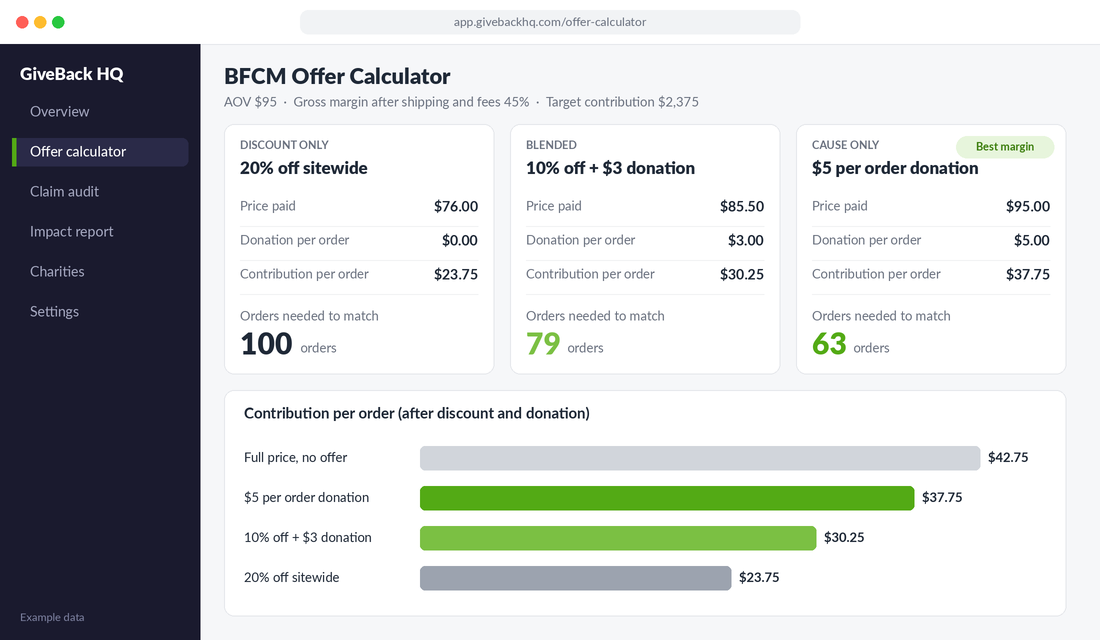
A blended option often works best for BFCM: a modest discount (say 10% off) plus a fixed $3 to $5 per order for the cause. You still show up in deal-hunters’ inboxes, but you’re not trapped in the 25% to 30% race. Whatever you choose, set a donation cap or a fixed campaign window in writing, and say so in your messaging. “Up to $10,000 across Black Friday weekend” is fine as long as you publish the cap.
Step 3: Write Claims You Can Prove (Word for Word)
This is where most give-back campaigns go wrong. The urge to sound generous produces vague promises. Vague promises are exactly what the ACCC looks at.
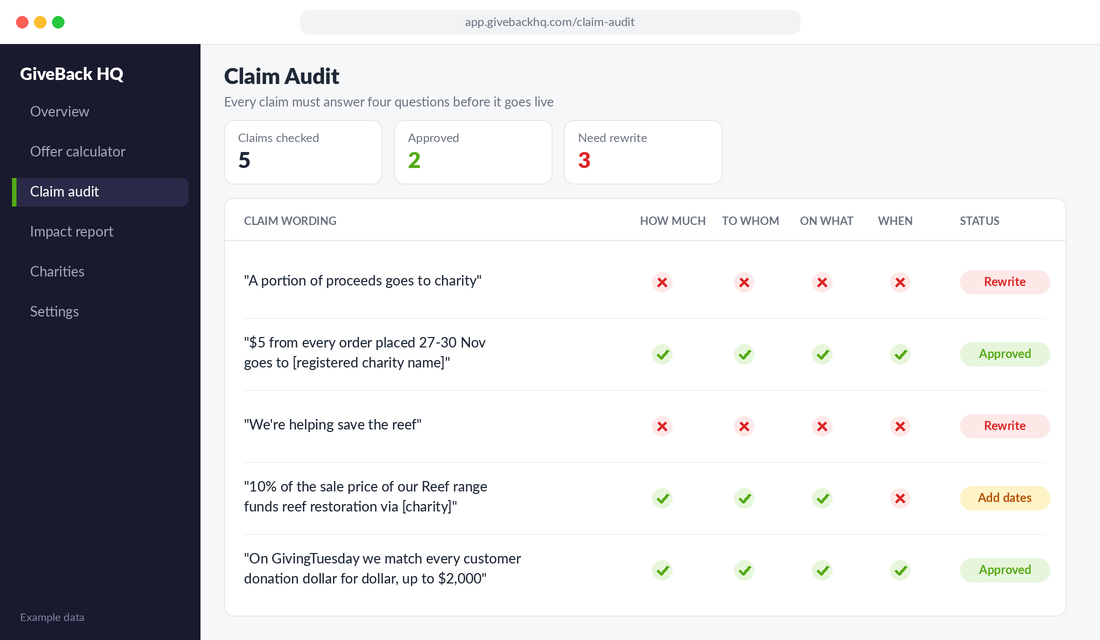
Every claim should answer four questions: how much, to whom, on what, and when. Here’s how that changes your copy:
- Weak: “A portion of proceeds goes to charity.” Strong: “$5 from every order placed 27 to 30 November goes to [your charity’s registered name].”
- Weak: “We’re helping save the reef.” Strong: “10% of the sale price of our Reef range funds reef restoration through [named registered charity].”
- Weak: “Every purchase makes a difference.” Strong: “On GivingTuesday (1 December) we’ll match every customer donation dollar for dollar, up to $2,000.”
Note on that middle example: name the actual registered charity you’ve confirmed. Don’t use a big brand name you haven’t spoken to.
Then add the fine print in plain English on a dedicated campaign page: the dates, the cap, which orders count (for example, whether refunded orders are excluded), when the donation will be paid, and where customers can see proof. Link that page from your announcement bar, product pages and every email.
Finally, decide what happens with refunds and cancellations. The cleanest approach is to donate on all orders placed, refunded or not. It costs a little more, but it removes any argument that you quietly reduced the total. If you do exclude refunds, say so upfront.
Step 4: Build It Into Your Store and Your BFCM Calendar
A give-back campaign only works if customers see it at the moment of decision. That means the product page, the cart and the checkout, not just a single Instagram post.
For most Australian brands, the easiest tool is Shop for Good by DailyKarma on the Shopify App Store. It supports a portion of sales on specific products or collections, round-ups at cart or checkout, flat customer donations, and works with Shopify Checkout and POS. It’s free to install, with a 10% processing fee plus card fees deducted from each donation on the starter plan. Paid plans start at US$299 a month.
Here’s the setup:
- Install the app from the Shopify App Store and connect your store.
- Create a campaign and choose the type: portion of sales for a brand-funded donation, or round-up for customer donations.
- Select or add your charity. Use the exact registered name from the ACNC register.
- Set the scope and dates. Pick the products or collections, the start and end time in AEDT, and any cap.
- Customise the widget message using your proven claim wording from Step 3, then place it on product pages and in the cart.
- Place a test order and confirm the donation shows correctly in the app dashboard before you announce anything.
If you’d rather avoid an app, a fixed per-order donation can be run natively. Use a Shopify Flow workflow triggered by “Order created” to tag every order in the campaign window (for example, cause-bfcm-2026). Then filter orders by that tag at the end of the campaign to calculate exactly what you owe. Add the message to your theme’s announcement bar and product template.
Then map it onto your BFCM week:
- Early November: Announce the cause to your early access list first. Share why you chose it and, if possible, a short video from someone at the charity.
- Black Friday (27 Nov) to Cyber Monday (30 Nov): Lead with the offer, reinforce with the cause. Show a live running total in emails (“$3,240 raised so far”).
- GivingTuesday (1 Dec): Close the week with a match. Your customers donate, you match up to a set cap. It’s a high-goodwill send to people who are tired of sale emails.
- Mid-December: Report the result (Step 5).
Live totals are powerful, but only show a figure you can back up from your order data at that moment. Round down, never up.
Step 5: Report the Impact (This Is Where the Loyalty Comes From)
Most brands announce a cause loudly and then go silent. That’s a missed opportunity and a risk. The follow-up is where you prove you did what you said and turn a one-off buyer into a fan.
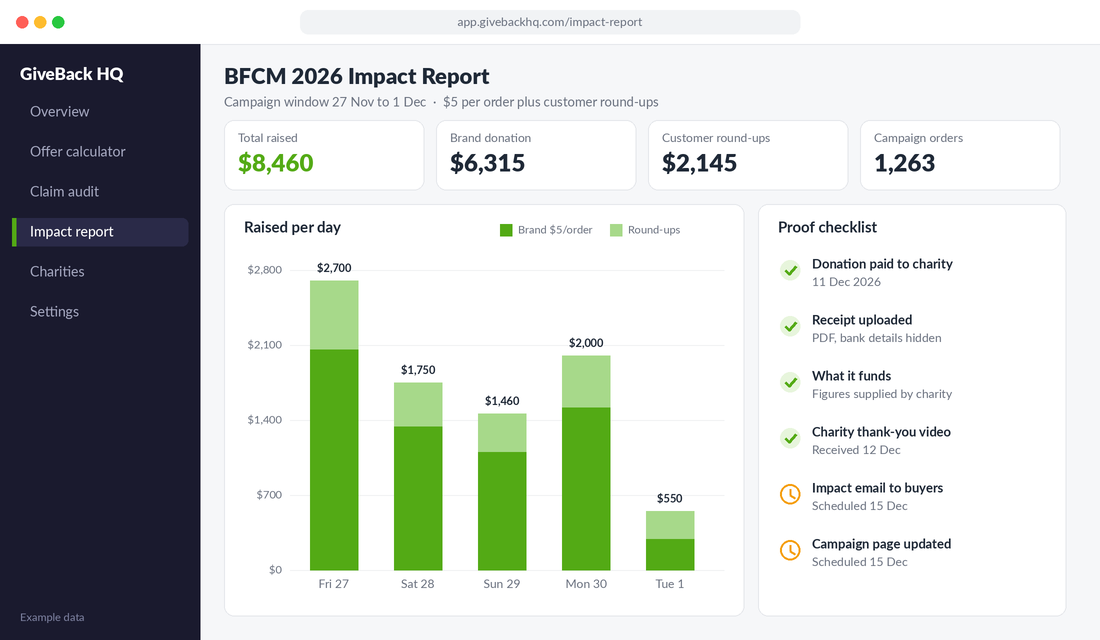
Build a simple impact report within two to three weeks of the campaign ending:
- Total raised, broken into your contribution and customer contributions.
- The receipt. A screenshot or PDF of the donation receipt from the charity, with bank details removed.
- What it funds. Ask the charity what your amount pays for in real terms, such as counselling sessions, meals or trees planted. Use their numbers, not yours.
- A thank-you from the charity, ideally a short quote or video.
- The date paid. If you promised to donate by 15 December, show that you did.
Publish the report on your campaign page, send it as a dedicated email to everyone who ordered during the campaign, and pin it to your social profiles. Then add a line to your post-purchase flow for new customers: “Last BFCM our customers raised $X for [charity].”
Track the commercial result too. Compare the campaign’s conversion rate, new customer share and 90-day repeat rate with last year’s pure discount campaign. If buyers acquired through the cause come back more often, that’s your case for doing it again.
How the Five Steps Compound
Each step on its own is helpful. Together, they turn a nice gesture into a commercial advantage.
The right cause (Step 1) makes your message instantly relevant. The margin maths (Step 2) means you can afford to run it without reaching for a deeper discount. Provable claims (Step 3) mean you can promote it loudly without legal risk. On-site placement and calendar timing (Step 4) put the cause in front of people at the moment they decide. And the impact report (Step 5) turns the campaign into proof, content and loyalty you can reuse every year.
Run it two or three years in a row with the same charity and it stops being a campaign. It becomes part of what your brand stands for, and that’s very hard for a cheaper competitor to copy.
Your Cause Marketing Checklist
Work through this before you announce anything:
- Shortlist two or three causes that link clearly to your product and customers.
- Verify each one on the ACNC Charity Register and check DGR status on ABN Lookup.
- Get written permission from the charity to use its name, logo and your campaign wording.
- Choose one giving model and run the margin maths against your planned discount.
- Set a campaign window and cap and write them down.
- Write every claim to answer how much, to whom, on what, and when.
- Build a campaign page with dates, cap, eligible orders and payment timing.
- Install Shop for Good or set up a Shopify Flow tag and place a test order.
- Add the message to product pages, cart, announcement bar and every BFCM email.
- Get advice before running customer round-ups or donation buttons.
- Pay the donation on time and keep the receipt.
- Publish the impact report and email it to every campaign customer.
Give Your Customers a Better Reason to Choose You
BFCM doesn’t have to be a margin-burning race to the bottom. A well-chosen cause, honest claims and a proper follow-up give your customers a reason to buy from you that a competitor can’t simply undercut. Just make sure every word you publish is something you can prove.
Inside eCommerce Circle, Promotion is one of the core pillars we work on with every member, and building campaigns that win orders without wrecking margin is a big part of it. If you want to see exactly where your store is being capped, take the free More Orders Scorecard. It takes two minutes and shows you which of the 10 P’s to fix first.