Search “ecommerce coach Australia” and you will find a wall of people promising to take you from zero to six figures in 90 days. Most of them have never run a profitable store. A few are excellent. The trouble is that from the outside, you cannot tell which is which.
What’s in This Article
So founders do one of two things. They sign with the first confident voice on Instagram, or they avoid coaching altogether and spend two more years learning everything by burning ad budget. Both are expensive. Both are avoidable.
Full disclosure: eCommerce Circle is a coaching business, so I have a stake in this topic. That is exactly why this guide includes the maths and the questions that would make you walk away from a coach, including us. By the end you will know what an ecommerce coach actually does, what to expect to pay, how to work out whether it pays back, and how to vet one in a 30-minute call.
What an Ecommerce Coach Actually Does
An ecommerce coach is a person who has built or scaled online stores and now spends their time helping you make better decisions in yours. The key word is decisions. A coach does not build your theme, write your ads or run your Klaviyo flows. You do, or your team does. The coach reviews your numbers, tells you what is capping growth, and holds you to a weekly rhythm of fixing it.
In practice, a good coaching engagement covers four jobs:
- Diagnosis. Finding the one or two constraints that matter most right now. For a store at $30k a month it is usually conversion rate or tracking. At $300k a month it is usually contribution margin or creative volume.
- Prioritisation. Choosing what to do this month and, more importantly, what to ignore. Most founders have a list of 40 ideas. A coach cuts it to three.
- Teaching. Giving you the mental models to read your own dashboard, brief an agency and interview a hire without being sold to.
- Accountability. A call every week or fortnight where someone asks “did you ship it?” This is underrated. Execution gaps sink more stores than strategy gaps.
What a coach is not: an agency, a freelancer or a guarantee. If you want someone to do the work, you need an agency or a specialist. We unpack that split in why most Shopify brands need both a coach and an agency, including which one to hire first at each revenue stage.
Coach, Consultant, Agency or Course: Which One Do You Need?
These four get lumped together, and mixing them up is how founders end up paying agency money for course-level outcomes. Here is the clean split.
- Course. One-to-many content. Cheapest and slowest. It works if you are disciplined and your store is simple. It fails the moment your situation is specific, because nobody reviews your actual numbers.
- Coach. One-to-one or small group, ongoing. You keep control and build skill. Best when you are under about $1M a year, or when you have a team but lack direction.
- Consultant. A project with a deliverable: an audit, a tracking fix, a pricing review. Best when you know the problem and need an expert to solve it once.
- Agency. Done-for-you execution on a retainer. Best when you know the channel works and need capacity. Our guide on how to choose an ecommerce agency in Australia covers vetting that side.
A simple rule: if you cannot yet say what is broken, hire a coach. If you can say what is broken, hire a consultant. If you know what works and cannot keep up, hire an agency.
Why the Australian Market Makes Good Coaching Worth More
The opportunity is large and getting more crowded. Australia Post’s annual eCommerce report found online shopping reached a record $82.6 billion in 2025, up 13.9% on the year, with 9.8 million households (around 82% of Australian homes) buying online. Online now accounts for roughly 24% of all retail spending.
But here is the line that matters for you: the same report shows the average online basket fell to a five-year low of $96. Shoppers are buying more often and spending less each time. That squeezes stores that rely on one-off buyers and cheap traffic, and it rewards stores that understand margin, repeat purchase and conversion.
In other words, the market is growing, but the easy money is gone. Australian founders also have local problems that generic overseas advice ignores: GST on low-value imports, Afterpay and Zip expectations, carrier cut-offs, and a population small enough that you exhaust your best audiences quickly. A coach who has worked inside this market saves you from importing US playbooks that do not fit.
What Ecommerce Coaching Costs in Australia (and the Maths That Matters More)
I have to be upfront here: there is no standard price list. Rates are not published in any reliable benchmark, and offers range from low-cost group programs to premium one-to-one retainers. Anyone quoting you a universal “typical price” is guessing. What I can give you are reference points and, more usefully, a way to judge any quote.
Reference points that are published: a Shopify plan on Shopify’s Australian pricing page runs from $56 AUD a month (Basic, billed monthly) through $149 (Grow) and $575 (Advanced). Hourly rates for Shopify specialists in Australia average roughly $40 to $85 an hour in industry rate surveys, and full-service agencies for growing brands commonly sit around $10,000 to $20,000 a month. Coaching generally lands well below agency cost, because you are buying advice and accountability, not labour.
But price is the wrong first question. The right question is: what does this need to deliver to pay for itself? Here is the formula.
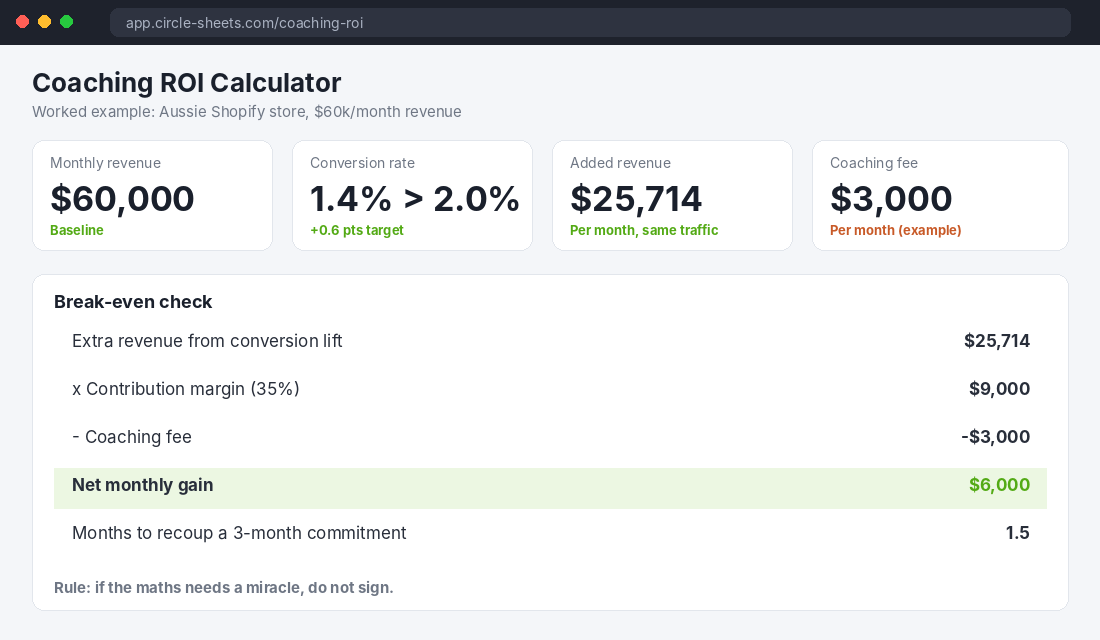
Required monthly gain = coaching fee ÷ your contribution margin.
Take a store doing $60,000 a month with a 1.4% conversion rate. If the coach lifts conversion to 2.0% on the same traffic, revenue rises by about $25,700 a month. At a 35% contribution margin, that is around $9,000 a month in profit. A $3,000 monthly fee returns $6,000 net, and you recoup a three-month commitment in about six weeks.
Now the sanity check. For context, published Shopify benchmarks put the median store conversion rate at roughly 1.4% to 1.8%, with the top 10% above about 4.7%. So a lift from 1.4% to 2.0% is realistic for a store that has not been optimised. A promise to take you from 1% to 5% is not. If the maths needs a miracle, do not sign.
Our Shopify conversion rate benchmarks by niche will help you set a believable target before you talk to anyone.
Five Signs You Are Ready for a Coach
Coaching is not for everyone, and the stores that get the most from it share a few traits.
- You have real sales. Not necessarily $1M. But a store with 20 orders a month does not need a coach, it needs traffic and a better product.
- You can name a ceiling. Revenue has plateaued, ad costs are climbing, or margins are shrinking and you do not know why.
- You will do the work. A coach multiplies effort. If you cannot commit to a few focused hours a week, save your money.
- You have basic data. Working GA4 or Shopify analytics, and a rough idea of your product margins. If not, fixing that is the first month’s job.
- You are the bottleneck. Your decisions, not your team’s execution, are what is capping the business.
Real Examples: What Operators Do Differently
Two public stories show the pattern. They are not coaching case studies, and I will not pretend they are, but they illustrate what a good outside voice helps you do.
Koala. The Australian mattress brand reported passing $1 million in sales in 79 days. Co-founder Dany Milham said the team took “a data-driven approach working purely on numbers” to its social strategy. They left branding off a wine-glass test video to make it more shareable (it reached around 5.5 million views), and replied to every comment on their posts, about 6,000 people. Cricketer Steve Smith began as an early backer and moved into an advisory role. The lesson is not “go viral”. It is that Koala treated marketing as a measurable system and used outside advisers where they had gaps.
Gymshark. Founder Ben Francis built the first site in 2011 and incorporated in 2012. The company became a billion-dollar business in 2020, and Francis spent six years rotating through senior roles, including technology, marketing and product, before returning as CEO. That is the slow route: learn every function the hard way. It works, but it took years. A coach compresses that curve by giving you pattern recognition from stores that have already made the mistakes.
How to Vet a Coach in a 30-Minute Call
Most bad coaching experiences were predictable in the first call. Use this scorecard. Score each answer 0, 1 or 2, and only proceed above 14 out of 20.
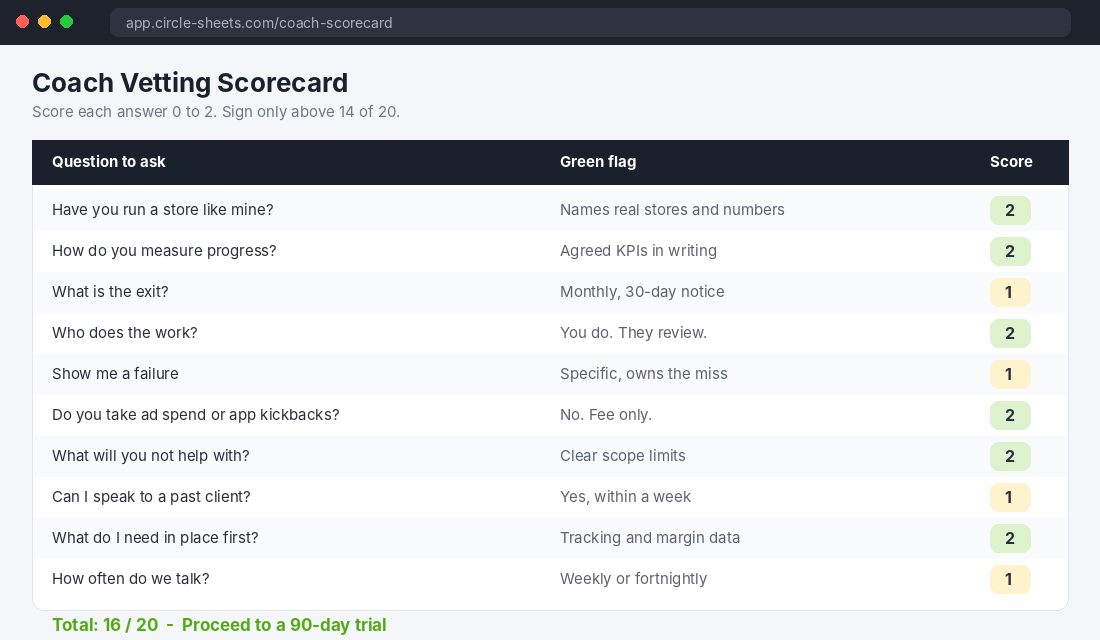
Four questions do most of the work:
- “Have you run a store like mine?” Look for named stores, specific numbers and a clear explanation of what was theirs versus a team’s work. Vague answers are a red flag.
- “How will we measure progress?” A good coach agrees two or three KPIs in writing before you start: conversion rate, contribution margin, repeat rate. Not “mindset”.
- “Do you take commissions or kickbacks?” If they earn money from the apps or agencies they recommend, their advice is compromised. Fee-only is cleaner.
- “What would make you tell me not to hire you?” A confident coach has a real answer. A salesperson does not.
Watch also for guarantees (“10x your revenue”), lock-in contracts longer than three months, and income screenshots in place of reasoning. Real coaches talk about constraints and trade-offs. Marketers talk about outcomes.
What a Good 90 Days Looks Like
The best way to protect yourself is to insist on a structure. Here is the shape of a healthy first quarter.
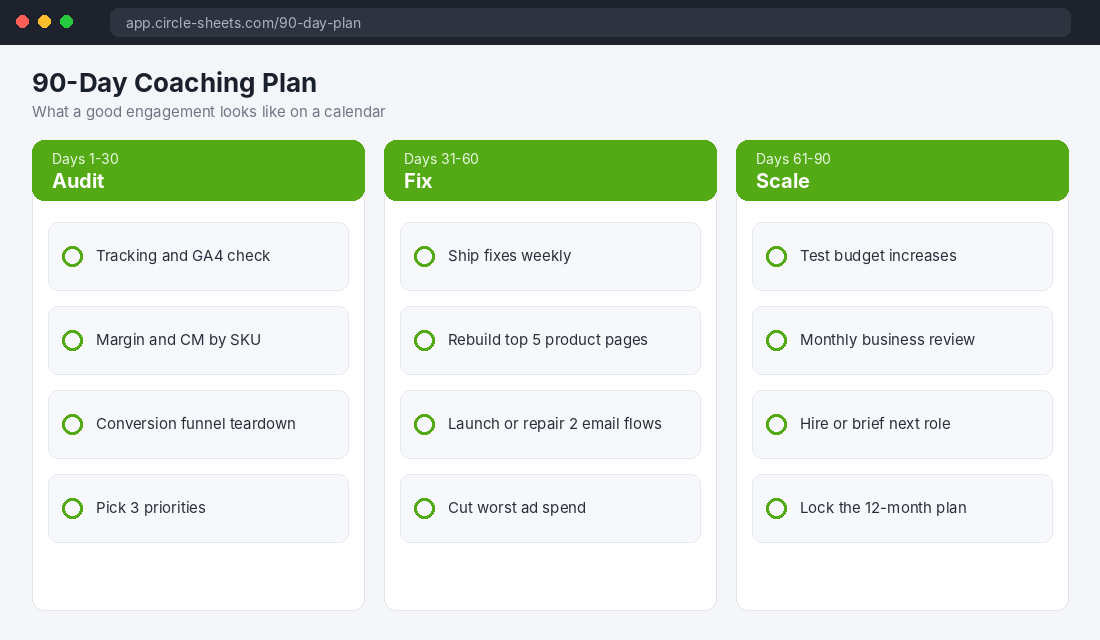
Days 1 to 30: audit. Check tracking and GA4, calculate margin and contribution margin by product, tear down the funnel, and pick three priorities. You should leave month one knowing exactly what is capping growth. If you do not, something is wrong.
Days 31 to 60: fix. Ship changes weekly. Typical early wins include rebuilding the top five product pages, repairing or launching two email flows (a welcome series and an abandoned cart flow), and cutting ad spend that cannot show a return.
Days 61 to 90: scale. Only now do you raise budgets, brief a hire or lock the next 12 months. Scaling a broken funnel is the most common and costliest mistake in ecommerce.
A coaching engagement without this kind of arc tends to drift into pleasant conversations. Pleasant conversations do not move revenue.
Set Up Your Own Coaching Dashboard (Free Tool, 20 Minutes)
Whoever you hire, you need one page that shows whether it is working. Use Google Sheets (free) and Shopify’s built-in reports. Here is the setup.
- Step 1. Create a Google Sheet with one row per week and these columns: sessions, orders, conversion rate, average order value, gross margin %, ad spend, new customers, repeat rate.
- Step 2. In Shopify, open Analytics, then Reports, and export “Sales over time” and “Conversion rate over time” each Monday. Paste the numbers in.
- Step 3. Add a column for contribution margin: revenue minus product cost, shipping, fees and ad spend, divided by revenue.
- Step 4. Set your baseline for the first four weeks before coaching starts, then colour-code anything that moves 10% or more.
- Step 5. Review it on every coaching call. If the numbers are not moving after 60 days, ask why, directly.
Our 1-page monthly business review dashboard goes further if you want a ready-made template.
The Compound Effect: Why Coaching Pays Back Slowly, Then All at Once
One fix rarely changes a business. A conversion lift of 0.5 points adds revenue. Better margins keep more of it. A repair to your email flows brings buyers back. Cleaner tracking tells you where to put the next dollar. None of these alone is dramatic. Together they compound.
This is why the best results come from coaching over 6 to 12 months rather than a one-off call. Month one finds the leaks. Months two to four fix them. By month six, you have a team that understands the system and a founder who no longer needs to guess. That is the point of the whole exercise: you should need the coach less over time, not more.
Common Questions Founders Ask Before Hiring a Coach
How long should I commit? Three months is the shortest period in which you can see movement in conversion and margin, and twelve is the longest sensible first commitment. Be wary of anything that locks you in for longer before you have seen results.
Do I need a coach if I already have an agency? Often, yes. An agency executes, but it also sells you more of its own services. A coach is the independent voice that checks whether the agency’s reports match your profit and loss. Founders who cannot read their own numbers tend to overpay agencies, and a coach fixes that without replacing them.
What if my store is brand new? Then spend your money on validating the product and getting your first 100 orders. Coaching on a store with no data is mostly guesswork, and you will get more value from a cheaper course or community until you have something to measure.
What should I bring to the first session? Your last 90 days of Shopify sales, your ad spend by channel, your product margins and your top three frustrations. A coach can only be as sharp as the data you hand over. The more specific you are, the faster the first month moves.
Three Mistakes That Waste a Coaching Budget
- Buying advice and ignoring it. The most common failure is not a bad coach. It is a founder who nods on calls and changes nothing. Decide before you start how many hours a week you will commit, and protect that time.
- Hiring for the channel, not the constraint. Founders ask for a “Meta ads coach” when the real problem is a product page that converts at 0.8%. Fix the constraint first, then buy more traffic.
- Measuring activity instead of outcomes. Calls held, audits delivered and slides shared are not results. Conversion rate, contribution margin and repeat purchase rate are.
Your Next Step
If you take one thing from this guide, make it the break-even maths. Before you speak to any coach, work out what lift you need to pay for the fee and whether it is realistic against the benchmarks above. Then run the scorecard on every call.
Inside eCommerce Circle, building this kind of operating rhythm is one of the core pillars we work on with every member. If you want to see exactly where your store is being capped, take the free More Orders Scorecard. It takes two minutes and shows you which of the 10 P’s to fix first. And if you would rather talk it through with our team, you can get in touch here.