Most Australian store owners search for ecommerce training the same way. They find a course, pay for it, watch the first four modules, and then the store goes back to looking exactly like it did before. Six months later they buy another course.
What’s in This Article
The problem is rarely the quality of the video. It is that training and results are two different things, and nobody tells you which one you are actually buying. Some training is excellent for what it does. Some of it is the wrong tool for the stage you are at.
This guide sorts the Australian options into what they cost, how long they take, and what they will and will not change in your store. You will also get a 30-day sprint that forces every lesson into something live, and an 8-question fit check so you can decide between courses and coaching in about five minutes.
The Four Kinds of Ecommerce Training Available in Australia
When people type “ecommerce training Australia” into Google, they are really choosing between four different products that get lumped together.
- Free platform training. Shopify Academy, Google Skillshop and Meta Blueprint. Tool-specific, self-paced, and priced at zero for the learning material.
- Short paid courses. Online providers selling an introduction to ecommerce for a few hundred dollars, usually 5 to 50 hours of video.
- Formal qualifications. University short courses and diplomas, such as RMIT Online and Greenwich College, built around structured assessment.
- Coaching and consulting. Someone who looks at your numbers, tells you what to fix first, and holds you to doing it. Different product, different job. We cover that separately in our guide to choosing an ecommerce coach and the ecommerce consultant breakdown.
Notice that the first three are about knowledge. The fourth is about decisions. Keep that distinction in your head, because it decides almost everything else in this article.
What Australian Ecommerce Courses Cost and How Long They Take
Prices and time commitments vary wildly, and the cheapest option is not always the lightest lift. Here is what the providers list publicly, pulled together in one view.
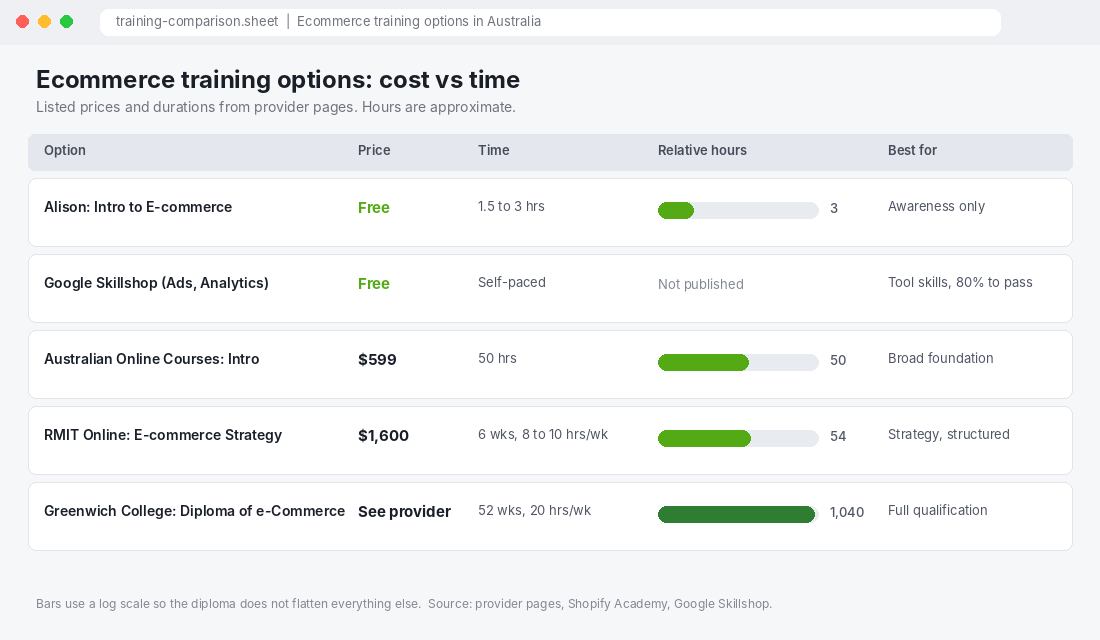
- Alison, Introduction to E-commerce Management: free, roughly 1.5 to 3 hours, according to The Retail Exec’s course roundup. Good for vocabulary, not for decisions.
- Australian Online Courses, Introduction to E-Commerce: listed at $599 for around 50 hours, including legal considerations (same roundup).
- RMIT Online, E-commerce Strategy and Experience: listed at $1,600 over 6 weeks at 8 to 10 hours a week (same roundup). Structured, assessed, and aimed at people building a career in the field.
- Greenwich College, Diploma of e-Commerce (11269NAT): 52 weeks full-time at 20 hours a week, delivered across Sydney, Melbourne and Brisbane, with ten units covering everything from path-to-purchase to paid traffic, per Greenwich College. That works out to roughly 1,000 hours of study. Entry requires Year 11 completion and English proficiency.
Do the maths on that last one. A founder running a live store cannot give 20 hours a week for a year to a diploma. The Greenwich qualification makes sense for someone entering the industry as an employee. It is a poor fit for an owner who needs results this quarter.
The shorter paid courses sit in the middle. They are cheap enough to be a low-risk way to learn the language of ecommerce, and shallow enough that they will not tell you what is wrong with your store.
The Free Training Most Founders Skip (and Should Not)
Before paying anyone, use the training the platforms themselves give away. It is the most current material available because the platform owners have every reason to keep it accurate.
Google Skillshop: set it up in 20 minutes
According to ReliableSoft’s Skillshop review, Skillshop courses and certification exams are free, the exams are multiple choice with an 80% pass mark, and every certification is valid for one year. If you run Google Ads or lean on Google Analytics, that is the cheapest education you will ever get.
- Sign in to Skillshop with the same Google account you use for Ads or Analytics.
- Pick one certification only: Google Analytics if your data is a mess, Google Ads if you are spending on search or Shopping.
- Work through the course modules, then take the knowledge check before the exam.
- Block your calendar for the exam. Closing it early counts as a fail, and you must wait a day to retake.
- Diary a renewal for 11 months out, because the certification lapses after a year.
Shopify Academy
Shopify Academy runs a catalogue of courses, paths and assessments. Many are tagged free, including “Introduction to Shopify”, while some paths such as conversion rate optimisation and influencer marketing carry a paid tag. Verified Skills badges come from proctored assessments, though several show as not currently available. Treat it as the reference library for how Shopify itself wants you to use the platform.
Meta Blueprint
Meta’s learning material is free, but the official certification exam is a paid, separate purchase. One 2026 review lists a US$99 voucher for the Associate exam, with the price varying by country (see Markampus). Completing the free lessons does not earn the credential. Do the learning, skip the exam unless a client or employer asks for the badge.
A simple rule: if you will never hand your ad account to an agency or hire a media buyer, the certificate itself is worthless. The knowledge is not.
Why Courses Fail Most Store Owners
Here is the uncomfortable part. A course teaches the average case. Your store is not the average case.
The Australian market also moves faster than a recorded module. Australia Post’s latest ecommerce data shows $21.9 billion spent online in the fourth quarter of FY26, an average basket of $90 that the report calls a record low, marketplaces taking 42% of online transactions, and 59% of shoppers saying they never buy at full price any more. Any course written two years ago was built for a shopper who behaved differently.
Courses fail in three predictable ways:
- The implementation gap. You finish the lesson, feel productive, and change nothing. Learning feels like progress, so you do more of it instead of shipping.
- The wrong problem. A 50-hour course covers email, ads, SEO and conversion. Your store might only have one of those broken. You pay for 40 hours you did not need.
- No feedback. Nobody looks at your numbers. If your conversion rate is the issue and you spend a month learning ad creative, you have optimised the wrong end of the funnel.
None of this makes courses bad. It makes them a tool for acquiring knowledge, which is only one of the three things a growing store needs. The other two are prioritisation (what to fix first) and accountability (making sure it gets done).
When Coaching Beats a Course
Coaching is not better than training. It is a different category, and it earns its cost in specific situations. You are probably ready for it when:
- You already have sales, but growth has stalled for a quarter or more and you cannot name the reason.
- You know a lot of tactics but keep bouncing between them without a clear order.
- A wrong decision is expensive. If a bad ad structure or a stock order costs you $5,000, paying someone to sanity-check your plan is cheap insurance.
- You have under five hours a week to spare. A course needs that time just to be consumed. Coaching tells you which two hours matter most.
- You need your actual numbers reviewed by someone who has seen the pattern across many stores.
Coaching is the wrong choice if you have no store, no product and no traffic. At that stage you need the basics, which means a cheap course or free platform training plus a lot of doing. Be wary of anyone who sells high-ticket coaching to a store with no revenue.
If you are weighing coaching against hiring outside help, our piece on whether you need a coach, an agency or both explains where each one fits, and the guide to choosing an ecommerce agency covers the other side of that decision.
A Real Example: Learning by Doing Beats Learning by Watching
The founder of The Oodie, David Fogarty, is worth studying here. According to SmartCompany, he went through several failed ventures first, then learned from free resources like YouTube, podcasts and books. He bought a camera, taught himself videography, and offered content work to small Adelaide businesses so he could learn on the job. He says that period of learning was “the defining moment” that stopped him failing businesses.
Look at what he did. The learning was tied to a live project from day one. The same article reports The Oodie reaching $155 million in a financial year, a 408% jump over FY2020, though that scale came from far more than his learning habits. The point is the method, not the headline number: he did not collect knowledge, he applied it to something real and measurable.
Greenwich College’s diploma is built on the same idea at the other end of the scale. Its units cover creating product listings, optimising the post-purchase process, and developing paid traffic strategies. The qualification works because the units are practical tasks, not only theory. You can copy that structure for free, which is what the sprint below does.
The 30-Day Training Sprint: Make Every Lesson Go Live
This is the framework we recommend to anyone who insists on learning through courses. It has one rule: no new lesson until last week’s lesson is live on your store.
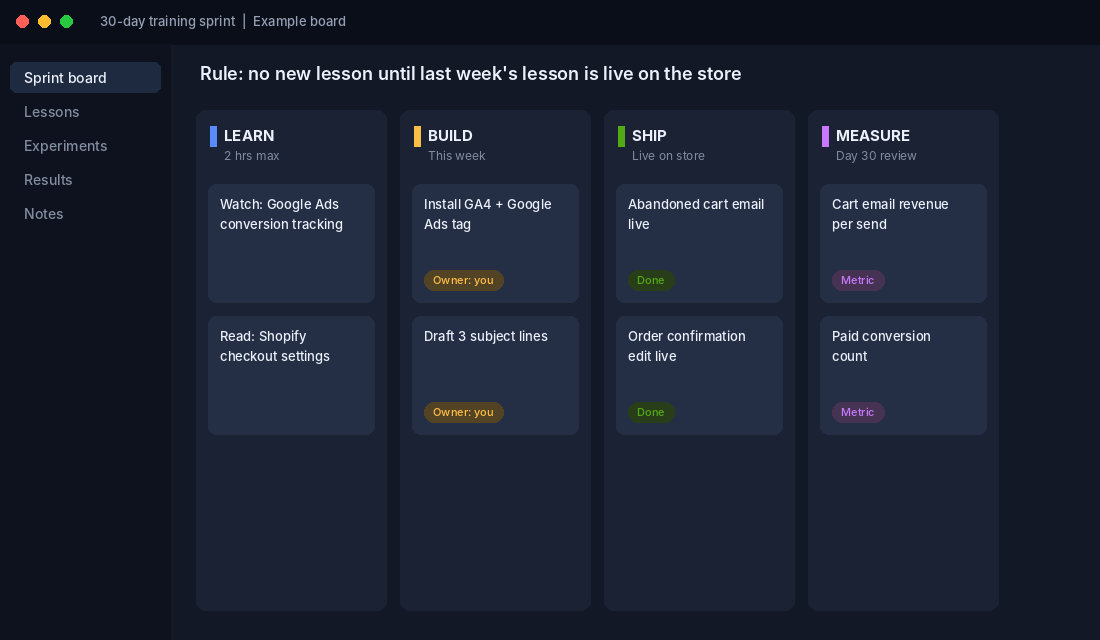
The four columns
- Learn (2 hours maximum per week). Pick one topic tied to one metric. Example: abandoned cart emails, because your cart-to-order rate is the weak link.
- Build (this week). Turn the lesson into a task with an owner and a deadline. If the owner is “someone”, it will not happen.
- Ship (live on the store). A drafted email does not count. A running flow does.
- Measure (day 30). Name the single number you expect to move before you start. Check it at the end of the month.
Sprint template you can copy today
- Metric I am trying to move: (one only, for example checkout conversion rate)
- Course or lesson I will use: (name, plus a hard stop of 2 hours a week)
- What I will build by Friday: (a specific change someone can see on the store)
- Who owns it: (a name and a date)
- How I will know it worked: (the number, and the day I check it)
- What I will stop doing: (if you add a task, remove one)
Run four of these in a row and you have completed a full quarter of improvements while most people are still on module six. If, after two sprints, you cannot pick the right metric or the numbers do not move, that is your signal to bring in a second set of eyes.
The Course or Coaching Fit Check
Score each line 0 for no or 1 for yes. Be honest, because nobody is marking you.
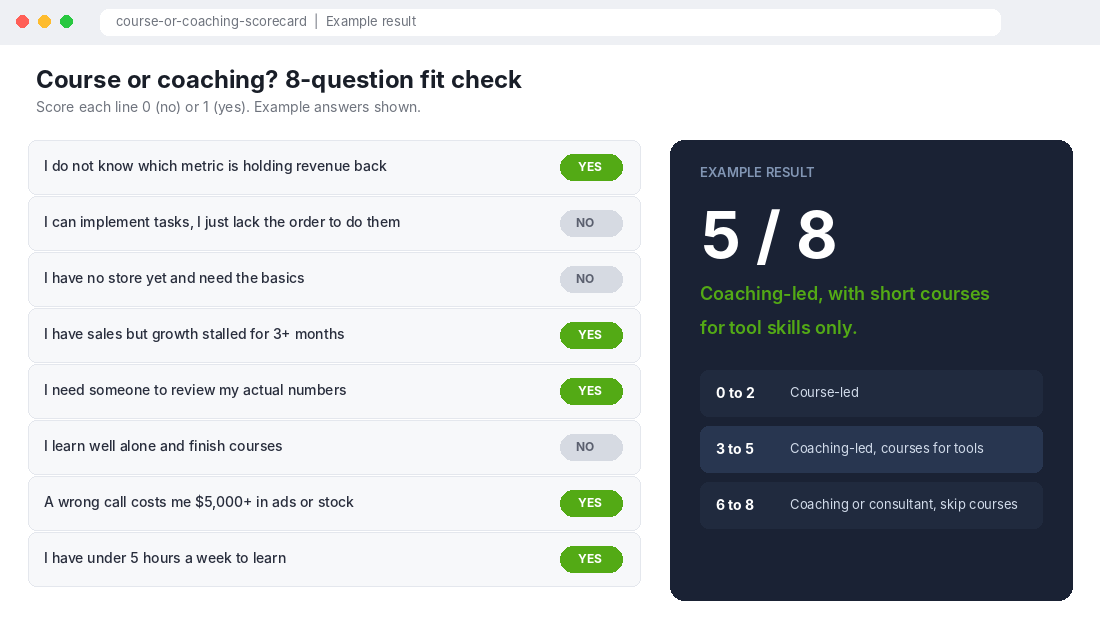
- I do not know which metric is holding my revenue back.
- I can implement tasks fine, I just lack the right order to do them in.
- I have no store yet and need the basics.
- I have sales, but growth has stalled for three months or more.
- I need someone to review my actual numbers.
- I learn well alone and I finish courses I start.
- A wrong call costs me $5,000 or more in ads or stock.
- I have under five hours a week to learn.
How to read your score. Questions 1, 4, 5, 7 and 8 point towards coaching. Questions 3 and 6 point towards courses. Question 2 is a tie-breaker: if you can already execute well, you may only need a plan, not a program.
- Mostly yes on 3 and 6: Start with free platform training and one short course. Run two sprints before spending more.
- Mostly yes on 1, 4, 5, 7 and 8: Skip the 50-hour course. Use the free Skillshop and Shopify material for tool skills only and put your budget into someone who reviews your numbers.
- A mix: Do both, in that order. Short course for vocabulary, then coaching to apply it.
What to Spend at Each Stage of Your Store
Match the training to the stage, not to the sales page. A rough guide we use when store owners ask where to put their money:
- Pre-launch or first sales: free platform training, plus one short paid course if you want structure. Your job is to get product, traffic and a working checkout, and no course can do that for you.
- Consistent sales, flat growth: targeted Skillshop or Shopify Academy modules for the channel that is underperforming, plus a monthly review of your numbers. This is where outside input starts to pay back.
- Scaling and hiring: training your team on specific tools matters more than your own education. Put the budget into onboarding and systems, and use coaching to keep the whole operation pointed at the right metric.
Whatever the stage, set a ceiling before you buy. Decide the most you will spend on learning this quarter and what result would justify it. If you cannot name the result, you are not ready to buy yet.
How to Spot a Course That Is Not Worth Your Money
Before you pay for any ecommerce course in Australia, run it through this checklist.
- Ask for the syllabus before you pay. If it is not published, treat that as a no.
- Check the date. Platforms change quickly. If the modules were recorded two or more years ago, ask what has been updated.
- Look for Australian specifics. GST, Australia Post and local carrier rates, Afterpay and Zip, and ACL obligations are not optional extras for an Aussie store.
- Find the practical assignments. If the course is video only with no tasks, you are buying content, not a result.
- Be wary of income promises. Anyone guaranteeing revenue cannot know your product, margin or audience.
- Cross-check the free alternative. If the same topic is covered in Shopify Academy or Skillshop for nothing, the paid version needs a clear reason to exist.
The Compound Effect: Knowledge, Priority and Accountability
Training works when three things stack together. Knowledge tells you how a tactic works. Prioritisation tells you which tactic to run first for your numbers. Accountability makes sure it is live by Friday and measured by month end.
Free platform training and short courses cover the first. A sprint board covers a lot of the third. The second is the piece most stores cannot do for themselves, because you cannot see your own blind spots. That is why the stores that grow fastest usually combine all three rather than looking for one perfect program.
So the best answer to “course or coaching?” is rarely one or the other. Use free training for the tool skills, one paid course if you need the vocabulary, and bring in outside eyes when the decisions start costing real money.
Inside eCommerce Circle, building a team and a learning rhythm that actually changes the store is one of the core pillars we work on with every member. If you want to see exactly where your store is being capped before you spend another dollar on training, take the free More Orders Scorecard. It takes two minutes and shows you which of the 10 P’s to fix first.