Most Aussie store owners treat a mastermind like a gym membership. They sign up in a burst of motivation, turn up twice, and decide it does not work. A smaller group does the opposite. They pick one room, show up every month with their real numbers, and quietly fix problems that cost everyone else six months.
What’s in This Article
Both groups are paying roughly the same money. The difference is the room they chose and what they brought to it. A MYOB Solo survey of 1,059 sole traders found that 77% feel lonely or isolated when working as their own boss. Running a Shopify store from a spare room or a warehouse office is a lonely job, and the people closest to you usually cannot tell you whether your 2.1% conversion rate is a problem.
This article gives you a straight answer to whether an ecommerce mastermind in Australia is worth it. You will get what the research does and does not prove, what the main formats cost, a six-test scorecard for vetting any room, a 90-minute meeting agenda, and a step-by-step way to build your own group if nothing on the market fits.
What an Ecommerce Mastermind Actually Is (and What It Is Not)
A mastermind is a small, recurring group of business owners who work on each other’s problems. That is it. There is no curriculum, no guru at the front, and no certificate at the end. The value comes from other operators asking sharper questions than you would ask yourself.
People mix this up with other support options all the time, so here is the clean split.
- Coach. One person who diagnoses your business and holds you accountable. We break down what that costs in our guide to an ecommerce coach in Australia.
- Consultant. A specialist you hire to fix or build one thing. See our comparison of an ecommerce consultant in Australia.
- Agency. A team that does the work for you, covered in when a brand needs a coach and an agency.
- Course. Recorded material you work through alone. We compare the options in ecommerce training in Australia: courses vs coaching.
- Mastermind. Peers at a similar stage, comparing real numbers and decisions. Nobody in the room is paid to be right, which is both the strength and the risk.
Notice what a mastermind cannot do. It will not build your Klaviyo flows, audit your Shopify theme, or tell you the one thing wrong with your funnel. Peers see your business through the narrow window you show them. If you want a diagnosis, you need a coach or consultant. If you want perspective, comparison and pressure to act, you need peers.
The Case For a Peer Group (and Why the Growth Stats Need a Grain of Salt)
Let’s start with the honest part. The most quoted numbers in this space come from the groups selling memberships, and they all suffer from the same flaw: successful founders are more likely to join, so you cannot tell whether the room caused the growth or attracted it.
With that caveat on the table, here is what the evidence says.
- Vistage: a 2017 analysis on Dun & Bradstreet data, published by Vistage, put member companies at a 28% average compound annual growth rate against 12.5% for average US small and medium businesses (788 member companies against 918 comparison companies).
- EO in Australia: a piece on the Entrepreneurs’ Organization and Australian SMEs claims members average 30% annual growth, against a national small business average of 3.7% (citing the 2024 Xero Small Business Insights).
- Million Dollar Sellers: a write-up by MDS on ecommerce mastermind groups cites a study in which member companies grew revenue 4.6% in 2020 while comparable non-members shrank 4.7%.
- Loneliness: in a YouGov survey for the UK’s Start Up Loans Company, 65% of owners trading for under a year reported loneliness, and 51% of owners in South East England said they wish they had someone to turn to. It is a UK sample, but the pattern matches what we hear from Australian founders.
Read those as direction, not proof. All three growth figures are published by or about the groups that benefit from them. But the isolation numbers are harder to argue with, and they explain why peer groups keep working for the founders who commit to them.
The real benefit is not advice. It is three things you cannot easily get elsewhere:
- A benchmark. You finally learn whether your 28% repeat purchase rate is average or a problem.
- A deadline. Telling five peers you will fix your checkout by the next meeting beats telling yourself.
- Pattern recognition. Someone has already survived the 3PL switch, the ad account ban or the first ops hire you are dreading.
Proof From Operators Who Did It
Here are three Australian examples worth knowing. None of them proves a mastermind causes growth, but each shows how experienced operators describe the value.
RPM Hire. Founder Ash Woodcock says his revenue grew from $6 million when he joined EO to a tracked $50 million, as reported in that same EO Australia profile. RPM Hire is an equipment business rather than a Shopify store, but the lesson transfers: he stayed in the room while the business outgrew its original problems.
WAG. Jeremy Goldman built the natural dog treat brand from a team of three to sixty over nine years. In the same profile he says the biggest lesson from EO was realising you are not alone in your journey. That is the unglamorous truth of most peer groups. The tactical advice is useful, but the steadiness is what keeps founders in the game.
Oz Hair & Beauty. COO Guy Nappa topped Inside Retail’s 2026 Top 50 People in E-commerce. In Australia Post’s write-up of the list, he says ecommerce operators share problems openly because they do not all compete directly, and credits that community with advice and contacts that helped him grow. Heather Earl of Nutrition Warehouse Group says the community has become tighter over the past 12 months, with more idea sharing among peers.
That last point matters for your decision. The best peer rooms are not made of direct competitors. They are made of founders in adjacent categories who face the same operating problems: ad costs, stock cash flow, hiring, carrier pricing.
What Ecommerce Masterminds Cost: The Four Tiers
Prices vary wildly, and most are quoted in US dollars. The figures below come from a GrowthMentor comparison of mastermind groups. GrowthMentor is itself one of the listed options, and several figures are marked “reported”, so treat them as ranges and confirm current pricing with each group before you apply.
| Tier | Typical cost | Examples and entry rules |
|---|---|---|
| Community or free | $0 to about $500 a year | Facebook groups, Slack communities. Open entry, no vetting, no accountability. |
| Paid online | About $100 to $1,000 a month | Matched pods and cohorts. MicroConf Masterminds charges a one-time matching fee of $250 to $2,500 by revenue tier. |
| Premium and in-person | About $2,500 to $25,000 a year | EO: roughly $2,630 a year plus about $3,500 initiation, and a $1M annual revenue gate. Vistage: roughly $13,000 to $22,000 a year, typically $5M+ revenue. Million Dollar Sellers: $8,997 a year, and $1M+ trailing ecommerce revenue plus two interviews. |
| Elite and curated | $25,000 to $100,000+ a year | Genius Network starts at $25,000 a year. Invite-only, founder-network style. |
Two practical points for Australian stores. First, most of these are priced in USD, so your real cost is higher once you convert. Second, the revenue gates tell you something. If a group requires $1M or more in revenue, it is built for operators with teams and stock exposure. If you are at $150,000 a year, you will be the smallest person in the room and the advice will not fit your constraints.
A useful rule: keep your total yearly spend on any peer group under 1% of your annual revenue until it has proven itself. At $400,000 a year in revenue, that is $4,000. It rules out the elite tiers and forces you to look at paid online or a local circle first.
When a Mastermind Is Worth It (and When It Is a Distraction)
Here is the opinion most coaching businesses will not give you: a mastermind is the wrong move for a lot of stores. It works when you already have something to compare and fix. It wastes time when you are still guessing.
It is worth it when
- You have at least 12 months of trading data and a store doing a steady monthly revenue.
- You can name a specific problem, such as a flat conversion rate, a payroll step-up or a supplier renegotiation.
- You have capacity to run an action between meetings, not just attend.
- You are the decision-maker. Peers cannot help a founder who has to ask three people before changing anything.
It is a distraction when
- You have not found a product that sells. You need customers and a diagnosis, not peers.
- You are hoping the room will fix your fundamentals. Start with the free More Orders Scorecard. It shows you which of the 10 P’s is capping orders, and the People section checks whether you have the support around you that growth needs.
- You are collecting groups to feel busy. Three half-attended rooms beat nothing, but one fully used room beats all three.
- You want someone to tell you what to do. That is a coach’s job.
How to Vet a Room: Six Tests Before You Pay
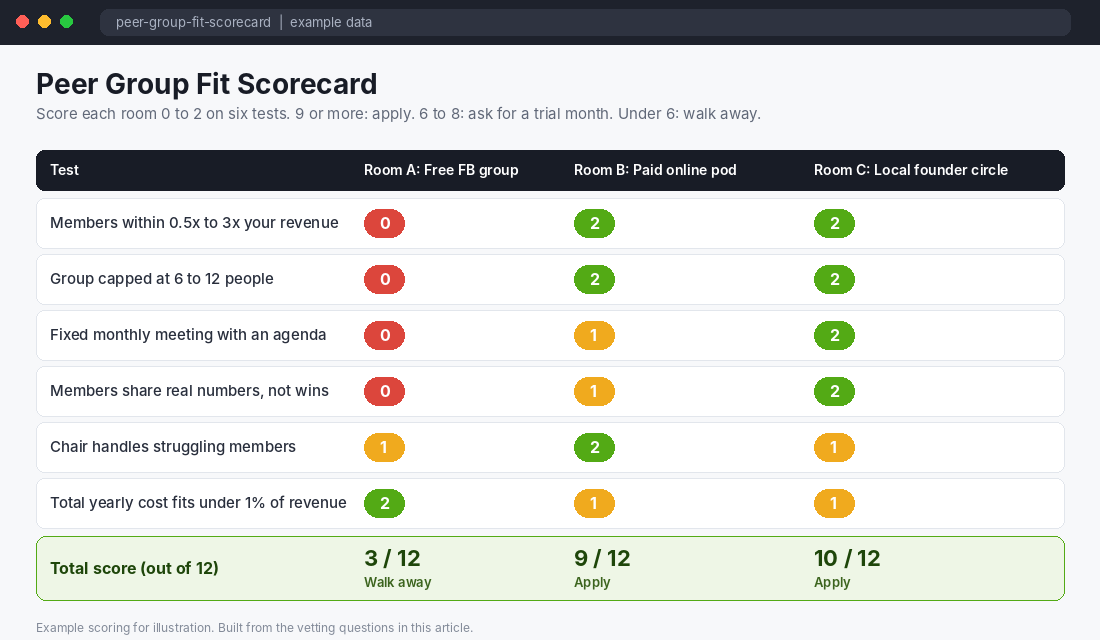
GrowthMentor’s own guidance lists the failure modes: a wrong cohort, no psychological safety, members who perform success and hide real problems, and a founder who steers the room towards the answer they already want. Turn those into six questions and score each room from 0 to 2.
- Who else is in the room? Ask for the revenue range, business model and tenure of current members. You want people between roughly half and three times your revenue. Anyone far below cannot challenge you and anyone far above is solving different problems.
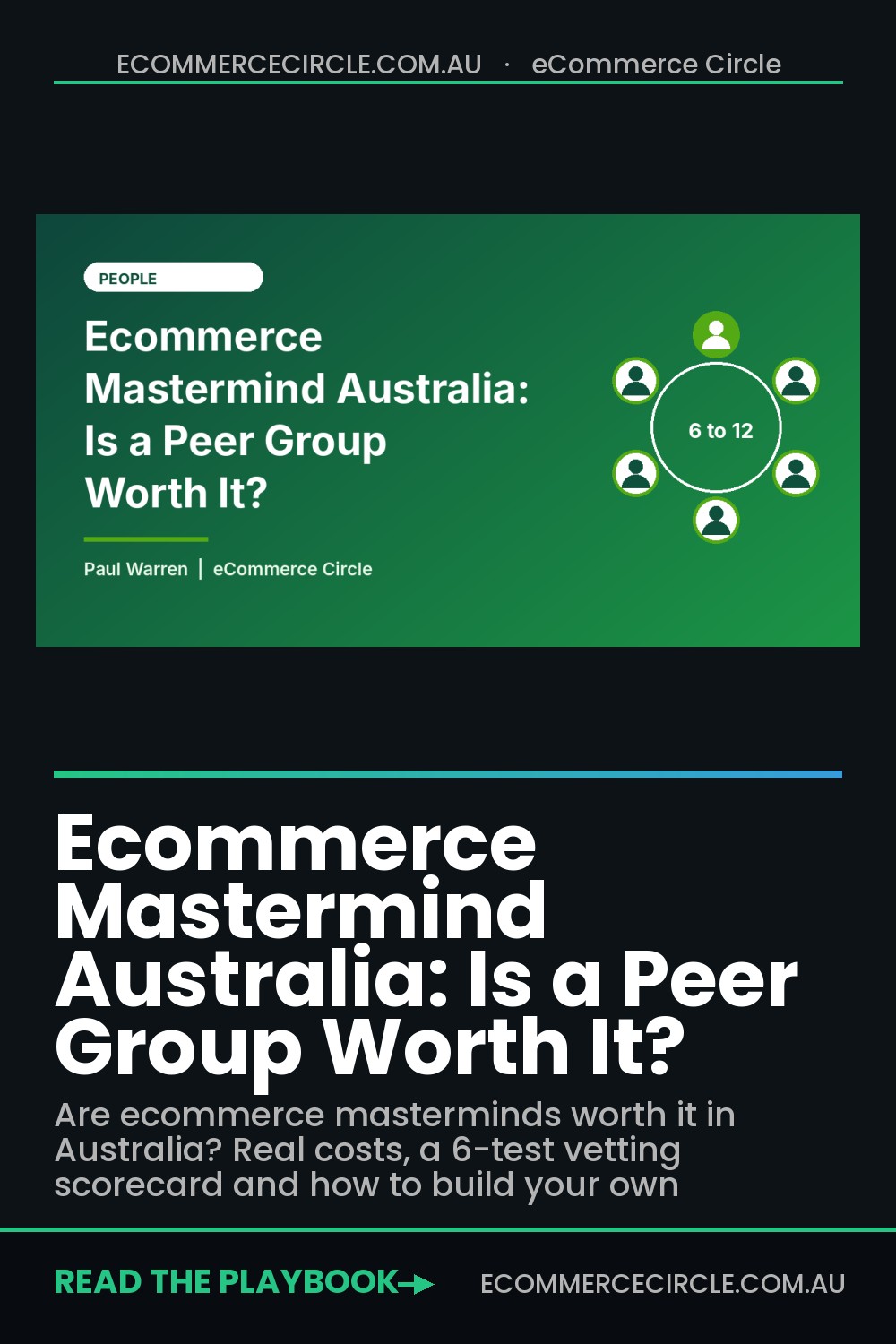
- How big is the group? Six to 12 members is the typical range, with squads of six to eight common in ecommerce. Past 12, nobody gets airtime.
- Is there a fixed cadence and agenda? Monthly works for most groups. A room that meets whenever people feel like it dies within a quarter.
- Do members share real numbers? If the room runs on wins and screenshots, you are in an audience, not a mastermind.
- What happens when a member is struggling? Ask this out loud. Vague answers mean the room will not deliver when you need it most.
- Who is the chair? Vet the person running your specific group, not the brand. A weak chair makes any price hard to justify.
Score 9 or more out of 12 and apply. Score 6 to 8 and ask for a trial month. Anything under 6, walk away. The scorecard image above shows three example rooms scored this way. The free Facebook group scores 3 out of 12, which is fine as a place to read, but is not a mastermind.
Build Your Own: A Six-Person Ecommerce Mastermind in 30 Days
If nothing on the market fits your stage or budget, build one. It costs almost nothing, and for stores between $150,000 and $1M a year it is often the better option. The GrowthMentor guide suggests starting with four to seven people, and six is the sweet spot because someone will always miss a meeting.
Step 1: Recruit five peers (week 1)
Look for founders in adjacent categories within about half to three times your revenue. Good sources are Shopify Partner events, your agency’s client list (ask for introductions), podcast communities and your supplier network. Do not invite direct competitors selling the same hero product.
Send a short message: who you are, what you do, the monthly format, and the one rule. Real numbers stay inside the group.
Step 2: Set up your tools (week 2)
You need three things, and all of them are free or close to it.
- A group chat. Slack or WhatsApp. One channel for quick questions, no side conversations.
- A shared Google Sheet. One row per member per month. Columns for revenue, conversion rate, average order value, MER, repeat rate, contribution margin and biggest bottleneck.
- A video call link. Zoom or Google Meet, with a recurring calendar invite that holds the same slot every month.
To fill the sheet, pull conversion rate, AOV and revenue from your Shopify Analytics dashboard for the previous calendar month. Calculate MER as total revenue divided by total ad spend. If you want a refresher on why that metric beats platform ROAS, read our guide to MER and why it replaces ROAS.
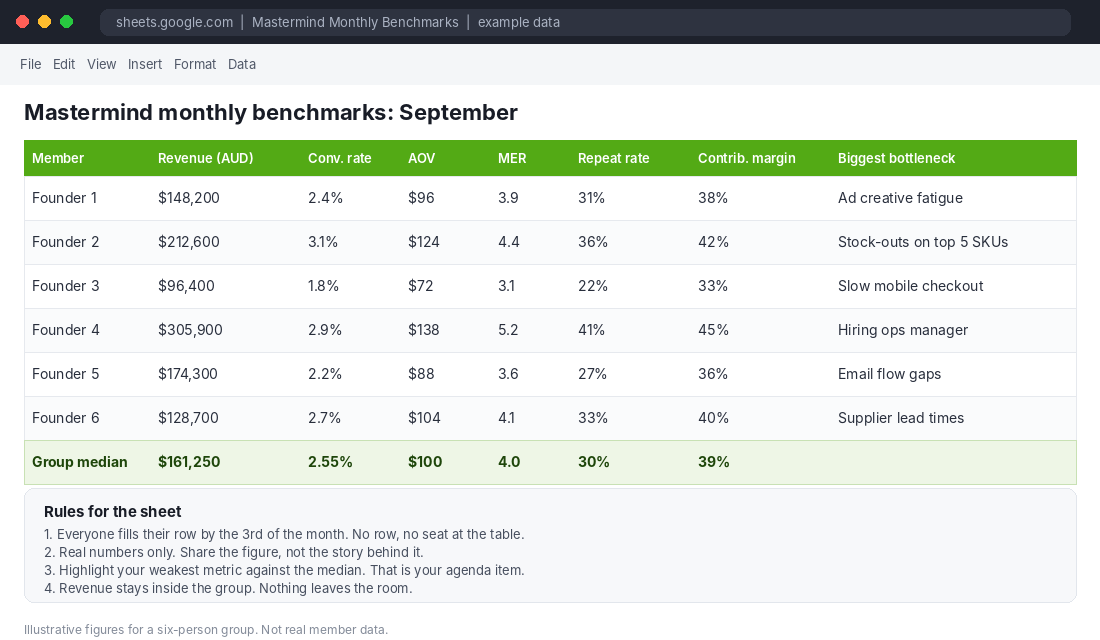
Set four rules in the first row of the sheet: everyone fills in by the 3rd, real numbers only, the weakest metric against the median becomes your agenda item, and revenue never leaves the group. The median row is the whole point. It turns a vague feeling that you are behind into a number.
Step 3: Run the 90-minute session (week 3)
Structure beats good intentions. This agenda works for six founders and keeps the meeting from turning into a chat.
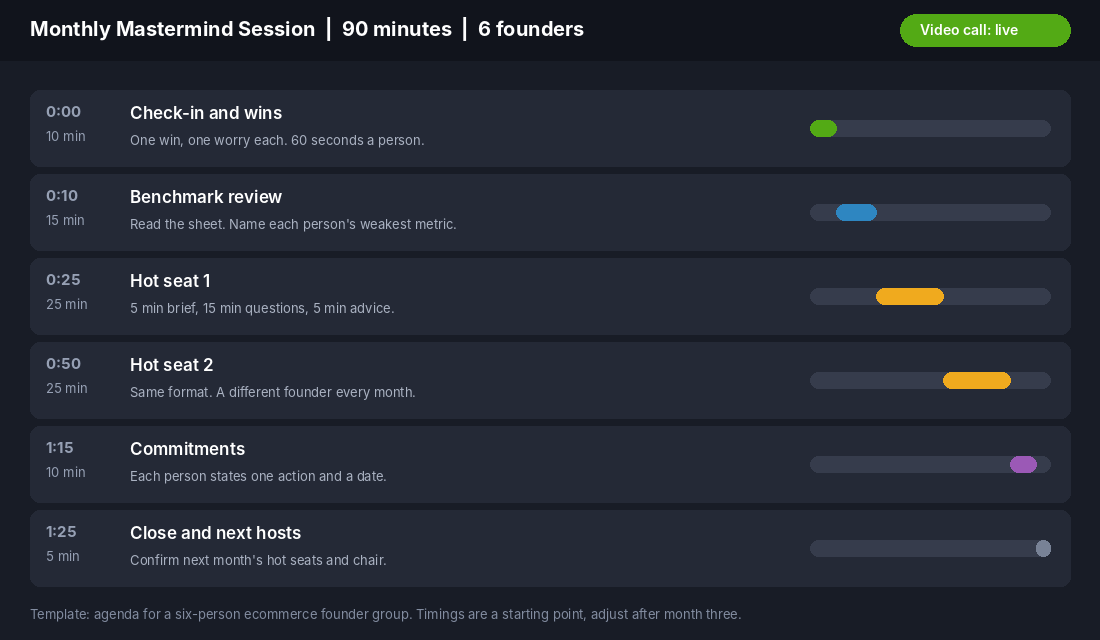
- 0:00 to 0:10, check-in. One win and one worry each, 60 seconds a person.
- 0:10 to 0:25, benchmark review. Read the sheet. Each founder names their weakest metric against the median.
- 0:25 to 0:50, hot seat one. Five minutes to brief the problem, 15 minutes of questions only, five minutes of advice.
- 0:50 to 1:15, hot seat two. Same format, different founder.
- 1:15 to 1:25, commitments. Everyone states one action and a date.
- 1:25 to 1:30, close. Confirm next month’s hot seats and chair.
The questions-only block is the most important rule. Most founders jump to advice in the first 30 seconds, based on their own business. Fifteen minutes of questions forces the group to understand the problem before anyone prescribes a fix.
Step 4: Hold the line (week 4 and beyond)
Rooms fail in month three, not month one. Appoint a rotating chair who owns the agenda and chases missing sheet rows. Remove anyone who misses two meetings in a row. Review the group after six months: if you cannot name three decisions that changed because of it, close it or recruit new members.
The Compound Effect: How the Pieces Work Together
A mastermind on its own is a conversation. The benchmark sheet on its own is a spreadsheet. The agenda on its own is a calendar invite. Put the three together and you get a loop that compounds.
The sheet shows each founder where they sit against the median. The hot seat gives the weakest metric 25 minutes of focused questioning from five people who have seen the problem before. The commitment round turns the advice into a dated action. Next month, the sheet shows whether the action moved the number. That is a feedback cycle most solo founders never build, and it is why the same room can look like a waste of money for one founder and a growth engine for another.
It also changes what you do between meetings. Knowing you will face your peers with a specific number in 30 days is a stronger motivator than a quarterly goal in a notebook.
Your Mastermind Checklist
Use this before you spend a dollar or send a single invite.
- I have at least 12 months of trading data and can name one specific problem to fix.
- I can spend two to three hours a month on preparation and the meeting itself, plus time for actions.
- My yearly spend on any group is under 1% of annual revenue.
- I have scored every room I am considering out of 12 and picked the highest above 8.
- The members are between half and three times my revenue and not direct competitors.
- The group has a fixed monthly cadence, a chair and a shared benchmark sheet.
- I will review the group at six months against three decisions it changed.
Where to Go From Here
Pick one next step this week. If you are at $150,000 or more in annual revenue and can name a problem, score two or three rooms using the six tests, or message five peers about starting your own. If you are earlier than that, use the time to fix your fundamentals first.
Inside eCommerce Circle, peer comparison and accountability are two of the core habits we work on with members. If you want to see exactly where your store is being capped, take the free More Orders Scorecard. It takes two minutes and shows you which of the 10 P’s to fix first.