A Shopify loyalty program pays when it rewards your second and third order without cutting margin on the first. Most stores do the opposite. They install a points app, hand out 10% back on everything, and wonder six months later why profit is down and repeat rate hasn’t moved.
Here is what the stores that get it right do differently. Adore Beauty, one of Australia’s biggest online retailers, reported that returning customers made up 71% of revenue after launching its Adore Society program, and it deliberately avoided a points model. You don’t need Adore’s scale to copy the thinking. You need a program built around your margin, your average order value and the one behaviour you want more of.
This guide gives you the exact build: how to decide if you’re ready, which model fits, how to price your rewards so they never eat your margin, the apps worth paying for, and a launch checklist you can run this week. If you want the benchmark first, start with our repeat customer rate guide, then come back.
Is a Loyalty Program Worth It for Your Store?
Not always. A loyalty program is a retention tool, so it only works when there is something to retain. Before you spend a cent, check three numbers inside Shopify analytics.
- Repeat customer rate. If it’s under 15% and your product is something people naturally buy again (skincare, coffee, pet food, apparel basics), a program has plenty of room to lift it. Many ecommerce roundups put the average repeat purchase rate near 28%, so use that as a rough yardstick, not a target.
- Orders per month. Under 100 orders a month, keep it simple: a thank-you email with a second-order code beats a full program. Over 300 a month, a program starts to earn its keep.
- Gross margin. Under 40% gross margin leaves very little room for rewards. Fix pricing first with our contribution margin audit.
The case for doing it is strong when those numbers line up. Industry roundups compiled by Ringly cite figures like repeat customers accounting for 65% of company revenue and acquiring a new customer costing 5 to 25 times more than keeping one (originally attributed to Edesk and Queue-it respectively). Treat those as directional, since they’re secondary citations, but they match what we see in coaching: your best customers are cheaper and more profitable than any new one your ads can find.
The most useful Australian numbers come from real brands. LoyaltyLion’s case study for Australian brand Esmi Skin Minerals reports 58% of customers enrolled and loyalty member spend doubling. Another LoyaltyLion client, The INKEY List, reports that its top-tier members spend 5.3 times more than its bottom-tier members. Those are vendor-published results, so expect your own to be lower, but the direction is consistent.
Pick the Right Model: Points, Tiers or Perks
Most failed programs pick the model first and the goal second. Flip that. Decide the single behaviour you want, then choose the model that rewards it.
| Model | Best for | Main risk |
|---|---|---|
| Points (earn per dollar, redeem for credit) | Frequent, lower-priced purchases like consumables and beauty | Points liability on your books, and customers who never reach a reward |
| Tiers (status based on 12-month spend) | Higher AOV brands and gifting, where status and early access matter | A first threshold that feels too far away |
| Perks / membership (free shipping, early access, no points) | Lean teams that want low admin and low margin risk | Hard to measure unless you tag members properly |
| Referrals (give $X, get $X) | Brands with strong word of mouth | Fraud and discount-hunters |
Adore Beauty is the best local example of choosing on purpose. According to SmartCompany’s 2022 coverage, loyalty lead Miranda Bliss avoided points because market research suggested around 90% of customers would never earn enough to redeem anything. Instead, Adore Society uses three spend-based levels (up to $399 a year, $400 to $1,499, and $1,500 or more) with benefits like masterclasses, exclusive offers and early access to new brands. Existing customers were rewarded retroactively for their previous 12 months, so people joined at a level they’d already earned. Over 90,000 members signed up in the first three months.
Notice what Adore didn’t copy: a discount. The rewards were access and status, which cost far less than a percentage off.
Our default recommendation for a Shopify store doing $300K to $3M a year: start with a simple points base plus two or three spend-based tiers where the perks are mostly access (early drops, free shipping, gifts) rather than cash. It gives casual buyers a reason to join and your best buyers a reason to stay.
Price Every Reward Before You Promise It
This is the section most guides skip, and it’s where programs quietly lose money. Every reward has a cost, and that cost comes out of gross profit on a repeat order. Work it out per reward, not as a vague percentage.
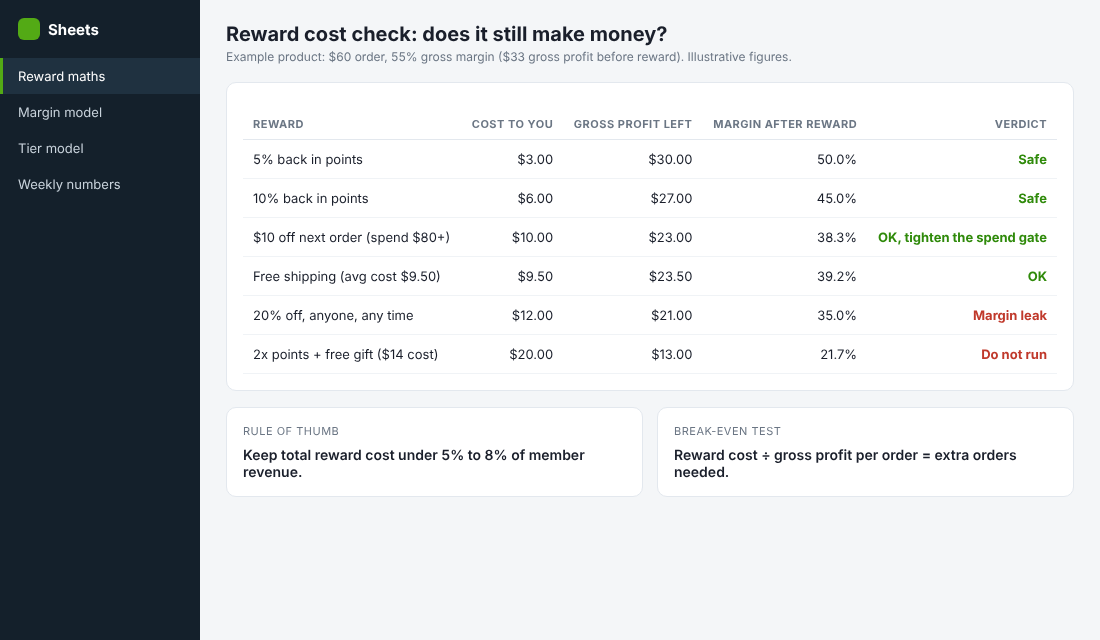
Here is the maths on a $60 order with a 55% gross margin. Gross profit before any reward is $33.
- 5% back in points costs $3. Gross profit left: $30, or a 50% margin. Safe.
- $10 off next order, with an $80 minimum spend costs $10. Gross profit left on a $60 order would be $23, but the minimum spend pushes the basket up, which is the whole point. OK.
- Free shipping at an average carrier cost of $9.50 leaves $23.50. OK, and it’s the perk Australian shoppers value most.
- 20% off for anyone, any time costs $12 and drops margin to 35%. That’s a margin leak, not a loyalty perk.
- Double points plus a $14 free gift costs $20 and leaves a 21.7% margin. Don’t run it.
Two rules keep you safe. First, keep total reward cost under roughly 5% to 8% of member revenue. That’s a guide from our client work, not an industry law, so test it against your own margin. Second, always gate a reward behind a spend or a time limit. A $10 voucher that needs an $80 basket changes behaviour. A $10 voucher with no condition just reduces profit.
Breakage (rewards that are earned but never redeemed) will help your numbers, but don’t build your maths around it. If your program only works because customers forget to use it, it’s fragile.
Build Tiers People Actually Climb
Tiers work through one psychological trick: people want to reach the next level. That only happens if the next level feels close. Set your first threshold at roughly 1.5 times your average order value, so one extra order or a slightly bigger basket gets someone over the line.
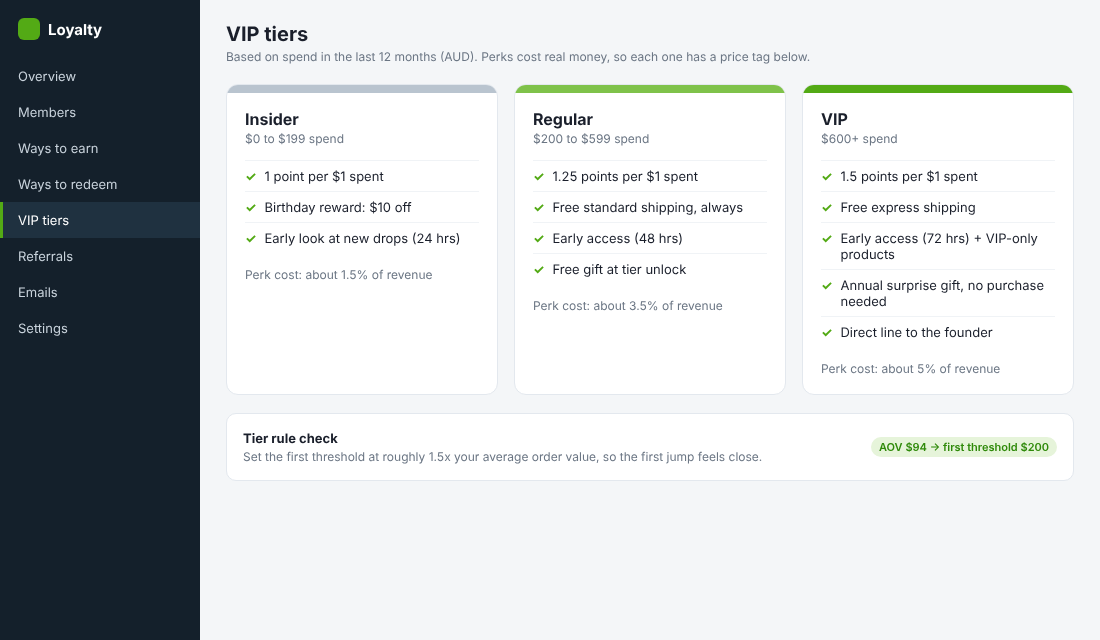
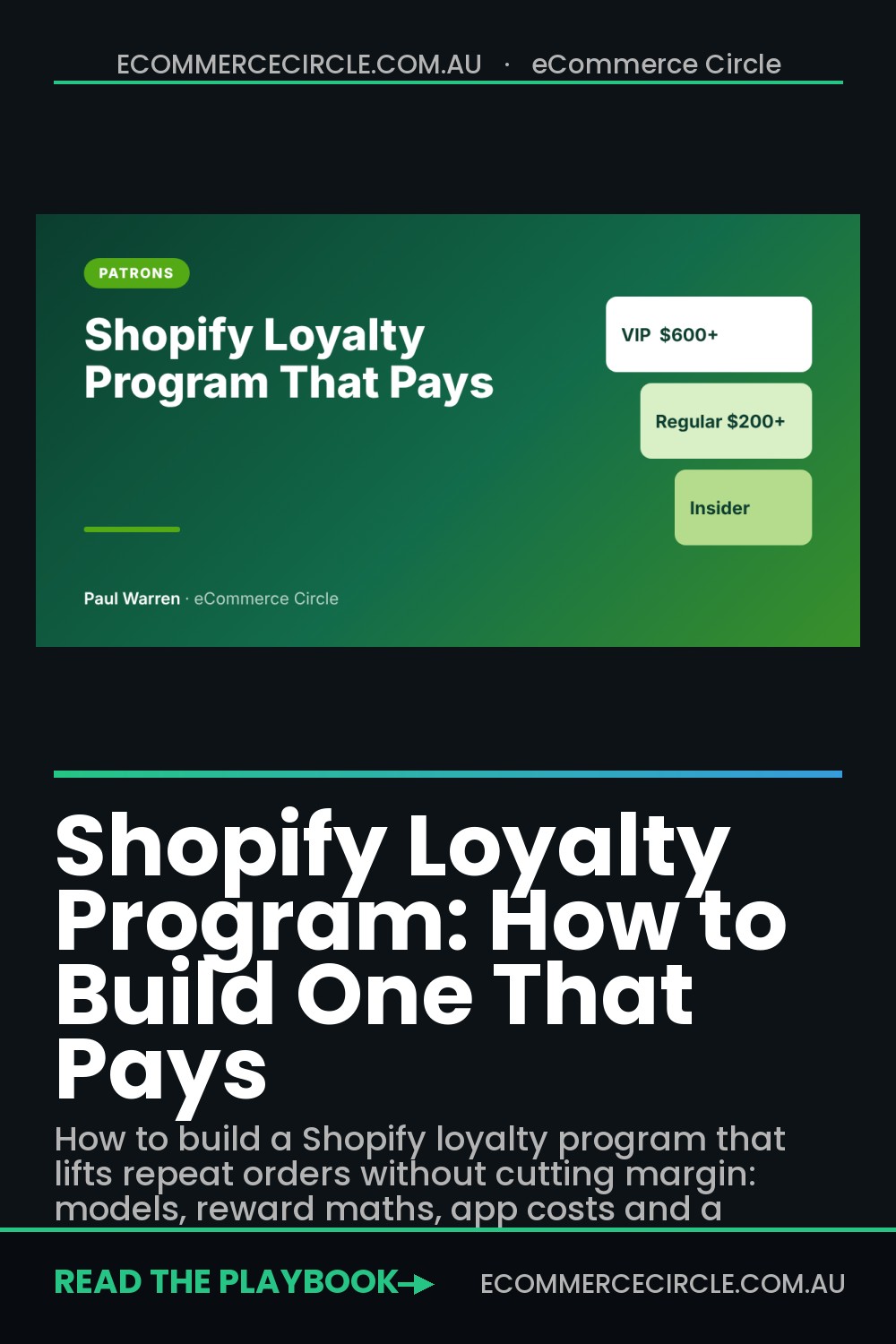
Using the example above, with an AOV of $94, the Regular tier starts at $200 of 12-month spend (about two orders) and VIP starts at $600. Each tier has a price tag attached:
- Insider ($0 to $199): 1 point per dollar, a birthday reward and a 24-hour early look at new drops. Cost: about 1.5% of revenue.
- Regular ($200 to $599): 1.25 points per dollar, free standard shipping and 48-hour early access. Cost: about 3.5%.
- VIP ($600+): 1.5 points per dollar, free express shipping, 72-hour early access, VIP-only products and an annual surprise gift with no purchase needed. Cost: about 5%.
That annual surprise gift is borrowed from Adore Society, where top-tier members can choose one day a year to receive a reward that isn’t tied to spending. It’s cheap, memorable and it’s what people talk about. Our surprise and delight playbook covers how to run these moments without wrecking margin.
Backdate the first tier
Do what Adore did. Credit existing customers for their last 12 months of orders on day one. Nobody likes joining at the bottom of a ladder they’ve already climbed, and it gives you an instant launch email list of people with a status to talk about.
The Australian Rules You Can’t Ignore
Loyalty programs sit under Australian Consumer Law, and the ACCC has looked closely at them. Its 2019 Customer Loyalty Schemes report found that almost nine in ten adults belong to a loyalty scheme, and the average Australian carries four to six loyalty cards. That’s great news for adoption and bad news for attention, because shoppers are tired of schemes that overpromise.
The ACCC flagged problems that small stores can easily fall into. Check each one against your program:
- Unclear terms. Publish how points are earned, when they expire and what counts as active. Hidden expiry rules were a core ACCC concern.
- Changing the deal quietly. If you reduce earn rates or devalue points, tell members clearly and in advance.
- Data use. Say in plain English what you do with member data. Update your privacy policy before you launch, not after.
- Misleading claims. Don’t advertise ‘up to 20% back’ if only one product qualifies. The ACCC reminded businesses to avoid statements likely to create a false impression.
This isn’t legal advice, so have your accountant or lawyer review the terms. If you offer store credit, our returns and legal guides cover the overlap: see the Shopify returns policy Australia template.
Choose Your App: What You’ll Actually Pay
You don’t need to build any of this by hand. Three apps cover most Aussie Shopify stores. Prices below are what the vendors or reviewers published at the time of writing, in USD unless stated, so check the current pricing page before you commit.
| App | Starting price | Good for | Watch out for |
|---|---|---|---|
| Smile.io | Free (200 orders a month cap). Standard from $79, Growth from $199 (VIP tiers start here), per a Rivo review dated April 2026 | Testing a basic points and referral program cheaply | VIP tiers aren’t on the free or Standard plans; Rivo is a competitor, so verify on Smile’s own page |
| LoyaltyLion | From $199 a month, depending on program size and features, per its Australian site | Brands that want points, VIP tiers, referrals and revenue attribution in one place | Priced for stores with real volume |
| Shopify’s native options | Included in your plan or via free discount and customer-tag setups | Perks-only programs run with customer tags and Klaviyo segments | More manual work, and no points ledger |
Setup steps with LoyaltyLion (about 2 hours)
- Install LoyaltyLion from the Shopify App Store and log in to your store to start the setup. Customer profiles and purchase history sync from Shopify automatically.
- Add your earning rules: points per dollar, plus a small bonus for a review or referral. Keep it to three rules, not ten.
- Add your rewards, using the cost check from earlier. Start with free shipping, a gated voucher and one product reward.
- Turn on VIP tiers and set your thresholds at 1.5x AOV for tier one. LoyaltyLion syncs tier tags back to Shopify, so you can segment in Klaviyo.
- Use the Theme Editor to build a loyalty page that matches your brand, with no code needed. Add a header link and a post-purchase widget.
- Check Loyalty Attributed Revenue in the analytics screen after 30 days to see what the program really drives.
If you run Klaviyo, sync the tier and points tags to profiles, and build the emails in our Klaviyo flows guide: a welcome-to-the-program email, a points reminder, a ‘you’re $X from the next tier’ nudge and a win-back for lapsed VIPs.
Launch It and Get the First 30% to Join
A program no one joins is a cost. Esmi Skin Minerals got 58% of customers enrolled, which is high, so aim lower and plan to build. A realistic first target is 20% to 30% of active customers in 90 days.
- Auto-enrol at checkout. Use a single tick-box on the thank-you page, not a separate signup that needs a password.
- Launch to your list first. A three-email sequence to your existing subscribers, with the backdated tier as the headline.
- Put it in the cart. Show ‘You’ll earn 94 points’ in the cart so the benefit is visible at the moment of decision.
- Make the first reward quick. Give new members a small first-order reward they can use within 30 days. Slow rewards kill momentum.
- Train your team. Customer service should answer ‘how many points do I have?’ in one message.
Measure It: The 5 Numbers That Matter
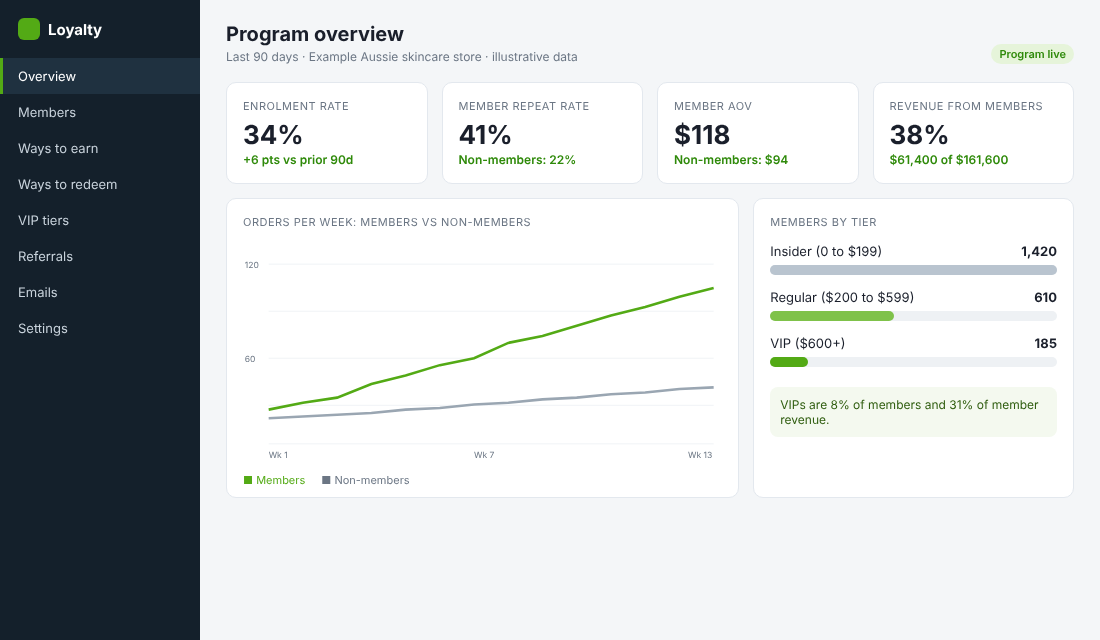
Report on these five numbers every month. If you can’t see them, the program is a hope, not an asset.
- Enrolment rate: members as a share of active customers in the last 12 months.
- Member repeat rate vs non-member repeat rate: the gap is your lift. (Remember that members self-select, so the true lift is smaller than the gap.)
- Member AOV vs non-member AOV: shows whether tiers and thresholds are lifting basket size.
- Share of revenue from members: LoyaltyLion’s published case studies show anything from 17% to 50% for their clients, so a healthy early number is 25% to 40%.
- Reward cost as a share of member revenue: keep it under your 5% to 8% ceiling.
One caution on redemption. Ringly’s roundup quotes figures such as redeeming members spending 3.1 times more than non-redeemers (attributed to Queue-it), and another stat that only 49% of members actively use the programs they’ve joined (attributed to Zoho Thrive). Take both as a reminder: joining is not engaging. Watch the redemption rate, and email dormant members before their points expire.
The Compound Effect: Why It Beats Another Ad Dollar
Put the pieces together. A priced reward ladder protects margin. Tiers give your best customers a reason to buy again. Backdating gives you an instant launch. Email flows keep the program visible. And the dashboard shows whether any of it works.
The result is a repeat-purchase engine that gets cheaper to run as your list grows, while ad costs only go one way. If you have 5,000 past customers and lift your repeat rate by 5 points, that’s 250 extra orders without buying a single click. At a $94 AOV, that’s about $23,500 in revenue, and it comes in at much better margin than a cold Meta ad.
Your Loyalty Program Build Checklist
Copy this into your project tool and tick through it in order.
- Check readiness: repeat rate, orders per month and gross margin recorded.
- Pick one goal: more second orders, bigger baskets or longer retention.
- Choose the model: points, tiers, perks or a mix, matched to the goal.
- Price every reward: cost per reward, margin after reward, a spend gate on each.
- Set tier thresholds: first tier at about 1.5x AOV, then roughly 3x for the next.
- Write plain-English terms: earning, expiry, changes and data use. Get them reviewed.
- Install and configure the app: three earning rules, three rewards, tier tags syncing.
- Backdate existing customers: credit the last 12 months on day one.
- Build the five emails: welcome, points reminder, next-tier nudge, expiry warning, win-back.
- Launch to your list: three emails, a cart message and a checkout tick-box.
- Review monthly: the five numbers, with a hard stop if reward cost passes your ceiling.
Common Mistakes That Sink Loyalty Programs
- Discount-led rewards. If every reward is a percentage off, you’ve trained customers to wait for it.
- Too many rules. If a customer needs a FAQ to understand it, they’ll skip it.
- No gate on the reward. Unconditional vouchers cost margin and change nothing.
- Setting and forgetting. Programs need a monthly review, like any channel.
- Skipping the legal check. The ACCC’s concerns are specific, and they’re easy to avoid.
Inside eCommerce Circle, retention is one of the core pillars we work on with every member, and a priced, well-structured loyalty program is usually one of the fastest ways to lift repeat revenue. If you want to see exactly where your store is being capped, take the free More Orders Scorecard. It takes two minutes and shows you which of the 10 P’s to fix first.
Sources: SmartCompany on Adore Beauty’s loyalty program (May 2022), LoyaltyLion Australia, LoyaltyLion case studies, ACCC loyalty schemes media release (September 2019), Rivo’s Smile.io pricing breakdown (April 2026), Ringly customer loyalty statistics roundup. Prices and vendor results change, so verify before you commit.