Most store owners who go looking for an ecommerce marketing agency are really looking for a strategy. They’ve had a flat quarter, Meta costs have crept up, someone in a Facebook group swears by their agency, and the obvious move feels like handing the whole thing to someone else.
Sometimes that’s the right call. But if you hire anyone before you can write your strategy on one page, you’re paying them to guess. And they’ll guess in the direction that suits how they get paid.
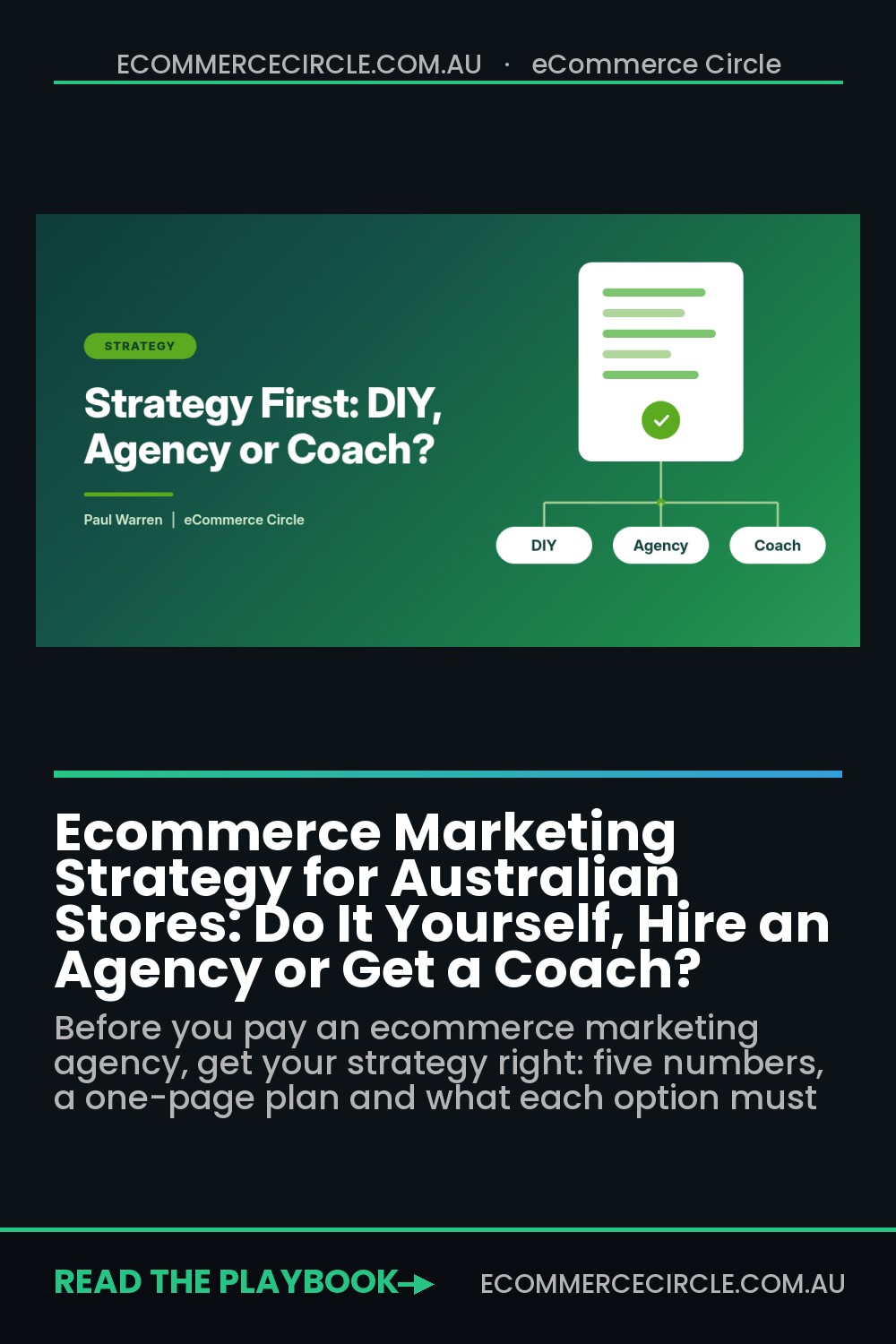
So this guide goes in the right order. First we build the strategy: the five numbers that run your store, a worked example you can copy, and a one-page template. Then we work out who should run it. You, an agency, an in-house hire or a coach. Each one has a cost you can put a number on, and once you’ve got your numbers the choice gets much easier.
What an Ecommerce Marketing Strategy Actually Is
A marketing strategy for an online store is not a list of channels. “We’ll do Meta, Google, email and a bit of TikTok” is a to-do list. A strategy answers three questions:
- Where is the growth going to come from? More visitors, a better conversion rate, bigger orders, or customers coming back more often.
- What can you afford to pay for it? That’s set by your contribution margin per order and your cash, not by what a channel rep tells you is normal.
- What are you not going to do this quarter? If a strategy doesn’t rule anything out, it isn’t one.
Everything else, like the campaigns, the creative and the email calendar, is execution. Execution can be done by you, an agency or a staff member. The strategy is yours. You can get help building it, but you can’t hand it off, because you’re the one who wears the result.
The Five Numbers That Run Your Store
Before you change anything, get these five numbers from the last 90 days. If you can’t get one of them, that gap is your first job.
| Number | What it tells you | Where to find it | The common mistake |
|---|---|---|---|
| AOV (average order value) | How much each order brings in | Shopify Analytics | Leaving GST in. Strip it out first (divide a GST-inclusive figure by 11 to find the GST) |
| Conversion rate | How well the store turns visitors into orders | Shopify Analytics | Comparing yourself to someone else’s store instead of to your own last quarter |
| CAC (customer acquisition cost) | What a new customer costs you | Ad spend ÷ new customers (not total orders) | Dividing by all orders, which hides how expensive new customers are |
| LTV (lifetime value) | What a customer is worth over time | Repeat rate × orders × contribution per order | Measuring LTV on revenue instead of contribution |
| Contribution margin | What each order leaves you after variable costs, before fixed costs | Your own sheet: price ex GST minus product, shipping, pick and pack, payment fees and returns | Forgetting payment fees and returns |
Two Australian details trip people up here.
GST. If you’re registered for GST (the ATO requires it once your GST turnover reaches $75,000 or more), the price your customer pays includes 10% GST. That GST isn’t yours. For a $95 order, $8.64 goes to the ATO and $86.36 is your real revenue. Work your margins on the ex-GST figure or you’ll overstate every one of them.
Payment fees. They’re small per order, but they’re a real variable cost. On Shopify Payments in Australia, online standard card rates currently run from 1.7% + 30c on Basic down to 1.55% + 30c on Grow and 1.35% + 30c on Advanced, with Amex and international cards higher. Use your actual blended rate from your payouts, not the headline rate.
If you want to go deeper on contribution margin, our Shopify contribution margin playbook walks through the full build. For this guide, a simple version is enough.
Worked Example: Running the Numbers on a Sample Store
This is an example. The store and its numbers are made up to show the maths. They are not a client, a benchmark or a target. Swap in your own figures.
Say an established Australian store has these numbers for a typical month:
- 40,000 sessions
- 2.0% conversion rate, so 800 orders
- AOV of $95 including GST
- Product cost (COGS) of 35% of the ex-GST price
- Net shipping cost of $9.00 per order after what the customer pays (AusPost, Sendle or whatever carrier mix you use; pull it from your own invoices)
- Pick, pack and packaging of $3.50 per order
- Shopify Payments on the Grow plan at 1.55% + 30c
- A returns allowance of 3% of ex-GST revenue
- $14,000 a month on ads, bringing in 350 new customers
Step 1: Contribution per order
| Line | Per order |
|---|---|
| Customer pays (inc GST) | $95.00 |
| Less GST (÷ 11) | −$8.64 |
| Revenue ex GST | $86.36 |
| Product cost (35%) | −$30.23 |
| Net shipping | −$9.00 |
| Pick, pack and packaging | −$3.50 |
| Payment fee (1.55% of $95 + 30c) | −$1.77 |
| Returns allowance (3%) | −$2.59 |
| Contribution per order | $39.27 (45.5% of ex-GST revenue) |
Step 2: CAC and LTV
- CAC = $14,000 ÷ 350 new customers = $40.00
- First-order contribution is $39.27, so a new customer roughly pays back their own acquisition cost on the first order, just short.
- Say the store’s own data shows an average customer places 1.8 orders in 12 months. Then 12-month contribution LTV = 1.8 × $39.27 = $70.69.
- LTV to CAC = $70.69 ÷ $40.00 = 1.77.
Step 3: The monthly picture
- 800 orders × $39.27 = $31,418 contribution
- Less $14,000 ads = $17,418 left to cover rent, wages, software and your profit
Step 4: Which lever is worth pulling?
Here’s what each change does on its own, with everything else held the same:
| Change | Orders | Contribution per order | Left after ads | Change vs now |
|---|---|---|---|---|
| Now | 800 | $39.27 | $17,418 | baseline |
| Conversion 2.0% → 2.2% | 880 | $39.27 | $20,560 | +$3,142 |
| AOV $95 → $105 | 800 | $44.75 | $21,803 | +$4,385 |
| Ad spend $14,000 → $12,000, same orders | 800 | $39.27 | $19,418 | +$2,000 |
In this example, a $10 lift in AOV beats a 0.2-point lift in conversion. That’s because a bigger order spreads shipping, pick and pack and the fixed 30c fee across more revenue. Your store might come out differently. The point is to run the sum before deciding where to spend the quarter.
A note on buy now, pay later: Afterpay’s retailer page says its active consumers’ average order value was 28% higher. That’s Afterpay’s own figure about its own users, not a promise about your store. If you add BNPL to lift AOV, put the merchant fee into your contribution sheet and check your AOV before and after.
The One-Page Ecommerce Marketing Strategy
Fill this in before you talk to anyone about who should run your marketing. If an agency, a hire or a coach can’t work from this page, that tells you something.
One-page marketing strategy for [store name], quarter [Q_ 20__]
1. The numbers (last 90 days, ex GST)
- AOV: $____
- Conversion rate: ____%
- CAC (new customers): $____
- 12-month LTV (contribution): $____
- Contribution per order: $____ (___%)
- Cash available for marketing this quarter: $____
2. The one constraint
- The number holding the store back most is: ________
- Because (evidence from the numbers above): ________
3. The goal for this quarter
- Move [number] from ____ to ____ by [date].
- That is worth $____ a month in contribution (show the sum).
4. The three bets
- Bet 1: ________. Cost: $____. How we’ll know by week 6: ________
- Bet 2: ________. Cost: $____. How we’ll know by week 6: ________
- Bet 3: ________. Cost: $____. How we’ll know by week 6: ________
5. What we are not doing this quarter
- ________
- ________
- ________
6. Who runs each part
- Strategy and decisions: me (owner)
- Execution of Bet 1: me, staff, agency or freelancer
- Execution of Bet 2: me, staff, agency or freelancer
- Execution of Bet 3: me, staff, agency or freelancer
- Who checks the numbers every week: ________
7. Compliance check (Australia)
- Every email and SMS list has consent (Spam Act)
- No fake, edited or undisclosed incentivised reviews (ACL)
- Prices shown include GST; margins worked ex GST
Section 7 isn’t padding. Two Australian rules catch out stores that hand marketing to someone else:
- Spam Act. The ACMA says you need consent before sending marketing messages, and that “even if someone else is sending out your marketing messages for you, you must still have consent” from each person. If an agency or freelancer imports a list into Klaviyo, the risk still sits with your business.
- Reviews and the ACL. Under the Australian Consumer Law, it’s illegal to create or arrange fake or misleading reviews. That includes reviews from family, staff or paid people without disclosure, and incentivised reviews where the incentive isn’t disclosed. “Arrange” covers whoever you pay to run your review program.
Who Should Run It: DIY, Agency, In-House or Coach
Once the one-page strategy is written, the “who” question is really four questions. What do you need done, how much of your time can you spare, what skills are missing, and what can the contribution margin carry?
Work down these questions in order:
- Is your one-page strategy written? If not, build it first, yourself or with a coach. If it is, go to question 2.
- Is the gap knowing what to do, or having hands to do it? If it’s knowing what to do, go to question 3. If it’s hands, go to question 4.
- Can you spare 5+ hours a week to do the work? If yes, do it yourself with outside guidance, such as a coach or a peer group. If no, get guidance and add hands, then go to question 4.
- Is the work ongoing every week and core to the business? If yes, look at an in-house hire. If it’s specialist or bursty work, use an agency or freelancer and run them against your strategy.
- Whichever way you land, run the break-even sum first.
The four options side by side
| Do it yourself | Agency | In-house hire | Coach | |
|---|---|---|---|---|
| What you’re buying | Your own time | Execution and specialist skills | A person’s full working week | Guidance, accountability and a second set of eyes on your numbers |
| Who owns the strategy | You | Should be you. Often drifts to the agency | You, with input | You. A coach helps you build it, they don’t run it |
| Who does the work | You | The agency’s team | Your staff member | You and your team |
| Main cost | Owner hours not spent elsewhere | Monthly retainer or fee, plus ad spend | Salary plus super (12% from 1 July 2025), tools, management time | The coach’s fee plus your time to act on it |
| Biggest risk | Spending your hours on tasks someone else could do instead of on the decisions only you can make | Paying for activity, not outcomes; losing know-how when you leave | Wrong hire, or one person stretched across five jobs | Advice that never gets done |
| Best when | Under-resourced but numerate, early in a channel | Strategy is clear, you need specialist hands (e.g. paid search build, Meta creative at volume) | The work is weekly and core, and the numbers carry a salary | You’re unsure what to do next, or keep changing direction |
The super figure comes from the ATO’s super guarantee table, which shows 12% for 2025-26 onwards.
These options aren’t exclusive. Plenty of established stores run a mix: the owner sets the strategy, a coach or peer group keeps them honest, and an agency or freelancer handles one specialist channel. The mistake is skipping the first part.
The break-even sum for any option
Every option has a monthly cost. Divide it by your contribution per order and you get the extra orders a month it has to produce just to pay for itself.
Fill in your own numbers. Use the actual quote or salary in front of you, not a market average.
| Option | Monthly cost (yours) | Extra orders needed a month | Lift needed on your current orders |
|---|---|---|---|
| Agency retainer (ad spend separate) | Monthly retainer: $____ | Monthly cost ÷ your contribution per order = ____ | Extra orders ÷ your orders a month = ____% |
| In-house hire | (Salary you’d offer + 12% super) ÷ 12 = $____ | Monthly cost ÷ your contribution per order = ____ | Extra orders ÷ your orders a month = ____% |
| Coach, consultant or freelancer | Their monthly fee: $____ | Monthly cost ÷ your contribution per order = ____ | Extra orders ÷ your orders a month = ____% |
To get a feel for the scale, take the example store from earlier, with $39.27 contribution per order and 800 orders a month. Every $1,000 a month of cost needs about 25.5 extra orders a month (1,000 ÷ 39.27), which is a lift of about 3.2% on 800 orders. Multiply that by your quote in thousands and you’ll see quickly whether you’re signing up for a small lift or a big one.
You don’t need orders to be the only measure. A better AOV or a lower CAC also adds contribution. But this sum stops you signing up for something that would need a big lift just to stand still, without having talked about where that lift comes from.
It also shows why the strategy has to come first. If the one-page strategy says the constraint is AOV, a retainer focused on new-customer acquisition is solving the wrong problem, however good the agency is.
Doing it yourself
DIY gets a bad rap, but for many established stores it’s right for at least part of the plan. You know the product, the customers and the cash position better than anyone, and there’s no handover cost.
It works when:
- You can protect a fixed block of time each week for marketing, not whatever’s left over after customer service and dispatch.
- The constraint is something you can fix with focus. Email flows, product page copy, offer structure and AOV levers like bundles are all things owners can do well.
- You’ve got a way to check your own work, like a weekly numbers review, a peer group or a coach. Owners working alone tend to mark their own homework generously.
It stops working when you’re the bottleneck. If the one-page strategy needs three bets and you can realistically run one, you need hands, not more willpower.
Hiring an ecommerce marketing agency
An agency makes sense when you know what needs doing and you need specialist skills or volume you don’t have. Building out Google Shopping properly, producing paid social creative at the rate Meta wants, or a big site migration are good examples.
We’ve covered how to vet one in detail in how to choose an ecommerce agency in Australia, so this is just the short version:
- Give them your one-page strategy and ask them to respond to it. A good agency will push back on parts of it. A weak one will ignore it and pitch its standard package.
- Agree the number they’re accountable for before you sign. Make it one from your five, such as CAC on new customers, not a platform-reported ROAS.
- Make sure you own your accounts. Ad accounts, Klaviyo, Google Analytics and Search Console should be in your business’s name, with the agency added as a user.
- Know your exit. Notice period, handover of creative and access, and what happens to work in progress.
Once you’ve signed, the job is managing them against the strategy, which our Shopify agency management playbook covers step by step.
Hiring in-house
An in-house person makes sense when the work is weekly, core and likely to stay that way, such as running email and SMS, managing the content calendar or coordinating creators. The break-even sum above is the honest test. A salary plus 12% super is a fixed cost that keeps going in a slow month, so the contribution has to carry it in your quiet months too, not just your best ones.
The common trap is hiring one “marketing manager” and expecting them to be a strategist, a media buyer, a designer and an email specialist at once. Hire for the job your one-page strategy says matters most, and keep the strategy with you.
Working with a coach
A coach (or a consultant, or a structured peer group) doesn’t run your ads or write your emails. What they do is help you build the strategy, read your numbers with you, and hold you to the plan when the next shiny thing turns up. You keep the knowledge, because you’re the one doing the thinking.
That makes coaching a fit when the gap is knowing what to do, or sticking to it, rather than having hands to do it. It’s a poor fit if you have no capacity to act on advice, because then you’re paying for a to-do list that never gets done. If you’re weighing a coach against a consultant or a course, our guide to ecommerce coaching in Australia sets out the differences.
The 90-Day Plan That Sits Under the Strategy
The one-page strategy says what and why. The 90-day plan says when and who. Keep it to five blocks:
| Weeks | What happens | Output | Who |
|---|---|---|---|
| 1 to 2: Baseline | Pull the five numbers for the last 90 days, ex GST. Build the contribution sheet. Check account ownership and list consent. | Completed section 1 of the one-page strategy | Owner |
| 3 to 4: Pick the constraint and the bets | Run the lever sum (like Step 4 above). Choose one constraint and up to three bets. Write the “not doing” list. Decide who executes each bet. | Completed one-page strategy; signed brief to any agency or hire | Owner, with a coach or adviser if you use one |
| 5 to 8: Run the bets | Execute. Review the five numbers every week in a 30-minute slot. Don’t add bets. | Weekly numbers log | Whoever the strategy names |
| 9 to 10: Week-6 check, then double down or cut | Each bet is judged against the “how we’ll know by week 6” line on the page. Cut anything that isn’t moving its number. Put the freed-up money into what is. | Updated bet list | Owner decides; executors report |
| 11 to 12: Review and reset | Compare the five numbers to the baseline. Work out the contribution change in dollars. Decide whether the “who” still fits: keep, change or add. Draft next quarter’s page. | Next quarter’s one-page strategy | Owner |
If you want the full quarterly sprint system with weekly rhythms and meeting templates, it’s in our 90-day growth sprint guide. The version above is the minimum you need to make the who-does-it decision properly.
Checklist: Before You Hire Anyone to Run Your Marketing
- I have the five numbers for the last 90 days, worked ex GST
- I know my contribution per order, including payment fees and returns
- My CAC is worked on new customers only
- I’ve written the one-page strategy, including what we’re not doing
- I’ve run the break-even sum on the quote or salary in front of me
- I know which single number the person or agency will be accountable for
- All ad, email, analytics and Search Console accounts are owned by my business
- Every list we market to has consent, and anyone sending on our behalf knows that
- Our review program has no fake, edited or undisclosed incentivised reviews
- I’ve booked a weekly 30-minute numbers review for the next 12 weeks
Frequently Asked Questions
What should an ecommerce marketing strategy include?
At minimum: your five numbers (AOV, conversion rate, CAC, LTV and contribution margin, all ex GST), the one constraint holding the store back, a goal for the quarter with a dollar value on it, up to three bets with costs and week-6 checks, a list of what you’re not doing, and who runs each part. If it fits on one page, you’ll actually use it.
Should I hire an ecommerce marketing agency or do it myself?
Write the strategy first, then decide. If the gap is knowing what to do, an agency won’t fix it, and DIY with outside guidance usually makes more sense. If the strategy is clear and you need specialist hands or volume you don’t have, an agency can be the right call. Divide the monthly fee by your contribution per order to see how many extra orders it has to produce to pay for itself.
How do I know if I can afford an agency or a marketing hire?
Use the break-even sum: monthly cost ÷ contribution per order = extra orders needed a month. For a hire, include super (12% under the ATO’s current super guarantee rate). Then ask whether your strategy shows a believable path to that many extra orders, or the equivalent in higher AOV or lower CAC.
Do I need an ecommerce marketing agency in Melbourne if my store is in Melbourne?
Not necessarily. Most of the work is done in your ad, email and analytics accounts, so location matters less than whether the agency works from your strategy, reports on your numbers and leaves you owning the accounts. Meeting face to face can be handy, but treat it as a bonus rather than the main reason to choose.
What’s the difference between an ecommerce coach and a marketing agency?
An agency does the work for you, such as running ads, building email flows or producing creative. A coach helps you decide what work should be done and holds you to it, but you or your team do the doing. Many established stores use both, with the strategy staying with the owner either way.
Should I calculate AOV with or without GST?
Without GST. If you’re registered for GST, the 10% in your customer’s price belongs to the ATO. Divide a GST-inclusive amount by 11 to find the GST component, and work your AOV, margins and CAC on the ex-GST figure.
Your Next Step
If you’d like help building your one-page strategy and checking it against your real numbers with other Australian store owners, start the Connect 7-day trial. Trial applies to the monthly plan only.