Send six texts between Thursday 26 November, 7pm AEDT and Monday 30 November, 7pm, keep each one to a single 160-character segment, and make sure every recipient has actually opted in. That is the whole plan. The rest of this article shows you how to build it, who gets which message, and how to stop it turning into the thing your customers screenshot and complain about.
Most Aussie Shopify stores get Black Friday SMS wrong in one of two ways. They either skip it because “we only do email”, or they blast one all-caps text at 8am to the entire list and wonder why 3% of people unsubscribe. Both mistakes cost you money. Email is crowded on Black Friday, with every brand in your customer’s inbox shouting the same discount. A text lands on a screen people check within minutes.
Black Friday 2026 falls on Friday 27 November, and Cyber Monday is Monday 30 November. If you want the full sale calendar and deadlines, start with our guide to Black Friday Australia 2026. This post covers one channel only: SMS. If you want the evergreen setup first, our Shopify SMS marketing playbook walks through the always-on flows.
Why SMS earns a spot in your Black Friday plan
SMS is not a replacement for email. It is the channel you save for the moments where timing matters, and Black Friday is the most time-sensitive weekend of the retail year.
The numbers back that up. Omnisend’s SMS benchmarks show click rates climbing every month into the sale season: 11.8% in September, 18.0% in October, 20.3% in November and 23.9% in December. People get more responsive to texts as the buying season builds. Omnisend also reports Black Friday SMS click rates of 5 to 10% against 2 to 3% for regular campaigns, although it does not name a source for that range, so treat it as directional.
Klaviyo’s 2024 BFCM results make the same point from the revenue side. Brands that added SMS to their marketing in the previous year saw a 20% year-over-year increase in ecommerce revenue over the Black Friday Cyber Monday period. Klaviyo only credits an SMS with a sale if the order lands within 24 hours of the text, so those numbers are not inflated by a five-day attribution window.
The Australian audience is receptive, too. Attentive’s 2023 consumer trends report found that more than 87% of Australian consumers were interested in, or had already signed up for, texts from brands. Yotpo’s roundup of Australian brands puts it at 74% already signed up. The exact figure depends on who asked, but the direction is the same: Aussies expect brands to text them if they have opted in.
Here is what that means in dollars. Omnisend found that Friday at 9am was the strongest send slot in its dataset: a 0.238% conversion rate across 4.57 million sends, and about 17 cents of revenue per text sent on Fridays. That data is US-led, so treat it as a best case. Even at half that rate, a 5,000-person SMS list earns roughly $425 from a single well-timed send. Six sends, properly segmented, is a meaningful extra weekend of revenue from a list you already own.
Get the legal bit right before you write a word
Australia’s Spam Act 2003 covers marketing texts, and the ACMA enforces it. You do not need a law degree to comply, but you do need to follow four rules every time.
- Have consent. Express consent means the person knowingly agreed to receive your marketing, for example by ticking an SMS box on your signup form. Inferred consent is possible with an ongoing customer relationship, but it does not cover someone who bought once and never joined your list. You cannot text someone to ask for consent. Keep a record of how and when each person opted in, because the ACMA can ask you to prove it.
- Identify your business. Each text must clearly identify who is sending it and include accurate contact details. If your platform sends on your behalf, the message must still name your business.
- Include a working opt-out. The unsubscribe method must be free to use (no cost beyond a normal text), must not require a login, and must keep working for at least 30 days after the message is sent.
- Honour opt-outs within 5 working days. In practice, your platform should do it instantly. Do not run a manual process for this on Black Friday weekend.
Two points surprise store owners. First, Australia has no time-of-day limit on marketing SMS under the Spam Act, and the Do Not Call Register does not apply to marketing texts. That does not mean you should text at 11pm. It means the discipline has to come from you, and from sending in each recipient’s time zone. Second, the penalties are real. The ACMA has issued multi-million dollar penalties to large brands for spam breaches, and a Black Friday weekend of unconsented texts is a bad way to find out how serious they are.
I am not a lawyer, and this is a summary rather than legal advice. Read the ACMA’s guidance on email and SMS unsubscribe rules and check it against your own setup. Our guide to ecommerce insurance in Australia also covers the related risk side if you want to tighten up the rest of your store.
Build the list before the sale, not during it
The single biggest lever for Black Friday SMS revenue is how many people are on your list on 26 November. You cannot buy that list or borrow it. You build it with a reason to join.
The best reason is early access. In Klaviyo’s case study on Hard Yakka, new subscribers were offered early access to the Black Friday sale in exchange for opting in to SMS. The brand used multi-step signup forms that let each person choose whether to join SMS, and it kept texts for key moments such as last-chance messages in the final hours of the sale. The case study reports 308% year-over-year growth in flows revenue during Black Friday 2023 and an 8.5x ROI from SMS in November 2023, the brand’s first month with SMS.
You can copy the mechanic in an afternoon:
- Add an SMS step to your existing signup form. After the email field, ask for a mobile number with a plain consent line such as: “Text me early access to Black Friday. Msg frequency varies. Reply STOP or use the link to opt out.”
- Promise the early-access window out loud. “VIP texts get the sale 3 hours early” is a stronger hook than “get 10% off” because it costs you nothing in margin.
- Run a two-week push from now. Put a banner on the homepage and a line in your post-purchase emails. If you need the full landing page treatment, our guide to a Black Friday landing page covers what goes above the fold.
- Ask existing email subscribers to add SMS. Send one email to your engaged segment explaining the early-access benefit. Do not text people who never opted in to SMS. Email consent is not SMS consent.
Omnisend’s Black Friday SMS guide shares a useful data point on early access: Vape Superstore’s early-bird text outsold its day-of messages by five to one. People who opt in for early access are your hottest buyers. Treat them accordingly.
The 6-text Black Friday SMS schedule
Here is the schedule I would run for most Australian Shopify stores. It runs from the night before Black Friday to the final hours of Cyber Monday. Every time is AEDT, but you should send in each recipient’s local time so your Perth and Brisbane customers are not texted at odd hours (Queensland does not observe daylight saving, and Western Australia is on a different time zone entirely).
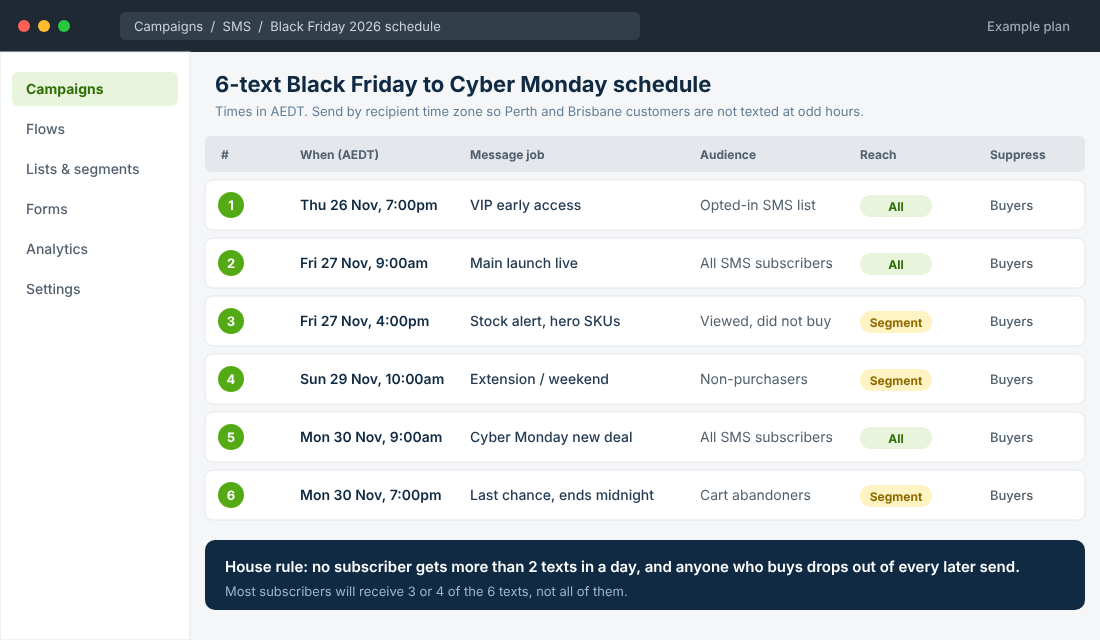
| # | When (AEDT) | Job of the text | Who gets it |
|---|---|---|---|
| 1 | Thu 26 Nov, 7:00pm | VIP early access | Everyone with SMS consent |
| 2 | Fri 27 Nov, 9:00am | Main launch: the sale is live | All SMS subscribers |
| 3 | Fri 27 Nov, 4:00pm | Stock alert on hero products | People who viewed but did not buy |
| 4 | Sun 29 Nov, 10:00am | Weekend extension or bonus | Non-purchasers only |
| 5 | Mon 30 Nov, 9:00am | Cyber Monday new deal or bundle | All SMS subscribers |
| 6 | Mon 30 Nov, 7:00pm | Last chance, ends midnight | Cart and checkout abandoners, plus non-purchasers |
A few rules sit behind this table.
- Never more than 2 texts in one day to the same person. Omnisend’s FAQ suggests a maximum of four Black Friday texts and two to three on Cyber Monday, spaced at least four hours apart. My schedule has up to six, but nobody should receive all six. Texts 3, 4 and 6 go to segments, and anyone who buys is suppressed from everything after.
- Friday 9am is your anchor. It lines up with Omnisend’s best-performing slot. Morning sends beat evening sends in its data, which is why the evening texts in this plan only go to people who already showed intent.
- Thursday night is not optional. Plenty of Australian brands start their sale before Friday. A 7pm VIP text gives your best customers a reason to feel looked after, and it spreads your order volume so your warehouse is not hit by everything at 9am.
- Pause the next text if the last one went badly. If an unsubscribe rate on any send goes above 2%, you are sending too much or to the wrong people. Omnisend uses 2% as its warning line.
What each text should say
Keep every message to one job. Here are templates you can adapt. Replace the bracketed parts and keep the link short.
- Text 1, VIP early access: “[Brand]: VIP early access is open. 30% off sitewide, 3 hours before everyone else. [link] Reply STOP to opt out.”
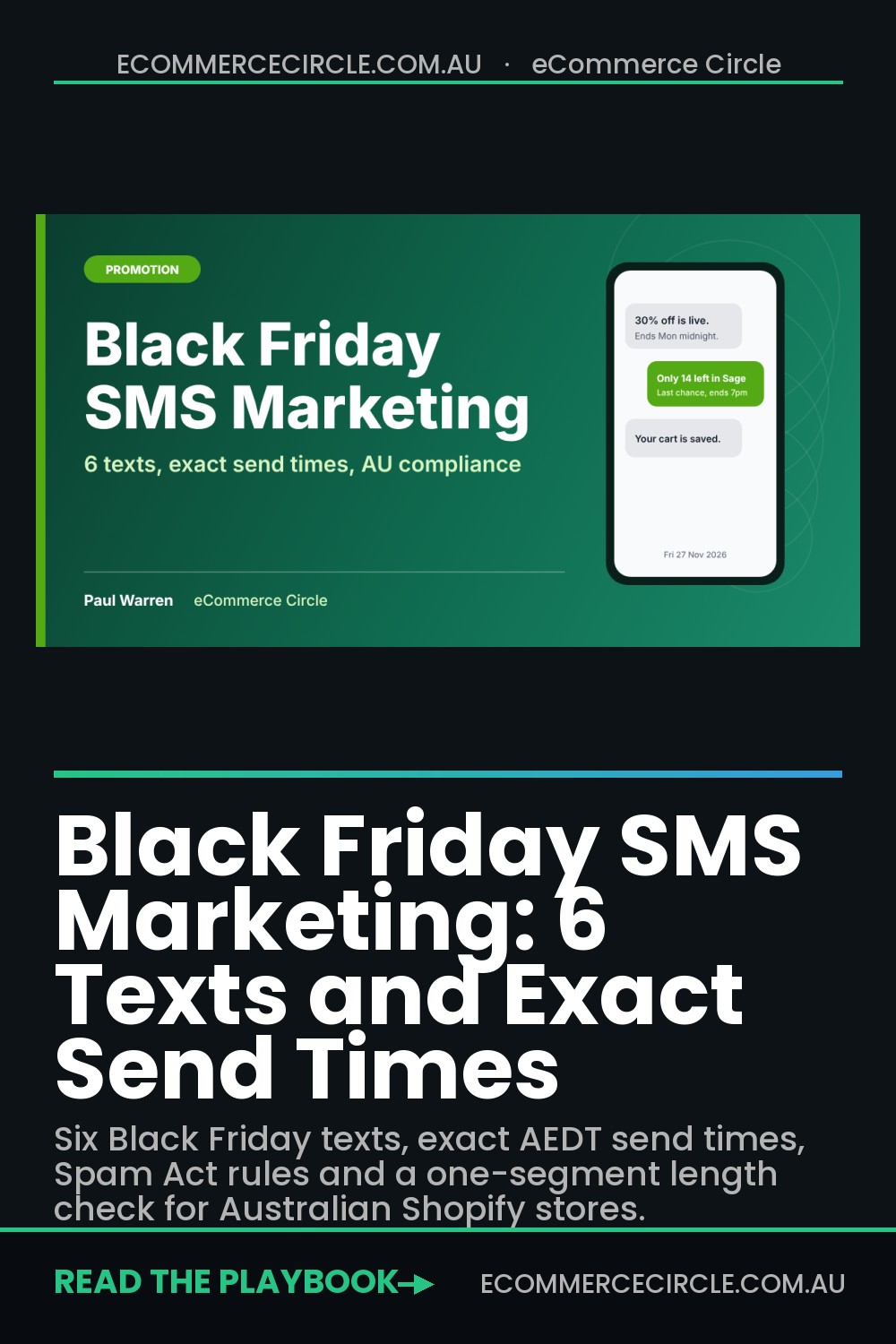
- Text 2, launch: “[Brand] Black Friday is live. 30% off sitewide, free shipping over $99. Ends Mon midnight. [link]”
- Text 3, stock alert: “Only 14 of the Linen Throw left in Sage. Colours sell out first. [link]”
- Text 4, extension: “Still thinking about it? We have added [bonus] to every order over $80 until tonight. [link]”
- Text 5, Cyber Monday: “Cyber Monday: new [bundle or deal], one day only. [link]”
- Text 6, last chance: “Last chance, [first name]. Your cart is saved and the code BF30 ends at midnight. [link]”
Your offer needs to be settled before any of this works. If you have not done the maths on your discount, our BFCM target maths guide walks through the break-even number. For the email side of the same weekend, see our Black Friday email subject lines and the Cyber Monday Australia plan.
Write texts that fit in one segment
This is where stores quietly burn money. An SMS segment holds 160 characters of plain text. Add a single emoji or special character and the limit falls to 70. Go over it and the message splits into multiple segments of 153 characters (67 with an emoji), and each segment is billed.
Klaviyo’s own documentation shows how fast this adds up. On its legacy credit pricing, an Australian SMS costs 4 credits per segment and an MMS costs 15. The billing formula is credits per segment, multiplied by recipients, multiplied by segments. Accounts on newer per-message pricing see costs in their billing currency, so check your account’s billing rates, but the principle stays the same. Two segments cost twice as much as one.
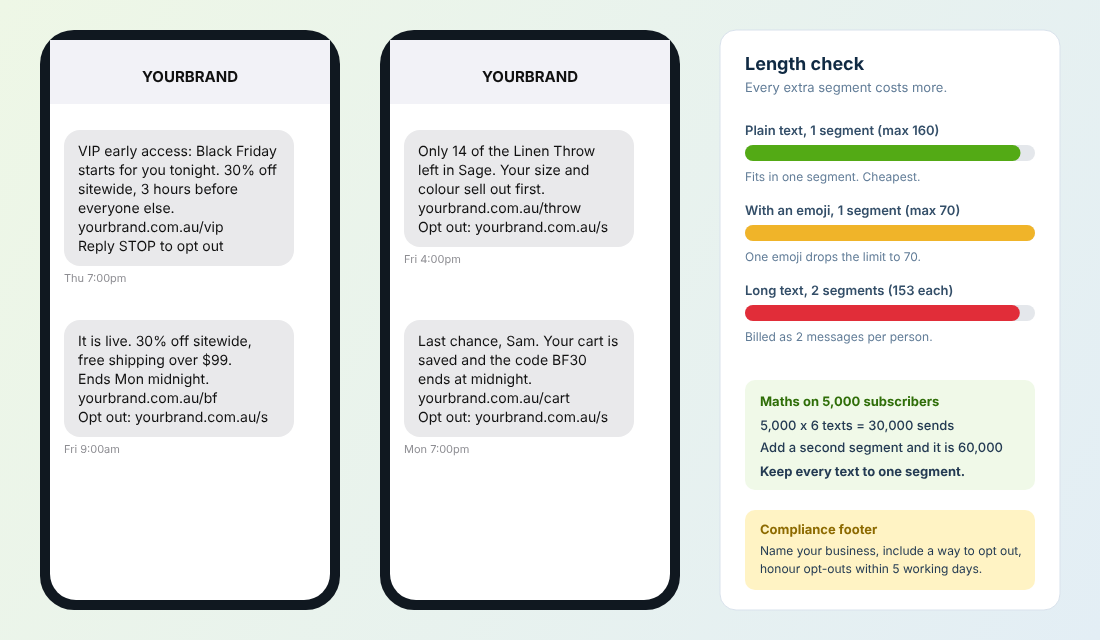
A worked example: 5,000 subscribers, six texts, one segment each is 30,000 sends. Let one of those texts spill into a second segment and you have added 5,000 more billable segments for that send alone. Multiply that across every text and you can double the cost of the weekend without changing the offer.
Use this short checklist before you schedule any text:
- Paste the text into a character counter. Stay at or under 160 characters including the link and opt-out line.
- Skip emojis unless you have a reason. If you use one, budget for 70 characters.
- Use a short branded link rather than a long URL with tracking parameters.
- Put your brand name first so the recipient knows who it is from. This also covers your identification duty under the Spam Act.
- Include the opt-out wording or link every time. Check how your sender setup handles it before launch.
One setup detail worth checking now rather than on Thursday night: on Klaviyo, Australian accounts can set up an alphanumeric Sender ID at no cost, but it only sends to Australian numbers and you can only have one per account. Alphanumeric sender IDs are generally one-way, which means customers cannot reply to them. Confirm with your platform how a customer opts out in that case, usually through a link in the message, and test it on your own phone.
Segment so the right people get the right text
The brands that make SMS work in Australia are not the ones that text the most. They are the ones that text the right people.
- Budgy Smuggler moved print launches from list-wide blasts to targeted sends. Its AFL and NRL premiership pairs campaign sent an SMS to fans of the winning club right after the grand final, with a prompt to order in a few taps. Klaviyo’s case study reports a 28% SMS click rate on that campaign and 30% of total store revenue coming from Klaviyo in 2023.
- Bangn Body links SMS to its email flows. If a shopper opens an email but does not buy, a text follows a few hours later. It also sends VIP texts about new launches so subscribers feel like insiders, according to Yotpo’s profile of Australian brands.
- JSHealth Vitamins sends a campaign to all customers and then a reminder to a smaller group of engaged customers as a promotion ends. That is exactly the shape of texts 3, 4 and 6 in the schedule above.
- Lounge Lovers reports a 55x ROI from SMS over the past year and more than 700 sofa sales attributed to SMS during its End of Financial Year sales, according to Attentive’s Australian press release. These are self-reported vendor figures, so use them as proof the channel works for considered purchases, not as a promise.
For Black Friday, build these five segments at least a week early:
- SMS-consented, all: your base for texts 1, 2 and 5.
- Viewed product, no purchase in 7 days: for text 3.
- Added to cart or started checkout, no order: for text 6.
- Bought in the last 30 days: usually excluded from the discount texts. People who paid full price a fortnight ago will not thank you for a 30% off text, which is a refund request waiting to happen.
- VIPs: your top 10 to 20% of customers by spend, for text 1.
If you want to run this alongside your wider send plan, the volume rules in our email frequency playbook apply to SMS as well as email.
How to set this up in Klaviyo (step by step)
Klaviyo has supported SMS in Australia since 27 September 2021, and it keeps SMS in the same platform as your email flows, which makes the suppression logic much easier. Postscript and Attentive are alternatives, but I will use Klaviyo here because most of the Shopify stores we work with already have it. Menu names change, so treat these as the order of operations rather than exact clicks.
- Turn on SMS and choose a sender. Set up your Sender ID, then confirm your plan has enough SMS allowance for 6 sends to your list.
- Add SMS consent to your signup form. Use a multi-step form: email first, then an optional mobile number step with the consent line above.
- Build your five segments from the list above, and save them with clear names such as “BF26 SMS viewed no buy”.
- Create each campaign and select the segment. Add excluded segments (recent purchasers) on the targeting step.
- Turn on send by recipient time zone. Check that smart sending is on, and look at the window it applies so your 9am and 4pm texts do not collide.
- Send a test to your own phone. Click the link, check the opt-out works, and check the text renders in one segment.
- Schedule all six and add a calendar reminder to review results after each one. Do not set and forget.
Allow a day for this. The slowest part is almost always getting people on the list, not configuring the campaigns.
Measure during the weekend, not after it
Open rates are not the right measure for SMS, as Omnisend points out. Track four numbers per send: click rate, conversion rate, revenue per recipient, and unsubscribe rate.
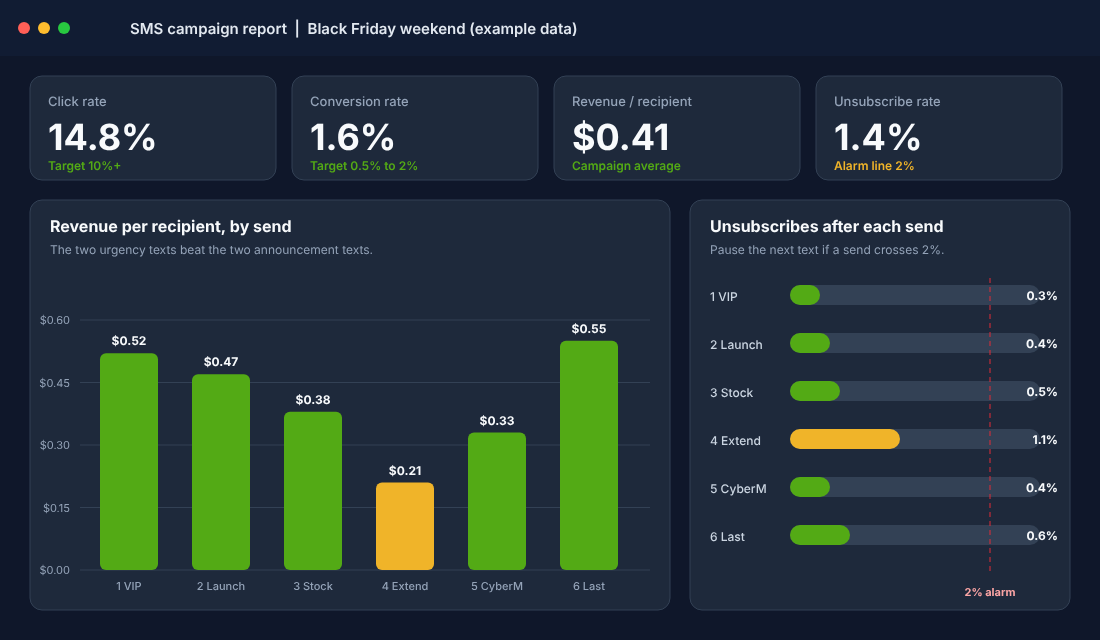
| Metric | What good looks like | Source / note |
|---|---|---|
| Click rate | 5 to 10% on Black Friday sends | Omnisend, source not cited, directional |
| Conversion rate | 0.5 to 2%, depending on offer and segment | Omnisend, source not cited, directional |
| Revenue per recipient | Compare your own sends against each other | Your best send sets the bar for the next |
| Unsubscribe rate | Under 2% per send | Omnisend uses 2% as a sign you are sending too much |
Two reading tips. First, compare your sends to each other rather than to a benchmark from another market. If text 4 earns half of text 2 per recipient, that is useful. Second, check the unsubscribe rate after every send, not at the end. If text 3 spikes, change text 4 before it goes out.
Omnisend’s Black Friday examples show what the upside looks like. Thoroughbred Diesel’s follow-up text earned a 22% click rate and $32,000 in revenue, inside $49,000 of total Black Friday SMS revenue. That is one store, and it is a vendor’s showcase, so read it as what a good follow-up can do rather than what yours will do.
The compound effect: SMS and email as one system
The real win is not any single text. It is how SMS and email share a suppression list and take turns.
Here is how the weekend works as a system. Email carries the detail: the full offer, the product grid, the story. SMS carries the nudge: the 160-character reminder that the sale ends in a few hours. The email subject line gets the open, and the text gets the click from the person who opened but did not act. Your cart abandonment flow catches the person who left, and text 6 catches the one who left it twice.
Because you suppress buyers from every later send, each customer gets fewer messages than your list size suggests, and the ones they get are relevant. That is what protects your unsubscribe rate, and it is why the stores that treat SMS as a segmented channel keep their lists for next year’s sale. A list that survives Black Friday is the asset. The weekend’s revenue is the bonus.
Your Black Friday SMS pre-launch checklist
Copy this into your project tool and tick it off by Monday 23 November.
- Every SMS subscriber has a recorded consent source and date.
- Signup form has a plain SMS consent line and a working opt-out.
- Sender ID is set up and tested on at least one iPhone and one Android phone.
- Opt-out link or STOP keyword tested end to end.
- Offer, code and end time are final and match the website and email.
- Five segments built: SMS-consented, viewed no buy, cart abandoners, recent buyers, VIPs.
- Recent buyers excluded from discount texts.
- All six texts written, each 160 characters or fewer with no emoji.
- Each text includes your brand name and a short link.
- Send in recipient time zone is on, and the 9am and 4pm texts are checked for overlap.
- Campaign sends scheduled, and a person assigned to monitor each one.
- Unsubscribe rate checked after each send, with a rule: over 2% means pause the next text and review.
- Customer service briefed on likely replies and opt-out questions.
Where to go from here
Inside eCommerce Circle, owned-channel promotion like SMS and email is one of the core pillars we work on with every member, because it is the cheapest revenue on Black Friday. If you want to see exactly where your store is being capped, take the free More Orders Scorecard. It takes two minutes and shows you which of the 10 P’s to fix first.