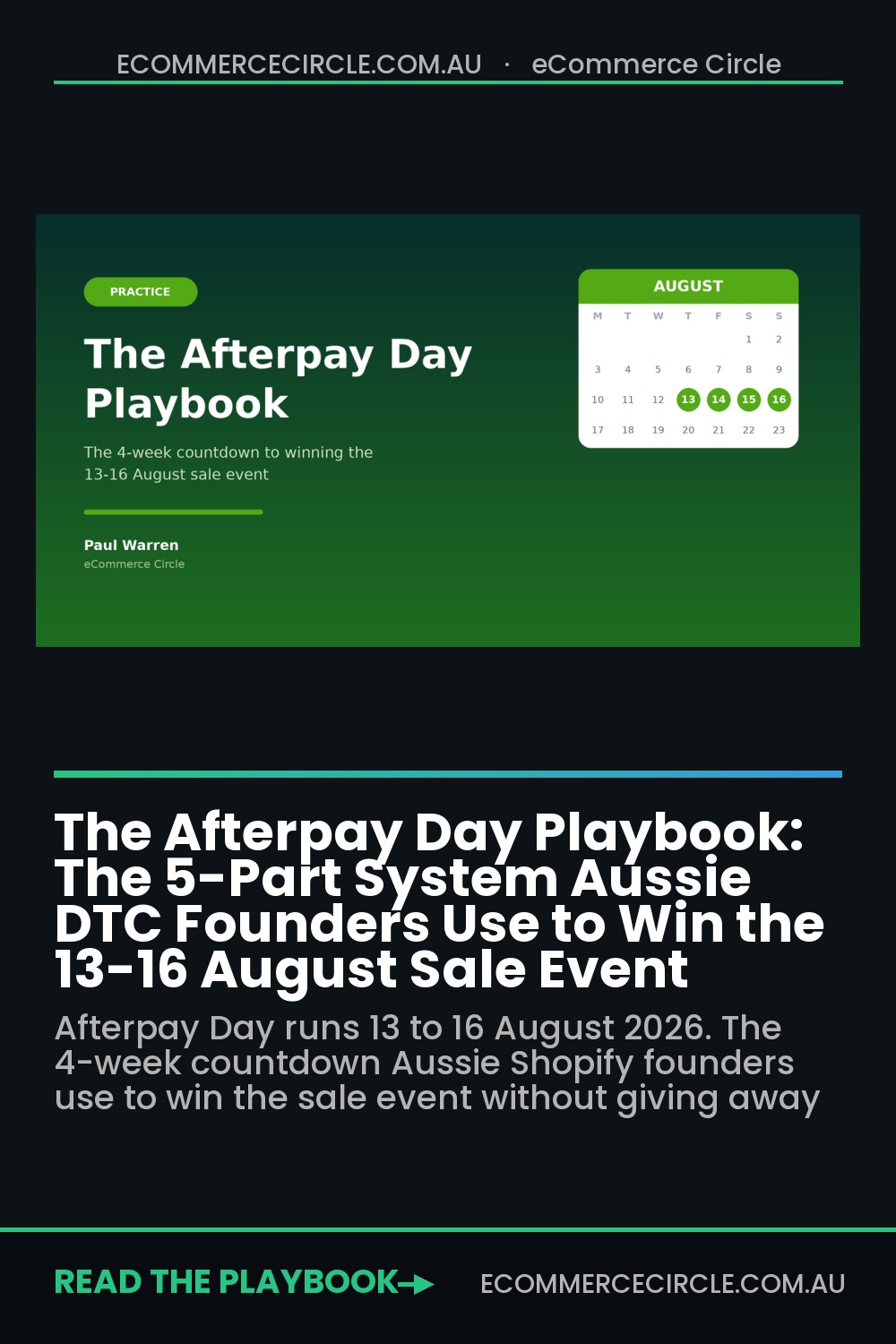
On Thursday 13 August at 8am AEST, more than a million high-intent Australian shoppers will start hunting for deals. They will keep hunting until 11:59pm on Sunday the 16th. That is Afterpay Day, and most Shopify founders will find out it is on when a competitor’s launch email lands in their inbox.
What’s in This Article
The numbers behind the event deserve your attention. As of March 2026, 41% of Australians had used a buy now pay later service in the previous six months, and 37% used one for online purchases specifically, up from 26% a year earlier. Afterpay remains the most-used provider in the country, and shoppers are 82% more likely to buy from a store that offers BNPL than one that does not.
Australia Post lists Afterpay Day alongside BFCM and EOFY in its calendar of the major Australian online sales events, and for stores selling to shoppers under 40 it regularly out-performs its size on paper. It is also the last major demand spike before the Black Friday build-up, which makes it the perfect live rehearsal for your peak season systems.
Here is the uncomfortable truth though: a sale event can just as easily wreck your August as make it. Discount too deep and you give away contribution you never get back. Show up with a lazy 10% code and you get buried by brands that planned properly. This playbook is the 5-part system to run the four days on your terms, with a 4-week countdown you can start this week.
Know the Shopper Before You Set the Offer
Afterpay Day is not a general-population event, and your offer should reflect who actually shows up. BNPL usage in Australia skews hard to younger buyers: 59% of Gen Y and 57% of Gen Z have used a BNPL service, against 30% of Gen X and just 15% of Baby Boomers. If your customer base is under 40, this event maps almost perfectly onto your audience. If you sell to an older demographic, plan for a solid weekend rather than a record one, and set your stock bets accordingly.
It is also a homegrown moment. Afterpay was founded in Sydney in 2014 and grew up on Australian fashion and beauty retail, which is why BNPL-native brands treat the event as a fixture in their promotional calendars. Participation now stretches from Gen Z fashion players through to mass retailers: BIG W has already confirmed Afterpay Day deals for August 2026, and the major shopping centres run their own participating-retailer campaigns around the same window. When brands that large lean in, they lift awareness for the whole event, and a well-prepared independent store gets to ride that wave without paying for it.
One more shopper insight worth building into your creative: these buyers think in instalments. A $200 bundle is “four payments of $50” in their heads. Write your ads, product page messaging, and email copy to match that mental model during the event window, because it is the frame the entire audience arrives with.
Part 1: Design an Offer That Sells Without Giving Away the Farm
The biggest Afterpay Day mistake happens before the event starts: founders pick a discount number by copying what everyone else does, not by doing the maths on their own unit economics. A sitewide 20% off sounds harmless until you remember it comes straight off contribution, not revenue.
Work through your offer in this order:
- Start with the contribution maths. For your hero products, calculate contribution per order at full price, then at 10%, 15% and 20% off. Factor in the extra payment processing cost of BNPL transactions, which typically runs higher than standard cards. Know the exact discount level where the extra volume stops paying for itself.
- Tier the offer instead of flattening it. A single sitewide percentage is the least creative option you have. Stronger structures: a deeper cut on a clearance collection you want gone, a moderate offer on core range, and a gift with purchase or bundle on heroes so the sticker price never drops.
- Set a spend threshold. “20% off when you spend $150” pushes your average order value up while protecting single-item orders. Aussie BNPL shoppers already skew to larger baskets, with Gen Z averaging around $111 per BNPL transaction, so a threshold works with the grain of the event.
- Decide your exclusions now. New season drops, collabs, and anything already thin on contribution sit outside the sale. Publish the exclusions clearly to avoid support tickets on day one.
If you have not built a promotion structure before, the Shopify Discount Discipline Framework covers the 5-tier architecture we use to stop sale events from training your customers to never pay full price. Afterpay Day should slot into that architecture, not blow it up.
Part 2: Get Technically Ready Two Weeks Out
Afterpay Day rewards stores that look like they belong in the event. That means the payment method, the messaging, and the merchandising all need to be in place before the first visitor lands.
- Enable Afterpay properly. In Shopify, head to Settings, then Payments, and confirm Afterpay is active as a payment method. If you are adding it fresh, allow a few days for merchant approval, which is exactly why this step sits two weeks out, not two days out.
- Turn on on-site messaging. The “4 payments of $24.99” widget on product pages is not decoration. It reframes a $99.95 item as a $25 decision, which is the entire psychology of the event. Afterpay’s Shopify integration includes the price breakdown messaging for product and cart pages; switch it on and check it renders on mobile.
- Register your offer with Afterpay. Afterpay promotes participating merchants through its app, email, and the Afterpay Day landing pages, and over a million shoppers browse those channels during the event. Submit your offer through the Afterpay business portal’s trade activity calendar before the deadline. A store that skips registration runs a sale; a registered store gets discovered.
- Build the sale collection. A dedicated “Afterpay Day” collection with your tiered offers, sorted by best sellers first, ready to be linked from your homepage hero, navigation, and every email. Keep it hidden until launch morning.
- Load test the basics. Check your site speed on mobile, confirm your top 20 sale products are deep on stock in the sizes that sell, and make sure your discount logic works with Afterpay at checkout. Test the full journey with a real transaction.
Part 3: Build the Runway So Launch Morning Is Not a Cold Start
The brands that win Afterpay Day do most of the selling before it starts. Your job in the fortnight before the event is to build a warm audience that is waiting for 8am Thursday, because the inbox on launch morning is a warzone and cold sends get lost in it.
- Tease without revealing. Seven days out, tell your list something is coming and invite them to a VIP early-access segment. Curiosity plus a deadline beats announcing the discount early and stalling full-price sales for a week.
- Give VIPs a real head start. Open the sale to your best customers the night before. It rewards loyalty, banks revenue before the rush, and gives you a live test of the offer and checkout under friendly fire.
- Swap your popup. For the two weeks around the event, your email capture popup should offer early access to the sale instead of the standard welcome discount. Sale-season subscribers are deal-driven; capture them into a segment you can market the event to directly.
- Prime your SMS list. SMS is the highest-urgency channel you own during a four-day window. If your SMS program is not set up, the Shopify SMS Marketing Playbook walks through compliant list building for Australian stores, and you have just enough runway to launch it before the event.
Part 4: Run the Four Days Like a Campaign, Not a Countdown Timer
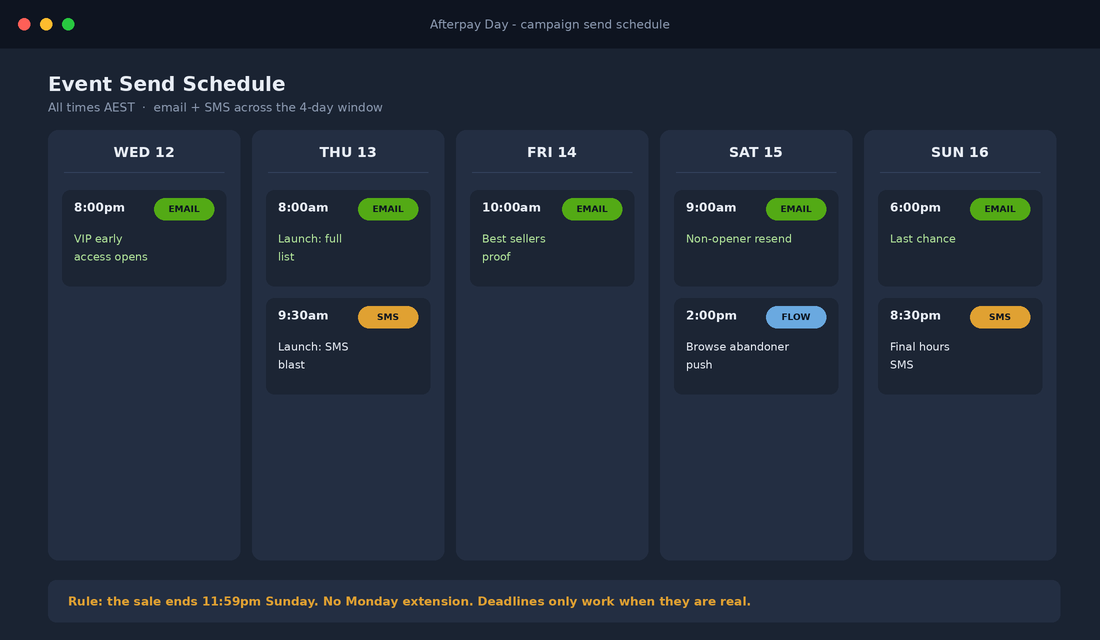
The event window is Thursday 8am AEST to Sunday 11:59pm. That is roughly 88 hours, and each phase of it does a different job. Here is the send schedule that works:
- Thursday 8am: launch. Email plus SMS to your full engaged list. Lead with the strongest offer and link straight to the sale collection. Subject lines with the specific offer beat clever ones during sale events; this is not the week for wit.
- Friday: proof and urgency. Show best sellers moving. “Selling fast” framed with real numbers (“300 sold yesterday”) outperforms generic urgency, and it keeps you honest.
- Saturday: segment sweep. Resend to non-openers with a new subject line, hit browse abandoners with the products they viewed, and put remarketing budget behind your sale collection on Meta while purchase intent is at its weekly peak.
- Sunday from 6pm: the close. The last-chance email and SMS drive the biggest single spike of the event. Send the email early evening and the SMS around 8 to 9pm, then let the deadline do the work. When it ends at 11:59pm, end it. Extending the sale on Monday teaches your list that your deadlines are fiction.
On paid channels, resist the urge to scale cold acquisition into the event. Auction prices rise during sale weekends as every retailer bids at once, and cold traffic converts worse than usual because shoppers are comparison-hunting across dozens of tabs. The better play is concentrating budget on retargeting: site visitors from the past 30 days, engaged email subscribers synced as custom audiences, and dynamic product ads against the sale collection. Warm traffic during a deadline event is about as efficient as Meta spend ever gets, and it protects your blended cost per acquisition while the auction is hot.
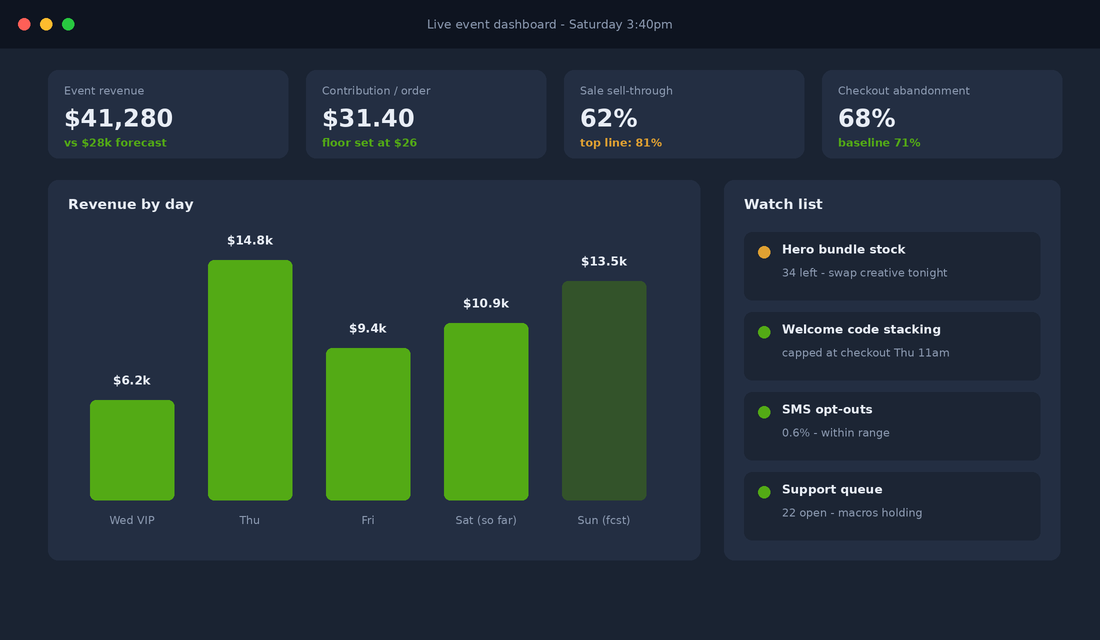
During the four days, watch three numbers live: contribution per order (not just revenue), sell-through on the products carrying the offer, and abandoned checkout rate. If checkout abandonment spikes, the usual culprit is a discount code conflicting with the sale pricing or a shipping threshold now out of reach; both are fixable mid-event if you are looking.
Part 5: The Fortnight After Is Where the Real Money Is
Afterpay Day hands you a cohort of new customers who bought on a deal. Left alone, deal-seeking cohorts repurchase at the lowest rate of any acquisition source. Worked properly, they become full-price customers, and that second order is where the event actually pays off.
- Tag the cohort. Every customer whose first order lands during the event window gets tagged in Klaviyo. You will report on this group’s 60 and 90-day repurchase rate separately.
- Run a value-first post-purchase sequence. Care instructions, styling or usage content, the brand story, a review request around delivery day. No discounts. The Shopify Post-Purchase Email Sequence covers the full 7-email structure.
- Make the second offer about the product, not the price. Three weeks after the event, show the cohort the products most commonly bought alongside what they own. A cross-sell at full price converts surprisingly well when the recommendation is actually relevant.
- Debrief while it is fresh. Within a week, write the one-page review: what sold, what stalled, contribution against forecast, which sends performed, what broke. File it where you will find it, because this exact event runs again in March.
The Non-Discount Offers That Still Win Afterpay Day
Some brands should not run a percentage off at all. If your contribution margin sits under 25%, or your brand positioning makes discounting expensive to unwind, a sitewide cut is the wrong instrument. That does not mean sitting the event out. It means changing what you put on the table.
The logic is simple. A 20% discount on a $150 order costs you $30 of pure contribution. A gift with purchase that retails at $30 might cost you $9 landed. Same perceived value to the shopper, a third of the cost to you, and no reference-price damage to clean up in September.
- Gift with purchase above a threshold. Pick something with a high perceived value and a low landed cost, ideally a sample or travel size of a product you want to seed for a repeat purchase. Set the threshold 20 to 30% above your current AOV so it pulls baskets up rather than rewarding orders you were getting anyway.
- Bundle pricing instead of line-item discounting. A three-piece set at $199 when the parts total $240 reads as value without ever putting a red strikethrough on the hero SKU. It also lifts units per order, which is where the fulfilment economics improve.
- Free upgraded shipping rather than free shipping. Express delivery costs you a few dollars more than standard and converts far better than another 5% off, particularly for the younger BNPL shopper who values speed.
- Extended returns window. Doubling the returns window for the event costs almost nothing if your return rate is stable, and it removes the main hesitation on a considered purchase.
- Loyalty points multiplier. Triple points during the event is a deferred cost that only lands if the customer comes back to redeem, which is exactly the behaviour you want to buy.
- Early access as the offer itself. For brands with genuine scarcity, being first to a restock or a limited run is worth more than money off, and it costs nothing.
Model the contribution on whichever structure you pick before you build the creative. The contribution margin guide shows how to load the real cost of a gift with purchase into the order maths, and the bundle playbook covers how to construct a set that reads as a deal without cannibalising your hero product. If gift cards are part of your mix, the gift card playbook is worth a read before you decide whether to include them in the offer.
The Monday Post-Mortem: The 7 Numbers That Say If It Actually Worked
Most founders judge a sale event on one number: revenue over the four days. It is the least useful number available, because it tells you nothing about what the event cost or what it bought you. Block 45 minutes on the Monday after and work through these seven instead.
- Total contribution dollars, not revenue. Revenue minus product cost, discount, processing (remember Afterpay sits at 4 to 6%), fulfilment, shipping and ad spend. This is the only number that answers whether the event made money.
- Incremental contribution versus a normal four days. Compare against the same weekdays two weeks prior. If your event contribution is $34,000 and a normal four days delivers $22,000, the event was worth $12,000, not $34,000.
- New versus returning revenue split. If more than about 70% came from your existing list, you ran a margin giveaway to people who were going to buy anyway. If new customers carried the event, you bought a cohort and the next number decides whether that was smart.
- Blended CAC during the event versus your run-rate. Auction prices rise across sale weekends. A CAC 30% above normal is expected. A CAC double your normal means you were bidding against the whole market for traffic you could have had cheaper in September.
- Average discount actually taken. Not the discount you offered. Stacked codes, loyalty redemptions and returns-adjusted refunds routinely push the realised discount 3 to 5 points past the advertised one.
- Sell-through on the products carrying the offer. The whole point of a tiered offer is to clear specific stock. If your clearance tier moved 40% and your hero product got discounted at full velocity, you funded the wrong thing.
- Return rate on event orders at the 30-day mark. Diarise this one for mid-September. Deal-driven orders return at a higher rate, and a return rate 5 to 8 points above your baseline can erase the whole event’s contribution after the fact.
Write the answers into a one-page event file with a short note on what you would change. Afterpay Day runs twice a year, so this document is the single most valuable asset the event produces. By the third one you are not guessing at a discount number, you are reading last time’s file. The next lever after that is turning the cohort into repeat buyers, which is the ground the repeat purchase playbook covers.
The Compound Effect: Two Events a Year, One System
Afterpay Day runs twice a year, March and August, on top of the big Australian retail moments. Once your offer maths, technical checklist, runway plan, send schedule, and post-event sequence exist, they become a reusable campaign system. August’s debrief sharpens March. March’s sharpens the next August. By your third event, the whole thing runs off a checklist in a fraction of the setup time, and the same machinery drives your November. If you want to see the full peak-season version, the Shopify BFCM Playbook applies this exact structure to the biggest event of the year.
That is the real prize. Not one good weekend in August, but a campaign muscle your store flexes six or more times a year while competitors reinvent the wheel every event.
Five Afterpay Day Mistakes That Cost Real Money
Before the checklist, the traps. Every one of these shows up in store reviews inside the Circle after a sale event, and every one is avoidable with a week of notice.
- Discounting the whole store when 20 products would do. Most Afterpay Day revenue concentrates in a small set of hero and clearance lines. A tiered offer on the right products captures the demand without repricing your entire catalogue.
- Forgetting the offer stacks. A 20% sale plus an active welcome code plus free shipping over a threshold can quietly push an order below breakeven. Map every discount that can combine at checkout and cap or exclude where needed.
- Launching with thin stock. Selling out of your lead offer by Friday morning turns your Saturday and Sunday sends into apologies. Forecast sale lines at 2 to 3 times a normal weekend and cut the offer list to what you can actually supply.
- Ignoring returns exposure. Deal-driven fashion orders return at higher rates. Build the expected returns into your contribution maths, and tighten your size guidance on sale products before the event rather than after.
- Going quiet afterwards. The brands that treat Monday the 17th as the finish line leave the second order on the table. The post-event fortnight in Part 5 is where the cohort either becomes customers or becomes a mailing list that only wakes up for discounts.
Your Takeaway: The 4-Week Afterpay Day Countdown
Work backwards from Thursday 13 August. Here is the week-by-week:
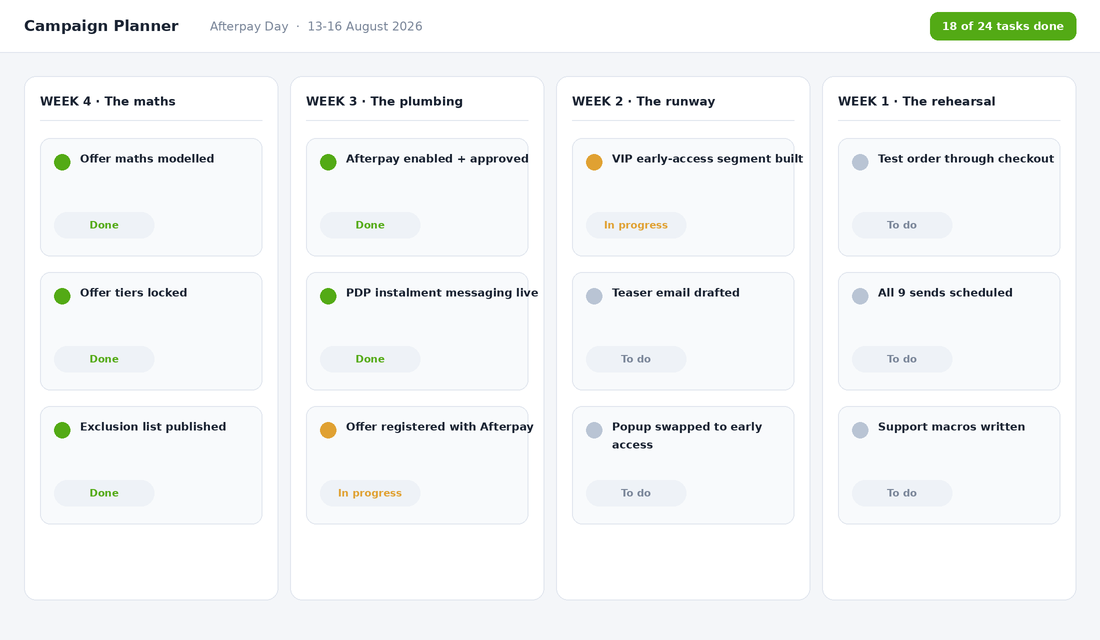
- Week 4 (this week): the maths. Contribution per order at each discount level, offer tiers chosen, exclusions listed, stock position checked against a 2 to 3x normal weekend forecast for sale lines.
- Week 3: the plumbing. Afterpay enabled and approved, on-site messaging live on PDPs and cart, offer registered in the Afterpay business portal, sale collection built and hidden.
- Week 2: the runway. Teaser email drafted, VIP early-access segment built, popup swapped to early-access capture, SMS compliance checked, all four days of sends written and scheduled.
- Week 1: the rehearsal. Full test transaction through Afterpay at checkout, mobile speed check, ad creative approved and scheduled, support macros written for offer questions, exclusions page live.
- Event week: execute and observe. VIP open Wednesday night, launch Thursday 8am, follow the schedule, watch contribution live, close hard at 11:59pm Sunday.
- Week after: the harvest. Cohort tagged, post-purchase flow running, debrief written, calendar note created for the March event.
Inside eCommerce Circle, Practice is one of the core pillars we work on with every member: turning one-off campaign scrambles into repeatable systems that compound. If you want a second opinion on your Afterpay Day plan before the 13th, let’s talk.