A Shopify referral program is a system that pays existing customers, in credit or cash, to bring you new ones. Done properly, each referred customer costs less than a paid-social customer and comes back more often. Done badly, it is a discount leak that trains your best customers to hunt for codes.
Most Aussie stores land on the bad version. They install an app, set “give $10, get $10,” bury the widget in the footer and wonder why six people used it. Then they decide referrals “don’t work for us.”
They do work, but only when you treat the program as a profit decision first and a marketing tactic second. UK deodorant brand Wild told Shopify Masters that roughly 25% to 30% of its sales now come through referral. That did not happen because of a footer widget. It happened because the offer, the timing and the economics were built on purpose.
This guide gives you the full build: the numbers to check before you launch, the reward structures that hold up, how Who Gives A Crap and Koala run theirs, the apps worth a look, the Australian rules to follow, and a launch checklist you can copy.
Why referrals beat paid ads on first-order profit
Start with the maths, because the maths is the whole case. Shopify’s referral marketing guide cites Elogic Commerce 2026 benchmarks putting referral traffic conversion at 2.5% to 3.5%, against 0.5% to 1% for paid social. That is roughly three to five times the conversion rate on the visit that matters.
Costs have moved the same way. The same guide cites UpCounting data showing paid channel customer acquisition costs rose 40% between 2023 and 2025. If you have felt your Meta CPA creep up while your margins stayed flat, you are not imagining it. If you want to pressure-test your own numbers, our guide to customer acquisition cost for Shopify has the formula and benchmarks.
Trust is the third piece. Shopify’s guide cites the Nielsen Trust in Advertising report finding that 89% of consumers trust word-of-mouth recommendations more than other forms of advertising. A friend saying “this is good” beats any ad you can write.
Here is what that looks like on a worked example. Say your average order is $95 and your gross margin is 55%, so you make $52.25 gross profit on a first order. You win a customer through Meta at a $48 CAC. Your net first-order profit is $4.25, before shipping and payment fees.
Now run the same customer through a referral offer of 15% off for the friend and a $15 store credit for the referrer, with a referral app taking a 3.5% commission. The friend pays $80.75, your gross profit drops to $38.00, and after the $15 credit and $2.83 commission you keep $20.17. That is nearly five times the first-order profit of the paid customer.
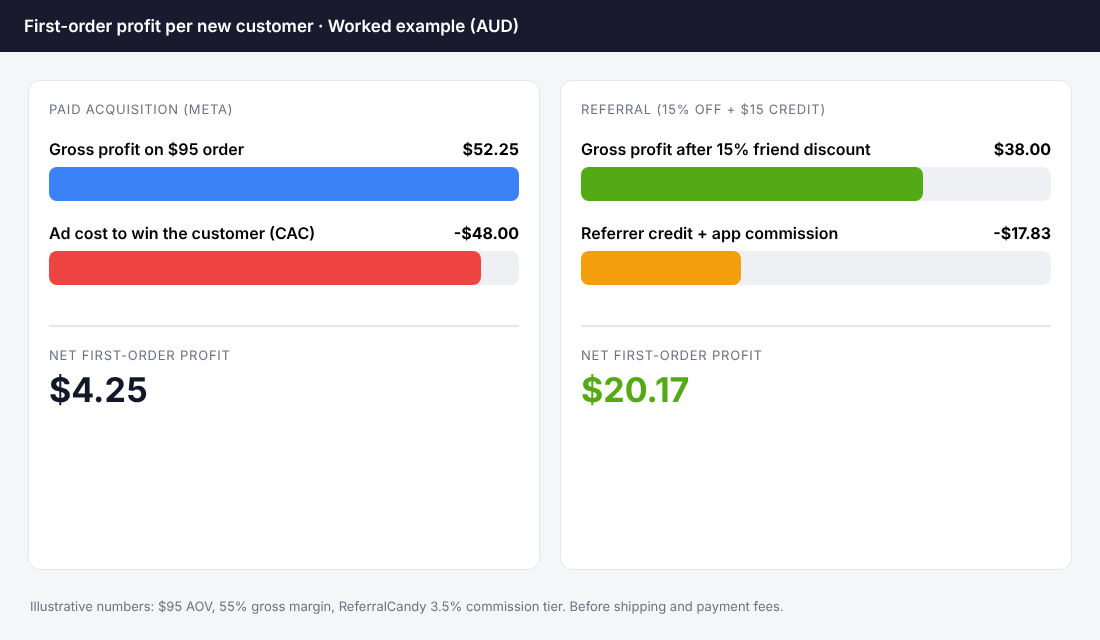
To be clear about the limits: this is a model, not a promise. Your margin, your AOV and your referral volume will change the answer. The point is to run your own version of this table before you pick a reward, which is exactly what the template later in this article does.
Run the numbers before you pick a reward
The most common mistake is choosing a reward because it sounds generous or because the app default is “$10 each.” Reward size should come out of your margin, not your instincts.
Step 1: Work out your gross profit per first order
Take your average first-order value, subtract product cost, and you have the pool the program has to be paid from. If your gross profit on a first order is $52, you cannot hand out $40 in rewards and call it growth. Use first-order AOV, not blended AOV, because referred customers are new customers.
Step 2: Set a maximum total incentive
A sensible ceiling is one half of first-order gross profit. On the $52.25 example, that is about $26. Both rewards together (friend discount plus referrer reward) should fit under that line. Remember a store credit only costs you the product cost when it is redeemed, but plan as though it costs face value until you have data.
Step 3: Compare it to your paid CAC
Your referral incentive plus app fees should land well under what you pay to win a customer through ads. If your all-in referral cost is $33 and your blended CAC is $34, you have built an expensive program with extra admin. If you are still working out your ad ceiling, our break even ROAS guide shows how to set it.
Step 4: Model the volume honestly
Shopify’s guide suggests a healthy referral rate of around 1% to 3% of customers for most ecommerce businesses. It does not name a study for that figure, so treat it as a rough guide rather than a benchmark.
Run it on your own base. If you have 2,000 customers and 2% become active advocates, that is 40 advocates. If each brings two friends, you get 80 new customers at about $20 net each, so roughly $1,600 of first-order profit. That is useful, not life-changing, and it grows as the base grows. Referrals are a compounding channel, not a switch.
Pick a reward structure that holds up
There are four structures worth considering. Each one suits a different kind of store.
| Structure | Example | Best for | Watch out for |
|---|---|---|---|
| Two-sided percentage | Friend gets 15% off, you get a 15% code | Low-ticket consumables | Margin erosion on repeat use |
| Two-sided fixed dollar | $20 off $80+ for both | Mid-ticket stores with healthy AOV | Minimum spend set too low |
| Store credit for referrer | $15 credit when friend’s order clears | Stores that want repeat purchases | Credit liability on your books |
| Cash or commission | 10% to the advocate | High-ticket or creator-led brands | Closer to affiliate, needs terms |
Our default recommendation for most Shopify stores under $2m is a two-sided offer with a minimum spend. The friend gets a discount that gets them over the line on a first order. The referrer gets store credit, which brings them back to buy again and is cheaper than cash once redeemed.
Avoid reward ladders and gamified tiers in your first version. Keep it to one offer you can explain in a sentence. You can add tiers later. If you are also building a points system, read how to build a Shopify loyalty program that pays first so the two do not fight each other.
What Who Gives A Crap and Koala actually offer
The best way to see good structure is to read the terms of brands that run referrals well. Two Australian examples, taken directly from their own help pages.
Who Gives A Crap: small reward, low friction
The friend gets 20% off a first purchase of $40 AUD or more. The referrer gets a 15% discount code on their next order of $28 AUD or more, sent once the friend’s order is complete. The friend must be a new customer and must click the referral link before ordering, and only one code can be used per order.
Notice three things. The minimum spends protect margin. The reward only arrives after a real purchase. And the referrer’s reward is a discount on a next order, which pulls them back into the store. For a consumable like toilet paper, where repeat purchase is the business model, that is a smart fit.
Koala: big reward, high ticket
Koala runs $200 off a first purchase of $750 or more for the friend, and $200 off the referrer’s next purchase of $750 or more. The referrer does not need to be an existing customer to share the link. Their code arrives about two weeks after the friend’s qualifying purchase, and the friend must buy on the same device where they clicked the link.
Same logic, different scale. A big-ticket furniture brand can afford a $200 incentive because first-order gross profit on a $750 order dwarfs it. The two-week delay also gives the order time to clear before any reward is issued. That delay is a quiet fraud and returns control worth copying.
Your offer will not look like either of these. Your margin decides that. But the pattern is the same: a minimum spend, new customers only, reward after the order is real.
Where and when to ask for the referral
An app does not create referrals. Asking at the right moment does. Most stores ask once, in the wrong place, and never again.
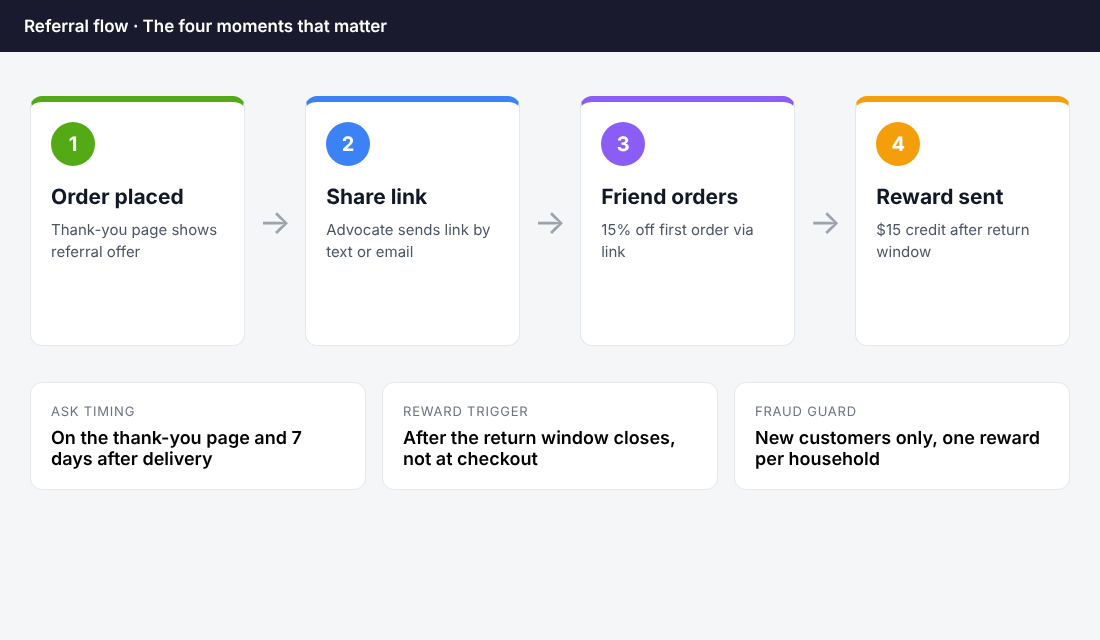
- The thank-you page. The customer has just paid and feels good about the purchase. Show the offer and a one-tap share button here. This is the highest-intent moment you have.
- The shipping confirmation email. Open rates on transactional emails are far higher than marketing sends. Add a single line and link under the tracking details.
- A post-delivery email, 7 days after the parcel lands. Ask once they have actually used the product. Pair it with your review request or send it right after. Build it as part of your core Klaviyo flows.
- The customer account page. Give returning customers a permanent place to find their link.
- Inside the box. A small card with a short link or QR code reaches people who ignore email. Keep it to one sentence and one reward.
One more rule: ask your happiest customers first. Segment by customers who left a four or five star review, bought twice or opened your last three emails. A referral request to a customer who is annoyed about a late parcel does nothing for you.
Choose a referral app (and keep the cost sane)
You do not need a custom build. A Shopify app handles link tracking, reward codes and the friend’s checkout experience. Pricing below is in USD as listed by Rivo’s roundup of Shopify referral apps, so confirm current rates on each vendor’s page before you commit.
| App | Pricing (USD, as listed) | Notes |
|---|---|---|
| ReferralCandy | From $39/mo plus 10.5% commission, dropping to 0.25% on higher tiers | Referral and affiliate in one app, cash, credit or coupon rewards |
| Smile.io | Free plan; Standard $79/mo; Growth $199/mo | Points loyalty with referrals built in |
| Rivo | Free plan; Scale from $49/mo | White-labelled campaigns, fraud tools, loyalty option |
| BON Loyalty | Free plan up to 250 orders a month | Two-sided rewards, combined loyalty and referrals |
| UpPromote | Free plan up to 200 orders a month; paid from $29.99/mo | Better for affiliates and creators than customer referrals |
For most stores doing under 500 orders a month, start on a free plan. Prove customers will refer before you pay for volume features. Watch the commission model closely: a percentage of referred sales is fine at low volume and gets expensive as you grow, which is why commission-based apps suit early stage and flat-fee apps suit scale.
Setup steps that work in any of these apps
- Install the app and connect your discount settings. Set the friend reward to new customers only, with a minimum order value.
- Set the referrer reward to issue only after the friend’s order is paid and the return window has passed. Fourteen days works for most stores.
- Customise the referral page and emails with your brand, one headline and one reward sentence. Skip jargon.
- Add the thank-you page widget and a link in your shipping confirmation email.
- Place a test order with a second email address and walk the full journey on mobile. Check the code actually applies at checkout.
- Turn on fraud settings: block self-referrals, same-address orders and the same payment method.
Stop fraud, abuse and discount leakage
Every referral program gets gamed eventually. People refer themselves with second email addresses, post codes on coupon sites or stack them on top of a sale. Build the guardrails in from day one, not after the first leak.
- New customers only. Check by email, shipping address and phone number where your app allows it.
- Delay the reward. Pay out after the return window. It filters returns and chargebacks out of your advocate payouts.
- Block stacking. One code per order, no combining with sitewide sales or other discounts. Koala and Who Gives A Crap both say this explicitly in their terms.
- Cap the reward per advocate. Set a monthly or lifetime ceiling so one prolific advocate cannot cost you a fortune. If they genuinely drive that volume, move them to a proper affiliate or creator deal.
- Watch the data weekly. Look for one advocate with a spike of orders from the same suburb or the same card type. It is almost always one person.
If you are also running a heavy sale period, decide now whether referrals pause. Referral codes plus a Black Friday discount can quietly wipe out a month of margin, so the safest default is no stacking at all.
Australian rules to get right
A few local rules apply to referral programs. This is general information, not legal advice, so check anything specific with a lawyer.
- Spam Act 2003. Commercial emails and SMS need consent, must identify you as the sender and must include a working unsubscribe. If an advocate types a friend’s email address into your form, design the flow so the friend opts in before they get your marketing. Safer still, let the advocate share their own link instead of you emailing the friend.
- Australian Consumer Law. Your headline and your fine print must both be accurate. State minimum spend, exclusions, expiry and caps up front. If your terms say “$20 off” but the real offer needs $120 spent, say that clearly where people see it.
- Trade promotion rules. A guaranteed reward for meeting set conditions typically does not need a trade promotion permit. Adding chance, such as entering every referrer into a prize draw, can make it a trade promotion lottery, and permit rules differ by state and territory.
- Privacy. Businesses over $3 million turnover are generally bound by the Australian Privacy Principles, and many smaller ones are exempt, but a clear privacy policy is good practice either way. Tell people what referral data you collect and do not pass it on.
Publish simple referral terms on a page of their own and link to them from every referral email and widget. Our returns policy guide shows the same approach: short, specific and easy to find.
How referrals compound into retention
The first order is the smallest part of the value. Referred customers tend to come in with higher trust, and advocates tend to stay longer themselves. Odd Bunch founder Divy Ojha told Shopify Masters that subscribers who made at least one referral had six-month retention “an order of magnitude higher” than those who did not. He did not give an exact percentage, so take it as direction rather than a benchmark.
This is the compound effect. A referral program lifts new customer volume at a low cost. Those new customers arrive warm, which helps your repeat rate. A higher repeat rate lifts lifetime value, which lets you afford a stronger referral reward or higher ad spend. Each piece makes the next one cheaper.
That is why referrals belong in your retention work, not in a separate “growth hacks” bucket. If your repeat customer rate is under 25%, fix the second order first. A referral request only works when the customer already loves the product. You can sweeten the loop with gift cards at Christmas, which double as a referral vehicle when people give them to friends.
Referral program economics template
Copy this into a spreadsheet before you touch your app settings. Fill each line with your own numbers.
- First-order AOV (new customers only): $____
- Product cost + packaging + pick/pack: $____
- Gross profit per first order: $____ (line 1 minus line 2)
- Maximum total incentive (50% of line 3): $____
- Friend discount (percentage of line 1): $____
- Referrer reward (face value): $____
- App commission or fee per referred order: $____
- Net first-order profit: line 3 minus line 5 minus line 6 minus line 7 = $____
- Paid CAC for comparison: $____ and its net first-order profit: $____
- Go or no go: launch only if line 8 beats line 9 and line 5 plus line 6 sits at or under line 4.
Referral program launch checklist
- Gross profit per first order calculated and total incentive capped
- Offer written as one sentence: who gets what, minimum spend, new customers only
- App installed with fraud settings on and reward delay set (14 days suggested)
- Referral terms page published and linked from every touchpoint
- Thank-you page widget live and tested on mobile
- Shipping confirmation and post-delivery emails updated with the referral link
- Test order placed end to end with a second email address
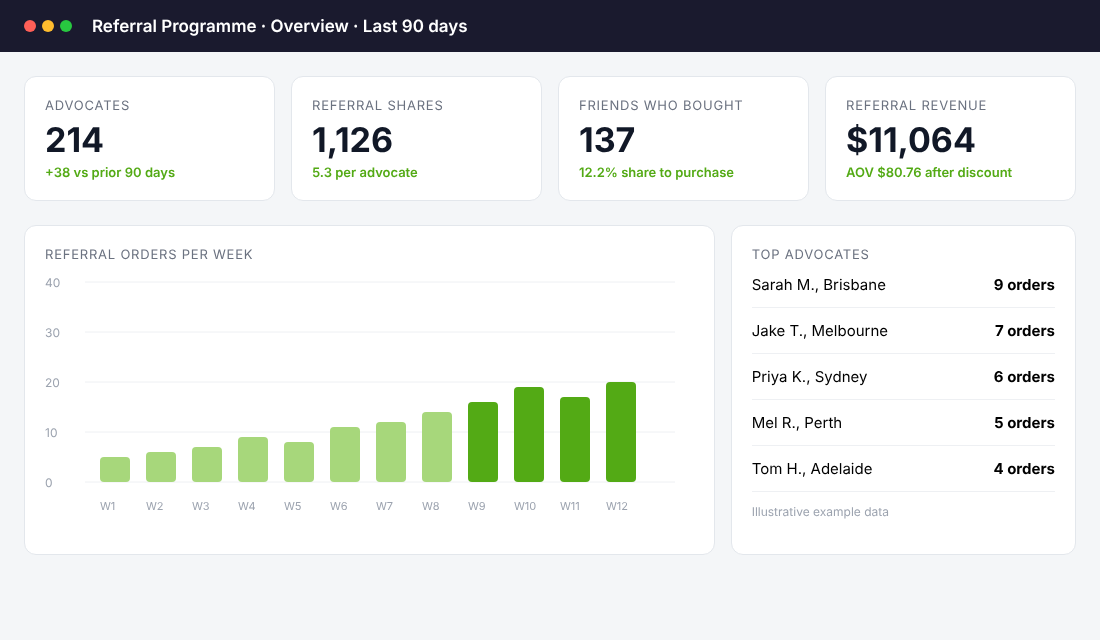
- Weekly report added to your dashboard: advocates, shares, referred orders, net profit per referred order
- Review at 90 days: keep, adjust the reward or kill it based on the numbers, not the feeling
Run it as an experiment for 90 days with a fixed review date. Keep the offer constant for the first four to six weeks so you can read the data. Then change one variable at a time: the reward amount, the ask timing or the placement of the widget.
Where to start this week
You do not need to build the whole system at once. Do the economics table today. Choose one offer. Install one free app. Put the ask on the thank-you page and in the shipping email. That alone puts you ahead of most stores, which still rely on a footer link nobody clicks.
Inside eCommerce Circle, retention and referral loops are core pillars we work on with every member. If you want to see exactly where your store is being capped, take the free More Orders Scorecard. It takes two minutes and shows you which of the 10 P’s to fix first.
Sources: Shopify referral marketing statistics (citing Elogic Commerce, UpCounting, Nielsen, Shopify Masters); Who Gives A Crap referral terms; Koala referral help page; Rivo referral app roundup; Sprintlaw refer-a-friend legal guide. Figures checked 8 November 2026.