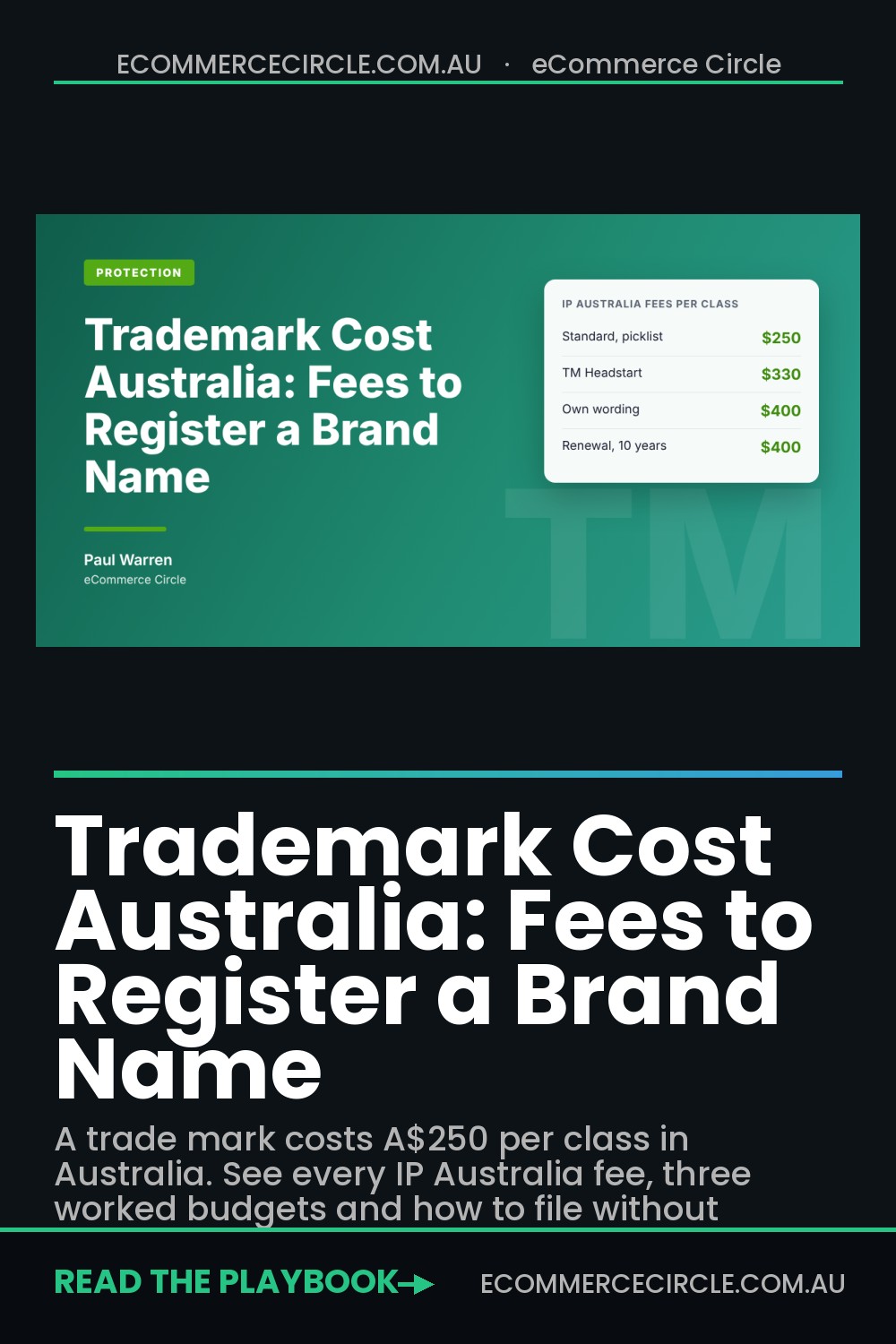
A trade mark in Australia costs A$250 per class if you file a standard application online using IP Australia’s picklist, or A$330 per class through the TM Headstart pre-application service. Registration lasts 10 years, and renewing costs A$400 per class.
That is the whole government bill for a simple brand name in one class. Most online stores end up paying more than that, and not because the fees are hidden. They pay more because they pick the wrong filing route, file in the wrong classes, or find out after two years of trading that someone else got there first.
Only 7% of active small and medium businesses in Australia hold a registered trade mark, according to IP Australia figures cited by Future Women. The other 93% are building brand value on a name they have never registered. This guide gives you every fee, three worked budgets, and the order to do things in so you only pay once.
A quick note before the numbers: this is general information for store owners, not legal advice. Fees below were checked against IP Australia’s published schedule on 18 November 2026.
Trademark Cost Australia: The Short Answer
Every IP Australia trade mark fee is charged per class. A class is a category of goods or services. There are 45 of them, and you pay for each one you want your name protected in.
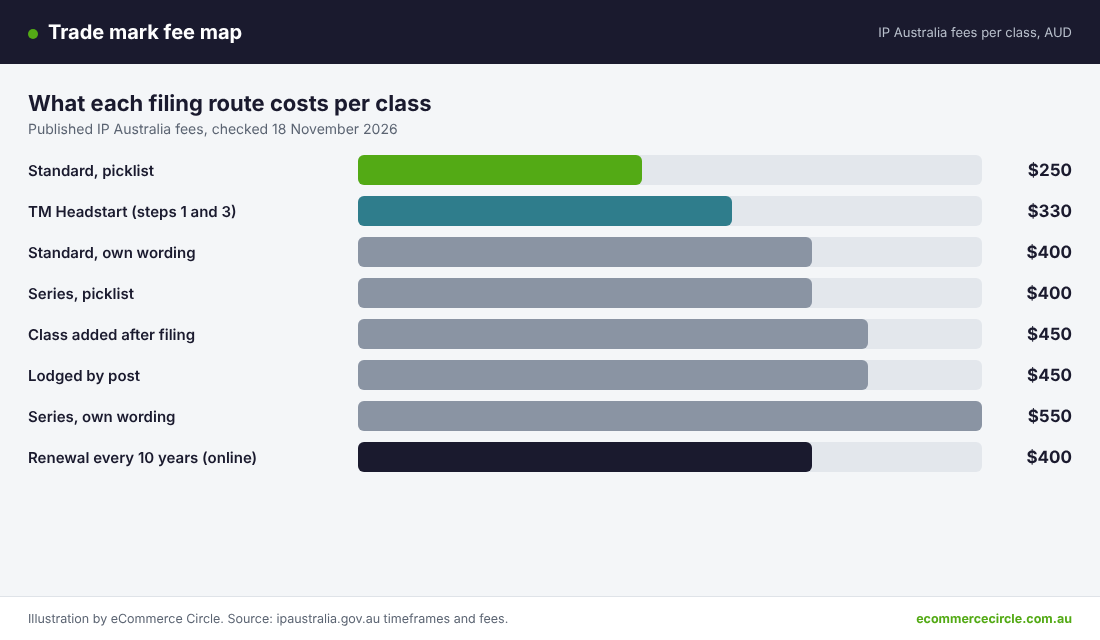
Here is the full schedule from IP Australia’s timeframes and fees page.
| What you are paying for | Fee per class (AUD) |
|---|---|
| Standard application, goods and services chosen from the picklist | A$250 |
| Standard application, your own wording (no picklist) | A$400 |
| TM Headstart request (step 1) | A$200 |
| TM Headstart conversion to a formal application (step 3) | A$130 |
| TM Headstart total, steps 1 and 3 | A$330 |
| Series application with picklist | A$400 |
| Series application without picklist | A$550 |
| Application lodged by post | A$450 |
| Renewal every 10 years, paid online | A$400 |
Three things in that table matter more than the rest.
- The picklist saves you A$150 a class. The picklist is IP Australia’s pre-approved list of goods and services descriptions. Write your own description and the fee jumps from A$250 to A$400. For a normal product brand, the picklist covers what you need.
- There is no separate registration fee. You pay at filing. If the application is accepted and nobody opposes it, registration follows without another invoice.
- Fees are not refunded. If the examiner knocks your name back, the money is gone. That is why the search step later in this guide is worth an hour of your time.
What a Class Is and Which Ones an Online Store Needs
Classes are where most of the overspending and most of the under-protection happens. Classes 1 to 34 cover goods. Classes 35 to 45 cover services.
Your trade mark only protects the name for the goods and services you list. Register a skincare name in class 3 and you have no automatic claim over the same name on clothing.
These are the classes Australian online stores file in most often:
- Class 3: cosmetics, skincare, haircare, soaps and fragrances.
- Class 5: dietary supplements, vitamins and baby food.
- Class 14: jewellery and watches.
- Class 18: bags, wallets and leather goods.
- Class 21: household and kitchen utensils, drink bottles and cookware.
- Class 25: clothing, footwear and headwear.
- Class 28: toys, games and sporting articles.
- Class 30: coffee, tea, confectionery and baked goods.
- Class 35: retail and online retail services, advertising and business services.
The rule I give founders is simple. File in the class for what you sell today, plus the class for what you will realistically sell in the next three years. Do not file in six classes “just in case”. A mark you never use in a class can be challenged and removed for non-use, and you have paid A$250 a class for protection that would not survive a fight.
One more trap. Adding a class to a standard application after you have filed costs A$450, not A$250. Get the class list right the first time.
Standard Application or TM Headstart: Which Route to Pay For
You have two ways to file. They cost different amounts and suit different people.
The standard application
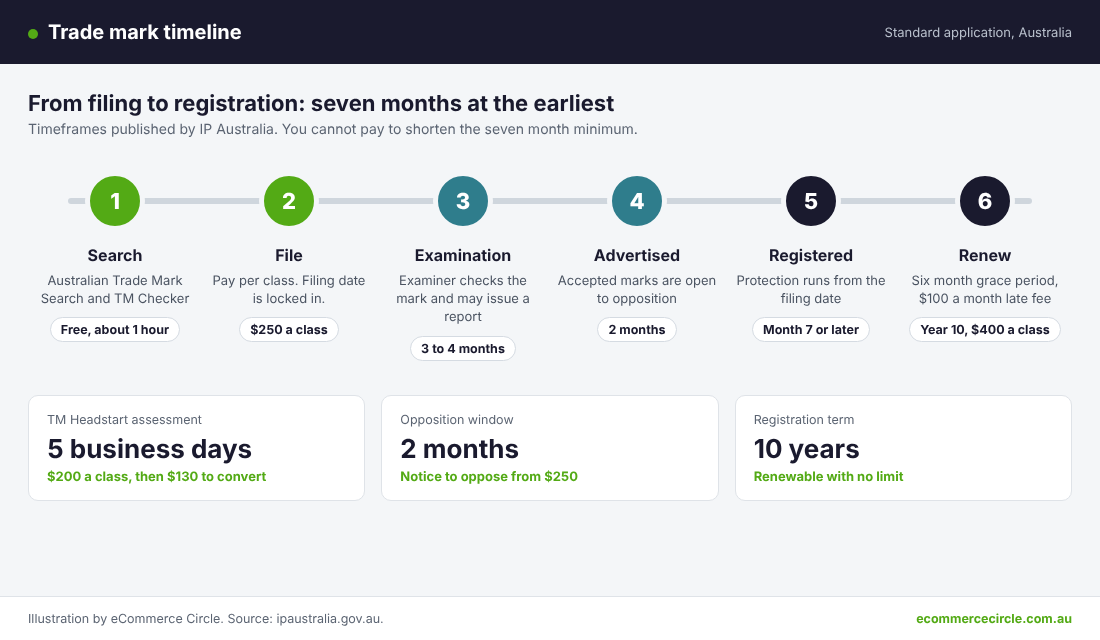
You pay the full A$250 a class up front and your application goes into the examination queue. You get your filing date immediately. That date matters, because trade mark rights in Australia run from the filing date. If a competitor files a similar name the day after you, yours wins on priority.
IP Australia says it usually takes three to four months to examine a standard application. If the examiner raises a problem, you get an examination report and a deadline to respond.
TM Headstart
TM Headstart is a pre-application check. You pay A$200 a class, and an examiner sends you an assessment within five business days. If the report is clean, you pay another A$130 a class to convert it into a formal application.
If the report shows a problem, you can pay to amend (A$150 to change the mark, A$200 to add a class) or walk away having spent A$200 instead of A$250.
Headstart has limits you need to know about:
- It only covers words, stylised words and logos. Shapes, sounds and other unusual marks need the standard route.
- You have five business days to amend and five business days to convert. Miss a deadline and the request lapses.
- Your filing date is set when you convert at step 3, not when you first lodge.
- The examiner will not give you legal advice or guarantee the result.
Which one I would pick
Choose Headstart if this is your first trade mark, your name is a bit descriptive, or you are not sure a similar mark exists. The extra A$80 a class buys you a fast answer from the same people who will examine the real application.
Choose the standard application if your name is invented and distinctive (think made-up words), your search came back clean, and you want the earliest possible filing date.
Three Worked Budgets for a Shopify Brand
These are illustrations I have calculated from the published fees. Your numbers depend on your classes and how many marks you file.
Budget 1: one name, one class
A candle brand registers its name in one class using the picklist.
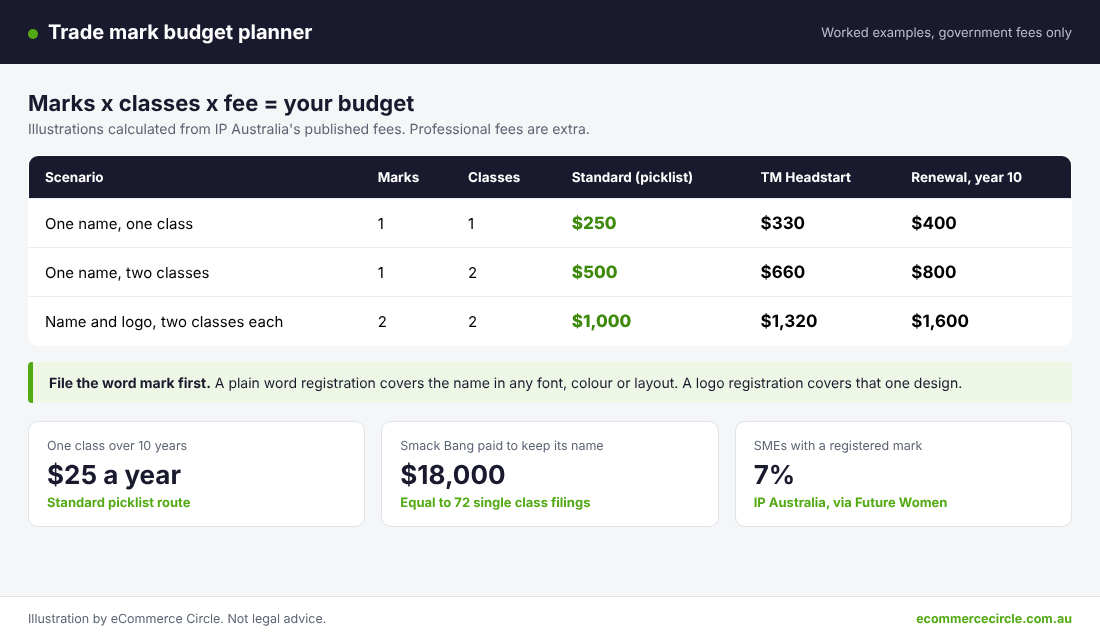
- Standard application: 1 class at A$250 = A$250
- Or TM Headstart: 1 class at A$330 = A$330
Spread over the 10 years the registration lasts, the standard route works out at A$25 a year. That is less than most stores spend on apps in a week.
Budget 2: one name, two classes
An activewear brand files in class 25 (clothing) and class 35 (online retail services).
- Standard application: 2 classes at A$250 = A$500
- Or TM Headstart: 2 classes at A$330 = A$660
- Renewal in year 10: 2 classes at A$400 = A$800
Budget 3: name and logo, two classes each
The same brand wants the logo protected as well. A word mark and a logo are two separate applications.
- Standard application: 2 marks x 2 classes x A$250 = A$1,000
- Or TM Headstart: 2 marks x 2 classes x A$330 = A$1,320
If the budget only stretches to one application, file the word mark first. A plain word registration protects the name in any font, colour or layout. A logo registration protects that particular design. You will redesign your logo before you rename your business.
| Scenario | Standard (picklist) | TM Headstart | Renewal at year 10 |
|---|---|---|---|
| One name, one class | A$250 | A$330 | A$400 |
| One name, two classes | A$500 | A$660 | A$800 |
| Name and logo, two classes each | A$1,000 | A$1,320 | A$1,600 |
The Costs That Sit Outside the Application Fee
The application fee is the floor. These are the lines that push the real figure up.
Professional fees
You can file yourself. Plenty of founders do. If you use a trade mark attorney or lawyer, you pay their fee on top of the government fee.
Most firms do not publish prices, so here is one that does. Coleman Greig’s published service overview (dated March 2025) lists a fixed fee of A$2,000 plus GST to prepare and lodge an application covering up to three classes, with IP Australia’s fees on top. Responding to an examination report or an opposition is billed hourly. Online legal services generally charge less than a traditional firm. Get two quotes and ask exactly what happens to the price if the examiner objects.
When is a professional worth it? When your search turns up a similar name, when your name describes your product, or when you plan to sell overseas. If your name is invented and the search is clean, DIY with Headstart is a reasonable call.
Opposition fees
Once your mark is accepted, it is advertised for two months. Anyone can oppose it in that window. IP Australia’s opposition fee schedule shows what a dispute costs in official fees alone:
- Notice of intention to oppose: from A$250
- Extension of time: A$150 a month
- Oral hearing: A$700 a day
- Hearing by written submissions: A$500
- Application to remove a mark for non-use: from A$350
Those are the government charges. The professional fees for evidence and submissions are where a contested opposition gets expensive.
Renewal and late fees
Renewal is A$400 a class online, due every 10 years. You can renew up to 12 months early. Miss the date and you have a six-month grace period, but it costs an extra A$100 for every month or part month you are late. After six months the registration lapses.
Put the renewal date in a shared calendar the day your certificate arrives. Ten years is long enough for the person who filed it to have left the business.
Overseas protection
An Australian trade mark protects you in Australia only. If you ship to New Zealand, the US or the UK in volume, you need protection there too.
The usual route is the Madrid System, run by WIPO. The basic fee is 653 Swiss francs for a black and white mark or 903 Swiss francs for a colour mark, plus a fee for each country you name. LegalVision put the basic fee at roughly A$1,150 in January 2025. Exchange rates move, so run WIPO’s fee calculator before you budget.
A Business Name Is Not a Trade Mark
This is the most expensive misunderstanding I see.
Registering a business name with ASIC costs A$47 for one year or A$108 for three years from 1 July 2026. It is a legal requirement if you trade under a name that is not your own. It gives you no ownership of that name.
Business.gov.au says it plainly: “Registering a business name doesn’t mean you have exclusive rights to use it.” The same applies to your domain name, your Instagram handle and your Shopify store name. None of them stop another business registering your name as a trade mark and then asking you to stop using it.
If you are at the very start, our guide to whether you need an ABN to sell online covers the registrations you do need. The trade mark is the one registration on the list that protects the brand itself.
What It Costs to Skip It: Three Australian Brands
A$250 feels optional until you see what the alternative looks like.
Clothing The Gaps. The Melbourne social enterprise took the name Clothing The Gap in 2019 and filed a trade mark. A couple of months later, US retailer The Gap filed a notice of intention to oppose. Co-founder Laura Thompson told IP Australia, “We didn’t have the resources or money to be able to fight back.” The dispute ran until January 2021, when the business settled and added an “s” to its name. Every product, label and piece of marketing had to change. Her co-founder’s advice: “Google your business name and see what else comes up.”
SWIISH, now Ziish. Sally Obermeder’s wellness brand traded as SWIISH for about a decade. In September 2026, Mediaweek reported the business had rebranded to Ziish after Swisse Wellness opposed its trade mark applications for skincare and supplements. The Trade Marks Office found the names visually, aurally and phonetically similar. Showing that no customer had actually been confused was not enough.
Smack Bang. Tess Robinson was three years into running her creative agency, Smack Bang Designs, when an IP lawyer found that a designer in another state had already registered the name. That designer was not using it. After lengthy negotiations, Robinson paid her A$18,000, as she told Future Women.
Line those up against the fee table. A$18,000 is 72 single-class applications. A rebrand after 10 years of trading touches every label, box and ad you have ever made.
The lesson from all three is the same. Filing an application is not the same as being cleared to use the name, and trading for years does not make the name yours. Search first, file early.
How to Search and File in Under Two Hours
This is the tool section. Everything here is free except the filing fee, and you can do it this week.
Step 1: search before you spend anything
Open Australian Trade Mark Search, IP Australia’s free public database.
- Search your exact name, then obvious misspellings and sound-alikes. SWIISH and Swisse are spelled differently and still clashed.
- Open each result and check the classes. A similar name in an unrelated class is far less of a problem than one in yours.
- Check the status. Registered and pending marks both matter. Lapsed or removed marks usually do not.
- Google the name with your product category and look for unregistered traders already using it in Australia.
If you find a close match in your class, stop and get advice before paying a filing fee.
Step 2: run TM Checker
IP Australia’s free TM Checker walks you through three steps: enter your mark, pick your goods or services, and review the results. It flags similar existing marks and shows you the cost of each filing route for the classes you selected.
Step 3: set up your account and file
- Create an IP Australia online services account in the name of the legal owner. That is you as an individual or your company, not your business name. A mark filed in the wrong owner’s name can be invalid.
- Choose TM Headstart or the standard application based on the section above.
- Upload the mark. For a word mark, type the word in plain capitals. Do not upload your logo if you want to protect the word.
- Pick goods and services from the picklist to keep the A$250 rate. Be specific. “Clothing” in class 25 is fine. Selecting everything in the class is not.
- Pay by card. For Headstart, diarise the five business day deadlines the moment you submit.
Step 4: track the timeline
IP Australia’s minimum time from filing to registration is seven months, and you cannot pay to shorten it. Expect roughly three to four months for examination, then acceptance, then two months of advertising for opposition.
You can use the TM symbol from day one. The R in a circle is only for registered marks, so wait for the certificate.
Your Trade Mark Cost Checklist
Copy this into your notes and work through it in order.
- Name check: exact and sound-alike searches done in Australian Trade Mark Search, results saved.
- Google check: no unregistered Australian business trading under the name in your category.
- Classes chosen: what you sell now plus what you will sell within three years. Count them.
- Owner confirmed: the individual or company that owns the brand, with its ABN or ACN.
- Route chosen: Headstart (A$330 a class) or standard (A$250 a class).
- Budget set: number of marks x number of classes x fee. Add professional fees if you are using an attorney.
- Word mark first: logo application added only if the budget allows.
- Deadlines diarised: Headstart response dates, examination report deadline, and the 10-year renewal.
- Overseas plan: list the countries where you ship in volume and price the Madrid System for each.
- Monitoring: a calendar reminder every six months to search for new marks similar to yours. IP Australia does not police infringement for you.
How the Pieces Fit Together
A trade mark is cheap. What makes it look expensive is doing the steps out of order.
Search first and you avoid paying a filing fee for a name you can never register. Choose classes carefully and you avoid both paying for protection you will not use and adding classes later at A$450 each. Pick the right route and you either get a five-day answer for A$80 more or lock in the earliest filing date. File the word mark first and your protection survives your next rebrand. Diarise the renewal and you never pay A$100 a month in late fees.
Demand for registration is climbing. IP Australia received a record 97,345 trade mark applications in 2025, up 13.3% on 2024, and registered a record 70,614 marks. Filings by Australian residents rose 15.1% to 55,913, according to the Australian IP Report 2026. Every one of those is a name somebody else now owns in at least one class. The longer you wait, the more crowded the register gets.
A registered mark also opens doors beyond defence. Marketplaces and brand protection programs generally ask for a registered or pending trade mark before they will act on a copycat listing, and a buyer valuing your store will ask who owns the name. For the wider plan, read our guide to ecommerce brand protection, and if you are still setting up, the nine steps to start an online store in Australia.
Frequently Asked Questions
How much does it cost to trademark a name in Australia?
A$250 per class for a standard online application using the picklist, or A$330 per class through TM Headstart. A name filed in two classes costs A$500 or A$660. These are IP Australia’s fees and do not include an attorney.
How long does a trade mark take in Australia?
At least seven months from filing to registration. Examination usually takes three to four months, and accepted marks are then advertised for two months so others can oppose.
How long does a trade mark last?
Ten years from the filing date. You can renew for A$400 per class every 10 years, with no limit on the number of renewals.
Can I trademark a name myself?
Yes. IP Australia’s online services, TM Checker and TM Headstart are built for people filing without a lawyer. Get professional advice if your search finds a similar mark, if your name describes your product, or if you receive an examination report you do not understand.
Do I need a trade mark if I have a registered business name?
Yes, if you want to own the name. A business name registration is a legal requirement for trading. It does not give you exclusive rights and does not stop someone else registering the name as a trade mark.
Is a trade mark fee refundable if the application fails?
No. Fees are not refunded if your application is rejected or you withdraw it. That is the reason to search first and consider TM Headstart.
The Next Step
Protection is one of the 10 P’s in the More Orders Operating System, and it is the one founders leave until something goes wrong. Inside eCommerce Circle, we get members to sort the name, the policies and the insurance early, so the growth work is built on something they own.
If you want to see where your store is exposed and what is capping your orders, take the free More Orders Scorecard. It takes two minutes and shows you which of the 10 P’s to fix first.