You don’t decide to outsource. You hit a wall. Orders pile up, the inbox hits 200 unread, the product listings are three weeks behind, and somebody says “just get a VA” or “just get an agency”.
Outsourcing done well buys back your time and lets the business grow past what you can personally carry. Done badly, it costs more than doing the work yourself, leaks customer data to people you’ve never met, and in the worst case lands you with a super bill or a sham contracting claim you didn’t see coming.
This guide is about the buying decision. Which kind of outsourcing partner suits which job, what it actually costs once you add Australian super, GST and privacy rules, and what to put in the contract before anyone touches your store.
Two things this post doesn’t cover, because we’ve already covered them in depth:
- What to outsource and what to keep at each revenue stage is in our ecommerce delegation playbook.
- How to find and hire a virtual assistant is in our comparison of VA hiring platforms for Aussie stores and our guide on when to hire your first VA.
Read those first if you haven’t decided what to hand over. Come back here when you’re choosing who to hand it to.
One thing worth doing first: check whether the job needs a person at all. Shopify Flow, Shopify’s own automation app, is free on the Basic, Grow, Advanced and Plus plans and can automate tasks inside your store and across your apps (Shopify Help: Shopify Flow). Check whether a rule-based job can be automated before you pay someone to do it by hand.
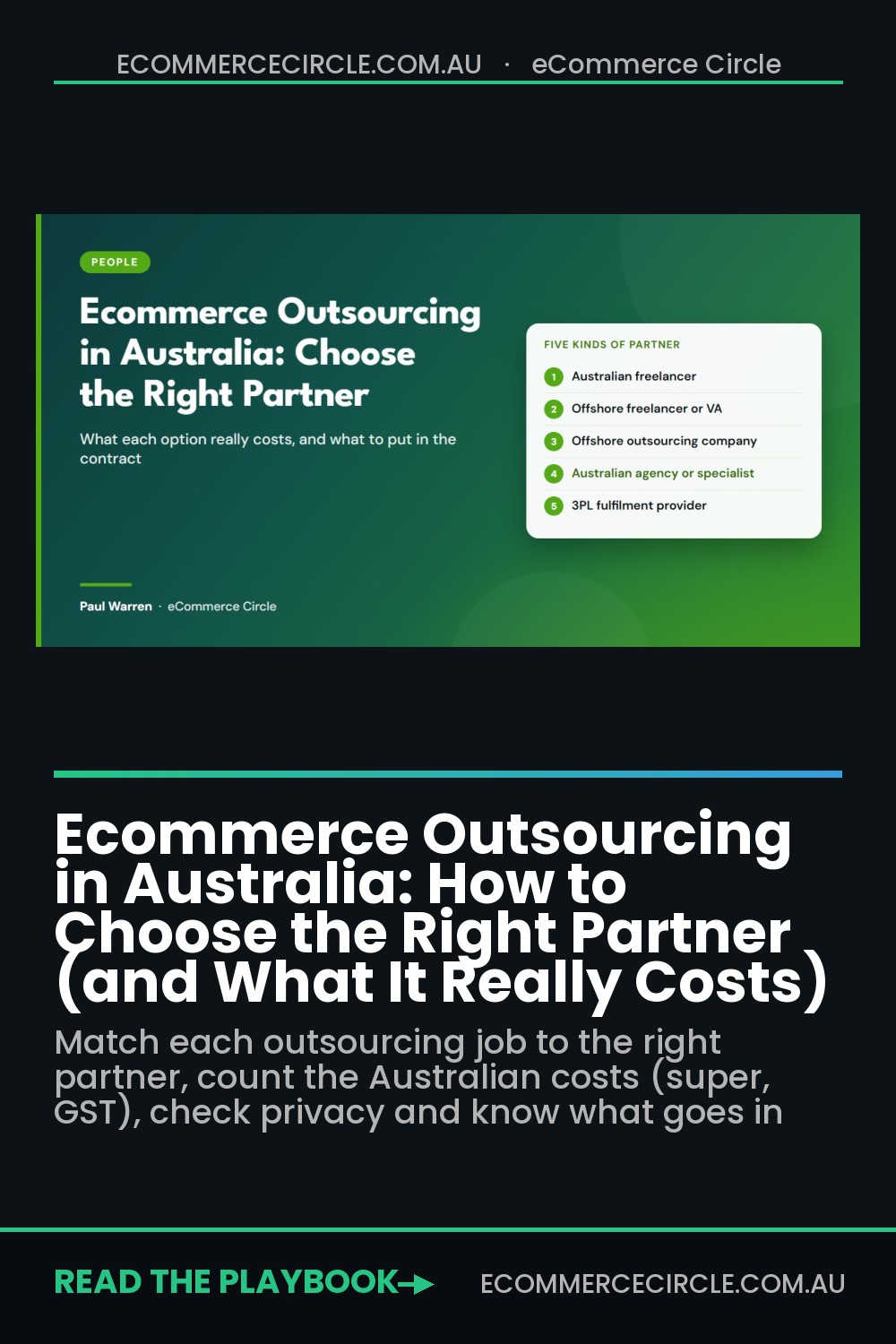
The five kinds of ecommerce outsourcing partner
“Ecommerce outsourcing services” covers very different arrangements. The legal, tax and privacy picture changes depending on which one you pick, so get this straight before you compare quotes.
| Partner type | Typical jobs | How you pay | Who manages the day-to-day | Main Australian risk to check |
|---|---|---|---|---|
| Individual freelancer in Australia | Copywriting, design, Shopify tweaks, bookkeeping | Hourly or per job, they invoice with an ABN | You | Super may be owed if it’s mainly for their labour; sham contracting if they’re really an employee |
| Individual offshore freelancer or VA (direct or via a marketplace) | Product uploads, customer service, admin, research | Hourly or monthly, plus any platform fees | You | Customer data going overseas (Privacy Act APP 8), IP ownership, time zones |
| Offshore outsourcing company (staff provided by a business) | Customer service teams, data entry, back office | Monthly per seat | Shared: they manage the person, you set the work | Privacy and data access, contract lock-ins |
| Australian agency or specialist firm | Ads, email, SEO, design, development | Retainer or fixed project | Them, against your brief | Unfair contract terms, who owns accounts and work |
| Fulfilment and logistics provider (3PL) | Storage, pick and pack, dispatch, returns | Per order, per pallet, plus fees | Them, against service levels | Stock liability, service levels, peak capacity |
Fulfilment is its own beast, with its own pricing and contracts. If that’s what you’re outsourcing, our guide to choosing an Australian 3PL for Shopify goes much deeper than we can here.
Which partner fits which job
Here’s a decision path you can use. It starts with the work, not the provider. Take one job you want off your plate and work down these questions:
- Is it physical: storage, packing, dispatch? If yes, use a 3PL or fulfilment partner. If no, go to question 2.
- Does it need specialist skill and a clear outcome, like ads, SEO or a site build? If yes, go to question 3. If no, go to question 4.
- Is it ongoing, or one project? One project suits a fixed-price specialist or agency project. Ongoing work suits an agency retainer with a scoreboard and a 30-day exit.
- Does it touch customer personal information? If yes, use a freelancer or company with privacy terms, staff-level access and a data checklist. If no, go to question 5.
- Is it more than about 20 hours a week of steady work? If yes, look at a dedicated VA or an outsourcing company seat. If no, pay a freelancer per task.
A few rules of thumb from those questions:
- Specialist work with a clear outcome suits a fixed-price project. You’re buying a result, so price the result.
- Repeatable admin suits a VA or a dedicated seat. You’re buying hours, so you need processes written down first.
- Anything touching customer data needs privacy terms, whoever does it. That includes your customer service inbox, your Shopify customer list and your email platform.
What outsourcing really costs in Australia
The quote is never the full cost. Here are the Australian line items that sit underneath it.
1. Super can be owed on contractors
The ATO says that if you pay an independent contractor mainly for their labour, they’re an employee for super guarantee purposes, and you may need to pay super for them, even if they have an ABN (ATO: super for independent contractors). The ATO’s tests include whether the contract is mainly for their labour (more than half the dollar value), whether they’re paid for their personal labour and skills rather than a result, and whether they have to do the work themselves.
If you contract with a company, trust or partnership instead, the ATO says you don’t have to pay super for the person they employ to do the work. The super guarantee rate is 12% (ATO: super guarantee).
This is mainly about individual contractors working for you in Australia. If you’re engaging individuals overseas, check with your accountant how the rules apply to your setup.
2. Sham contracting is expensive
Calling someone a contractor when they’re really an employee is sham contracting. The Fair Work Ombudsman says it’s illegal to represent to a worker that they’re a contractor when the business doesn’t reasonably believe it, and lists maximum penalties per contravention of $21,840 for individuals, $109,200 for businesses with fewer than 15 employees, and $546,000 for businesses with more than 15 (Fair Work: sham contracting).
If your “contractor” works set hours, only for you, using your systems, under your direction, get advice before you go further.
3. GST on overseas services
If your business is registered for GST and you buy services from an overseas supplier, the ATO says you should give the supplier your ABN and state that you’re registered for GST. Then GST generally won’t apply to imported services you use in your business (ATO: importing goods and services). If you’re not registered for GST, GST will apply to those purchases, so factor in the extra 10%.
For local suppliers who are registered for GST, you’ll be charged GST and can usually claim it back as a credit. Compare quotes ex GST if you’re registered and GST-inclusive if you’re not.
4. Platform fees
Marketplaces add their own fees on top of the worker’s rate, and they don’t always quote them the same way. Take Upwork:
- Its client pricing page shows a 5% service fee on the free Basic plan.
- Its help centre says Basic-plan clients pay a Client Marketplace Fee of up to 7.99% on all payments to freelancers.
- There’s also a one-off contract initiation fee of US$0.99 to US$14.99 per contract on Basic.
- Freelancers pay Upwork a service fee of 0% to 15% per contract out of their earnings.
- Budget on the 7.99% ceiling and check the fee line when you fund the contract.
OnlineJobs.ph charges a monthly subscription to contact and hire workers (OnlineJobs.ph pricing). These change, so check the current page before you budget.
5. Your management time
It won’t show on any quote, but it’s real. Someone has to brief the work, answer questions, check quality and fix mistakes. In the first month that’s likely to be you, and it can be more hours than you expect.
Worked example: 20 hours a week of customer service
Let’s cost one job four ways. The job is customer service for a store: email and chat, order tracking questions, returns requests. Twenty hours a week, every week.
The legal figures are real and sourced. The hourly rates for the contractor, offshore and agency options are example figures only. Plug in the actual quotes you get.
Option A: part-time employee in Australia
- Pay rate: $26.44 an hour, the National Minimum Wage from 1 July 2026 (Fair Work: minimum wages). Your award may set a higher rate, so check it.
- Weekly pay: 20 × $26.44 = $528.80
- Super at 12%: $528.80 × 0.12 = $63.46
- Weekly total: $592.26
- Yearly (52 weeks, paid leave included in the 52): $592.26 × 52 = $30,797.52, call it $30,798
- Not included: workers’ compensation insurance, any award loadings or penalty rates, recruitment and equipment.
Option B: Australian sole-trader contractor, paid mainly for labour (example rate $45/hour ex GST)
- Weekly fee: 20 × $45 = $900
- Super may be owed, because it’s mainly for their labour: $900 × 0.12 = $108
- Weekly total: $1,008
- Yearly: $52,416 ex GST
Option C: offshore VA through a marketplace (example rate $12/hour, converted to AUD)
- Weekly fee: 20 × $12 = $240
- Marketplace fee, budgeted at Upwork’s “up to 7.99%” ceiling: $240 × 0.0799 = $19.18
- Weekly total: $259.18
- Yearly: $259.18 × 52 = $13,477.36, call it $13,477, plus currency conversion costs and any one-off contract fees
Option D: Australian outsourcing company providing a person (example rate $60/hour ex GST)
- Weekly fee: 20 × $60 = $1,200
- Super: not owed by you, because you’re contracting with a company
- Yearly: $62,400 ex GST
| Option | Example yearly cost | Super risk | Privacy setup needed | Your management load |
|---|---|---|---|---|
| A. Part-time employee | $30,798 + on-costs | You pay it (it’s built in) | Normal | High at first, then normal |
| B. Local sole trader (labour) | $52,416 ex GST | Likely owed | Normal | High |
| C. Offshore VA via marketplace | $13,477 + FX | Check with your accountant | APP 8 steps for overseas disclosure | High, plus time zones |
| D. Local outsourcing company | $62,400 ex GST | None for you | Contract terms | Lower |
First, the “cheap” local contractor (B) can cost more than an employee (A) once super is added, while carrying sham contracting risk if the arrangement looks like employment. If you need someone for 20 steady hours a week in Australia, it’s worth pricing up an employee properly.
Second, the offshore option (C) is the cheapest on paper by a long way, which is the appeal. But your customer service inbox is full of names, addresses, phone numbers and order histories. You’re sending that personal information overseas, and that comes with obligations (below).
Third, the company option (D) costs the most, but you’re paying for supervision, cover when someone’s sick, and no super or employment risk. For some owners, that’s worth it.
None of these is the “right” answer. The right answer depends on how much management time you’ve got, how sensitive the work is, and whether the hours are steady. Our customer service playbook covers how to set the job up so whoever you choose can actually do it.
Privacy: the bit that’s easy to skip
Does the Privacy Act apply to you?
The OAIC says a small business with annual turnover of $3 million or less is generally exempt from the Privacy Act, with exceptions, such as businesses that trade in personal information. A business can also choose to opt in (OAIC: small business). Turnover here includes all income from all sources.
An established store can be over $3 million. If that’s you, the rules below apply directly. If you’re under, they’re still a sensible standard, because a data leak hurts your customers and your reputation either way.
Sending customer data overseas
Under Australian Privacy Principle 8, before you disclose personal information to an overseas recipient, you must take reasonable steps to make sure they don’t breach the APPs. And under section 16C you stay accountable if they do, subject to exceptions (OAIC: sending personal information overseas). The OAIC also notes that where it’s unclear whether you’re “using” or “disclosing” the information, the best approach is to take reasonable steps anyway.
In practice, for an offshore VA or company handling your store:
- Put privacy and confidentiality obligations in the contract, including for anyone they subcontract to.
- Give staff-level logins with only the permissions they need. Never share the owner login or your payment gateway login.
- Use a password manager to share access, so you can revoke it in one click.
- Keep customer data inside your systems (Shopify, your helpdesk) rather than exported to spreadsheets.
- Have an offboarding checklist: remove access the day the engagement ends.
Who owns the work
This one catches people out with designers, copywriters and developers. IP Australia says that in Australia, IP created by a contractor belongs to the contractor unless the contract says otherwise (IP Australia: who owns IP?). Business.gov.au lists assigning intellectual property rights as one of the things to set out when you prepare a contractor agreement (business.gov.au: prepare a contract).
So your product descriptions, photography, designs, code and email templates need a written assignment to you. And every account (ad accounts, email platform, analytics, domain) should be in your business’s name, with the partner added as a user.
Contract terms that protect you
If you’re a small business buying from a bigger supplier, the unfair contract terms law can help you. Since 9 November 2023, it covers standard form contracts with small businesses that have fewer than 100 employees or less than $10 million turnover, and penalties now apply. The ACCC gives examples of terms that may be unfair, such as terms that let only one party end the contract, change it, or avoid its responsibilities (ACCC: contracts).
That doesn’t mean every lock-in is illegal. But a contract where only the provider can end early or change the price is worth questioning before you sign.
Your outsourcing partner checklist
Run every provider through this before you sign. It works for a freelancer, a VA, an offshore company or an agency.
Before you shortlist
- I’ve written down the job: tasks, hours, quality standard and how I’ll measure it.
- I’ve decided which partner type fits (use the decision questions above).
- I’ve costed it ex GST (or GST-inclusive if I’m not registered), including super, platform fees and my own management time.
Before you sign
- I know whether the person is an employee, a contractor paid for labour, or someone supplied by a company, and what that means for super.
- The arrangement wouldn’t look like employment dressed up as contracting.
- The contract assigns all IP to my business, including from subcontractors.
- Confidentiality and privacy obligations are in writing, including for subcontractors.
- If customer data goes overseas, I’ve taken reasonable steps (contract terms, limited access, offboarding).
- Exit terms work both ways. I can end it with reasonable notice and no penalty.
- Every account is in my business’s name. The partner is a user, not the owner.
In the first 30 days
- Written SOPs for every task they own.
- A weekly check of two or three numbers (response time, error rate, tasks done).
- Staff-level logins only, shared through a password manager.
- A review at day 30: keep, change, or end.
A simple 30-day trial plan
Whichever partner you choose, don’t hand over everything on day one.
- Week 1: one task, fully documented. Pick the most repetitive job. Record a walkthrough video and write the steps down.
- Week 2: check every piece of work. Yes, every one. It’s the only way to find the gaps in your instructions.
- Week 3: spot-check. Drop to checking one in five. Track errors.
- Week 4: review against your numbers. If the error rate and turnaround are where you need them, add the next task. If not, fix the process or end it.
This works because of where outsourcing tends to go wrong. It’s rarely about the person. It’s vague instructions, no measure of quality, and no review point.
Frequently asked questions
What ecommerce tasks are best to outsource?
Repetitive, rules-based work with a clear quality standard is usually the easiest to hand over: product uploads, order tracking emails, basic customer service, data entry and bookkeeping. Specialist work like ads, SEO or a site build suits a fixed-price project with a clear outcome.
Do I have to pay super for a contractor in Australia?
You might. The ATO says contractors paid mainly for their labour are employees for super guarantee purposes, even if they have an ABN. If you contract with a company, trust or partnership, you don’t pay super for the person they employ. Check the ATO’s rules or your accountant before you engage someone.
Do I pay GST on overseas outsourcing services?
If you’re registered for GST and give the overseas supplier your ABN and confirm you’re registered, GST generally won’t apply to imported services you use in your business. If you’re not registered for GST, GST will apply.
Is it legal to give an offshore VA access to my customer data?
Yes, but if the Privacy Act applies to you, you must take reasonable steps to make sure the overseas recipient doesn’t breach the Australian Privacy Principles, and you generally stay accountable if they do. Even if you’re under the $3 million small business threshold, limit access and put privacy terms in the contract.
Who owns the work an outsourced designer or copywriter creates?
In Australia, IP created by a contractor belongs to the contractor unless the contract says otherwise. Put a written IP assignment in every contract, and keep every account in your business’s name.
How do I know if an outsourcing partner is working?
Agree two or three numbers before you start, like response time, error rate or tasks completed, and review them weekly. Hold a proper review at day 30 and decide whether to keep, change or end the arrangement.
Decide what to outsource next
Connect is the daily coaching room for Aussie Shopify operators. If you’d like to bring your own outsourcing decision to the room, start your 7-day Connect trial. Trial applies to the monthly plan only.