You have done everything right. Your Meta Ads are bringing traffic. Your product pages are converting browsers to add-to-carts. But then, at the final hurdle, 35% of your customers abandon checkout and vanish. The sale was right there — and you lost it.
What’s in This Article
Checkout abandonment is the most expensive problem most Shopify stores ignore. On a store doing $40K/month, a 35% checkout abandonment rate means roughly $21,500 in lost monthly revenue — from customers who were literally about to buy. Even recovering a fraction of that is transformative.
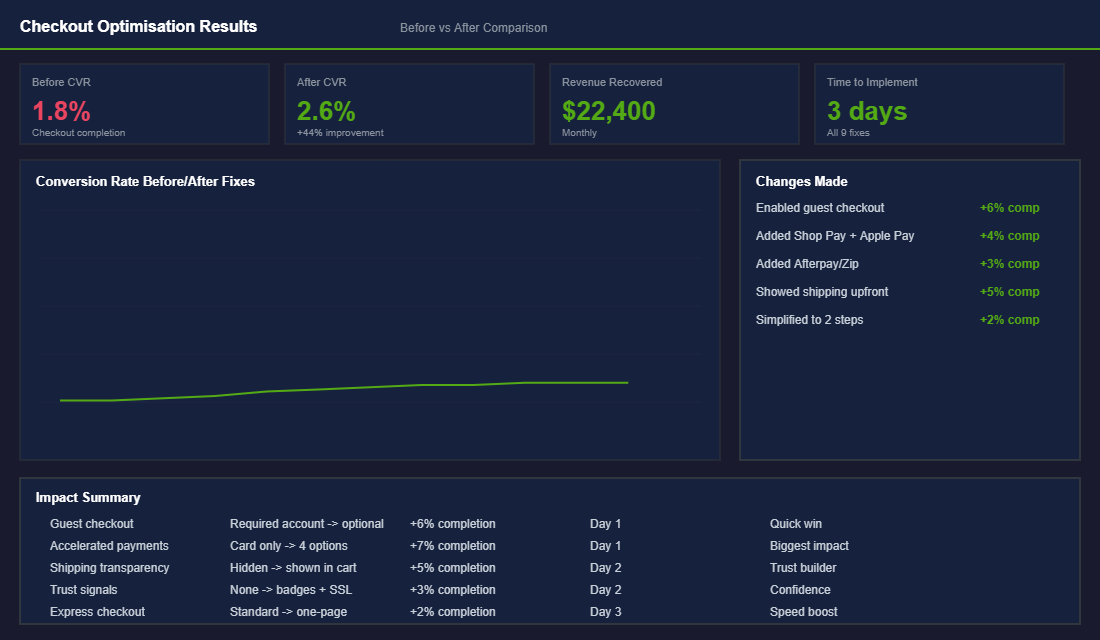
We recently worked with an eCommerce Circle member to implement these nine checkout fixes. The result: $22,400 in recovered monthly revenue. Three days of work. Zero additional ad spend. Here are the exact changes.
Why Checkout Is The Highest-Impact Place On Your Whole Store
Most Aussie founders spend 80% of their time and energy on the top of the funnel — Meta Ads, TikTok creative, SEO, influencer drops. That is the easiest part of the store to obsess over, but it is not where the money is leaking.
The Baymard Institute pegs the global average cart abandonment rate at 70.19%. Shopify’s own data on AU stores has checkout-specific abandonment sitting around 30-40%. That means for every 100 people who hit “Buy Now,” 30 to 40 of them never actually finish the order. They have already self-selected as buyers. They have already pulled out their wallet. And then your store quietly loses them on a friction point that costs nothing to fix.
Here is the maths that should keep you up at night. If you are doing $40K/month at a 35% checkout abandonment rate, recovering half of those abandons puts roughly $7K back in your pocket every month with zero extra ad spend. Over 12 months, that is $84K in pure margin recovered — money you already paid Meta to earn.
This is what we mean at eCommerce Circle when we talk about conversion architecture — the discipline of removing friction at the exact moment a customer has signalled intent. Checkout is the highest-leverage real estate on your entire store. Get it right and every dollar you spend acquiring traffic works harder. Get it wrong and you are subsidising your competitors.
The Aussie Checkout Benchmarks You Should Be Measuring Against
Before you touch a single setting, you need to know what “good” looks like. Pull these numbers from your Shopify Analytics > Behaviour > Online store conversion over the last 90 days:
- Add to cart rate: 8-12% is healthy for Australian fashion and accessories. Under 5% means your product page is the bottleneck, not your checkout.
- Reached checkout rate: 4-6% of sessions. Below 3% suggests cart-page friction (shipping costs, AOV thresholds, code anxiety).
- Checkout completion rate: 65-75% is the target. Under 60% means at least one of the nine fixes below is leaking serious revenue.
- Mobile vs desktop completion: Mobile should be within 10 percentage points of desktop. A 20+ point gap = mobile checkout is broken.
- Repeat purchase rate at checkout: Returning customers should complete at 80%+. If they do not, your login/account experience is killing them.
If you have not pulled these numbers in the last 30 days, stop reading this and go and grab them right now. You cannot optimise what you do not measure. (This is why we built the Shopify Store Scorecard — to give founders a benchmark for every part of the funnel, not just checkout.)
Fix 1: Enable Guest Checkout (Stop Forcing Account Creation)
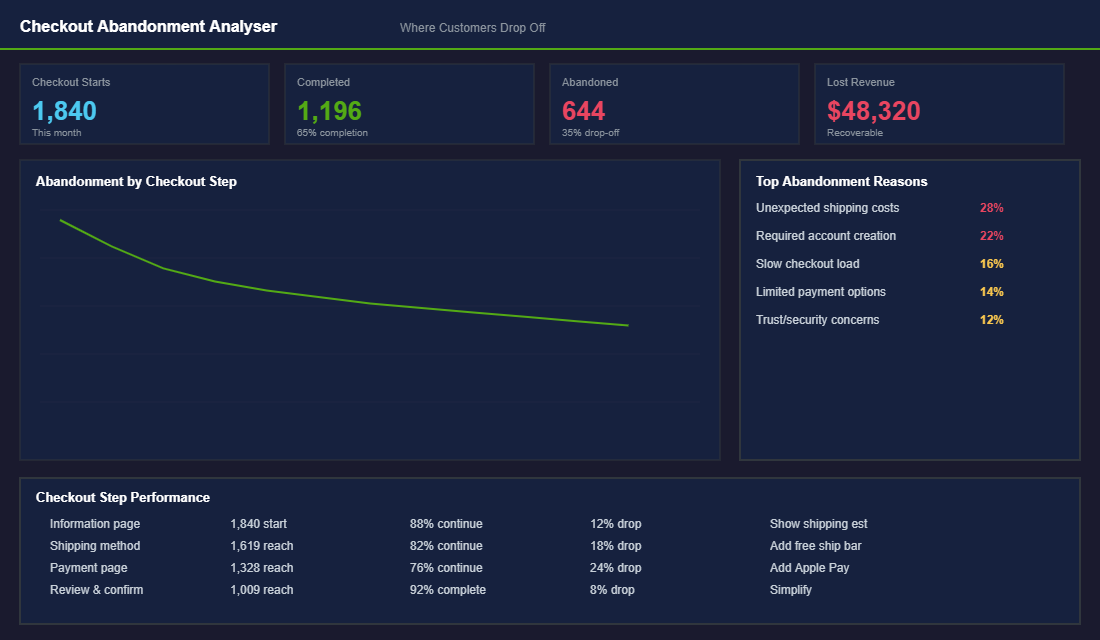
This is the single biggest checkout killer on Shopify. Requiring customers to create an account before purchasing adds friction at the worst possible moment. 22% of checkout abandonments are caused by mandatory account creation.
Go to Shopify Settings > Checkout and change “Customer accounts” to “Accounts are optional.” Customers can still create accounts if they want, but they are not forced to. This single change typically improves checkout completion by 5-8%.
Fix 2: Add Accelerated Payment Options
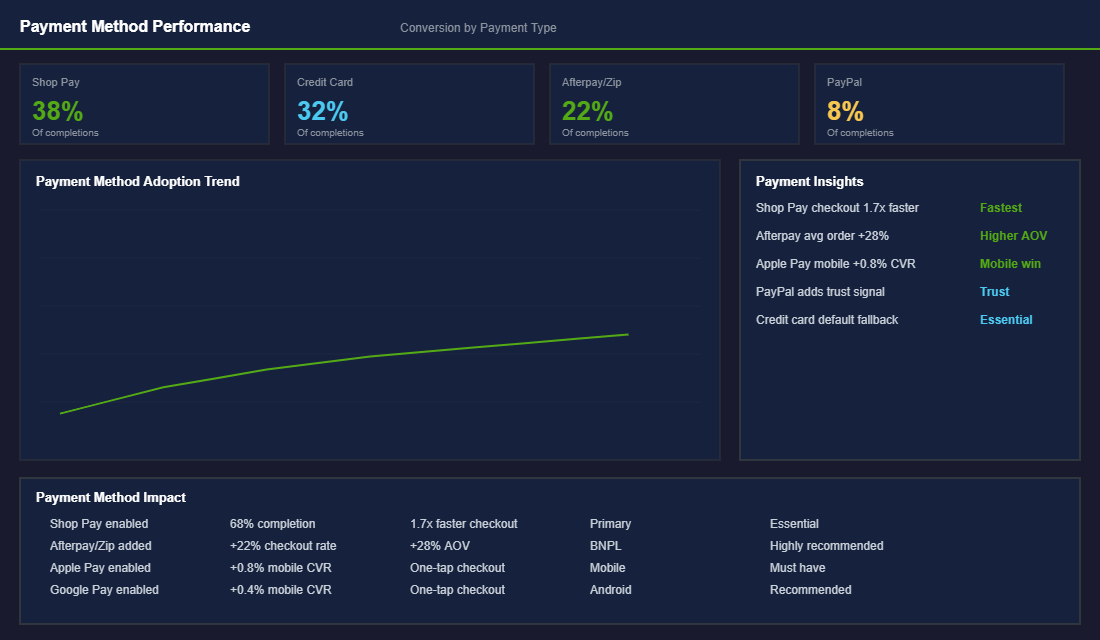
If your checkout only accepts credit cards, you are losing customers who prefer other payment methods. Australian shoppers increasingly expect multiple options:
- Shop Pay: Shopify’s own accelerated checkout. Returns customers can pay with one tap. Checkout is 1.7x faster, and conversion rates are measurably higher.
- Apple Pay and Google Pay: One-tap mobile payments that skip the entire form-filling process. Critical for mobile conversion, where most checkout abandonment happens.
- Afterpay and Zip: Buy-now-pay-later options are not just for young shoppers. BNPL users spend an average of 28% more per order and are more likely to complete checkout because the upfront cost feels lower.
- PayPal: Still used by 8-12% of Australian online shoppers, particularly older demographics who trust PayPal’s buyer protection.
Enable all of these. Each payment method you add removes a friction point for a segment of your customers. Together, they can improve checkout completion by 10-15%.
Fix 3: Show Shipping Costs Before Checkout
Unexpected shipping costs are the number one reason for checkout abandonment globally — 28% of abandonments happen because the customer got sticker shock at the shipping step. The fix is simple: show estimated shipping costs on the cart page before they enter checkout.
Use a Shopify app or theme customisation to display “Estimated shipping: $8.95” on the cart page. Better yet, show a free shipping progress bar: “Add $24 more for FREE shipping.” This sets expectations and often increases AOV simultaneously.
Fixes 4-9: The Quick Wins That Stack Up
- Fix 4: Add trust badges to checkout. Display SSL security badge, payment method logos, and a “30-day money back guarantee” badge on the checkout page. Trust signals reduce the 12% of abandonments caused by security concerns.
- Fix 5: Pre-fill address with Google Autocomplete. Shopify supports this natively. Enable it in Settings > Checkout. It cuts form-filling time in half and reduces address errors that cause delivery issues.
- Fix 6: Simplify to fewer steps. If your theme supports one-page checkout, use it. Fewer steps = fewer opportunities for the customer to leave. Shopify’s latest checkout redesign supports this out of the box.
- Fix 7: Add an order summary sidebar. Customers want to see what they are buying while entering payment details. A persistent order summary with product images reduces anxiety and “let me go back and check” abandonments.
- Fix 8: Display your returns policy in checkout. A single line: “Free returns within 30 days” or “Easy exchanges, no questions asked.” This removes the last objection at the point of purchase.
- Fix 9: Optimise checkout page speed. Remove unnecessary scripts, compress images, and disable apps that inject code into checkout. Every second of load time at checkout costs you 2-3% of conversions.
Tools and Apps That Make Checkout Optimisation Faster
You do not need to custom-code any of this. The Aussie Shopify ecosystem has matured to the point where 80% of the fixes above are app-installable in under an hour. Here is the toolkit we install for eCommerce Circle members on a typical checkout sprint:
- Shop Pay (free, native): Turn it on inside Shopify Payments. It typically lifts mobile conversion by 8-12% on its own because returning shoppers skip the form entirely.
- Klaviyo (free up to 250 contacts): The abandoned checkout flow that recovers 5-15% of lost sales. Set up the 3-email sequence at 1hr, 24hr, and 48hr after abandonment.
- Rebuy Personalisation Engine: Smart cart upsells and post-purchase offers that lift AOV by 8-15% without touching the checkout itself.
- UpCart or Slide Cart Drawer: Cart drawer apps that surface free-shipping progress bars, gift offers, and quick add-to-cart upsells without forcing a page reload.
- Loop or ReturnGO: Returns automation that lets you promote a stronger returns policy at checkout (anxiety reducer) without drowning your team in tickets.
- Zip, Afterpay, Klarna (BNPL): Non-negotiable for Aussie stores in fashion, beauty, and homewares. Activate all three — different demographics use different services.
- Hotjar or Lucky Orange: Session recordings of failed checkouts. Watch 20 of them and you will spot your specific friction points in under an hour.
One small caveat: more apps is not better. Every app you install adds milliseconds to your checkout page load. Audit your app stack quarterly and uninstall anything that is not directly tied to revenue. If your Shopify page speed is sub-50 on PageSpeed Insights mobile, app bloat is almost always part of the problem.
The Five Checkout Mistakes That Cost Aussie Stores The Most Money
Even with all nine fixes installed, we still see otherwise-good stores leaking conversion because of avoidable mistakes. Watch out for these:
- Mistake 1: Surprising people with GST. Aussie shoppers expect prices to include GST. If your prices look exclusive of tax until the checkout summary, expect a 5-8% drop in completion. Display GST-inclusive pricing everywhere.
- Mistake 2: Forcing newsletter sign-up to checkout. A pre-ticked “subscribe me” box at checkout is fine. A required tick before they can pay is a conversion killer worth 2-4 percentage points.
- Mistake 3: Hiding the contact phone number. A small, visible phone number at checkout (even if it just rings to voicemail) increases completion by 3-5%. It signals you are a real business with real humans.
- Mistake 4: No exit-intent on the cart page. A simple “Wait — here is a 10% code” exit pop on the cart or checkout will recover 1-3% of abandons, every single day, forever.
- Mistake 5: Using a generic “Place Order” button. Test specific button copy. “Complete My Order — Pay $89.95” tends to beat generic “Place Order” by 3-8% because it reduces last-second hesitation.
None of these are revolutionary. They are just small things that quietly compound. A 3% lift here, a 5% lift there — over a year, that is the difference between a store that scales and one that plateaus.
The 60-Second Checkout Audit You Can Run Before Touching a Single Setting
Before you change anything, get a baseline. You can’t tell whether a fix worked if you never measured the starting point, and most Aussie founders skip this step and end up guessing.
Open Shopify Analytics and pull your checkout conversion rate, the percentage of sessions that reach checkout and then complete an order. Anything under 45 to 50% means real money is leaking. Then open GA4 and build a funnel exploration from add_to_cart to begin_checkout to purchase, so you can see exactly which step bleeds the most people.
Next, watch five session recordings of abandoned checkouts in Lucky Orange or Hotjar (both have free tiers). You’ll learn more from five real sessions than from any blog post, including this one. Watch where the cursor hesitates, which field gets re-typed, and whether anyone rage-clicks a shipping line.
Finally, run your own checkout on a phone using mobile data, not wifi. Roughly 70 to 75% of Aussie store traffic is mobile, so a checkout that feels fine on your desktop can be quietly losing two in three buyers. Time it. If it takes more than 60 seconds from cart to confirmation, you’ve found your first fix.
Write down these four numbers before you start:
- Checkout conversion rate (target 50% or higher)
- Mobile vs desktop completion gap
- Average number of fields completed before drop-off
- Payment-method mix, especially how many buyers reach for express pay
In 30 days, after you’ve worked through the fixes above, run the same audit and compare. That before-and-after is what turns “I think it helped” into a number you can take to the bank. If you want to be certain a change caused the lift rather than seasonality, run it as a proper experiment using the approach in our Shopify A/B testing playbook.
The Compound Effect: Small Checkout Fixes = Massive Revenue Impact
None of these fixes individually is revolutionary. But stacked together, they transformed a 65% checkout completion rate into a 79% completion rate for the eCommerce Circle member we worked with. On their traffic volume, that translated to $22,400 in additional monthly revenue — without changing a single ad, product, or price.
This is the power of CRO at the checkout level. You have already paid to acquire these customers. You have already convinced them to add to cart. The checkout is the last 10 metres of the race — make sure you are not tripping at the finish line.
Where To Go From Here
If you only have one hour this week, here is the priority order:
- Turn on Shop Pay, Apple Pay, Google Pay, and BNPL (15 minutes).
- Disable forced account creation (5 minutes).
- Add a free-shipping progress bar to the cart drawer (30 minutes).
- Install Klaviyo abandoned checkout flow (10 minutes, then leave it running).
That four-step combo alone is typically worth 8-15% in checkout completion within 14 days, with zero new ad spend and no design work. Once that is humming, layer in the deeper structural fixes — shipping cost transparency, trust signals, mobile UX — and start tracking the compound effect week by week.
For the bigger picture on how checkout fits into your overall growth system, read our deep-dive on Shopify conversion rate optimisation and the full cart abandonment recovery playbook.
Want a second pair of eyes on your checkout? At eCommerce Circle we run a 90-minute checkout audit for members where we walk through your store, screen-share the friction, and hand you a prioritised fix list. Most members find at least $5K-$15K in monthly recoverable revenue inside the first session.
Let’s Talk About Your Checkout →
Related reading: our buy now, pay later guide for Shopify.