You have a list of 14,000 past customers. About 3,000 of them have not opened an email from you in nine months. They are not unsubscribed, they are just gone. Your Klaviyo dashboard calls them a segment. Your accountant calls them dead money.
What’s in This Article
So you do what everyone does. You upload them to Meta as a custom audience and pay to shout at them again, at a CPM that has climbed roughly 18% year on year in the ecommerce vertical and now sits near sixteen dollars per thousand impressions. Or you send a fourth win-back email into an inbox that has already decided you are noise.
Meanwhile there is a channel where you face almost no competition, where you have the recipient’s undivided attention for the eight seconds it takes them to walk from the letterbox to the bin, and where the average response rate for a house list sits between 5 and 9%. It is the post. Australian letter volumes fell 11.7% in FY2025 alone and are down 72% since 2006-07, and that collapse is exactly why a well-targeted card now works. The letterbox is the only marketing channel in Australia where your share of voice is going up while you sleep.
This is not a nostalgia piece. Direct mail is expensive, slow, and unforgiving of sloppy data. Used on the wrong segment it will torch four figures of cash in a fortnight. Used on the right 1,200 people it is the highest-return retention lever most Aussie Shopify brands have never pulled. Here is how to run it properly.
Your Letterbox Has Never Been Emptier, And That Is the Whole Point
Understand the structural shift before you spend a cent on it.
Australia Post’s letters business lost 230 million dollars in FY2025 and its own projections have volumes falling another 11.1% in 2025/26, 10.1% in 2026/27 and 9.3% the year after. The basic postage rate climbs from 1.70 to 1.85 on 1 September 2026. Every one of those numbers is bad news for Australia Post and good news for you, because volume decline is not evenly distributed. What disappeared from the letterbox was bank statements, utility bills, insurance renewals and government notices. All of it moved to email.
So the household letterbox that used to hold eleven items on a Tuesday now holds two. A card from a brand someone actually bought from is no longer competing for attention with a wall of admin. It is one of two things a person touches that day.
Compare that to the inbox, where the average person receives well over a hundred commercial emails a week, and where your win-back sequence is landing under Promotions next to eleven other brands running the same 15% off play. Response rate per piece tells the story. ANA and DMA benchmarks put direct mail near 4.4% on average across all list types, against email response rates measured in fractions of a percent. Per piece sent, mail generates roughly 36 times the response.
Do not read those numbers as permission to mail everyone. Read them as evidence that the channel still has physics on its side. Everything that follows is about pointing it at the small group of people where the maths clears.
What a Posted Card Actually Costs in Australia
Most founders abandon this idea at the pricing page because they compare a card to an email. That is the wrong comparison and it kills the project before it starts.
Landed cost per card in Australia, print and postage combined, currently sits in these bands:
- Automated platform, low volume. PostGrid Australia starts around 0.79 per postcard above 500 pieces a month, with print, postage and address validation included. This is the realistic starting point for a store doing under 500k a year.
- Automated platform, higher volume. Per-piece pricing drops toward 0.55 to 0.65 in the platforms serving larger senders, though several of those are US-first and you will need to confirm Australian delivery before committing.
- Australia Post bulk direct. PreSort Letters needs a minimum of 300 identical articles per lodgement. Promo Post, the genuinely cheap tier, requires 4,000 barcoded articles per lodgement. Below that volume you are better off paying a platform to handle sorting and barcoding.
Call it 0.84 all-in for a decent A6 card at realistic Aussie volumes. Now run the only sum that matters.
The break-even card. Take your gross profit per order, not your AOV. If your AOV is 140 and your blended gross margin is 62%, your gross profit per order is about 87. At 0.84 a card, mailing 1,000 people costs 840. You need 840 divided by 87, which is 9.7 orders, to break even before you count any repeat value. That is a required response rate of 0.97%.
Read that number again, because it is the whole argument. You need roughly 1% response to break even on the first order. Australian benchmarks put well-targeted postcards to a house list in the 4 to 6% band, with lapsed-customer campaigns commonly landing higher. Paperlust’s 2026 Australian data puts cost per response in the 30 to 37 dollar range at a 3% response on a 1,000-piece run. Your break-even is a quarter to a sixth of the realistic outcome.
Compare that against what it costs to bring the same lapsed customer back with paid media, where you are paying a rising CPM to reach someone who has already stopped responding to you, and the picture changes fast. Tier 1 markets including Australia saw ad costs rise about 12% year on year, and the number of Australian businesses running active Meta campaigns grew 22% between Q1 2025 and Q1 2026. More bidders, same inventory.
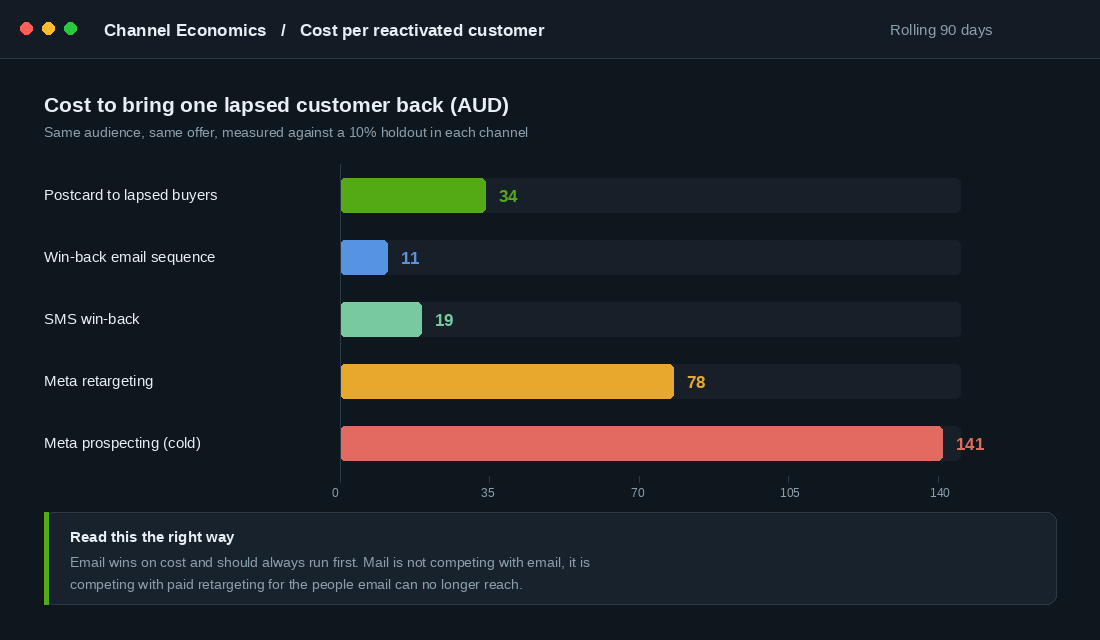
The honest framing is this. Email will always be cheaper and should always run first. Mail earns its place on the customers email has stopped reaching, and it should be benchmarked against your retargeting cost per acquisition, never against your email cost per send.
The Five Segments Worth Mailing, And the Ones That Will Burn You
Direct mail punishes broad targeting harder than any other channel, because there is no impression-level optimisation to save you. You choose the list, you pay for every piece, and you find out six weeks later. So the segment work is the campaign.
Mail these five.
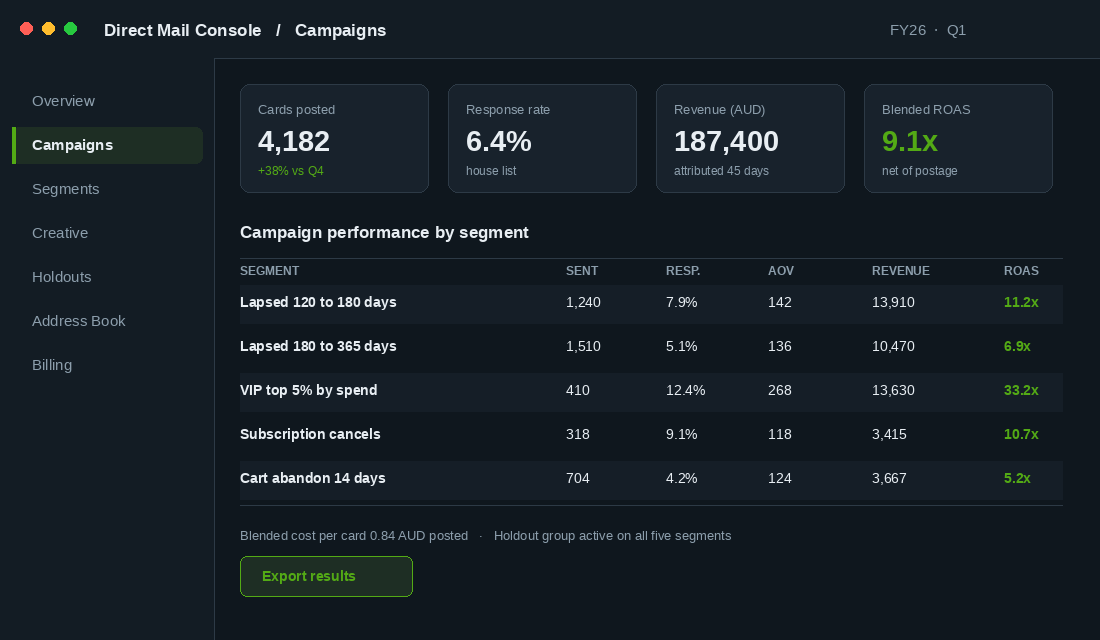
- Lapsed buyers at 120 to 180 days who have gone quiet in email. Two purchases minimum, no order in four to six months, no email open in 90 days. This is the single best-performing segment in almost every programme. Dr. Squatch built a winback campaign aimed at customers 7 to 9 months lapsed and reported a 12.66% conversion rate at better than 10x ROAS.
- Your top 5% by lifetime spend. Not a discount, a thank you. High AOV makes the maths trivial and the goodwill compounds. Obvi ran a VIP winback and pulled more than twenty thousand dollars in sales at 37x ROAS off a tiny list.
- Cancelled subscribers. People who cancelled a subscription have already proven they will pay repeatedly. A card thirty days after cancellation, arriving when the product has actually run out, catches them at the moment of felt need rather than the moment of admin frustration.
- High-value cart abandoners past day 14. Only worth it above a cart value threshold you set, typically two to three times your AOV. Below that the card costs more than the profit it can recover.
- Postcode clusters where you already over-index. If you have mapped where your customers actually live, a saturation drop into a handful of suburbs that already buy from you is prospecting with a warm signal underneath it. Our postcode mapping playbook walks through how to build that view from your own order data before you spend anything.
Do not mail these three.
- One-time buyers under 60 days. Your email flows are still working on them and mail cannibalises a conversion you would have got for free.
- Anyone with a return rate above 40%. You are paying 84 cents to invite a refund and a restocking cost.
- Addresses you have not validated. Australian address data decays at roughly 15 to 20% a year through moves alone. Unvalidated lists mean you pay full freight for cards that reach a stranger. Every serious platform includes address verification against the Australia Post Address File. Use it, and suppress anything that fails.
What Actually Goes on the Card
The creative rules for mail are not the creative rules for a Meta ad, and treating a postcard like a static ad is the most common way founders waste the spend.
A card gets one look, held in a hand, on the walk from the letterbox. You have about four seconds to survive the bin. Design for that moment.
- Name them in the largest type on the card. Not “Hi there”. First name, big, above the fold of a hand. Variable data printing costs nothing extra on any modern platform and it is the single strongest signal that this is not junk mail.
- Reference the actual product they bought. “Your Wattle Candle is about six weeks past empty” beats any generic headline you can write. Pull the last purchased product title as a merge field. This is where mail crushes a Meta ad, because you have first-party data and no privacy wall between you and it.
- One offer, one deadline, one code. A unique code per recipient is how you attribute cleanly. Give it an expiry of 30 days, which is long enough to survive Australia Post’s regular timetable and short enough to create urgency. Never run two offers on one card.
- Make the URL typeable. A QR code is fine as a secondary path but the primary call to action should be a short vanity URL a person can enter with their thumbs. yourbrand.com.au/back, not a UTM-strung monster.
- Print the reason. One line explaining why they got this. “You bought from us in March and we have not seen you since.” Transparency raises response and lowers the creep factor of receiving post from a brand.
- Go heavier stock than you think. 350gsm minimum. Thin cards read as bulk mail before anyone has processed a word, and the cost difference over a 1,200-piece run is small.
On discounting, be deliberate. Urbani Truffles ran their lapsed-customer campaign on an elegant, minimal card with a meaningful discount and used it to pull people back onto the email list, which is the right way to think about it. The card is not the sale, it is the reintroduction. If your gross margin is thin, lead with a free shipping threshold or a gift with purchase instead of a percentage off.
Wiring It Into Shopify and Klaviyo Without a Developer
The reason most brands never start is that they picture a print broker, a spreadsheet and a courier. That is not how this works any more. Here is the actual build using PostGrid Australia, which is the most practical option for an Aussie store because it prints and lodges domestically and validates against Australian address data.
- Confirm you are collecting addresses at all. Shopify stores the shipping address on every order, but if you sell digital products or use a marketplace you may have gaps. Export your customer list and check the fill rate on address1, city, province and zip before anything else.
- Connect PostGrid to Klaviyo. In PostGrid, open Integrations and authorise Klaviyo with your private API key. This exposes your Klaviyo lists and segments as mail audiences and lets you map Klaviyo profile properties to merge fields on the card.
- Run address verification across the base. Push your full customer list through PostGrid’s verification once, before any campaign. Tag failures in Klaviyo as a suppression segment. Expect to lose 8 to 15% of a list that has never been cleaned.
- Build the segment in Klaviyo, not in the mail tool. Create a segment: placed order at least twice, no order in the last 120 days, not opened email in the last 90 days, has a valid address, not in the suppression tag. Keep the logic in Klaviyo so it stays consistent with the rest of your retention programme.
- Design the card in PostGrid’s template editor. Drag-and-drop with merge tags mapped to Klaviyo properties: first name, last ordered product, unique discount code. Preview against five real profiles before you approve anything, because merge field failures print.
- Generate unique codes in Shopify. Use a discount code bulk generation app or the Shopify Admin API to mint one code per recipient with a 30-day expiry, then push them into Klaviyo as a profile property the card can merge.
- Split off a holdout before you send. Randomly hold back 10% of the segment and mail them nothing. This is the step everyone skips and the one that makes the whole programme defensible.
- Send a test to yourself and three staff. Physically. Wait for it. Hold it. If it does not survive your own letterbox test, fix the card before you spend on the run.
- Lodge the run and set a 45-day attribution window. Print and lodgement typically completes within two business days, then allow for Australia Post’s regular delivery timetable on top. Do not judge results before day 21.
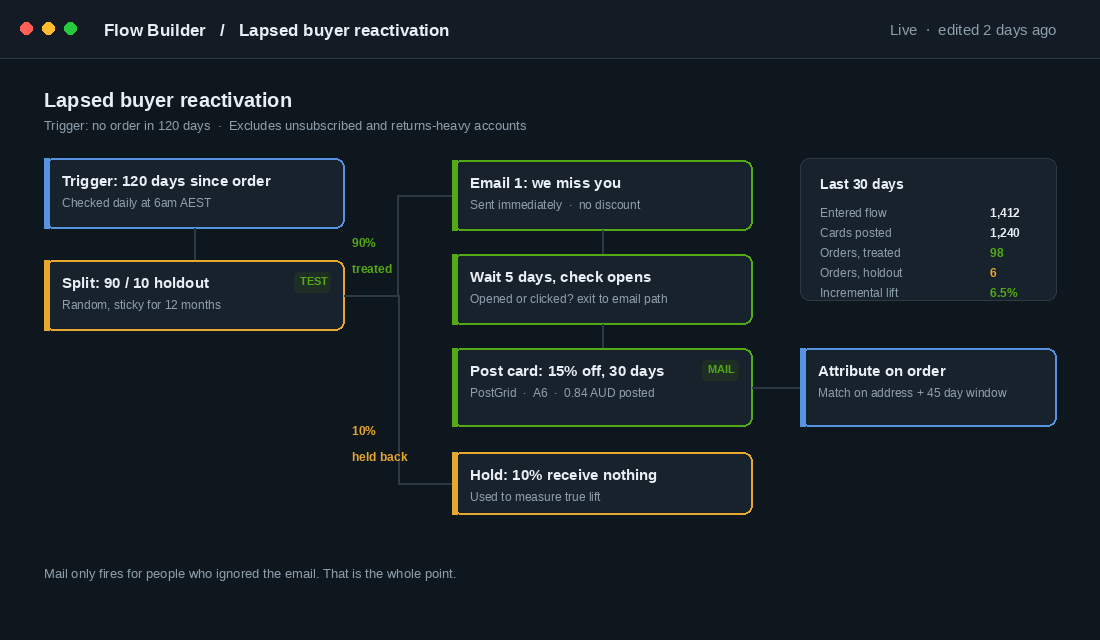
Notice the sequencing in that flow. Mail fires only for the people who ignored the emails. If your win-back email sequence is not built and running first, do not start with mail. You will pay 84 cents each to reach people a free email would have converted.
The Holdout That Keeps You Honest
Here is the trap with direct mail. It looks brilliant on a code-redemption report and it is very easy to fool yourself.
You mail 1,200 lapsed customers. Ninety-eight of them order in the next six weeks. Your platform reports 11x return and you feel like a genius. But some slice of those ninety-eight were going to come back anyway. Lapsed customers do reactivate on their own, at a base rate of anywhere from 2 to 6% over a six-week window depending on your category and repeat cycle. If your natural reactivation rate is 5%, sixty of those ninety-eight orders were never incremental. Your real return is closer to 4x, not 11x.
The fix is the holdout, and it costs you nothing but discipline.
- Hold back 10% at random. Same segment, same criteria, same time window. They simply receive no card. Make the assignment sticky for twelve months so a customer does not bounce between treated and held.
- Measure order rate, not revenue, first. Orders per hundred customers in each group over 45 days. Revenue is noisier because one big order distorts a small holdout.
- Calculate incremental lift. Treated order rate minus holdout order rate. In the flow above, 98 orders from 1,240 treated is 7.9%, against 6 orders from 138 held, which is 4.3%. The incremental lift is 3.6 percentage points, so about 45 of those 98 orders were genuinely caused by the card.
- Recalculate ROAS on incremental orders only. That is your true number and it is the one to take to a decision about scaling.
- Keep the holdout at 10% minimum, and larger on small lists. On a segment under 800 people, a 10% holdout is too small to read. Go to 20% or accept you are running a directional test, not a measured one.
This is the same logic we apply to paid media, and if you have already read our piece on incrementality testing with geo-holdouts, apply exactly that thinking here. Mail is actually easier to test than paid media, because you control the treatment list precisely and there is no spillover between groups.
Where Mail Compounds: The Third Leg of Retention
Run any one of these campaigns and you get a decent quarter. Run the system and something different happens.
Most Australian brands have a two-legged retention programme. Email carries the load, SMS handles the urgent moments, and everything else is paid retargeting dressed up as retention. The problem is that both legs decay against the same customer. Someone who has stopped opening email has usually stopped reading SMS too, because disengagement is a person-level behaviour, not a channel-level one. So your retention programme quietly narrows to the people who were always going to stay.
Mail breaks that. It reaches the disengaged tail specifically, which is why the compounding shows up in a place people do not expect: your email list health. Every reactivated customer re-enters your email programme as an engaged profile. HexClad reported roughly 3.2 million dollars over about four months at better than 12x return running direct mail across winbacks and other segments, and the revenue is only half the story. Each of those customers goes back into flows that keep earning without further print cost.
Three effects stack over about twelve months:
- Your active list stops shrinking. A quarterly mail programme recovering 5 to 7% of the lapsed pool offsets most of the natural decay in a healthy list, which means your email revenue holds without buying more traffic.
- Your deliverability improves. Reactivated profiles start opening again, which lifts engagement metrics and helps the emails you send to everyone else land in the inbox rather than Promotions.
- Your blended acquisition cost falls. Every customer you recover is a customer you do not need to buy at a rising CPM. On a store recovering 300 customers a quarter at 34 dollars each against a retargeting cost of 78, that is thirteen thousand dollars a quarter that stops leaving the business.
None of that shows up in the first campaign report. It shows up in the fourth.
Your 90-Day Direct Mail Rollout
Do not launch a programme. Launch one test, prove the number, then build the programme on top of a result you trust. Here is the sequence, and you can lift it straight into your project tool.
- Days 1 to 7: audit the data. Export customers, check address fill rate, run verification, tag failures as suppressed. Calculate your true gross profit per order and your break-even response rate. Write both numbers down.
- Days 8 to 14: confirm the email programme is doing its job. If your win-back sequence is not live and measured, build that first. Mail is layer two, never layer one.
- Days 15 to 21: build one segment only. Lapsed 120 to 180 days, two or more prior orders, no email engagement in 90 days, valid address. Target roughly 1,000 to 1,500 people. Split off a 10% holdout and freeze it.
- Days 22 to 30: design and proof. One card, one offer, unique codes, physical proofs posted to yourself. Do not skip the physical proof.
- Day 31: lodge the run. Budget roughly 850 to 1,300 dollars all-in for that volume.
- Days 32 to 52: leave it alone. Do not check daily. Delivery plus consideration plus purchase takes three weeks minimum on the regular timetable.
- Days 53 to 60: read the holdout. Order rate treated versus held. Calculate incremental orders and recalculate return on incremental only. Compare that to your retargeting cost per acquisition, not to your email numbers.
- Days 61 to 75: decide, then widen by one segment. If incremental return beat 3x, add your VIP thank-you drop or your cancelled-subscriber card. One new segment at a time, each with its own holdout.
- Days 76 to 90: automate what worked. Move the winning campaign from a one-off blast to a triggered flow so cards post continuously as people cross the 120-day line, rather than in quarterly batches you have to remember to run.
The whole test costs about the same as three days of Meta spend on a mid-size store. The difference is that at the end of it you own a channel nobody else in your category is using, on a list nobody else can bid against.
The brands who will get the most out of this over the next two years are the ones who start while the letterbox is still quiet and the data is still cheap to clean. Australia Post’s volumes are not coming back. Your competitors’ attention is still fixed on a CPM auction that gets more expensive every quarter. That gap is the opportunity, and it will not stay open forever.
The Three Costs Founders Forget When They Quote a Drop
The per-piece print and postage figure is the number everyone quotes. It is also the number least likely to blow your budget. The three that do the damage are the ones nobody puts in the spreadsheet.
- Data cleaning. On a list that has never been mailed, expect 8% to 15% of addresses to be unusable, missing a unit number, misspelt, or long since moved on from. Address verification runs a few cents per record and is the cheapest insurance you will buy. Every undeliverable piece is print, postage and handling spent on nobody.
- Design and setup. Artwork, a test proof, and a variable data file for personalisation. On a first drop this is often a few hundred dollars amortised across a small run, which quietly doubles your effective cost per piece. It approaches zero by your third drop, which is one more reason a single test drop misprices the channel.
- The reprint. Budget for one. A wrong promo code, an expired offer date, or a URL typo on 5,000 pieces is a lesson you pay for at full retail. Always proof a physical sample, not a PDF, before the run goes to press.
Add all three in before you calculate your break-even response rate. A drop that looks viable at 90 cents a piece and is actually costing $1.40 all-in will fail a test it should have passed, and you will write off a channel for the wrong reason.
Why One Drop Tells You Almost Nothing
Direct mail is not a one-shot channel and it never has been. The first drop into a list that has not seen a physical piece from you before is measuring novelty as much as offer. Response on a second drop to the same segment 8 to 12 weeks later is usually the number worth planning against, because by then the audience knows the format and the brand together.
Plan a three-drop test, not a one-drop test. Same segment, same offer structure, 8 to 12 week gaps, with the holdout group held constant across all three. What you are looking for is not whether drop one beat the control, but whether the gap between mailed and held-out widens across the sequence. That widening gap is the compounding effect, and it is invisible in a single test.
Keep the cadence honest too. Mailing the same house list more than about four times a year starts eating into the novelty that makes the channel work in the first place. Quarterly is the sweet spot for most Australian DTC brands, timed to sit in the gaps where your email calendar is quietest rather than stacked on top of a sale you are already promoting hard. That coordination question is the same one behind your win-back sequencing, and the two channels should be planned on one calendar, not two.
Inside eCommerce Circle, mapping the retention channels a brand is not using yet is one of the first things we do with every member. If you want a second opinion on where your reactivation money should actually go, let’s talk.