Every October the same thing happens in Aussie Shopify stores. Around the 20th, someone in the team says “should we do something for Halloween?” A pumpkin goes on the announcement bar, a 20% off code goes out to the whole list, and on 1 November the founder looks at the numbers and wonders why the sale did nothing except train customers to wait for the next discount.
What’s in This Article
That is a shame, because Halloween is no longer a small American import. According to research from the Australian Retailers Association and Roy Morgan, Australians were forecast to spend a record $500 million on Halloween in 2025, up 11% on the year before, with 4.8 million adults planning to take part. Average spend per participant hit $103.
The brands that do well out of it treat Halloween differently. They do not see it as a sale. They see it as a four-week warm-up for Black Friday: a chance to grow the email list, test creative while ad costs are still sane, and pressure-test fulfilment before the real peak hits. This playbook shows you how to run it that way in 2026, with a calendar built backwards from Saturday 31 October and a checklist you can work through this week.
Why Halloween Deserves a Line in Your Q4 Plan
Most founders still file Halloween under “kids and lollies”. The data says otherwise.
- It keeps growing. In 2022, the ARA and Roy Morgan forecast Halloween spending at $430 million, or $86 per person. By 2025 that had climbed to around $500 million and $103 per person. That is roughly a 20% jump in spend per participant in three years.
- It is not just parents. In the 2025 research, participation among 50 to 64 year olds rose to 21% (up 8%), and over-65s also sat at 21% (up 12%). That is about 1 million more older Australians joining in.
- Spending is spread across categories. The top activities were buying sweets (47%), trick-or-treating (46%), costumes (43%) and home decorating (38%). Costumed pets got a specific mention from the ARA too.
- Some states spend more. Victoria and Tasmania led at $112 per person, ahead of NSW at $107 and South Australia at $102. Queensland and WA came in just under $100.
The US gives you a preview of where this goes. The National Retail Federation forecast a record US$13.1 billion in Halloween spending for 2025, and found that 49% of shoppers started buying in September or earlier. The top source of inspiration was online search (37%), and 31% planned to buy online.
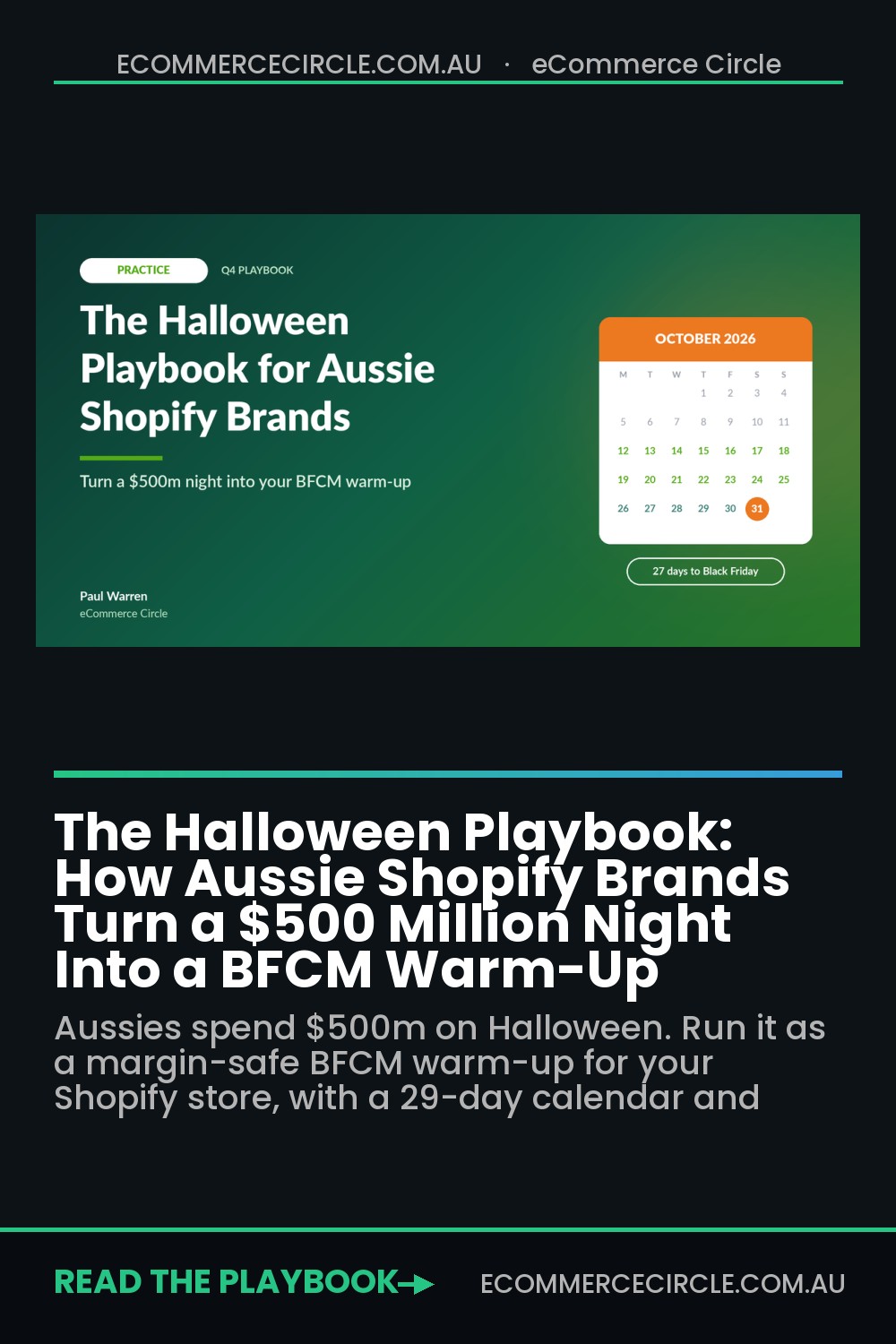
Here is the part most Aussie brands miss. In 2026, Halloween lands on a Saturday, and Black Friday lands on 27 November. That is 27 days apart. Whatever you do for Halloween will either set up your BFCM or quietly undermine it. If you have not done your peak-season numbers yet, start with our BFCM target maths guide and then come back here.
Step 1: Pick Your Halloween Play (Core, Adjacent or Borrowed)
Before you design a single banner, decide how much Halloween actually fits your brand. Forcing it is how you end up with a skincare store selling “spooky savings” that nobody asked for. There are three plays, and each one has a different goal.
- Core play (you sell the category). Costumes, party supplies, decorations, lollies, homewares, kids’ dress-ups. Halloween is a genuine revenue event for you. Goal: maximise contribution margin and clear seasonal stock by 31 October.
- Adjacent play (you can make a themed version). Sleepwear, socks, pet accessories, candles, beauty, baked goods, jewellery, kids’ clothing. You can create a limited capsule without changing who you are. Goal: new customers and list growth at a healthy margin.
- Borrowed play (no natural fit). Supplements, office gear, outdoor equipment, most B2B. Do not run a Halloween sale. Goal: use the moment for engagement and creative testing only.
Peter Alexander is a good example of the adjacent play done well. It is a sleepwear brand, not a costume brand, yet it runs a dedicated Halloween collection on its site. The product is still pyjamas, so the brand stays intact. The theme just gives customers a fresh reason to buy in a month that would otherwise be quiet before Christmas.
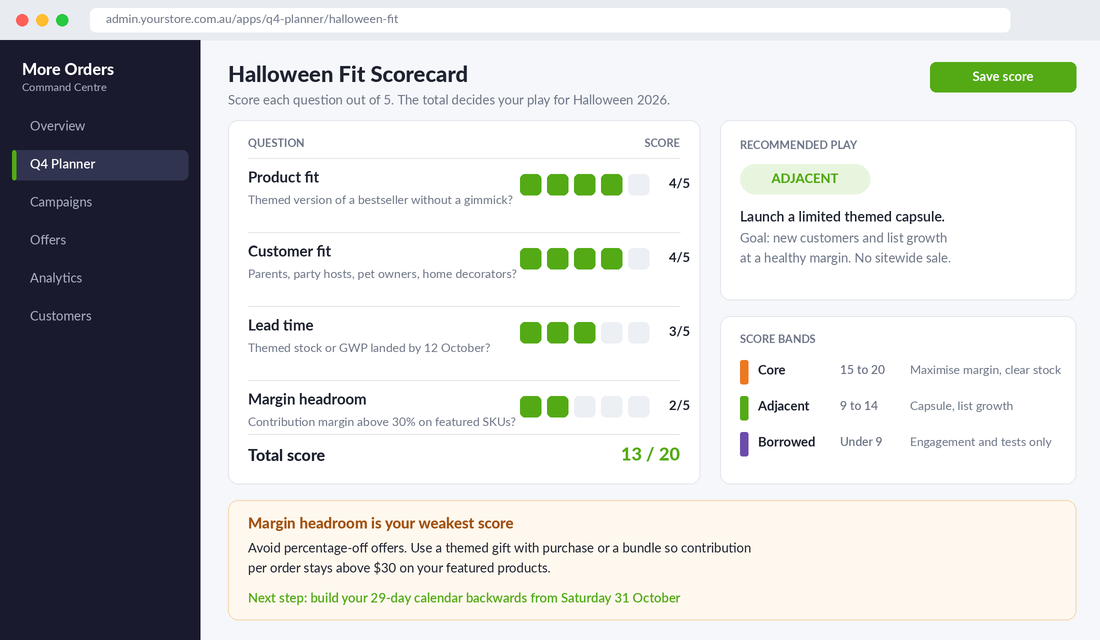
To pick your play, score your brand out of 5 on four questions:
- Product fit: Could you sell a themed version of a bestseller without it feeling like a gimmick?
- Customer fit: Do your buyers include parents, party hosts, pet owners or people who decorate their homes?
- Lead time: Can you get themed stock, packaging or a gift-with-purchase item landed by 12 October?
- Margin headroom: Is your contribution margin above 30% on the products you would feature?
A total of 15 or more is a core play. Between 9 and 14 is adjacent. Under 9 is borrowed. Write the score down and stick to it. The most expensive Halloween mistake is a borrowed-fit brand running a core-sized discount.
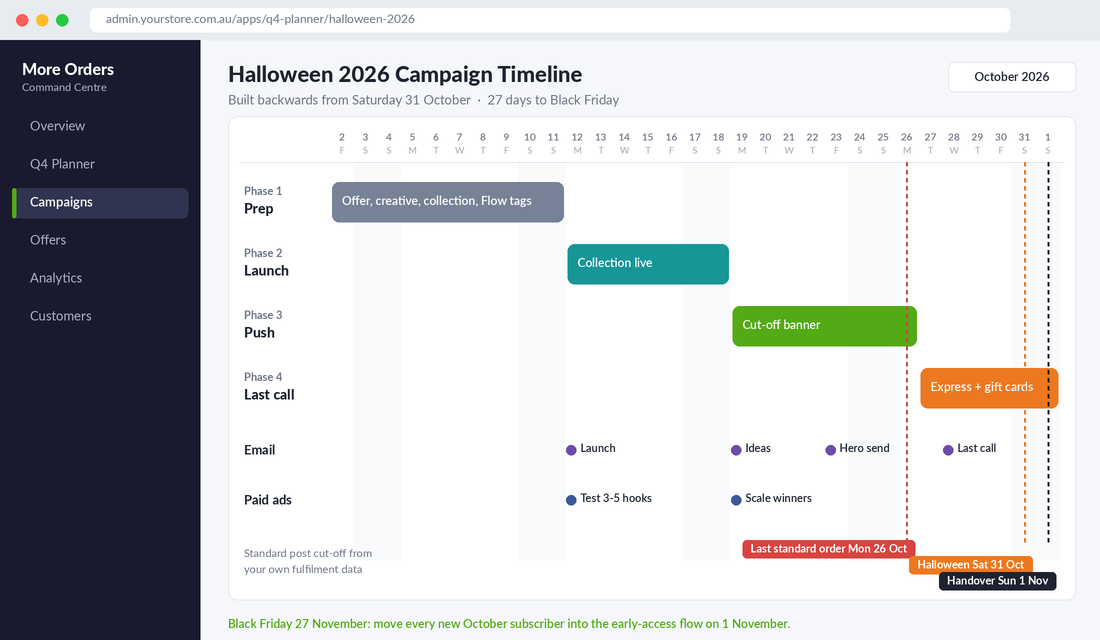
Step 2: Build Your 29-Day Calendar Backwards From 31 October
Halloween has a hard stop that most sale events do not. A costume that arrives on 2 November is a return, not a sale. So you plan backwards from the delivery date, not forwards from today.
Start with your last safe order date. Pull your own fulfilment data from Shopify for the last 90 days: average days from order to dispatch, plus your carrier’s delivery time to your slowest common zone (regional WA, far north Queensland and Tasmania usually take longest). Add one day of buffer for peak volume. For most Aussie brands shipping standard parcel post, that puts the last safe standard order date somewhere around Monday 26 October, with express running a few days later.
Then map the month in four phases:
- Phase 1, Prep (2 to 11 October). Lock your play and offer, brief creative, build the Halloween collection, write emails, set up tracking tags. Order any themed stock or gift-with-purchase items now.
- Phase 2, Launch (12 to 18 October). Publish the collection, send the launch email to engaged subscribers, start organic content and Pinterest pins. Turn on paid ads at test budgets.
- Phase 3, Push (19 to 26 October). This is where most Halloween revenue lands. Show the shipping cut-off everywhere, send your strongest email, scale the ad sets that won in Phase 2.
- Phase 4, Last call and handover (27 October to 1 November). Switch to express shipping and digital gift cards, run a short “last chance” message, then pull Halloween down on Sunday 1 November and pivot straight into your BFCM early-access list.
Notice what is missing: there is no sitewide sale on the calendar. That is deliberate, and it is the next step.
Step 3: Choose Offers That Do Not Train Discount Hunters
Four weeks before Black Friday is the worst possible time to run a big percentage-off sale. Anyone who buys at 25% off in October now knows you discount, and they will wait for you in November. You have spent margin to pull forward a sale you would have made anyway.
Here is the maths on a typical product. Say you sell a $79 item with $28 landed cost, $12 pick, pack and postage, and roughly 2% in payment fees.
- Full price: $79 minus $28, $12 and $1.58 in fees leaves $37.42 contribution per order.
- 25% off ($59.25): $59.25 minus $28, $12 and $1.19 leaves $18.06. You need 2.07 times the orders just to make the same money.
- Full price plus a $6 themed gift-with-purchase: $37.42 minus $6 leaves $31.42. You need only 1.19 times the orders to break even on the offer.
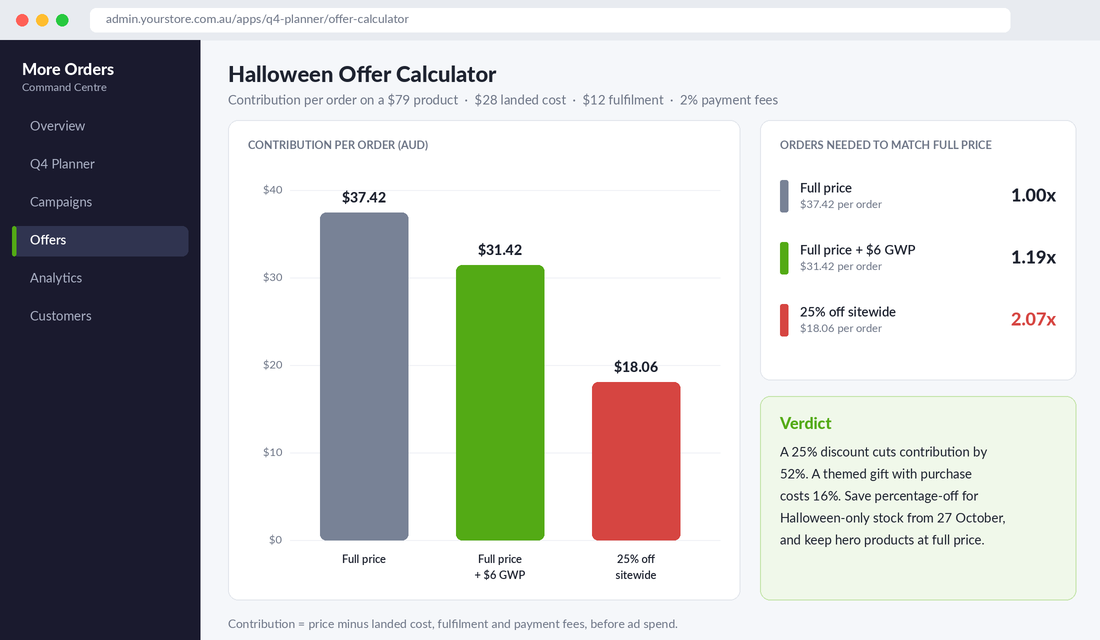
That is the whole argument in one line. A themed gift costs you about a sixth of your margin. A 25% discount costs you more than half. So build your Halloween offer from these instead:
- Themed bundles. “The Haunted House Kit” or “The Spooky Night In” built from existing SKUs, priced at a small saving against buying separately. Bundles lift order value without putting a percentage on your brand.
- Gift with purchase over a threshold. A limited-edition sticker sheet, tote, mini candle or treat bag above a spend level sitting about 20% above your current average order value.
- Limited-edition products. A capsule that only exists until 31 October. Scarcity that is real, not a fake countdown timer.
- Free express shipping in the last week. Paid for by the margin you protected, and it solves the buyer’s biggest worry.
If you are a core-play brand with seasonal stock that has to clear, you can discount, but discount late and narrowly. Mark down specific Halloween SKUs from 27 October, not the whole store, and keep the discount off your hero products. The Profit section of the More Orders Scorecard checks exactly this kind of margin discipline.
Step 4: Merchandise the Store So Halloween Shoppers Find What They Came For
Halloween shoppers arrive with a job to do: a costume for Friday’s party, decorations for the street, a treat for the dog. If your store makes them dig, they leave. Five changes cover most of it.
- A dedicated collection with a permanent URL. Use something like /collections/halloween, not /collections/halloween-2026. Keep the same URL every year so it builds search authority. Never delete it in November. Swap the products out and add a “back next year” sign-up form instead.
- A homepage hero swap, not a full redesign. Duplicate your live theme, change the hero, the announcement bar and one featured collection, then publish. On 1 November you republish the original. Two clicks either way.
- Shop-by-need navigation. Group the collection by job: “For the kids”, “For the party”, “For the house”, “For the pets”. It mirrors how people actually plan Halloween.
- Search synonyms. Shoppers type “dress up”, “fancy dress”, “costume” and “spooky”. In Shopify’s Search & Discovery app, add synonym groups so each term returns the same products.
- A visible shipping cut-off. Put “Order by Monday 26 October for standard delivery by Halloween” in the announcement bar and directly under the Add to Cart button. This is a conversion lever, not just a service note.
Costume Box, a Sydney-based Shopify retailer trading since 2007, shows the content side of this. Its homepage links repeatedly into a Halloween costume ideas hub and a Halloween decorations range, alongside the other dress-up moments it plans for each year, like Book Week and Oktoberfest. It is not one sale. It is a calendar of events, each with its own landing page that customers can find again next year.
That idea works for adjacent brands too. A one-page “Halloween ideas” guide featuring your products answers the searches that the NRF says drive 37% of Halloween inspiration, and it keeps earning traffic every October after this one.
Step 5: Use Halloween as Your BFCM Test Lab
This is the step that turns Halloween from a small revenue bump into a strategic advantage. Everything you will need to get right in November, you can rehearse in October at lower cost and lower risk.
Grow the list before you need it
Run a Halloween-themed sign-up offer from 12 October: a “costume ideas” guide, a quiz, or entry into a giveaway for a themed bundle. Every subscriber you add in October is someone you can email for free on Black Friday instead of paying Meta to reach them. On 1 November, move these new subscribers straight into your BFCM early-access flow. Our early-access list playbook walks through that flow step by step.
Test creative while it is still affordable
Ad auctions get crowded in November as every retailer piles in. October is your window to test hooks, formats and offers at more reasonable costs. Run three to five creative concepts against the same audience during Phase 2. Track hook rate and cost per add-to-cart, not just ROAS. The winning angles (not the pumpkins) become the starting point for your Black Friday creative.
Pressure-test operations
Your Phase 3 push is a mini peak. Watch dispatch times, how your 3PL or warehouse team copes with a volume spike, how fast support replies, and whether any app slows the site. Write down every problem. You have three weeks to fix them before your pre-peak code freeze.
Email the right people, not everyone
Do not blast your whole list four times in October. You will burn engagement right before the month you need it most. Send Halloween emails to the segments where it fits: past buyers of themed products, customers with kids or pets (if you collect that data), and anyone who clicked a Halloween email last year. Everyone else gets your normal content.
Step 6: Tag Halloween Buyers Automatically With Shopify Flow and Klaviyo
The real value of a Halloween customer shows up next year. If you know who bought themed products, you can invite them back in September 2027 before your competitors have even planned. Shopify Flow is free on the Basic plan and above, and this workflow takes about ten minutes.
- Tag your Halloween products. In Shopify admin, add the product tag halloween to every product in the Halloween collection, including bundles and the gift-with-purchase item.
- Create the workflow. Open the Shopify Flow app, click Create workflow, and choose the Order created trigger.
- Add a condition. Set it to check whether any line item’s product tags include halloween.
- Add the action. If the condition is true, choose Add customer tags and enter halloween-buyer-2026.
- Turn it on and test. Place a test order on a tagged product and check that the tag appears on the customer record.
- Build the Klaviyo segment. Klaviyo syncs Shopify customer tags. Create a segment where the Shopify tags property contains halloween-buyer-2026. Use it for a thank-you email in November, a BFCM early-access invite, and a “your Halloween kit is back” campaign next September.
While you are in Flow, add a second simple workflow that tags any order containing a Halloween product as halloween-order. When you run your debrief on 2 November, you can filter orders by that tag and see exactly what Halloween delivered, separate from your normal trading.
Step 7: Run the 1 November Handover Properly
The day after Halloween is when most brands get sloppy. Pumpkins stay on the homepage for a week, the Halloween discount code keeps working, and abandoned cart emails keep pushing costumes nobody wants anymore. Block out one hour on Sunday 1 November and work through this:
- Republish your standard theme and remove Halloween from the announcement bar.
- Expire every Halloween discount code and automatic discount. Check that none of them are being shared on coupon sites.
- Swap the Halloween collection to a “back next year” page with a sign-up form. Keep the URL live.
- Exclude Halloween products from abandoned cart and browse abandonment flows so you are not chasing out-of-season sales.
- Move leftover stock into a small clearance section or bundle it into your BFCM gift-with-purchase pool. Do not let it sit in the warehouse for 11 months.
- Write the debrief while it is fresh: revenue from halloween-order tags, new customers, new subscribers, contribution margin, best creative, and every operational problem.
The Compound Effect: How Halloween Pays You Three Times
Look at what this system does when you run it end to end.
First, it pays you in October revenue at a healthy margin, because you sold themed bundles and gift-with-purchase offers instead of cutting prices across the store.
Second, it pays you in November. You walk into Black Friday with a bigger list, creative that has already been tested, and an operation that has already handled a spike. Your BFCM ad spend works harder because the guesswork was done in October.
Third, it pays you next year. You have a tagged list of Halloween buyers, a collection URL with a year of search history behind it, and a debrief that tells you exactly what to repeat. Your 2027 Halloween starts in September with a warm audience instead of a scramble on 20 October.
The brands that lose on Halloween are not the ones who skip it. They are the ones who run it as a one-off discount and then wonder why their Black Friday numbers came in soft.
Your Halloween 2026 Checklist
Copy this into your project tool and work through it in order.
This week (by 11 October)
- Score your brand on the four fit questions and write down your play: core, adjacent or borrowed.
- Calculate your last safe standard and express order dates from your own fulfilment data.
- Choose your offer: themed bundle, gift with purchase, limited edition or free express shipping.
- Run the contribution maths on your top three featured products at full price and at your planned offer.
- Order any themed stock or gift-with-purchase items.
- Build the Shopify Flow tagging workflows and the Klaviyo segment.
Launch week (12 to 18 October)
- Publish the Halloween collection on a permanent URL with shop-by-need groups.
- Add search synonyms for costume, dress up, fancy dress and spooky.
- Launch the themed sign-up offer.
- Send the launch email to segments that fit, not the whole list.
- Start three to five creative tests at test budgets.
Push week (19 to 26 October)
- Show the shipping cut-off in the announcement bar and under Add to Cart.
- Scale the winning ad sets and pause the losers.
- Track dispatch time and support response time every day.
Last call and handover (27 October to 2 November)
- Switch messaging to express shipping and digital gift cards.
- On 1 November, republish the standard theme, expire codes and swap the collection to “back next year”.
- Move new subscribers into your BFCM early-access flow.
- Write the debrief and save your winning creative angles for Black Friday.
Halloween will not make or break your year. But how you run it says a lot about how you will run the six weeks after it. Treat it as a rehearsal, protect your margin, and you go into Black Friday with more customers, better data and fewer surprises.
Inside eCommerce Circle, seasonal planning and execution rhythm is one of the core pillars we work on with every member. If you want to see exactly where your store is being capped, take the free More Orders Scorecard. It takes two minutes and shows you which of the 10 P’s to fix first.