Your hero product is flying. Customers love it, reviews are stacking up, and every second DM asks the same thing: “What else have you got?” So you do what almost every founder does next. You pick the product you are most excited about, place a 1,000-unit MOQ with your supplier, and wait for the launch email to print money.
What’s in This Article
Six months later, half that stock is still sitting in the 3PL, the ad account is split between two products instead of one, and your hero has quietly lost momentum because nobody was feeding it.
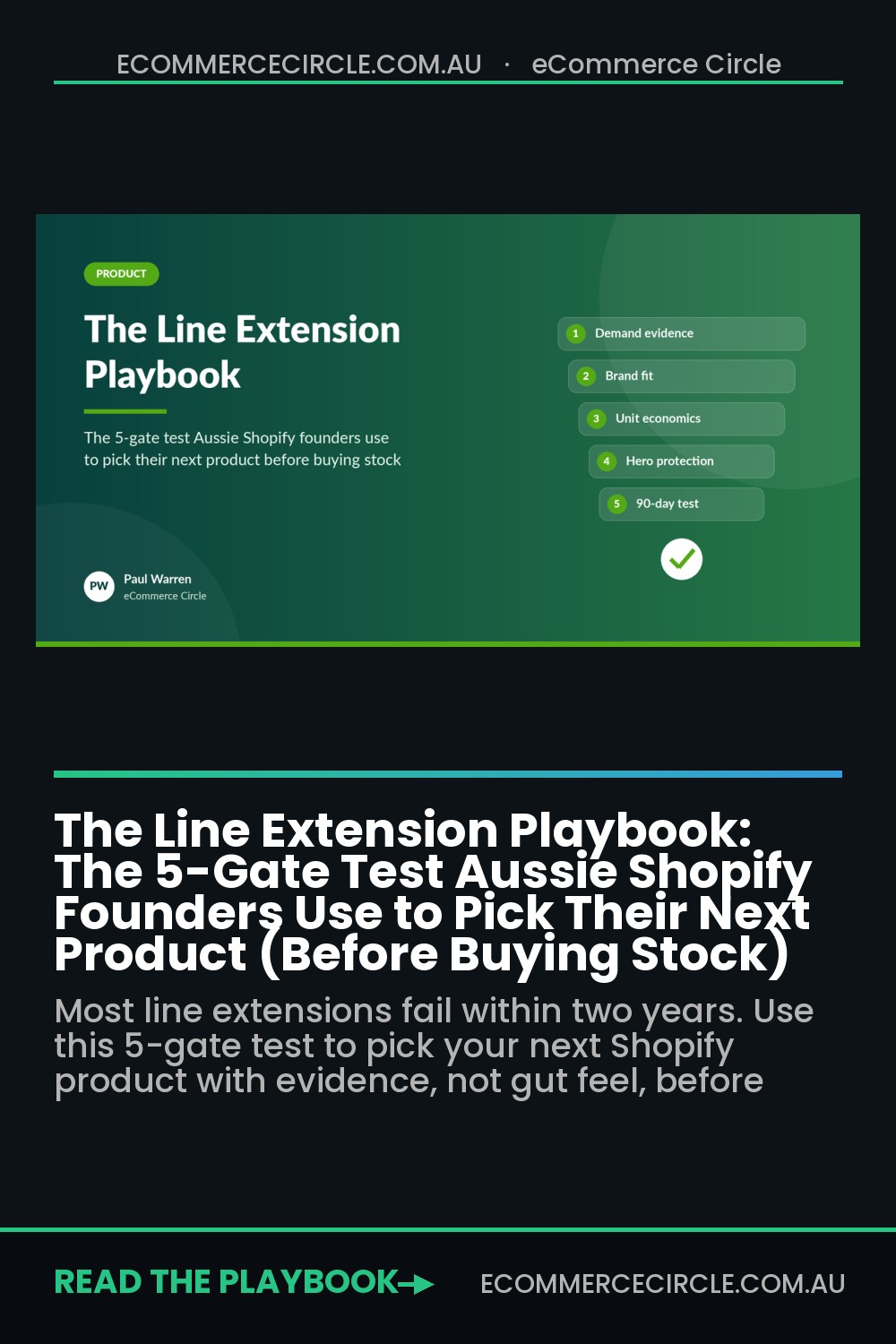
This is the most expensive mistake in DTC, and it is almost always made with good intentions. The research is brutal: only 30% of brand extensions in the US consumer goods market survive their first two years, a success rate no better than launching a brand-new brand. The founders who grow from one hero to a genuine range do not guess better. They run every new product idea through a set of gates before a single dollar goes to the supplier. This playbook gives you those five gates.
Why Most Line Extensions Fail (and Why Your Brand Name Will Not Save You)
A line extension is any new product you sell under your existing brand: a new scent, a new size, a new colourway, or a new product in the same category. It feels safer than launching something new because the brand already has customers and credibility. That assumption is exactly what gets founders into trouble.
Here is what the data actually says:
- Almost 70% of new consumer packaged goods products are brand extensions, yet only 30% survive two years, according to a 2023 Journal of Marketing meta-analysis by Peng, Bijmolt, Völckner and Zhao.
- The Ehrenberg-Bass Institute in Adelaide tracked 83,719 new product introductions over eight years. Around one in four failed to survive a single year, rising to around 40% by year two.
- A separate Ehrenberg-Bass study of 36,994 line extensions found around 50% fail within a year of launch. Strip out seasonal and limited editions and that failure rate roughly halves, which tells you a lot of “failures” were never built to last in the first place.
The pattern behind the failures is consistent. Extensions die when they are chosen by founder enthusiasm instead of customer evidence, when they do not fit the reason people bought the brand, when the unit economics only work at a volume the business cannot reach, and when launching them starves the hero of attention.
Every one of those failure modes is predictable. Which means every one of them can be tested before you order stock.
Gate 1: Demand Evidence (Prove Customers Are Already Asking)
The first gate is simple. Do you have evidence that existing customers want this product, collected from what they did rather than what they said?
Most founders skip this gate because they are close to the customer and “just know”. But your gut is shaped by the loudest five customers, not the quiet 5,000. You need signals from the whole base.
Here are the six places to mine demand evidence, ranked from strongest to weakest:
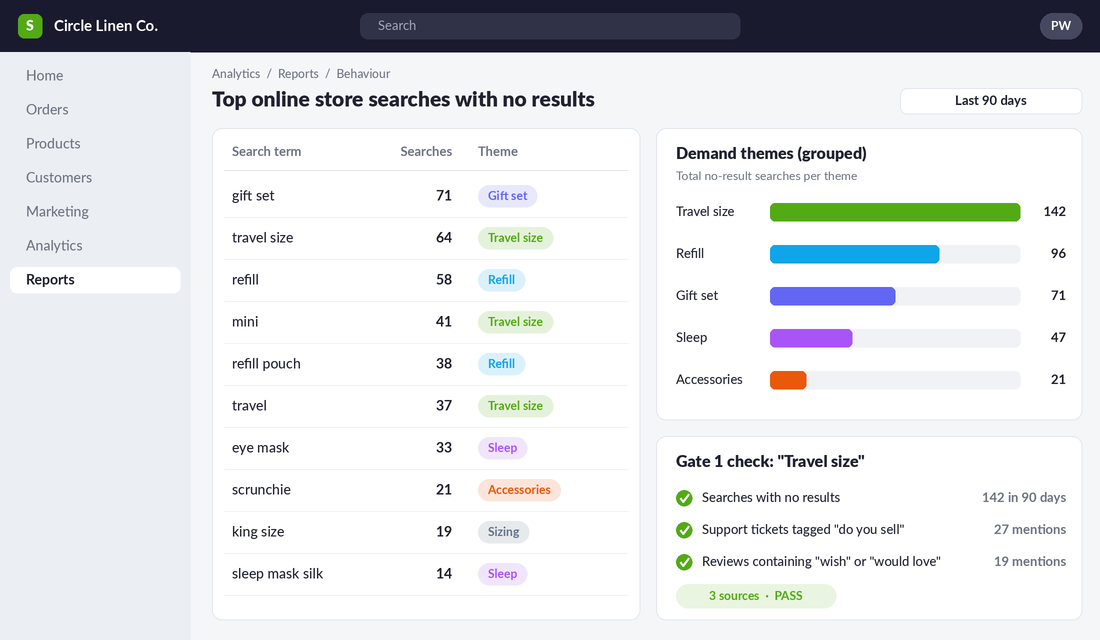
- Searches with no results. In Shopify admin, go to Analytics, then Reports, and open Top online store searches with no results. If 140 people searched “travel size” last quarter and you do not sell one, that is a customer telling you exactly what to make.
- Top on-site searches. The companion report, Searches by search query, shows which terms keep coming up. Look for terms that map to adjacent products, not just product names you already stock.
- Support tickets and DMs. Export the last 90 days from Gorgias, Zendesk or your Instagram inbox and tag every “do you sell” or “will you ever make” message. Count them.
- Review text. Pull every review for your hero and search for “wish”, “if only” and “would love”. Customers write your product brief for you in reviews.
- Post-purchase survey answers. Add one question to your survey in Klaviyo, KnoCommerce or Fairing: “What is one product you wish we made?” Run it for 30 days.
- Competitor bundles. What are customers buying alongside your hero from other brands? Your post-purchase survey can ask this directly.
Set yourself a minimum bar before an idea can move to Gate 2. A useful rule for a store doing $1 to $5 million a year: at least three independent sources pointing at the same need, with at least one of them being behavioural (search data or orders) rather than opinion.
If an idea fails Gate 1, it does not die. It goes into a “watch list” and you revisit it next quarter with fresh data.
Gate 2: Brand Fit (Same Buyer, Same Reason, Same Feel)
The Journal of Marketing meta-analysis found that extension fit is the single strongest driver of extension success, slightly ahead of parent brand strength. Improving fit gave a 61.4% probability of a more positive customer response, versus 60.6% for improving brand equity. The researchers also found that fit on product features matters more than fit on usage occasion.
In plain English: customers need to look at the new product and instantly understand why your brand makes it.
Score every idea out of 10 on each of these three fit tests:
- Same buyer. Would the person who bought your hero buy this? Or does it need a different customer entirely? A new customer is a new brand problem, not an extension.
- Same reason. Customers bought your hero for a specific benefit: the scent, the fabric, the result, the values. Does the extension deliver that same benefit in a new form?
- Same feel. Does it share visible features, ingredients, materials or design cues with the hero, so it looks like it belongs?
Frank Body is the Aussie case study every founder should know. The Melbourne brand launched in 2013 with a single coffee body scrub and grew to around 6 million customers. When co-founder Jess Hatzis told Foundr how they grew the range, she explained that customer research showed that unless people were loyal buyers, they only associated the brand with the coffee scrub. So every new product had to be as recognisably “frank” as the first: same irreverent voice, same scrub heritage, and a Glycolic and an Australian-botanical version of the scrub before they pushed further into skincare.
Who Gives A Crap is the other local benchmark. The Melbourne-founded brand started with recycled toilet paper, then moved into tissues and paper towels, and only in October 2024 added bin bags and dog poo bags. Every step is the same buyer, the same bathroom-and-kitchen reorder habit, and the same “good for the planet, funny on the pack” promise.
A total fit score under 21 out of 30 is a red flag. Under 15 is a hard no.
Gate 3: Unit Economics (Will It Pay You Back or Just Tie Up Cash?)
A product can pass demand and fit and still be a bad idea if the maths does not work at the volume you can realistically sell. This is where most extension decisions fall apart, because founders model the upside and forget the cash.
Build a simple one-page model with these six numbers before you approve anything:
- Contribution margin per unit. Retail price, minus COGS, landed freight, duty, packaging, pick and pack, payment fees and an allowance for returns. Aim for at least the same contribution margin percentage as your hero. A lower-margin extension drags the whole P&L down as it grows.
- MOQ cash. Minimum order quantity multiplied by landed cost. If your supplier’s MOQ is 1,000 units at a landed cost of $14, that is $14,000 of cash locked up before you sell one.
- Weeks of cover at the MOQ. Estimate realistic weekly sales for the extension (a safe starting assumption is 15 to 25% of your hero’s weekly units). Divide the MOQ by that number. More than 26 weeks of cover means the MOQ is too big for the demand.
- Cannibalisation. What share of the extension’s sales will simply replace hero sales? A new colourway of a best-selling tee can easily cannibalise half its volume. A complementary product (the pillow case for your pillow) usually cannibalises very little.
- Attach rate. What percentage of hero orders could realistically include this product? Complementary extensions lift AOV. Substitute extensions mostly move revenue sideways.
- GMROI target. Gross margin dollars divided by average inventory cost. If the extension cannot return at least $2 of gross margin for every $1 of stock you hold, it is a cash trap. Our GMROI playbook walks you through the calculation.
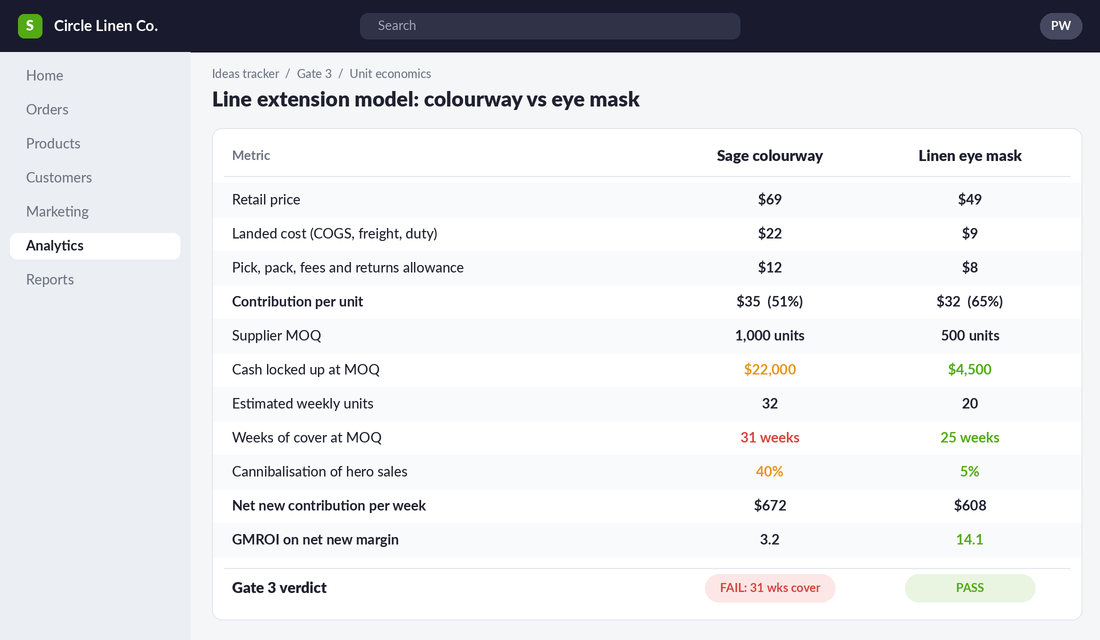
Here is a worked example. Say your hero is a $69 linen pillowcase set with a $22 landed cost, selling around 160 units a week. You are weighing two extensions: a new colourway, and a matching $49 linen eye mask. The colourway would share the hero’s MOQ and landed cost but cannibalise an estimated 40% of its sales. The eye mask has a $9 landed cost, a 500-unit MOQ ($4,500 cash), and could attach to one in eight hero orders. On paper, the colourway looks like the “safer” launch. In the model, the colourway needs $22,000 of cash and 31 weeks to sell through its MOQ, failing the 26-week rule. The eye mask delivers around 90% of the colourway’s net new margin with about a fifth of the cash at risk, a GMROI more than four times higher, and a bigger basket on every order it joins.
This is exactly the kind of call you cannot make from your gut.
Gate 4: Hero Protection (Never Starve the Product That Pays the Bills)
This is the gate nobody talks about, and it is the one that quietly breaks growing brands.
Ehrenberg-Bass research shows a brand’s top-selling SKU typically supplies half of the brand’s buyers and around 40% of total brand sales. Your hero is not just one product in the range. It is the front door for most of your new customers.
When you launch an extension, three things usually happen to the hero:
- Ad budget gets split. The new product gets a launch budget, and it comes out of the hero’s prospecting spend rather than new money.
- Homepage and email real estate shifts. The hero drops off the hero banner and out of the flow content that was converting.
- Stock and cash get tight. The extension’s MOQ competes with the hero’s reorder, and the hero stocks out at the worst possible moment.
Put three rules in writing before any launch:
- Hero budget floor. The hero keeps at least 60% of prospecting spend during the extension’s first 90 days. The extension’s launch budget is new money or it waits.
- Hero reorder first. The hero’s next purchase order is placed and paid for before the extension’s MOQ is committed.
- Hero stays front of house. The hero keeps its place in the homepage hero, your welcome flow and your best-performing ads. The extension earns its placement through cross-sells, bundles and post-purchase flows.
If you have not properly identified and scaled your hero yet, fix that first with the Hero Product Playbook. Extending a range with no clear hero just spreads a weak brand thinner.
Gate 5: The 90-Day Penetration Test (Measure New Buyers, Not Love)
The final gate happens after launch, and it decides whether the extension becomes a permanent part of the range or gets cut before it costs you more.
The Ehrenberg-Bass study of 7,195 successful and 5,294 failed line extensions found that the difference between winners and losers shows up in penetration, not loyalty. Winners keep gaining new buyers. Losers stall on buyer numbers, then see repeat rates drop from around the third quarter. Critically, the gap between the two emerges soon after launch, which means you can spot a failing extension early instead of propping it up for a year.
So stop judging an extension by how much your existing fans love it. Judge it by how many buyers it adds. Before launch, lock in these kill-or-scale criteria:
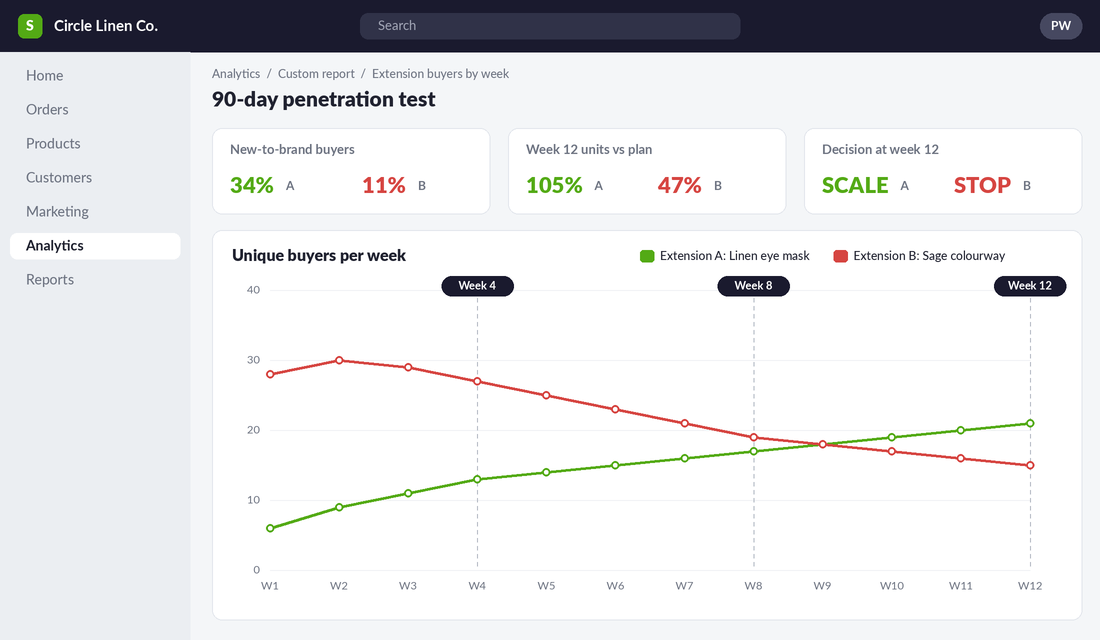
- Week 4 check. Unique buyers of the extension, and what share of them are new to the brand. A healthy early target is at least 20% first-time customers.
- Week 8 check. Is weekly buyer count still growing, flat or falling? Flat by week 8 with no paid support behind it is an early warning.
- Week 12 decision. Compare actual units, contribution margin and new-customer share against the Gate 3 model. If the extension is below 60% of plan on units and not growing, you stop reordering and move it into a clearance or bundle plan.
Limit the downside by testing small. Run a preorder for the first batch, a smaller first MOQ even at a higher unit cost, or a limited-edition drop before you commit to a core-range SKU. Our Preorder Playbook shows how to take real money for stock that has not landed yet, which is the cleanest demand test you can run.
Then, when an extension passes, use the Product Launch Playbook to give it a proper runway rather than a single email and a hope.
The Tools That Make This a 30-Minute Monthly Habit
You do not need a product development team to run these gates. You need four tools you probably already have:
- Shopify Analytics reports. Your no-result searches and top searches feed Gate 1. Your sales-by-product report and the new versus returning customer split feed Gate 5.
- Klaviyo. Set up a “coming soon” signup form on a hidden product page and a simple waitlist flow. Waitlist signups divided by hero page views gives you a demand signal before stock exists.
- A post-purchase survey tool. KnoCommerce, Fairing or Klaviyo’s own forms can run your “one product you wish we made” question.
- A shared spreadsheet. One tab per idea, with the five gates as rows and a pass, watch or fail status on each.
Here is how to set up the Gate 1 search report in five minutes:
- In Shopify admin, open Analytics and click Reports.
- Search the report list for “searches” and open Top online store searches with no results (it has a delay of up to 72 hours).
- Set the date range to the last 90 days and sort by search count.
- Export to CSV and paste it into your ideas spreadsheet.
- Group similar terms (“travel”, “mini”, “small size”) into one theme and total the count for each theme.
Run this on the first Monday of every month. In six months you will have a ranked list of what your customers have been searching for, and your next extension will pick itself.
How the Five Gates Compound
Each gate on its own stops a different kind of mistake. Together, they change how your whole range grows.
Gate 1 means you only work on products customers are already asking for. Gate 2 means every new product makes the brand stronger instead of blurrier. Gate 3 means cash goes into stock that turns, not stock that sits. Gate 4 means your hero keeps bringing in the new customers who will later buy the extension. And Gate 5 means you kill weak launches in 12 weeks instead of 12 months.
The compounding happens because every successful extension feeds the next round of Gate 1. More products means more search data, more reviews and more survey answers, which means better evidence for the next decision. Frank Body’s co-founder described the goal as eventually moving the hero out of the top sellers by growing the rest of the range. That does not happen with one lucky launch. It happens with a repeatable decision system run for years.
Your Line Extension Scorecard
Copy this into a spreadsheet and run every product idea through it before you contact a supplier.
- Gate 1: Demand evidence. Three or more independent sources, at least one behavioural. Pass / Watch / Fail.
- Gate 2: Brand fit. Same buyer, same reason, same feel. Score out of 30. Pass at 21+.
- Gate 3: Unit economics. Contribution margin at or above the hero’s, 26 weeks of cover or less at MOQ, GMROI of 2.0 or better after cannibalisation. Pass / Fail.
- Gate 4: Hero protection. Hero budget floor agreed, hero reorder funded first, hero keeps front-of-house placement. All three signed off.
- Gate 5: 90-day penetration test. Kill-or-scale criteria written down before launch, with week 4, week 8 and week 12 checks booked in the calendar.
An idea needs to pass Gates 1 to 4 before it gets a purchase order. Gate 5 decides whether it gets a second one.
Pick Your Next Product Like an Operator, Not a Fan
The founders who build $10 million brands are rarely the ones with the most product ideas. They are the ones who say no to most of them, back the few that customers are already asking for, and protect the hero while the range grows around it.
Inside eCommerce Circle, product and range decisions are one of the core pillars we work on with every member, because one wrong MOQ can wipe out a year of margin. If you want to see exactly where your store is being capped, take the free More Orders Scorecard. It takes two minutes and shows you which of the 10 P’s to fix first.