Every few months a founder sends me a Tapcart demo link and asks the same question. “Should we build an app?” The pitch deck always looks great. Higher conversion, higher AOV, push notifications that land straight on the lock screen. What the deck never includes is the one thing that decides it, which is whether your store has enough repeat buyers to fill an app in the first place.
What’s in This Article
Most brands get this backwards. They look at their mobile conversion rate, see it sitting at 1.9% against a desktop rate of 3.8%, and conclude the mobile experience is broken. So they go looking for a bigger fix than another round of speed work. An app feels like that bigger fix. Then they spend eighteen months and a five-figure platform contract discovering that an app does not create demand, it concentrates demand you already have.
The brands that win with apps did not build one to fix a conversion problem. They built one because they already had thousands of people buying three and four times a year and no efficient way to reach them. Princess Polly’s app is now their second highest revenue channel and converts 27% better than their mobile site. That did not happen because the app was clever. It happened because Princess Polly had a customer base worth putting behind a home screen icon.
This is the decision framework. Six numbers, one break-even model, and a list of the brands that should absolutely not build one.
Start With the Two Numbers That Frame the Whole Decision
According to the Australia Post eCommerce Report 2026, 77% of Australian site visits and 68% of online orders now happen on a smartphone. Aussie shoppers spent a record A$82.6 billion online in 2025, up 14% year on year, across 9.8 million households.
So mobile is not a segment. It is the store. But here is the gap that keeps founders awake: average mobile ecommerce conversion sits between 1.5% and 3%, while desktop lands between 3% and 4.5%. You are sending three quarters of your traffic to the screen that converts at half the rate.
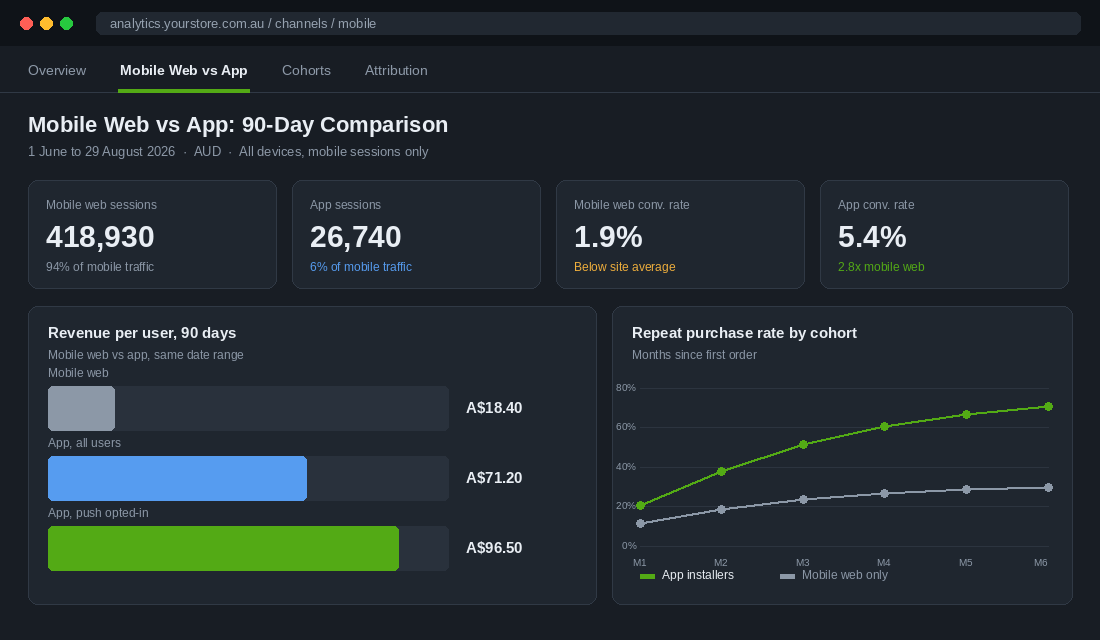
An app closes some of that gap, and the data is not subtle about it. Ecommerce apps typically convert around three times better than mobile web, with app users generating 3.5 to 7 times more revenue per user, according to MobiLoud’s ecommerce app benchmark work. In their sample, brands were pulling 24% to 65% of mobile revenue from just 2% to 16% of mobile traffic.
Read that last line twice, because it is the whole argument in one sentence. An app does not lift your mobile conversion rate. It carves out a small, high-intent slice of your mobile audience and monetises that slice ferociously. If you do not have a slice worth carving out, there is nothing to concentrate.
What an App Actually Buys You (and What It Definitely Does Not)
Be precise about the mechanism, because most of the benefits people attribute to apps are really benefits of the customers who install them.
- A notification channel you own. Ecommerce apps average around a 68% push opt-in rate, though the split is stark. iOS sits near 44% to 50% because Apple forces an explicit prompt, while Android runs far higher. Compare that to email, where a 25% open rate is respectable and deliverability is a permanent fight.
- Zero friction on the second order. Card details, shipping address, size preferences and login all persist. The customer taps twice. This is why app AOVs run 10% to 50% above mobile web.
- Permanent placement. A home screen icon is the cheapest retargeting you will ever buy. No auction, no CPM inflation in November, no attribution debate.
- Session depth. App sessions run dramatically longer than mobile web sessions, which matters enormously if you have a deep catalogue and a browse-led buying pattern.
Now the things an app does not do, which is the part the demo skips.
- It will not acquire new customers. Nobody installs an app for a brand they have never bought from. Installs come almost entirely from your existing traffic and buyer base.
- It will not fix a slow or confusing mobile site. Ninety percent of your mobile traffic will still land on the site. If the site is broken, an app just means you now have two properties to maintain and one of them is still broken.
- It will not save a brand with a weak second order. If your 90-day repeat purchase rate is 12%, an app gives you a beautifully designed place for nobody to come back to.
One piece of good news that most founders do not know: Apple and Google’s 30% commission applies to digital goods only. Physical products and real-world services are exempt, and in fact Apple forbids you from using in-app purchase for them. You run Shopify Payments or your existing processor inside the app and pay your normal 2% to 3%. The app tax is not a factor in this decision.
Run the Break-Even Model Before You Take a Single Sales Call
Here is the model I run with members. Six inputs, one output, and it takes fifteen minutes in a spreadsheet.
- Monthly mobile web revenue. Pull it from Shopify Analytics, segmented by device. Not total revenue. Mobile only.
- Current mobile web conversion rate. Your baseline. This is what the app has to beat.
- Expected app conversion rate. Do not use the 3x figure from a vendor deck. Use 2 to 2.5 times your mobile web rate as a planning assumption and treat anything above that as upside.
- Install rate among mobile buyers. Realistically 5% to 12% of your mobile purchasers in year one, depending on how hard you push installs. Model 8%.
- Platform cost per month. Real numbers below.
- One-off build, design and creative. Budget A$3,000 to A$8,000 for a templated build if you want it to look like your brand and not like a template.
The output that matters is incremental revenue, not app revenue. If a customer would have bought on your mobile site anyway and instead bought in the app, you have moved revenue between pockets. Model roughly 25% to 35% of app revenue as genuinely incremental in the first year, coming from the extra orders push notifications generate. Then subtract the platform fee.
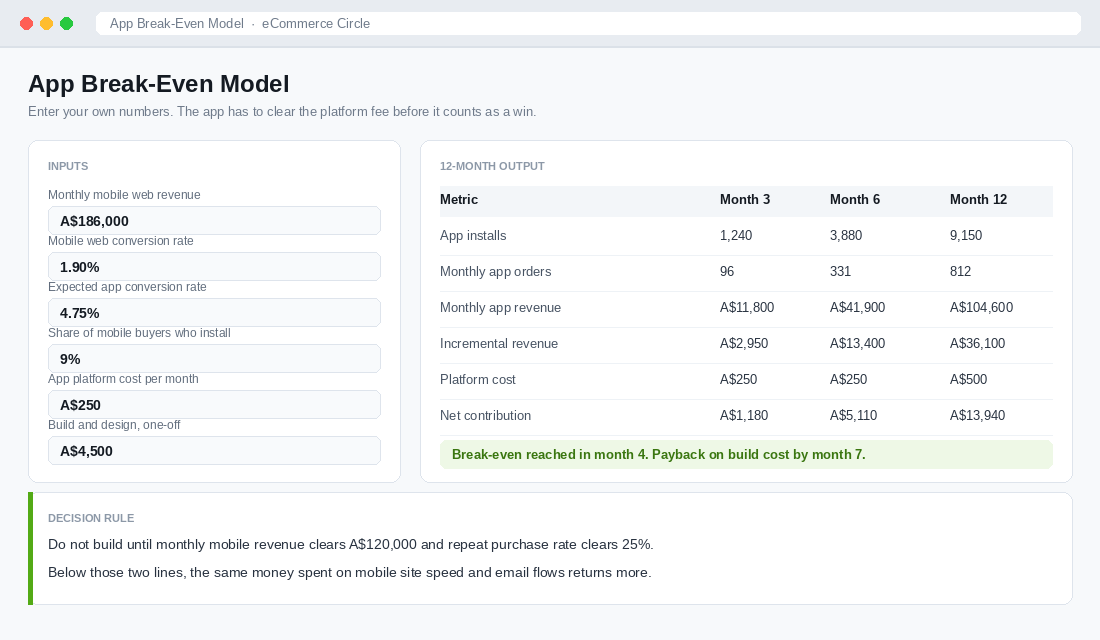
My rule of thumb after running this with a lot of Aussie brands: do not build until monthly mobile revenue clears roughly A$120,000 and your 90-day repeat purchase rate clears 25%. Below either line, the same budget spent on mobile site speed, a proper post-purchase flow, and better product content will return more. I have watched brands spend a year on an app when the honest answer was that their mobile site had six unfixed conversion leaks and nobody wanted to do the boring work.
The Four Brands That Should Not Build an App
Be honest about which of these you are. Getting this wrong is expensive and the contracts are usually twelve months.
- The considered, once-every-few-years purchase. Mattresses, furniture, prams, high-end appliances. Nobody keeps a mattress app. Your money belongs in SEO, content and referral instead.
- The shallow catalogue. Under about 40 SKUs there is nothing to browse. The app becomes a slower way to reach four product pages.
- The brand with a repeat rate under 20%. An app is a retention tool. If retention is the problem, fix the problem, do not buy a container for it. Start with the second-order economics before you go anywhere near a build.
- The brand under about A$80,000 a month in mobile revenue. The platform fee alone eats the gain. At US$250 a month plus build, you need meaningful volume just to break even on the subscription, before you have paid for a single hour of your own time managing it.
The profile that should build one is the mirror image: consumable or fashion category, deep catalogue, drops or restocks, repeat rate above 30%, mobile revenue well into six figures monthly, and an existing audience that already follows you somewhere. Culture Kings reports up to 30% of revenue flowing through their app. That is a streetwear brand with constant drops and a rabid returning audience. It is the ideal case, not the average one.
Choosing a Platform Without Locking Yourself In
You are not building this from scratch. Native app development for a Shopify store is a waste of money in almost every case. The builder market is mature and prices are public, so here is the honest landscape as at this year.
- Shopney. From roughly US$49 to US$249 a month. The sensible starting point for brands testing the channel. Core native experience, decent push tooling, responsive support, no enterprise contract.
- Superfans (formerly Vajro). From about US$150 a month up to US$1,000. Strong on live selling if that is part of your model.
- Tapcart. From US$250 a month, with Ultimate at US$500 and Enterprise at US$1,000 plus performance-based charges. The category leader, used by Princess Polly and Culture Kings. Worth noting that a twelve-month contract is standard and multiple reviewers report friction cancelling, so read the term before you sign.
- AppBrew. From around US$499 a month. Shopify-exclusive and commerce-focused, aimed at larger catalogues.
A practical setup sequence if you go with Shopney as a test:
- Install from the Shopify App Store and connect the store. Product, collection and inventory sync is automatic and real time.
- Set your theme, brand colours and typography in the visual builder. Budget half a day if you want it to actually look like your brand.
- Map your top five collections to the app navigation. Do not mirror your website menu. App navigation should be shallower, usually four to six top-level items.
- Connect Klaviyo or your ESP so app users stay in the same profiles. If you skip this you will end up messaging the same person twice with different offers.
- Set up your Apple Developer account (US$99 a year) and Google Play Console account (US$25 once). These are yours, not the vendor’s. Insist on it, because it is what lets you switch platforms later without losing your installs.
- Submit for review. Apple takes two to five days typically. Build in two weeks of buffer before any launch campaign.
Point five is the one people skip and regret. If the app builder owns the developer accounts, migrating means asking every customer to reinstall. Own the accounts from day one.
The Install Engine Is Where Most Aussie App Launches Die
Here is the failure I see most often. Brand launches an app, posts about it twice on Instagram, adds a footer link, gets 400 installs in the first month, then watches the number flatten. Twelve months later they are paying US$3,000 a year for a channel doing 1.5% of revenue and they quietly cancel.
Installs do not happen by accident. They need a permanent, systematic engine. These are the placements that actually move the number, roughly in order of effectiveness:
- Order confirmation and shipping notification emails. Your highest-engagement emails, opened by people who just proved they will buy. A single banner offering app-only order tracking converts better than anything else you will run.
- Smart banner on mobile web. A native iOS or Android smart banner at the top of every mobile page. Persistent, low friction, and it only shows to the device that can install.
- App-exclusive early access on drops and restocks. The single strongest install driver for fashion and consumables. “App users get it 24 hours early” is a real reason to install. A discount is not.
- Packaging insert with a QR code. Cheap, and it reaches customers at the moment they feel best about the brand. Print it on the thank-you card rather than a separate flyer.
- Post-purchase page and order tracking page. Both are dead space on most Shopify stores and both are viewed repeatedly.
What does not work: paid install campaigns. Cost per install for a DTC brand in Australia rarely justifies itself, and installs bought from cold audiences churn within a fortnight. Grow the app from people who have already given you money.
Treat Push Like a Channel, Not a Megaphone
Push is the entire economic argument for an app, and it is also the fastest way to destroy one. Notification fatigue leads to uninstalls, and unlike an email unsubscribe, an uninstall takes the whole channel with it.
The pattern that holds up across every brand I have seen do this well is the same pattern that works in email. Triggered and segmented sends carry the revenue. Broadcasts to everyone carry the churn.
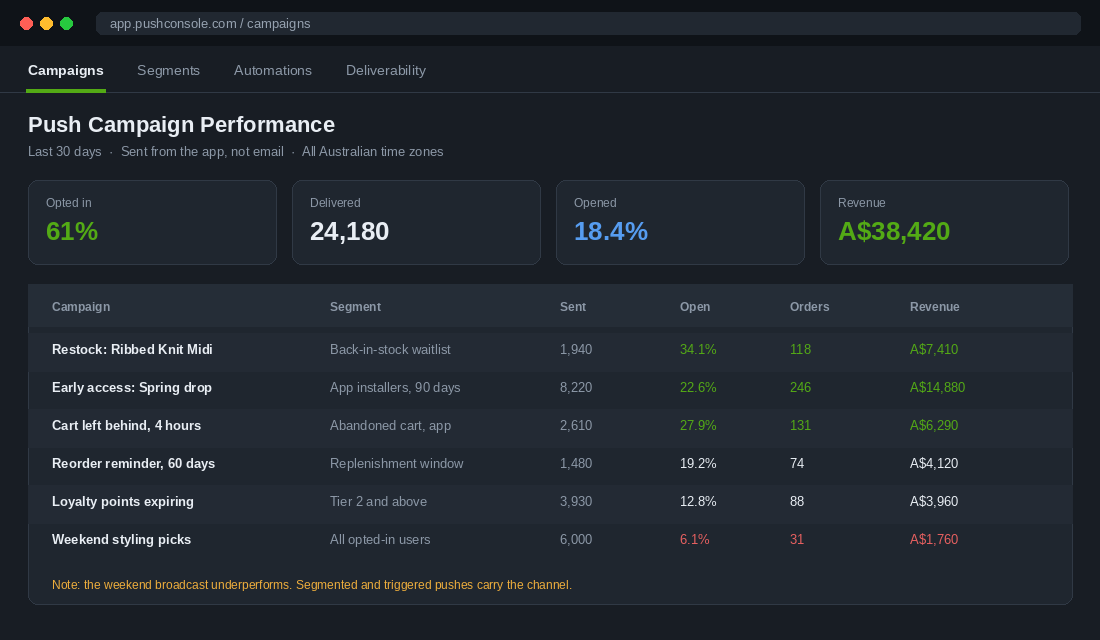
Set these four automations before you send a single broadcast:
- Back in stock. Highest open rate of anything you will send. The customer asked for this.
- Cart left behind, four hours. Not thirty minutes. Give people time to finish what they were doing.
- Replenishment reminder. Timed to your actual average reorder gap, which you can pull from Shopify. For most consumables it lands between 45 and 75 days.
- Early access on drops. The reason they installed. Deliver on it every single time or the install stops being worth anything.
Cap broadcast sends at two a week and never send between 8pm and 8am local. Australia spans three time zones in summer, so if your push tool cannot schedule by recipient time zone, send at 10am AEST and accept that Perth gets it at 7am rather than waking anyone at 5am. If you have not yet built a notification habit, web push on your existing site is a much cheaper way to learn the discipline before you commit to an app.
The 90-Day App Scorecard
If you launch, hold the channel to a scorecard from day one. Review it monthly and be willing to kill it at day 180 if it fails. Copy this into a sheet and fill in the right-hand column each month.
- Installs per 1,000 mobile sessions. Target 4 to 8 by month three. Below 2 means your install engine is not built, not that the app failed.
- Push opt-in rate. Target above 55% blended. If iOS is under 35%, your permission prompt is asking too early. Ask after the first positive action, not on launch.
- App conversion rate versus mobile web. Target at least 2x by month three. If it is not clearing 1.5x, the app build itself has a problem.
- Repeat purchase rate, app installers versus mobile web buyers. The number the whole business case rests on. You want a visible gap by month four.
- Uninstall rate per month. Above 8% means you are over-sending. Cut broadcast frequency in half and watch it recover.
- Incremental revenue after platform cost. The only number that decides renewal. Not app revenue. Incremental.
Write your kill criteria down before launch, while you are still objective. Something like: “If incremental monthly revenue is under A$4,000 at day 180, we cancel.” Founders almost never kill an app once it exists, because it feels like admitting a mistake. Deciding in advance removes the ego from it.
How the Pieces Compound
The reason Princess Polly reports roughly A$400 of in-app revenue for every dollar of platform spend is not the app. It is the stack underneath it.
They had a mobile site converting well, so app users arrived with a good first experience already behind them. They had a drop cadence, so early access was a genuine reason to install. They had a repeat purchase rate high enough that a home screen icon got tapped rather than deleted. And they had enough volume that a small percentage of installers still meant tens of thousands of engaged customers.
Take any one of those away and the maths collapses. Which is the real lesson here, and the reason this article spends more time on qualifying out than on building. An app is an amplifier. Point it at a business with strong retention, a deep catalogue and a reason to come back, and it produces a channel that can carry 20% or 30% of revenue at almost no marginal cost. Point it at a business still leaking orders on its mobile product pages, and it amplifies the leak.
Run the six numbers. If you clear both lines, build it and hold it to the scorecard. If you do not clear them, you have just saved yourself a twelve-month contract and found a much better place to put the same money.
Inside eCommerce Circle, deciding what to build next and what to deliberately not build is one of the core pillars we work on with every member. If you want a second opinion on whether an app is the right next move for your store, let’s talk.